-
-
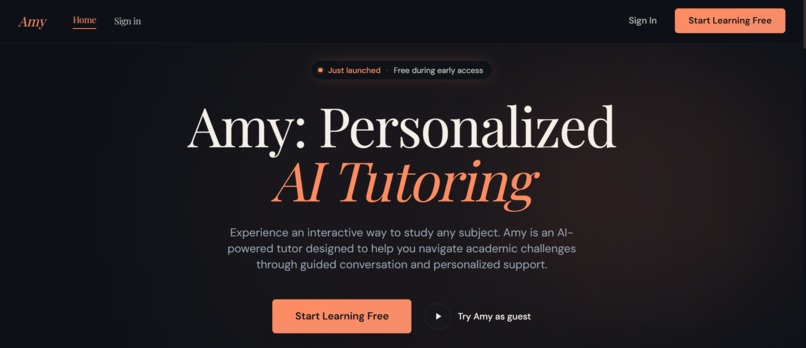
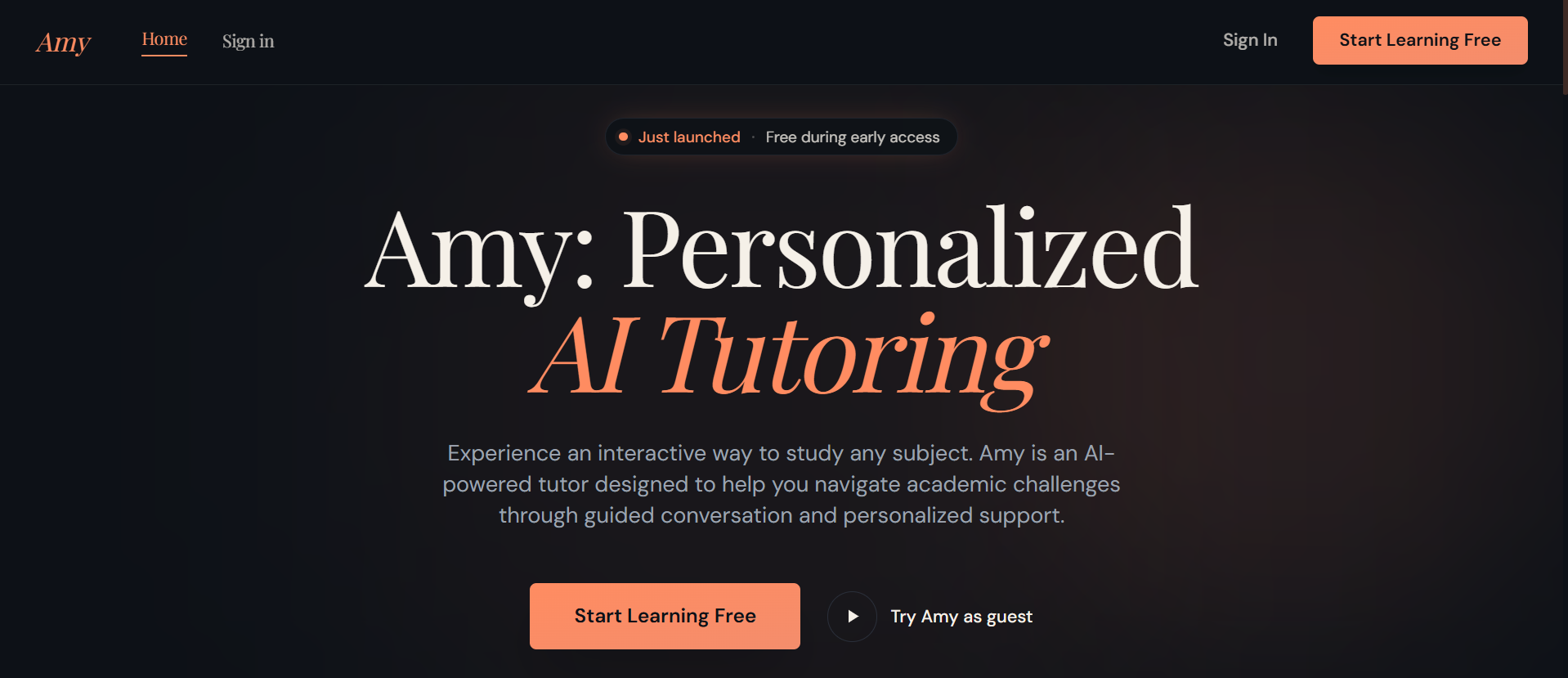
Amy website
Inspiration
As a student, I noticed that most educational content is created for an “average” learner who does not really exist. Every student understands concepts differently, learns at a different pace, and struggles with different parts of the same chapter—yet they are usually given the same textbook, video, or lecture.
AI tutors can answer questions, but I wanted to go beyond a chatbot that waits for the student to ask the right question. I imagined a tutor that could take a student’s actual syllabus or learning material and build an entire personalised learning experience around it: explanations, visual slides, narration, whiteboard-style teaching, interactive activities, and revision resources.
That idea became Amy.
I began building Amy while still in school, inspired partly by my own experience of understanding some subjects quickly while feeling completely stuck in others. My goal is to make high-quality, personalised teaching available to students regardless of their school, board, location, or access to private tutoring.
Amy is built around a simple belief: students should not have to adapt themselves to the lesson. The lesson should adapt itself to the student.
What it does
Amy is an AI tutor that turns a student’s syllabus or learning material into a complete, personalised learning experience.
Instead of functioning only as a chatbot, Amy creates the different resources a teacher might use while teaching a lesson. From one course or chapter, it can generate structured explanations, presentation slides, teaching scripts, whiteboard-style content, interactive activities, infographics, and revision material.
Students can learn through the format that works best for them rather than being forced to rely on one textbook explanation or one long video. Amy is designed to support different school boards and subjects, while adapting the depth, language, examples, and teaching style to the learner.
For teachers and administrators, Amy also includes tools to generate an entire course’s learning resources through a managed generation system. Large generation requests are placed into a persistent queue, processed one course at a time, and can be monitored, resumed, or cancelled.
Amy’s goal is not to replace teachers. It is to give every student access to lessons that feel as though they were prepared specifically for them.
How we built it
Amy is a full-stack web application built with TypeScript and deployed on Vercel, with Supabase handling the database and persistent application data.
The platform uses a job-based generation architecture. When an administrator requests resources for an entire course, Amy creates a bulk-generation job, divides it into individual course tasks, and processes them through a controlled queue. The system records progress, successes, failures, and error information so that long-running operations do not disappear when the page is refreshed.
GPT-5.6 is used as the intelligence behind Amy’s educational generation workflow. It helps transform source material into structured teaching outputs while maintaining context across the different resources belonging to the same lesson. Rather than independently generating disconnected pieces of content, Amy aims to create resources that work together as one coherent learning experience.
Codex was used throughout development to understand the existing codebase, plan architectural changes, implement features, debug failures, and improve the reliability of the generation workflow. We used it as an engineering collaborator, while making the main product, architecture, and UX decisions ourselves.
A major part of the work was not simply prompting a model. It was building the surrounding system that makes AI generation reliable, persistent, testable, and usable for real courses.
Challenges we ran into
One of our biggest challenges was handling large generation requests reliably.
Generating one resource is relatively simple. Generating slides, scripts, whiteboard content, interactives, and infographics across many lessons creates a much harder engineering problem. Requests may take time, individual generations may fail, users may refresh the page, and the application must avoid generating the same resource twice.
Our first generation flow was too dependent on the active browser session. Reloading the page could cause the visible state to reset, and administrators had limited information about what was happening in the background.
We redesigned this around persistent jobs and course-level tasks. This introduced new challenges involving queue order, idempotency, retries, cancellation, accurate progress counts, and ensuring that only one course was processed at a time.
We also had to solve product challenges. Educational content cannot merely sound convincing—it must be structured, understandable, relevant to the syllabus, and consistent across formats. A slide deck, narration script, and interactive activity for the same lesson should reinforce one another rather than feeling like unrelated AI outputs.
Another challenge was deciding where AI should make decisions and where the application needed strict rules. We learned that reliable AI products need both: flexible model intelligence and carefully designed software constraints.
Accomplishments that we're proud of
We are proud that Amy grew beyond a basic “chat with your textbook” prototype.
Amy can take educational material and create multiple coordinated teaching resources from it, giving students more than one way to understand the same concept.
We built a persistent bulk-generation system that can:
Queue complete courses for generation Process one course at a time Track completed, failed, and pending work Preserve progress across page refreshes Prevent duplicate generation Resume interrupted work safely Display useful error information Allow administrators to cancel jobs
We are also proud that Amy was built from the perspective of an actual student. The product was not based only on assumptions about how students learn. Many of its decisions came from experiencing the limitations of textbooks, recorded lectures, generic AI answers, and one-size-fits-all education firsthand.
Most importantly, we built a functioning product rather than only a concept or demonstration. Amy represents months of iteration, debugging, redesigning, and learning.
What we learned
We learned that building an AI product is very different from building an impressive AI demo.
A demo only needs to work once. A real product must handle incomplete data, failures, refreshes, repeated requests, unexpected model output, and users who do not follow the ideal path.
We learned that the quality of an AI application depends heavily on everything surrounding the model: context preparation, prompt design, output validation, persistence, interface design, error handling, and the structure of the workflow.
Working with Codex also changed how we approached development. It was especially useful for exploring a large codebase, tracing bugs across multiple files, implementing repetitive changes, and accelerating iteration. At the same time, we learned that human judgement remains essential. Codex could help us reach an implementation faster, but we still needed to define the product, question its suggestions, test the result, and decide what experience we wanted students to have.
We also learned that personalisation does not mean adding a student’s name to generic content. Real personalisation means changing how something is explained, what examples are used, how deeply it is taught, and which learning format is provided.
What's next for Amy — The AI Tutor That Builds the Lesson Around You
The next stage for Amy is to become a tutor that learns continuously from the student.
We plan to add a deeper student model that understands what a learner has mastered, where they repeatedly struggle, which explanations have helped them, and when they are likely to forget a concept. Amy could then adjust future lessons and revision plans automatically.
We also want to improve source understanding so teachers can upload textbooks, notes, worksheets, and syllabus documents while preserving diagrams, tables, formulas, and chapter structure.
Future plans include:
Adaptive quizzes that respond to each answer Long-term student memory and mastery tracking Automatic revision schedules using spaced repetition Voice-based tutoring Better support for diagrams, mathematics, and scientific notation Teacher dashboards showing class-level learning gaps More Indian and international school boards Collaboration tools for teachers to review and edit generated lessons Stronger factual verification and educational quality checks More accessible lessons for students with different learning needs
Our long-term vision is for Amy to become a complete personalised learning layer: one that can understand what a student needs to learn, create the right lesson, teach it in the right format, check whether the student understood it, and adapt what happens next.
The lesson should adapt itself to the student—not the other way around.
Built With
- ai
- claude
- codex
- fable
- full
- generative
- gpt-5.6
- next.js
- stack
- typescript


Log in or sign up for Devpost to join the conversation.