-
-
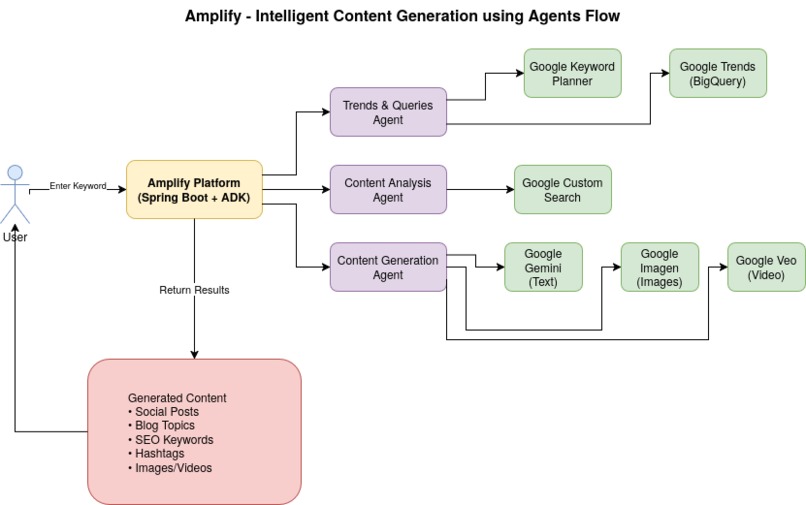
Amplify Flow - Using Agents for Intelligent Content Generation
-
Amplify


About the Project
Inspiration
We're friends who love building stuff together - late-night debugging sessions and random startup ideas are our norm. We kept talking about how small businesses and creators struggle with digital marketing: the tools are expensive, complicated, or incredibly time-consuming.
When this hackathon came up, we finally decided to build something about it. Social media marketing is powerful if you can stand out, but most content from smaller teams gets ignored. Not because the ideas are bad, but because creating engaging content consistently is hard.
So we built Amplify - an AI-powered platform that helps people generate high-quality, engaging content from keyword research to full posts. What started as a simple ad banner idea grew into a complete content generation system.
What it does
Amplify helps creators and small businesses grow their digital presence without the guesswork.
You enter something simple like "homemade brownies." Amplify immediately shows you the most popular search queries and trending topics, so you know what terms will give you the most reach.
It analyzes top search results to help you understand what your audience cares about, what content performs well, and what gaps you can fill.
Then you generate content: Instagram captions, blog topics with SEO keywords, hashtag suggestions - all instantly tailored to your brand and platform. It's like having a marketing team that gets what you're trying to say and makes it sound good.
How we built it
Amplify is a multi-agent AI system built on Java Spring Boot. Think of it as a team of specialized agents handling different parts of content generation.
The Relevant Trends & Queries service combines Google Keyword Planner, Google Trends (via BigQuery), and LLM agents to generate optimized search queries from your input. Instead of just "homemade brownies," you get "fudgy no-preservative brownies for kids."
The Content Analysis service takes those queries and uses Google Custom Search to pull top-ranking content. An LLM agent analyzes patterns and opportunities like "Everyone's talking about gluten-free but no one covers holiday packaging."
The Content Generation service turns research into actual content using Google's Gemini for text, Imagen for images, and Veo for video.
We used Google's Agent Development Kit (ADK) to connect everything, making the system modular and scalable despite the hackathon timeline.
Building across Pacific and IST time zones meant early mornings and late nights, but somehow it worked.
Challenges
Google Custom Search worked perfectly locally but completely failed in production. After hours of debugging, we found incorrect API specifications. The worst part? Error responses were just HTML pages from Google.
Our service logs weren't showing up due to misconfigured logback setup, so we were debugging blind.
Cloud Run revisions didn't reflect deletions immediately, making debugging confusing with delayed logs and limited shell access.
Getting the multi-agent pipeline working with Google ADK took lots of trial and error, though it eventually made everything clean and modular.
Accomplishments that we're proud of
We built a fully functional, end-to-end workflow in under a week, mostly close to the deadline.
We're especially proud of using a completely new framework (Google ADK) and building our first multi-agent setup. Learning and adapting that fast while making it work showed us what we're capable of under pressure.
What we learned
We learned to structure agents, handle async flows, and manage session state between components in a working multi-agent pipeline.
Structured logging across multiple layers with GCP saved us during production debugging when logs weren't where expected.
We learned Cloud Run's quirks: service revision behavior, environment variable management, and delayed change reflection.
Building LLM fallbacks proved useful when Google Custom Search returned messy data. We got hands-on with Google's entire ecosystem: Keyword Planner, Trends, Custom Search, Imagen, Veo, and Gemini.
We came out more confident with distributed agents, cloud infrastructure, and AI tooling.
What's next for Amplify
We've barely scratched the surface. There's huge potential in deeper Google Trends integration for more personalized content.
We're exploring additional prompts for caption/blog template generation, auto-generated videos, and letting users upload product images for custom content creation.
Now that we have a solid foundation, ideas are flowing and we can't wait to keep building.
Final thoughts
We're grateful for this hackathon opportunity - it gave us the momentum to build something we're genuinely excited about.


Log in or sign up for Devpost to join the conversation.