Inspiration
Many people want to use AI for real work, but they often start with the wrong prompt or use AI without enough structure.
They may ask ChatGPT, Claude, Gemini, or Codex a broad question and get a broad answer. The problem is not that AI is useless. The problem is that the user does not always know how to turn a real work problem into the right prompt, the right workflow, and the right safety checks.
Amo.ng was created to solve that gap.
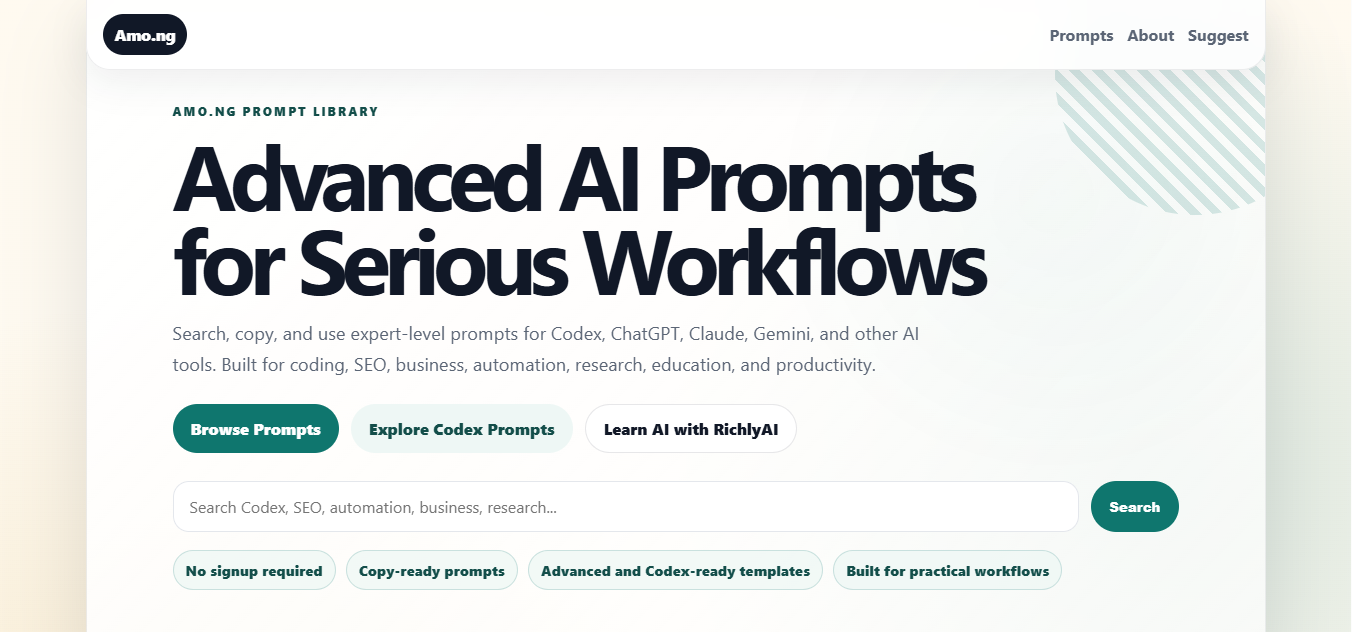
Amo.ng is a free public AI prompt library for practical work across coding, business, SEO, automation, analytics, education, marketing, and AI governance.
For OpenAI Build Week, I am extending Amo.ng with an AI Prompt Workflow Assistant that helps users describe what they are trying to do, match the problem to relevant expert prompts, and follow a safer workflow for using AI tools.
What it does
Amo.ng AI Prompt Workflow Assistant helps users move from a vague work problem to a practical AI workflow.
A user can describe a task such as:
- “My GitHub Actions workflow is failing.”
- “I need to review a pull request before merging.”
- “My WordPress site is slow.”
- “I need to audit lead routing in my CRM.”
- “I want to review a spreadsheet model before a financial decision.”
The assistant then helps the user:
- Understand the type of problem they are solving.
- Match the problem to relevant expert prompts.
- Choose the right AI tool, such as ChatGPT, Claude, Gemini, or Codex.
- Follow a safe workflow with evidence, assumptions, review gates, and verification steps.
- Open and copy the prompt for immediate use.
How I built it
The project is built on Amo.ng, a Laravel-based public prompt library.
For OpenAI Build Week, Codex is being used to inspect the existing Laravel codebase, plan safe changes, implement the workflow assistant, connect it to existing prompt records, and verify that existing public prompt pages, copy behavior, draft/publish logic, sitemap behavior, and admin workflows are not broken.
The project uses GPT-5.6 for practical AI reasoning around prompt matching, workflow guidance, and user task interpretation.
The system is designed to remain simple, public, searchable, and copy-first. Users do not need to create an account to use the prompt library.
Challenges
The biggest challenge is not generating more prompts. It is helping users find the right prompt for the right work problem.
Another challenge is safety. A prompt library should not encourage users to blindly accept AI output, especially for code changes, security reviews, financial decisions, legal/compliance concerns, customer-facing work, or production systems.
That is why Amo.ng prompts emphasize:
- Evidence over assumptions.
- Human review gates.
- Tool-specific usage guidance.
- Verification steps.
- Practical output formats.
- Safe workflows before action.
What I learned
I learned that practical AI adoption depends heavily on workflow design.
People do not only need “better prompts.”
They need better ways to decide:
- What problem am I solving?
- Which AI tool should I use?
- What context should I provide?
- What should the AI output include?
- What needs human review?
- What should be verified before action?
Amo.ng is my attempt to make that process easier and more accessible.
What is next
Next, I plan to improve the workflow assistant with better prompt recommendations, category filtering, tool-specific guidance, and more practical workflows for developers, founders, marketers, operators, educators, analysts, and teams adopting AI safely.
The long-term goal is to make Amo.ng a free public resource for practical AI work.
Built With
- ai-workflows
- chatgpt
- claude
- cloudflare
- codex
- cpanel
- css
- developer-tools
- gemini
- gpt-5.6
- html
- javascript
- laravel
- machine
- mysql
- openai
- php
- productivity
- prompt-engineering
- seo
- tailwind-css
- web

Log in or sign up for Devpost to join the conversation.