Inspiration ✨
Road accidents kill 3-4 people every day in the New York City region. That's around 1095-1460 deaths in a 365-day calendar year! Even worse, most of these deaths could have been prevented if ambulances had arrived more quickly. Our application seeks to resolve this issue and help ambulances arrive at the scene as quickly as possible.
What it does ❓
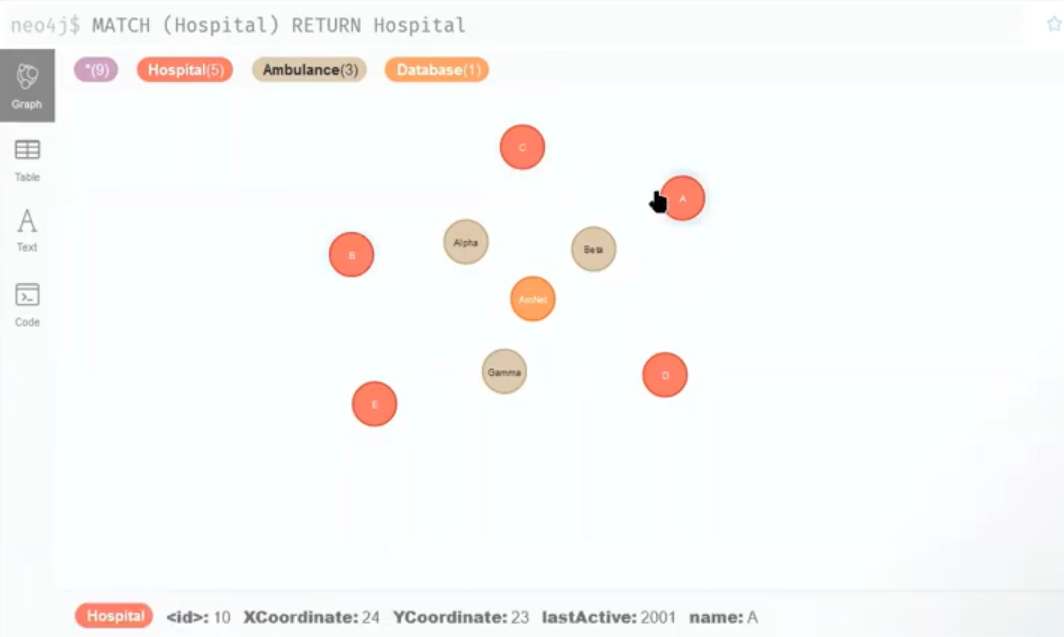
Our Neo4j GraphQL application contains two types of structures, which are "Hospital" and "Ambulance". In our database, hospitals are stored with their coordinates and names in nodes, while ambulances are stored with their coordinates and operator names. Using these coordinates, we can use Prim's or Dijkstra's algorithm to determine the shortest distance to reach highways or main points of road accidents. In addition, these coordinates can be used to establish underground tunnels that lead directly to connecting hospitals to their nearest highways, which will in fact increase chances of survival for victims of road accidents by cutting down the travel time from hours to minutes from one end to the other.
How we built it 🚀
We used Neo4J GraphQL library with NodeJS for developing the backend and Neo4J Sandbox with Cypher Query Language for visualizations.
Challenges we ran into 👀
Setting up the library was difficult as we aren't experienced with Node.js, but it was a great learning experience nonetheless.
Accomplishments that we're proud of 🙌
It is honestly amazing that we managed to set everything up and run it, albeit in a partial state.
What we learned 🏫
We learned about using Node.js and connecting it to libraries, and also got to experiment with Code Sandbox!
What's next for AmNet 🔮
In the future, we hope to develop a full-fledged client application that can be used by hospital ambulances to figure out the shortest possible distance to road accident sites and increase the likelihood of saving victims.


Log in or sign up for Devpost to join the conversation.