Inspiration
We share a special bond with Iowa State University. Recently, while talking with our friends at Iowa State, we learned that a common issue among iowa state grads and faculty was the unpredictable nature of the housing market in Ames, making it difficult for them to confidently purchase residences in the town and causing many to leave. Such discussions inspired us to make a change
We decided to take action and leverage our experience to make a positive impact in the University town of Ames Iowa by creating an AI-powered application that allow users to predict value of homes accurately. By harnessing the power of artificial intelligence, this application will allow Ames residents to make informed decisions on purchasing real estate and allow them to successfully secure their financial future.
But it wasn't just about financial gains. We realized that a reliable housing price predictor could have profound implications for sustainability in Ames. By enabling users to gauge the value of properties accurately, we could contribute to a more sustainable real estate market.
How does it improve sustainability, you might ask? Well, by equipping potential buyers and sellers with the knowledge to accurately assess a property's worth, our AI application would discourage overpricing and prevent excessive speculation in the university town. This would foster a more balanced and affordable housing market, attracting more investment in the town and contributing to its sustainability and growth.
A sustainable real estate market doesn't just benefit the population but also the local economy. With more people investing in Ames, the city's economy would thrive, creating jobs, attracting businesses, and enhancing the overall quality of life for its residents.
What it does
The AI-powered application serves as a valuable tool for residents and potential buyers in Ames, Iowa, by accurately predicting housing prices with a root mean squared error (RMSE) of 25,937.56. Through the use of a linear regression model trained on a Kaggle dataset with housing data specific to Ames, the application provides users with reliable estimates for property values. By leveraging the power of artificial intelligence, the application empowers individuals to make informed decisions regarding real estate investments, thereby promoting financial security and stability. Additionally, by fostering a balanced and affordable housing market, the application contributes to the sustainability of Ames by discouraging overpricing, preventing speculation, and attracting investment, leading to economic growth, job creation, and an improved quality of life for residents.
How we built it
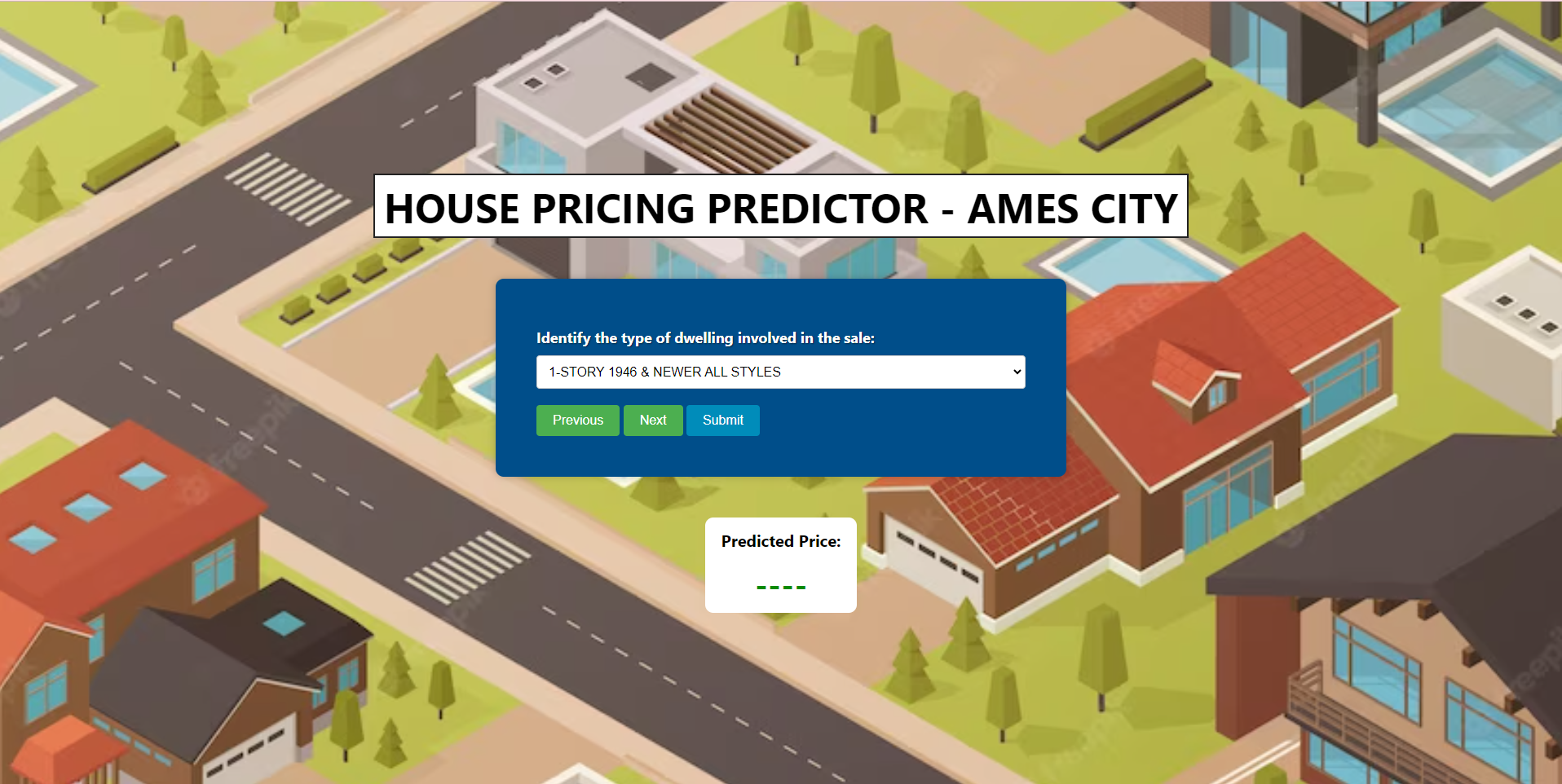
Front-end: We developed the website's user interface using HTML, CSS, and JavaScript. These technologies allowed us to create visually appealing and interactive web pages.
Back-end: We used Flask, a Python web framework, to handle the server-side logic. Flask enabled us to create APIs and manage the communication between the front-end and back-end components of our application.The backend was hosted on the free software, pythonanywhere.
Machine learning model: We employed a linear regression model, specifically the GradientBoostingClassifier algorithm, to predict housing prices. This model was trained using a dataset obtained from Kaggle, which contained information on housing prices in Ames City, Iowa.
Data processing: When a user interacts with the website, their input data is sent to the back-end through an API call. The back-end receives the user's information and processes it, passing it to the machine learning model for prediction.
API communication: We utilized the REST framework to establish the API communication between the front-end and back-end. This framework facilitated the transfer of data and predictions, ensuring a smooth flow of information between the user interface and the machine learning model.
Displaying results: Once the machine learning model generates a prediction, it is sent back to the user through the API call. The front-end then displays the predicted housing prices to the user, providing them with the information they requested.
Challenges we ran into
Terminology within the field of real estate can be quite confusing, especially to individuals with no experience in the field. Although real estate agents can easily understand such terminology with no issue, the average joe will find it difficult to comprehend such terms. Therefore, we had to translate industry specific terms into words that the average individual can understand. However, despite undergoing this process of making industry terminology more understandable, some terms are still relatively ambiguous, and may affect the useability of our application. We are currently testing the useability of our application by having others use it, and are currently receiving feedback on the application’s useability, and we are expecting to improve it in the future.
Accomplishments that we're proud of
We our very proud of our creative use of ChatGPT to expedite the development process. During the development of our application’s front-end using HTML, we successfully utilized ChatGPT to expedite the development process, and develop 738 lines of working HTML in as little as 3 hours. Essentially, we would write a section in HTML, and ask ChatGPT to adhere to that sections format while changing the parameters. The use of such framework allowed us to save many hours of work time, and create a functional and beautiful front end in as little as 3 hours, allowing us to allocate more time for back-end development.
What we learned
Over the course of development, we learned many invaluable lessons. Firstly, we realized the importance of robust data collection for machine learning. By incorporating a wide range of variables, such as property features and geographic location, we were able to enhance the accuracy of our application. Essentially, the more data collected, the more accurate our machine learning application got.
Second, we realized the profound positive impact that technology-driven solutions can have on sustainability. By assisting individuals in accurately valuing properties, our application facilitates fair pricing and reduces the risk of overpaying/ underselling in Ames. This helps create a more stable and sustainable real estate market in the region, fostering economic growth, attracting investment, and preserving the livability of the community.
Through our journey of creating this application, we not only developed a powerful tool but also gained a deeper appreciation for the interplay between technology, sustainability, and community development. Our application has the potential to transform the way people approach real estate transactions, enhancing the overall well-being of and its residents.
What's next for Ames City Housing Price Predictor
In the future, we hope to expand our application to predict housing prices in other US cities and towns. We are hoping to develop a similar housing price predictor for larger real estate markets like San Francisco, Los Angeles, and New York. In addition to this,we are continually training our current model to make it more accurate, and making our application more useable by having other individuals use it and making them supply feedback on issues during use and confusing industry terminology. We will use such feedback to improve the application’s useability.


Log in or sign up for Devpost to join the conversation.