-
-
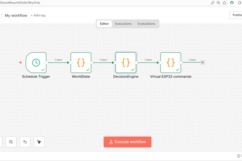
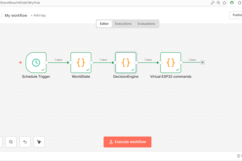
backend decision-making workflow
-
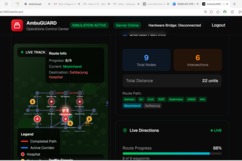
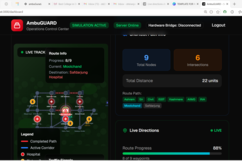
AmbuGUARD Operations Control Dashboard
Inspiration
AmbuGUARD was inspired by a critical real-world challenge: ambulances losing life-saving time because traffic congestion and uncoordinated intersections make emergency movement slow and unpredictable. In fast-growing urban environments, the delay is often not caused by distance, but by the absence of an intelligent coordination layer that can respond in real time.
We wanted to build something that does more than visualize a problem. AmbuGUARD was designed to show how an AI-driven system can make emergency response faster, more adaptive, and more operationally intelligent. The project represents the idea that modern infrastructure should not only transport vehicles, but actively support urgent decisions when lives are at stake.
What it does
AmbuGUARD is an AI-powered smart ambulance corridor system that dynamically creates a priority path for emergency vehicles.
The system:
- detects and tracks ambulance movement,
- generates optimized emergency routes,
- coordinates traffic signals ahead of the ambulance,
- clears congestion by creating a real-time green corridor,
- and visualizes the entire emergency flow in a live simulation dashboard.
At its core, AmbuGUARD demonstrates how AI-driven coordination can reduce response time, improve emergency readiness, and turn traffic infrastructure into a more responsive system.
How we built it
AmbuGUARD was developed as a demo-first, simulation-driven prototype so the core idea could be shown clearly within the hackathon timeframe.
The frontend was built using React with TypeScript to create an interactive and scalable dashboard. The interface presents a map-based simulation of routes, nodes, and intersections, while the logic layer manages ambulance movement and corridor behavior.
Claude API is integrated as the reasoning layer of the system, supporting route intelligence, prioritization, conflict handling, and explainable decision-making. This makes the prototype feel more like an intelligent coordination platform than a static demo.
Tech Stack
- Frontend: React with TypeScript (TSX)
- Logic Layer: TypeScript
- Styling: CSS
- Structure: HTML
- Visualization: Google Maps-based simulation
- Realtime Support: socket.io
- Runtime: Node.js
- AI Integration: Claude API
System Flow
- Ambulance location is detected or simulated.
- The route is generated and analyzed.
- Traffic conditions along the route are evaluated.
- Intersections ahead are prioritized.
- A continuous emergency corridor is maintained.
- The dashboard updates the response in real time.
Challenges we ran into
One of the biggest challenges was turning a complex real-world coordination problem into a prototype that is simple enough to understand but still realistic enough to feel meaningful.
Traffic coordination involves many unpredictable variables, so we had to balance simplicity with credibility. Another challenge was making sure the AI component contributed directly to the decision flow instead of feeling like an extra feature.
We also had to keep the project strong as a frontend-first submission while still showing technical depth, system thinking, and practical value.
Accomplishments that we're proud of
We successfully built a working prototype that demonstrates how emergency routing can be improved through intelligent coordination.
We are proud that the project combines route logic, traffic prioritization, visualization, and AI reasoning into one unified system. It also presents a practical approach to applying AI in infrastructure-related problems without losing clarity.
Most importantly, we transformed a serious societal problem into a clear and technically grounded solution that is easy to explain and demo.
What we learned
This project reinforced that impactful innovation requires more than just code. A strong solution must also have context, clarity, and purpose.
We learned how AI can function as a decision-support system in public infrastructure, and how simulation-first design can help communicate complex ideas effectively. We also learned how to structure a prototype so that it feels both technically credible and presentation-ready.
What's next for AmbuGUARD
Future versions of AmbuGUARD can include:
- real-time GPS integration,
- live traffic data,
- IoT-based smart traffic signal control,
- multi-ambulance coordination,
- a deployment-ready control dashboard,
- and deeper predictive routing logic.
The long-term goal is to evolve AmbuGUARD into a scalable smart mobility and emergency-response platform.
Domains
Primary domain: AI / Machine Learning
Secondary domains:
- Software and Web Development
- Automation and Smart Systems


Log in or sign up for Devpost to join the conversation.