-
-
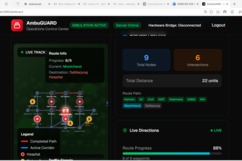
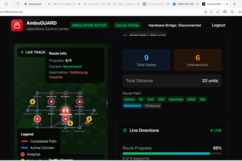
AmbuGUARD Operations Control Dashboard
-
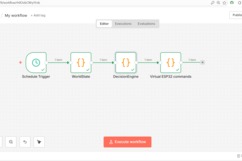
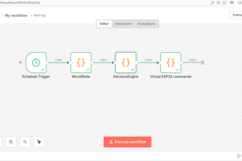
backend decision-making workflow
Project Overview
AmbuGUARD is an AI-powered emergency response prototype that predicts route conflicts and coordinates a smart corridor for ambulances in real time. The system demonstrates how applied AI can be used to make time-critical decisions, improve routing efficiency, and automate traffic prioritization in a practical working prototype.
Problem
Ambulances often lose valuable time because of congestion, uncoordinated intersections, and delayed routing decisions. In emergency situations, even small delays can reduce the chance of survival. The core challenge is not only traffic, but intelligent coordination.
Solution
AmbuGUARD solves this by simulating a smart ambulance corridor system that:
- detects ambulance movement,
- predicts route conflicts,
- prioritizes intersections ahead of the vehicle,
- clears a green corridor in real time,
- and visualizes the process in a live dashboard.
What it does
AmbuGUARD combines AI reasoning with a frontend simulation to show how emergency routing can be automated. Claude is used as the reasoning layer to support decision-making, route prioritization, and explainable system behavior.
How we built it
We built AmbuGUARD as a frontend-first prototype with a clean and interactive dashboard. The application uses React and TypeScript for the interface, CSS and HTML for structure and styling, and a map-based simulation to represent route flow and traffic coordination.
Claude was integrated as the core decision-support engine to help reason about corridor selection, traffic prioritization, and conflict handling. The result is a functional demo that shows how AI can support real-world automation.
Challenges we ran into
One challenge was simplifying a complex real-world system into a prototype that still feels realistic. Traffic coordination has many edge cases, so we had to design a model that was understandable, visually clear, and still technically meaningful.
Another challenge was making the project strong as a hackathon submission while keeping the codebase readable, structured, and easy to demo. We also had to make Claude’s role central rather than decorative.
Accomplishments that we’re proud of
We are proud that we turned a high-pressure real-world problem into a working AI prototype. The project demonstrates route intelligence, coordination logic, and real-time emergency support in a way that is easy to understand and present.
We are also proud that the system feels like a practical innovation rather than just a concept. It shows how AI can be used for automation, decision support, and smart infrastructure.
What we learned
We learned that strong hackathon projects are built around a real problem, a visible solution, and a clear story. A project becomes much stronger when AI is used as part of the system’s logic, not just as an add-on.
We also learned how to design a prototype that balances technical depth with usability and presentation quality.
What’s next for AmbuGUARD
Next, we want to expand AmbuGUARD with live GPS integration, smarter route prediction, and multi-vehicle conflict handling. Future versions could include IoT-based traffic control, a control dashboard, and better automation for real-time emergency coordination.
The long-term vision is to evolve AmbuGUARD into a deployable AI system for smart mobility and emergency response.
Built With
- ai
- automation
- css
- google-maps
- html5
- javascript
- node.js
- react
- smartsystems
- socket.io
- typescript


Log in or sign up for Devpost to join the conversation.