-
-

Our Motto
-
Our Solution

Inspiration
The world is facing an unprecedented challenge with communities and economies everywhere affected by the growing COVID-19 pandemic. Ventilation machines can double the survival rates of COVID-19 patients. However, there is a global shortage of these life-saving devices.
“This can ventilate millions in Africa when no other machine is around,” said innovation consultant Eitan Eliram, commenting: “In Africa, they haven’t fully woken up to the coronavirus and there are hardly any ventilators, so this can make a huge difference.” [https://www.timesofisrael.com/israeli-innovators-want-to-help-africans-breathe-through-covid-19/?fbclid=IwAR3VzILelp-rfL-MU5En6x0vC-yo4FVWghmD_Ek0Yek9OUYpdK1ckQf_ZoE]
We act and pray that our digital network and open-source code mode of operations will move faster than the virus can kill. "He who saves one soul as if he saved a world entire" (Jewish scripurs)
What it does
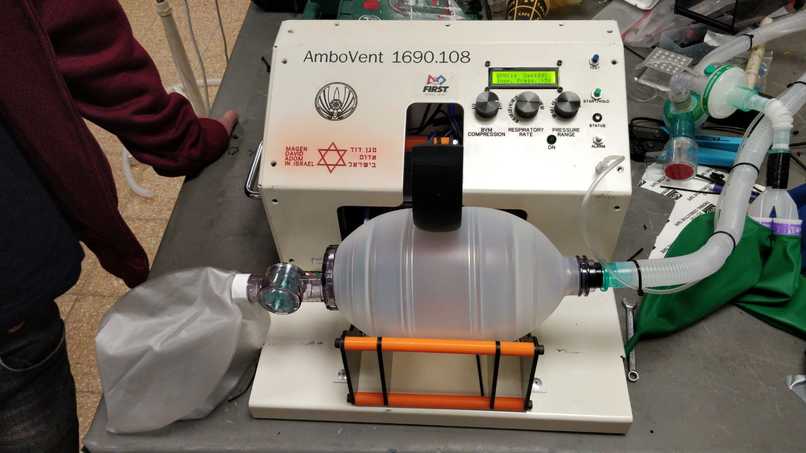
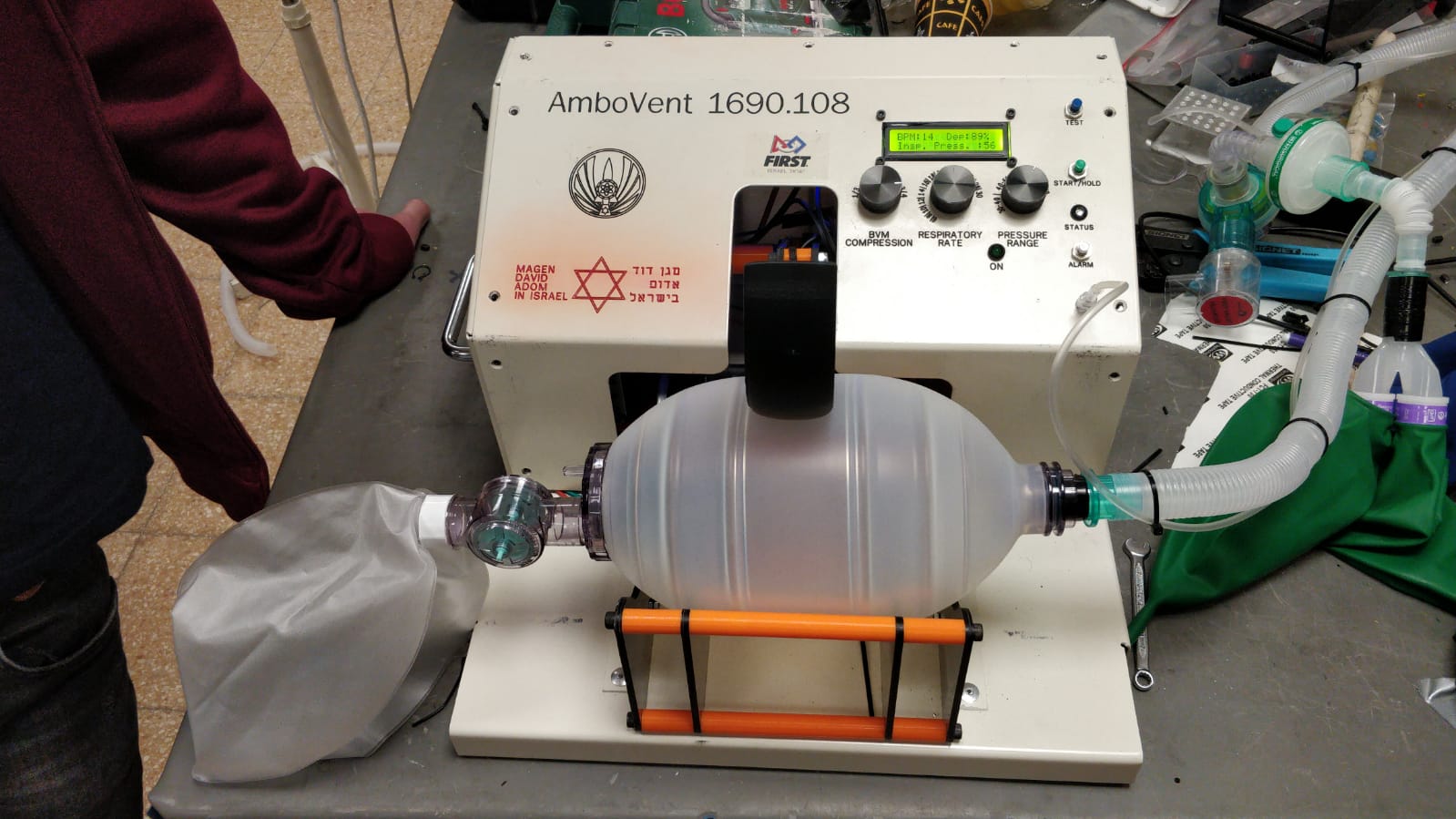
AmboVent, an open-source automatically controlled medical ventilator device, designed by a team of Israeli engineers and medical experts as a response to the worldwide shortages in mechanical ventilation devices due to the COVID-19 respiratory disease epidemic outbreak caused by Coronavirus.
How we built it
The AmboVent respirator was engineered for mass-production at low costs, using off-the-shelf components removing the need for intricate assembly lines. The device's entire blueprints, mechanical & electrical designs, source-codes, and medical/engineering test reports are published on GitHub as open-source hardware and software.
- The device includes a frame and mechanical arm which are designed to securely hold and periodically compress a standard resuscitation bag from approved bag-valve-mask (BVM; 1100-1475 cc) devices. The Ambovent includes potentiometers which allow for ventilation rates (6-24 BPM), maximum inhalation pressure (30-70 cm H2O) and tidal volume (calibrated 33-75% of total bag volume) control systems. The device can also set to operate in a synchronous ventilation mode, with respect to the breathing sequence of the patient.
- To ensure patient safety, the AmboVent is designed with insulated electrical components, two-hour battery backup, and includes a cut-off mechanism that stops the inhalation cycle when resistance is sensed and restarts a new cycle subsequently. In addition, the device includes visual and auditory alerts for malfunctions.
Challenges we ran into
Our main challenge was to build a fully functional medical device, leveraging state of the art innovation techniques, including crowdsourcing a open source-code solution, for the greater good. All of this in the midst of quarantine conditions and strict limitations on movement and gatherings.
Management Challenges: Our team consists of robotics, electronics, mechanics, engineers, clinicians, and medical professionals. All have been able to put together in less than ten days a cheap and mass-produced respirator. How did we do it so quickly? We kicked off an open-source code mentality, improving the design with tens of thousands of partners from all over the world.
Technological and Medical Challenges:
- Meeting the requirements of MHRA RMVS001, Specification for ventilators to be used in UK hospitals during the coronavirus (COVID-19) outbreak
- Can be assembled on the ground by using standard medical equipment and affordable materials.
- Can reach the underdeveloped and most distant areas around the world.
- Can replace high-end ventilation machines for patients that need a lower standard of ventilation, releasing these machines for those who are sick with COVID-19.
- Design to costs of approx. $1000 per unit (in large quantities), while most ventilation systems sell for $6,000-$10,000 and above
Accomplishments that we're proud of
Building a full functioning prototype, in less than 10 days, in the midst of quarantine, while everything was in low a availability.
the solution was ranked as the Best BVM based ventilator by Dr. Robert Lee Robert L. Read, Editor of Presidential Innovation Fellows Foundation and Public Invention (from Austin Texas) names AmboVent a "Game-Changing" move after comparing similar systems. [https://medium.com/@RobertLeeRead/the-open-source-ventilator-game-has-changed-ambovent-and-medtronic-covid-19-ventilators-open-d645bde594cc]
43,000 Github entries a day after the ope-source code was released on GitHub
Conducting a live animal study. The machine performed remarkably well even in extreme simulated conditions. [https://www.linkedin.com/posts/yoav-mintz-98b35a2a_covid19-eaesabreu-activity-6653552640070303744-v90I/]
Building a large online community of makers community around our solution from more than 40 countries around the globe, including USA, Canada, Britain , Italy, Egypt , Ethiopia , Guatemala, Brazil, Alaska, Ghana, Benin, South-Africa, Namibia and more..
Our team keep supporting more than 150 teams worldwide
The prototype was successfuly assembled by 4 different teams around the world - NewHaven, Alaska, Singapure, Guatamala
What we learned
The pandemic brought us to work together and remotely, it taught us how to emplify ones skill sets and experience, in an efficient and rapid way, to save lives. We have learned that CrowdSourcing and Open-source code mentality can assist in hacking critical problems, such as global shortage of these life-saving respirators.
It is more than giving the world a grasp of hope, but also granting the world a novice and achievable blueprint for a full functioning respirator. Changing the way we used to collaborate, helped us in simplifying the design and significantly decrease the price of ventilators, makeing them affordable, achievable, and taiored for mass production.
What's next for AmboVent
We are currently constructing the first 20 AmboVent Ventilators to be distributed worldwide, for regulation (towards deployment in Hospitals) and for conducting full clinical tests. At this point, our goal is to get the AmboVent approved by local health regulators in each country, so it can enter mass production by a local manufacturer, and then deployed in hospitals.


Log in or sign up for Devpost to join the conversation.