-
-

Landing Page
-

Login Screen
-

Dashboard
-

Dashboard Screen
-
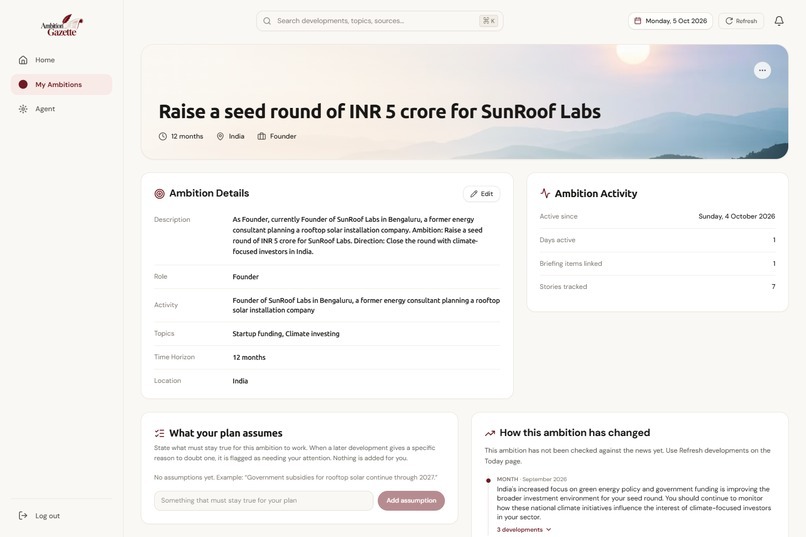
Ambitions Screen
-

Ambition Impact Section
-

Agent Daily Overview Screen
-

Multilingual Voice Assistant
-

Live Assistant Screen
-
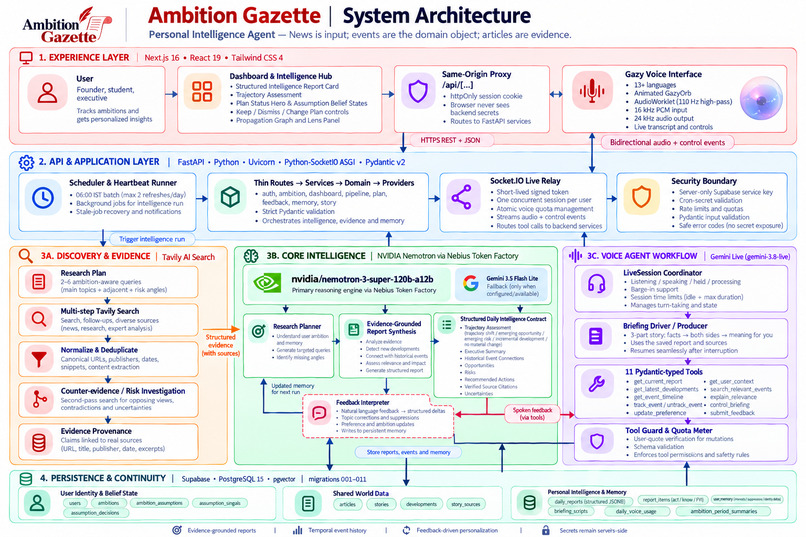
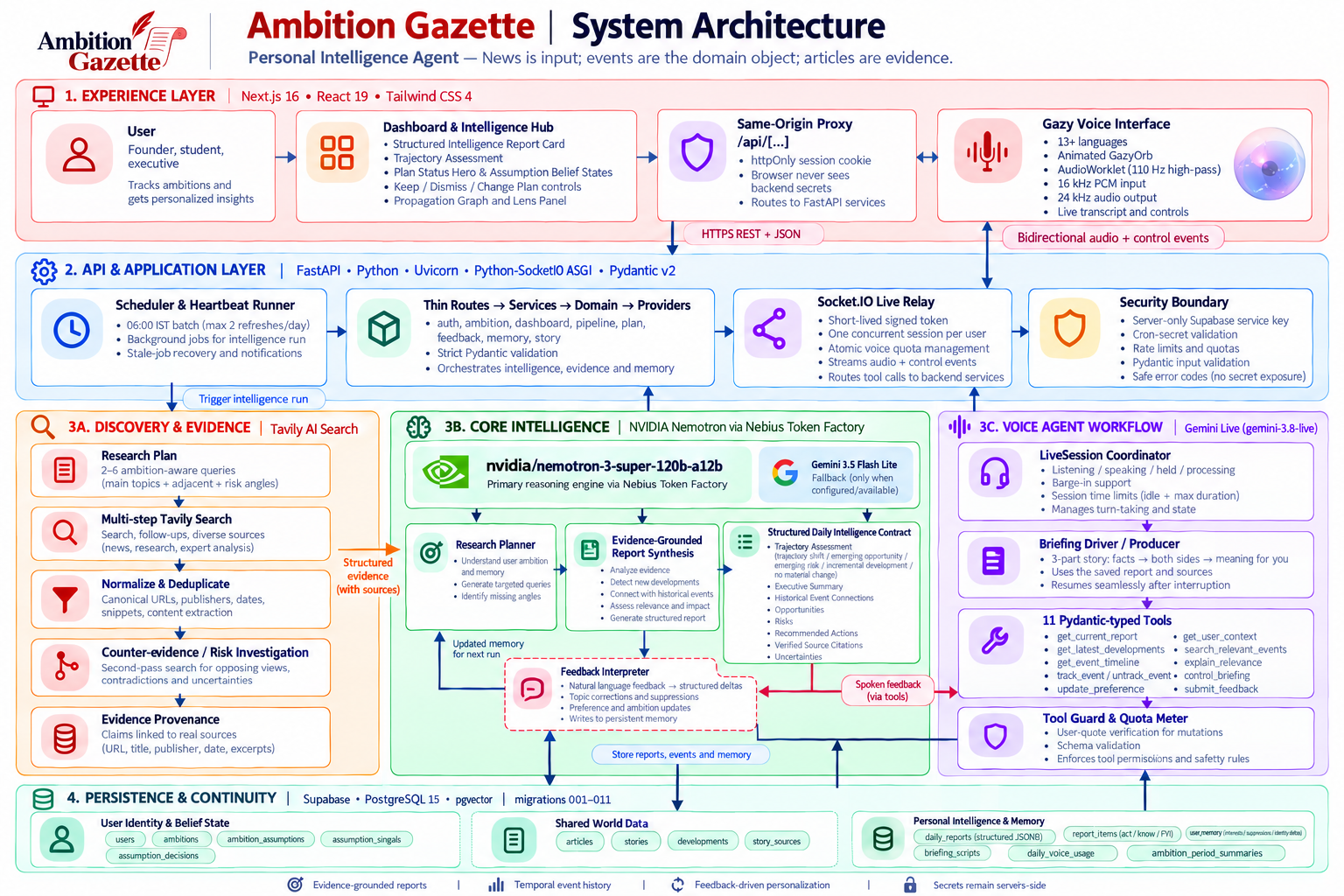
Architecture Diagram




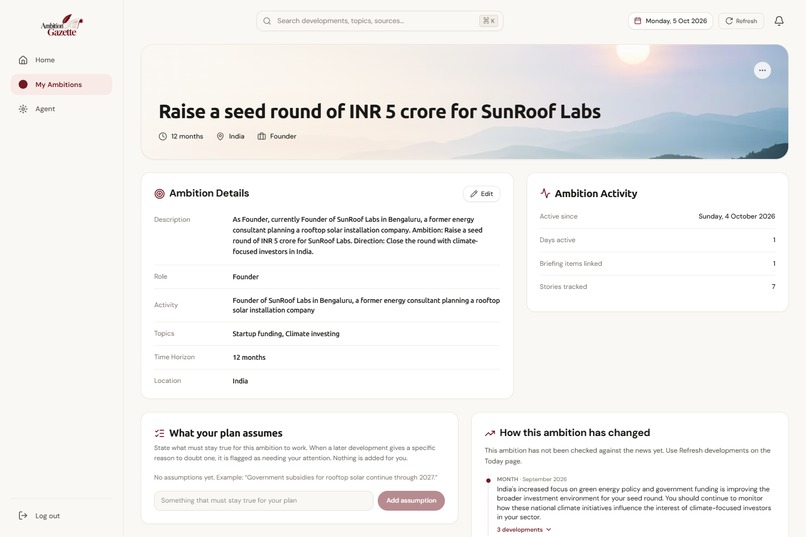




Ambition Gazette
Nebius × NVIDIA Global AI Hackathon 2026
Track: Best Apps and Agents | Bonus Track: Best Use of Tavily
The Problem No One Is Naming
Every AI product built in the last three years answers the same question:
"What do you want to know?"
Search engines answer it. Recommendation feeds answer it. AI assistants answer it. Summarizers, chatbots, briefing tools — all of them start from your explicit prompt or your click history and give you more of what you already looked for.
That is a solved problem. And it is the wrong problem.
The real threat to anyone executing a long-term plan — a founder, an executive, an investor, a researcher, or a student building a career — is not information they searched for and failed to find.
It is information they had no reason to search for.
A subtle regulatory shift in Brussels. A demographic reversal. A battery supply chain pivot in Southeast Asia. A quiet policy change that invalidates a fundamental business model assumption. Nobody searches for those. Nobody's feed surfaces them. And by the time the downstream consequences are obvious enough to query, the window to adapt has already closed.
This is the problem Ambition Gazette solves.
What We Built — And What Makes It Different
Ambition Gazette is not a news reader. It is not an AI assistant. It is not a personalized feed.
It is an autonomous, plan-aware personal intelligence agent that watches the real world on behalf of what you are trying to accomplish.
You give it your ambitions. You give it the underlying assumptions your plan depends on. It does the rest — not by summarizing headlines, but by actively evaluating whether real-world developments challenge the ground your strategy stands on.
The output is never "here is today's news." The output is a structured intelligence assessment:
"This assumption behind your plan was challenged today — here is the verifiable evidence chain, trajectory assessment, and recommended next action."
Or, just as importantly:
"No material change to your plan today — here is the research plan and the evidence we verified."
That second answer is as valuable as the first. Silence is a feature, not a failure.
The Autonomous Loop Across Time
Ambition Gazette does not treat intelligence as a one-off stateless query. Its autonomous loop operates across time:
User Ambition, Assumptions & Temporal Memory
               │
               ▼
NVIDIA Nemotron (Nebius Token Factory) ──► Targeted Multi-Angle Research Plan
               │
               ▼
       Tavily Search Engine ─────────────► Live Web Discovery & Evidence Retrieval
               │
               ▼
Evidence Layer & Normalization ──────────► Deduplication, Canonical URLs & Provenance
               │
               ▼
NVIDIA Nemotron Reasoning Engine ────────► Trajectory Shift, Opportunities, Risks & Actions
               │
               ▼
     Structured Daily Report ────────────► Grounded Text Briefing & Verifiable Citations
               │
               ▼
      Gemini 3.8 Live Voice ─────────────► Interactive Spoken Briefing & Clarifications
               │
               ▼
Feedback Interpreter (Nemotron) ─────────► Structured Preferences & Memory Deltas
               │
               ▼
Durable Temporal Memory ─────────────────► Reshapes Day 2 Research Queries & Relevance
The Technical Architecture That Makes This Possible
1. Dual-Engine Intelligence: NVIDIA Nemotron on Nebius Token Factory
At the core of Ambition Gazette is NVIDIA Nemotron (nvidia/nemotron-3-super-120b-a12b) hosted on the Nebius Token Factory. We deliberately decoupled the intelligence layer from vendor lock-in to leverage high-throughput, low-latency open-weights reasoning:
- Targeted Research Planning (
build_research_plan): Rather than running naive keyword searches, Nemotron evaluates the user's strategic ambitions, stated assumptions, and active memory suppressions to formulate two to six targeted search directions, including dedicated risk and opposing-evidence queries. - Structured Report Synthesis (
synthesize_daily_report): Nemotron synthesizes incoming developments against the user's historical memory, classifying the overall momentum into one of five deterministic trajectory states:no_material_change,incremental_development,emerging_opportunity,emerging_risk, ortrajectory_shift. It outputs executive summaries, historical event connections, opportunities, risks, and concrete next actions. - Natural Language Feedback Interpretation (
interpret_and_apply_user_feedback): When a user provides feedback — spoken or written — Nemotron extracts the structural intent (e.g., distinguishing a topic preference correction from a permanent suppression or an ambition change) and writes durable memory deltas.
2. Multi-Step Live Evidence Gathering with Tavily AI Search
Generic web scrapers fail at strategic intelligence because they drown the reasoning engine in noise, ads, and duplicate syndicated articles. We integrated the Tavily AI Search Engine to power an observable, five-stage evidence workflow:
- Stage A (Plan Execution): Receives the research plan formulated by Nemotron.
- Stage B (Targeted Search): Executes multi-angle queries with publisher attribution and publication date preservation.
- Stage C (Normalization & Deduplication): Normalizes text, resolves canonical URLs, and removes redundant syndicated stories.
- Stage D (Counter-Evidence Investigation): Automatically executes a second-pass search specifically investigating opposing views and risk factors generated by Nemotron.
- Stage E (Provenance Packaging): Emits a verified evidence package where every finding is tied to its original canonical source URL.
3. Persistent Stories & The Assumption Belief Engine
Most AI systems treat every article as an isolated event. Ambition Gazette clusters incoming developments into persistent, evolving stories using gemini-embedding-001 (768d) vector similarity and model resolution. Each story maintains a historical timeline of developments, distinguishing event occurrence time from article publication time.
Crucially, the system tracks the belief state of every user-stated assumption:
- Signals: Incoming developments are evaluated as signals that
challenges,supports, or creates anopportunityfor an assumption. - States: Assumptions dynamically transition between
holding,watch, andchallenged. - Decisions: Users maintain full agency through explicit decision controls (
keep,dismiss, orchange_plan).
4. Personalizing Relevance Without Personalizing Reality
Every information system faces a fundamental choice: optimize for engagement, or optimize for truth.
Engagement-optimized systems learn click patterns and feed them back to the user, creating insular filter bubbles. Ambition Gazette avoids this by strictly separating three independent signals:
- World significance — how consequential an event is, independent of any user
- Personal relevance — how directly it intersects with a user's ambitions and assumptions
- User interest — whether the user has historically engaged with the subject
A development with high world significance and zero prior user interest can still surface if it intersects with a foundational assumption in their plan. A user who builds AI software will not be trapped in an AI bubble; if a regulatory embargo or an energy grid shift threatens their compute supply chain assumption, it surfaces regardless of past reading history.
Your ambitions determine what deserves explanation. They do not determine what the world is allowed to contain.
5. The Durable Temporal Feedback Loop (Day 1 ➔ Day 2)
Ambition Gazette's core architectural differentiator is that corrections today change what the system searches for, evaluates, and explains tomorrow:
- Day 1: A founder with the ambition "Build an AI robotics startup" receives developments covering both robotics actuators and foundation models.
- User Feedback: The user tells the voice agent:
"I only care about the AI software layer, not robotics hardware manufacturing." - Nemotron Interpretation: Nemotron identifies this as a
topic_preference_correction, assigns asuppress_topicoperation forrobotics hardware, and persists a durablesuppressionrecord inuser_memory. - Day 2: When the pipeline runs, the research planner retrieves active suppressions (
suppressions=['robotics hardware']), excludes hardware manufacturing queries, and focuses exclusively on software and agentic intelligence. The relevance engine filters out hardware-only news.
The system does not just summarize; it learns your strategic boundary conditions over time.
The Voice Layer — Built for Thinking, Not Playback
Ambition Gazette features an interactive, real-time voice interface powered by Gemini 3.8 Live (gemini-3.8-live).
Conventional voice briefings simply read text aloud. Ambition Gazette uses a server-directed Briefing Driver and a bidirectional AudioWorklet pipeline (110 Hz high-pass filter, adaptive gain, 16 kHz PCM uplink, and 24 kHz playback) rendered with an interactive animated orb canvas (GazyOrbCanvas):
- Structured Dialogue: The host delivers stories in three distinct chapters: verified facts, multiple perspectives, and specific meaning for your plan.
- Sub-Second Barge-In: Interruptions are detected in under 400 milliseconds. The user can challenge an assessment, ask for counter-arguments, or query source credibility. Once answered, the driver smoothly resumes where it was interrupted.
- 11 Pydantic-Typed Tools: The voice agent does not hallucinate facts. It calls dedicated server tools, including:
get_current_report— allows the agent to discuss the daily executive summary, trajectory assessment, risks, opportunities, and recommended next actionsexplain_relevance— articulates the evidence chain connecting an event to a user's ambitionget_event_timeline— walks through historical developmentstrack_event/untrack_event— updates active story trackingsubmit_feedback— routes spoken corrections directly into the NVIDIA Nemotron feedback interpreter to update durable memory in real time
What We Learned Building This
1. Decoupling the Intelligence Layer Unlocks Specialization
Routing research planning, trajectory evaluation, and feedback interpretation to NVIDIA Nemotron on Nebius Token Factory gave us transparent control over reasoning depth and structured JSON output. Pairing Nemotron with Tavily for live discovery and Gemini 3.8 Live for native audio streaming proved that the strongest agents are composable multi-provider architectures.
2. Personalization and Filter Bubbles Are Separable Problems
Most builders assume that personalization inherently causes filter bubbles. They are wrong. You can personalize why an event matters to a specific human plan without narrowing what real-world events the system is allowed to observe.
3. Negative Outputs Are Strategically Critical
Conventional engagement feeds are incapable of saying "nothing worth your attention happened today." In strategic intelligence, confirming that your plan held firm against today's global events is often more valuable than manufacturing artificial relevance to fill a screen.
4. Plans Fail at the Assumption Layer, Not the Goal Layer
People rarely lose sight of their ultimate goal. They lose sight of the quiet assumptions beneath the goal. By making those assumptions first-class domain objects and evaluating real-world developments against them, we transform news from passive consumption into strategic resilience.
Technical Stack
| Layer | Technologies & Providers |
|---|---|
| Reasoning Engine | Nebius Token Factory (nvidia/nemotron-3-super-120b-a12b - NVIDIA Nemotron 120B)Transparent fallback to Google Gemini 3.5 Flash Lite |
| Live Discovery & Evidence | Tavily AI Search API (Multi-step targeted search, counter-evidence queries, canonical provenance) |
| Voice Interface | Google Gemini 3.8 Live (gemini-3.8-live) with 11 Pydantic-typed tools, AudioWorklet PCM streaming |
| Backend API | Python 3.11/3.12, FastAPI, Uvicorn, Python-SocketIO (ASGI), Pydantic v2, Pydantic-Settings |
| Frontend Experience | Next.js 16, React 19, TypeScript, Tailwind CSS 4, Lucide Icons, Canvas Audio Visualizer |
| Persistence & Continuity | Supabase (PostgreSQL 15 + pgvector), 11 schema migrations, atomic IST quota procedures |
| Embeddings & Similarity | Google GenAI (gemini-embedding-001, 768-dimensional vectors) |
| Validation & Contracts | Pydantic v2 at all API, model reasoning, and function-calling boundaries |
Verification & Key Endpoints
GET /api/pipeline/providers/health: Live health-check verifying server-side inference on Nebius Token Factory (NVIDIA Nemotron), Tavily search connectivity, and Gemini Live voice infrastructure.POST /api/feedback/interpret: Interprets natural language user corrections into structured temporal memory updates using Nemotron.pytest api/tests -v: Complete automated test suite covering Tavily normalization, Nebius structured schema compliance, daily intelligence contracts, and the Day 1 ➔ Day 2 temporal memory loop.
What's Next
- Primary Source Deep Scraping: Ingesting full regulatory filings, patents, and technical arXiv preprints for specialized domains.
- Cross-Ambition Contagion: Modeling how an assumption failure in one industry cascades across multiple unrelated user ambitions.
- Proactive Ambient Alerts: Out-of-band alerts when a trajectory-shifting development challenges a high-priority assumption between scheduled runs.
- Team Intelligence Mesh: Allowing leadership teams to map organizational ambitions and surface collective blind spots without creating noise.
Built With
- 768-dimensional-vectors
- agentic
- fastapi
- gemini
- gemini-3.8-live
- gemini-embedding-001
- memory-layers
- nebius
- nemotron
- nemotron-3-super-120b-a12b
- nextjs
- nvidia
- pcm
- pgvector
- postgresql
- pydantic-v2
- python
- python-socketio
- supabase
- tavily
- typescript

Log in or sign up for Devpost to join the conversation.