-
-

Landing Page
-

Login Page
-

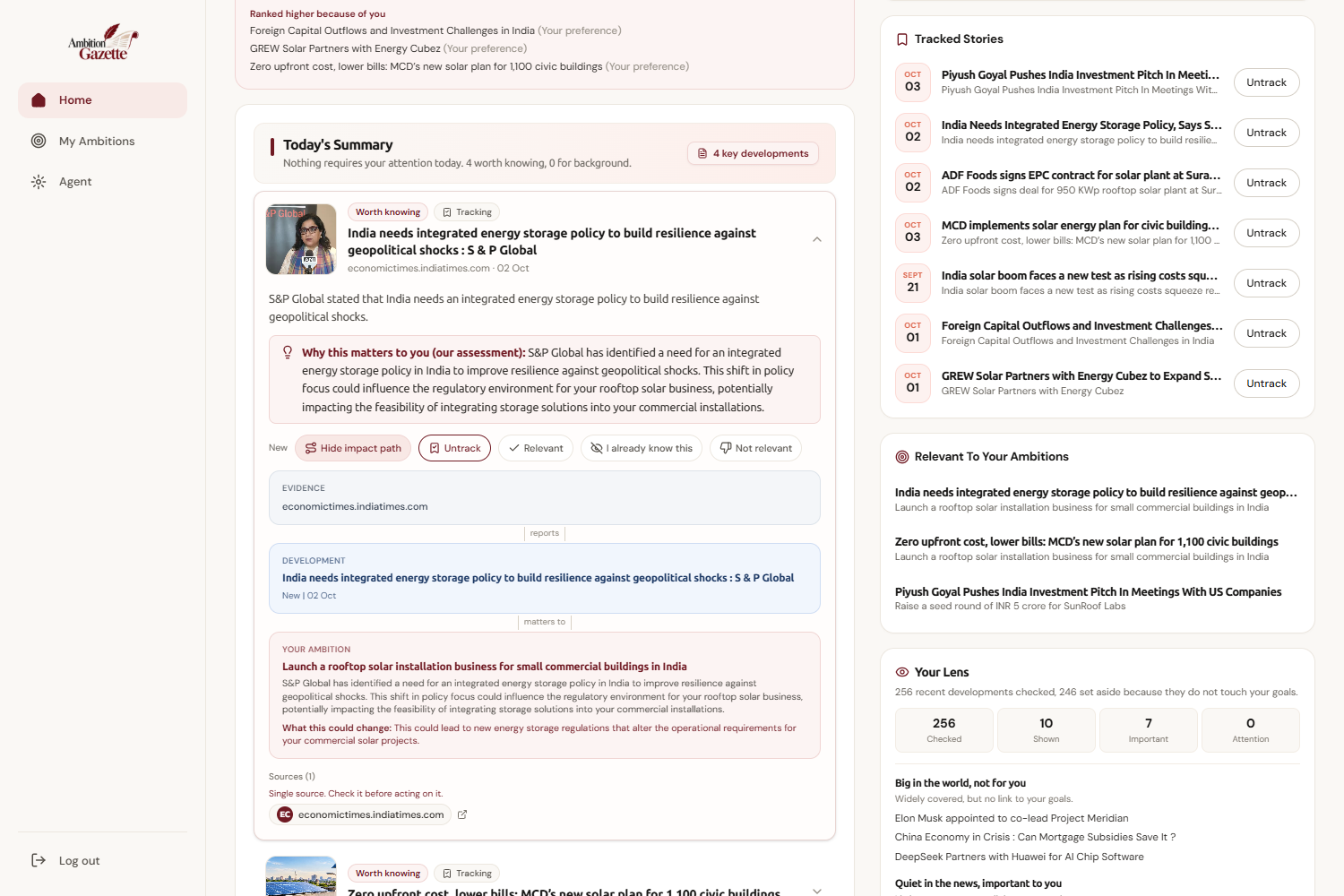
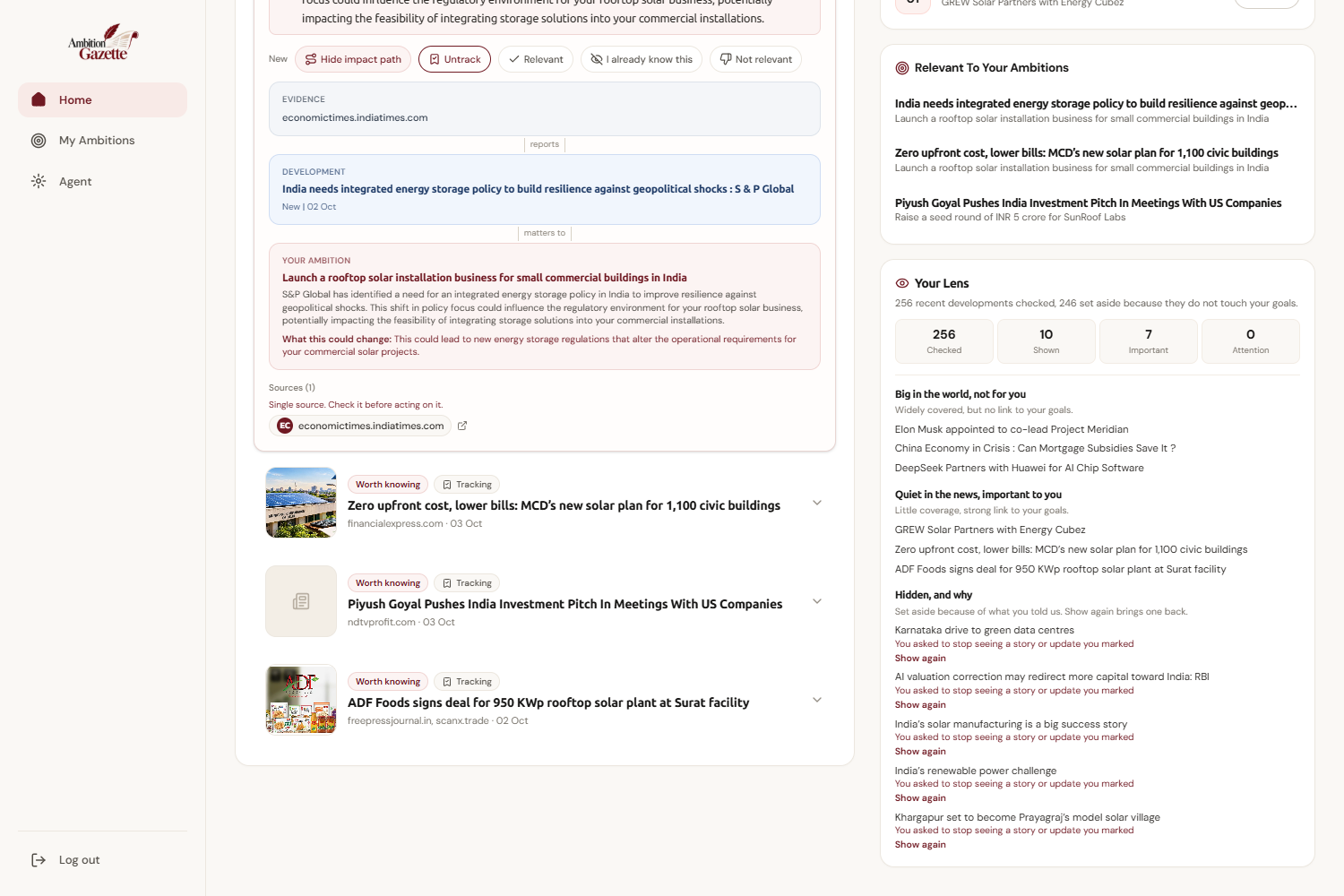
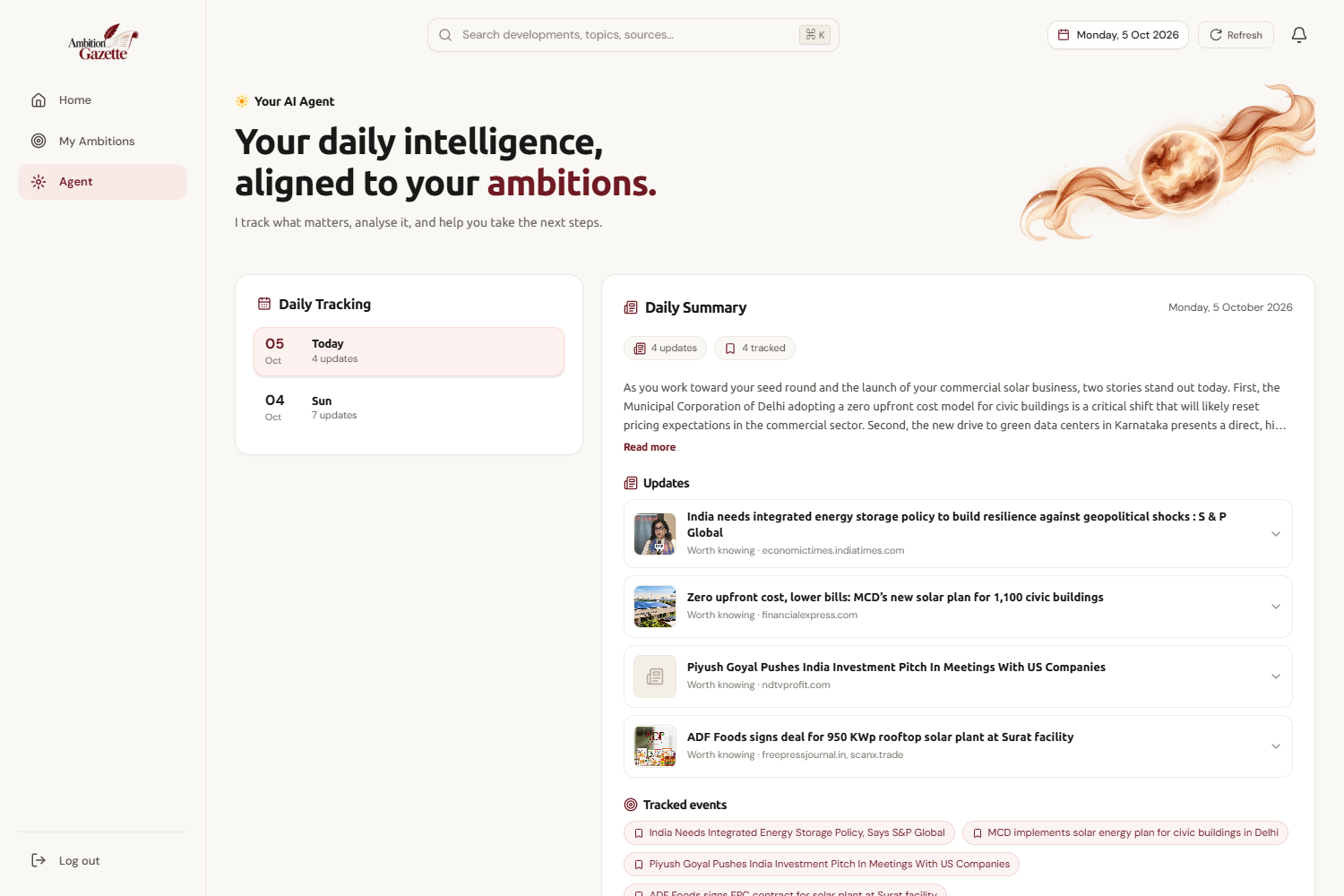
User Today's Dashboard
-
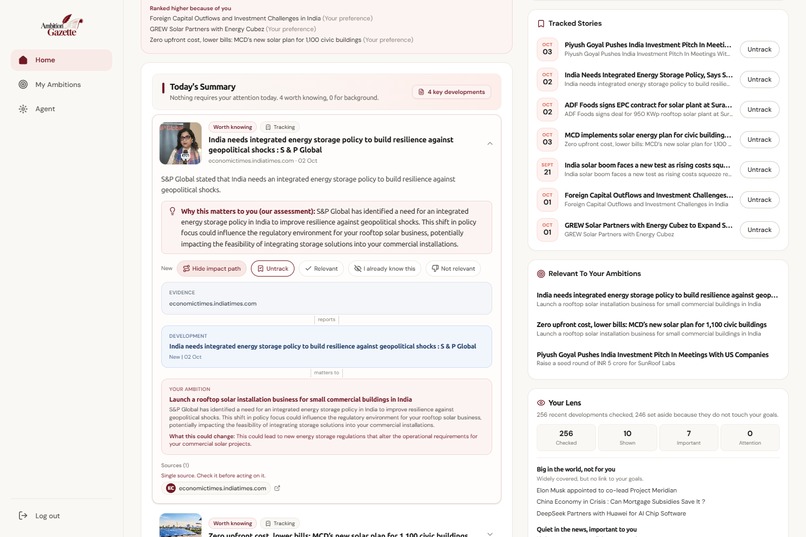
Event Connection
-
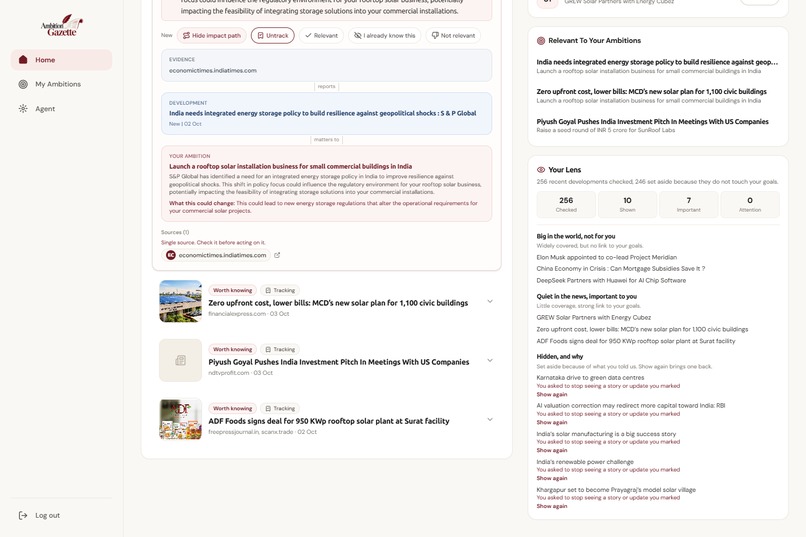
Event Track
-
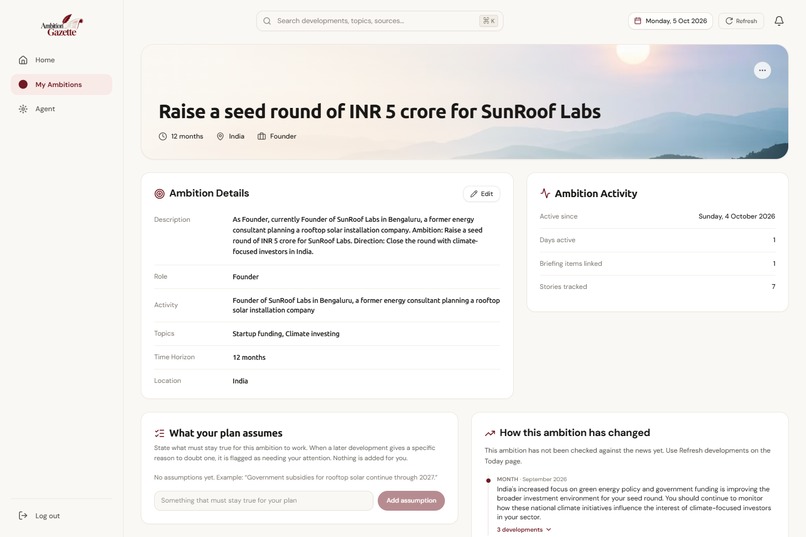
Ambition Inventory
-
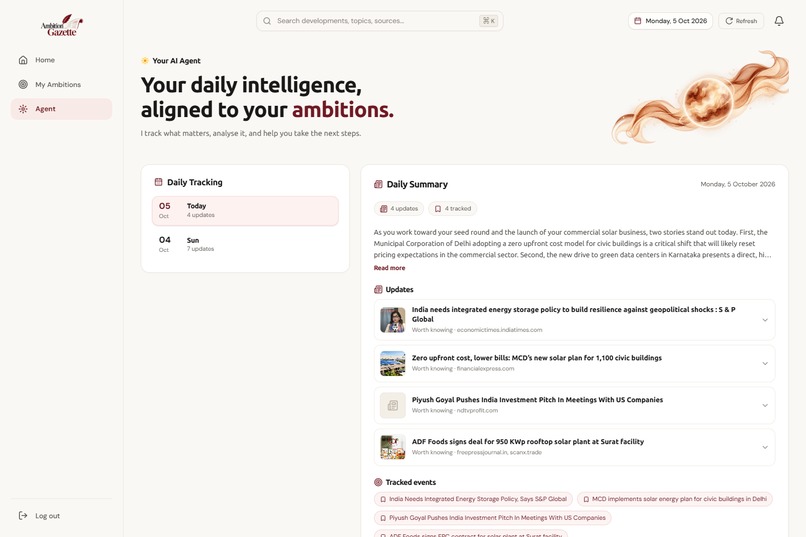
Agent Actions
-
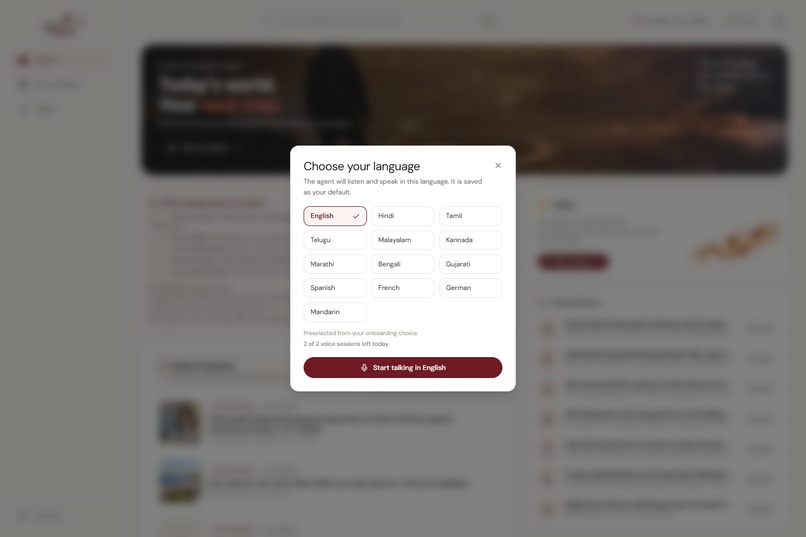
Agent Call Initiation
-

Talk with Agent
-
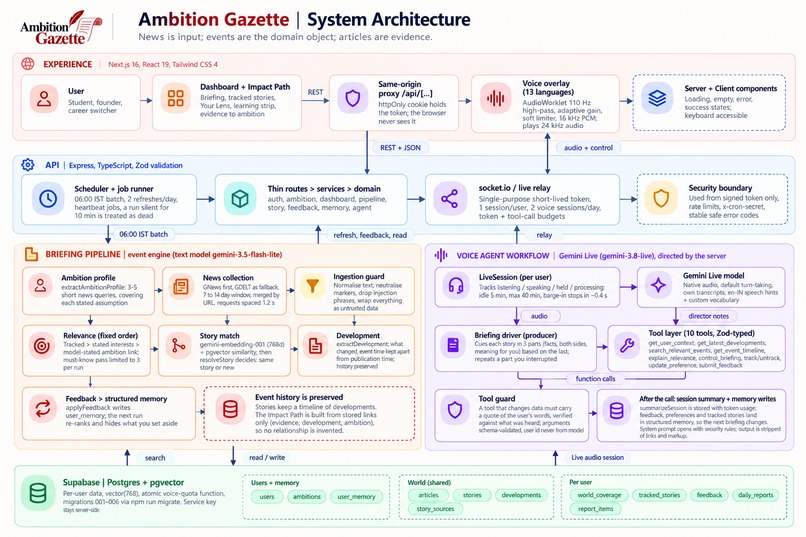
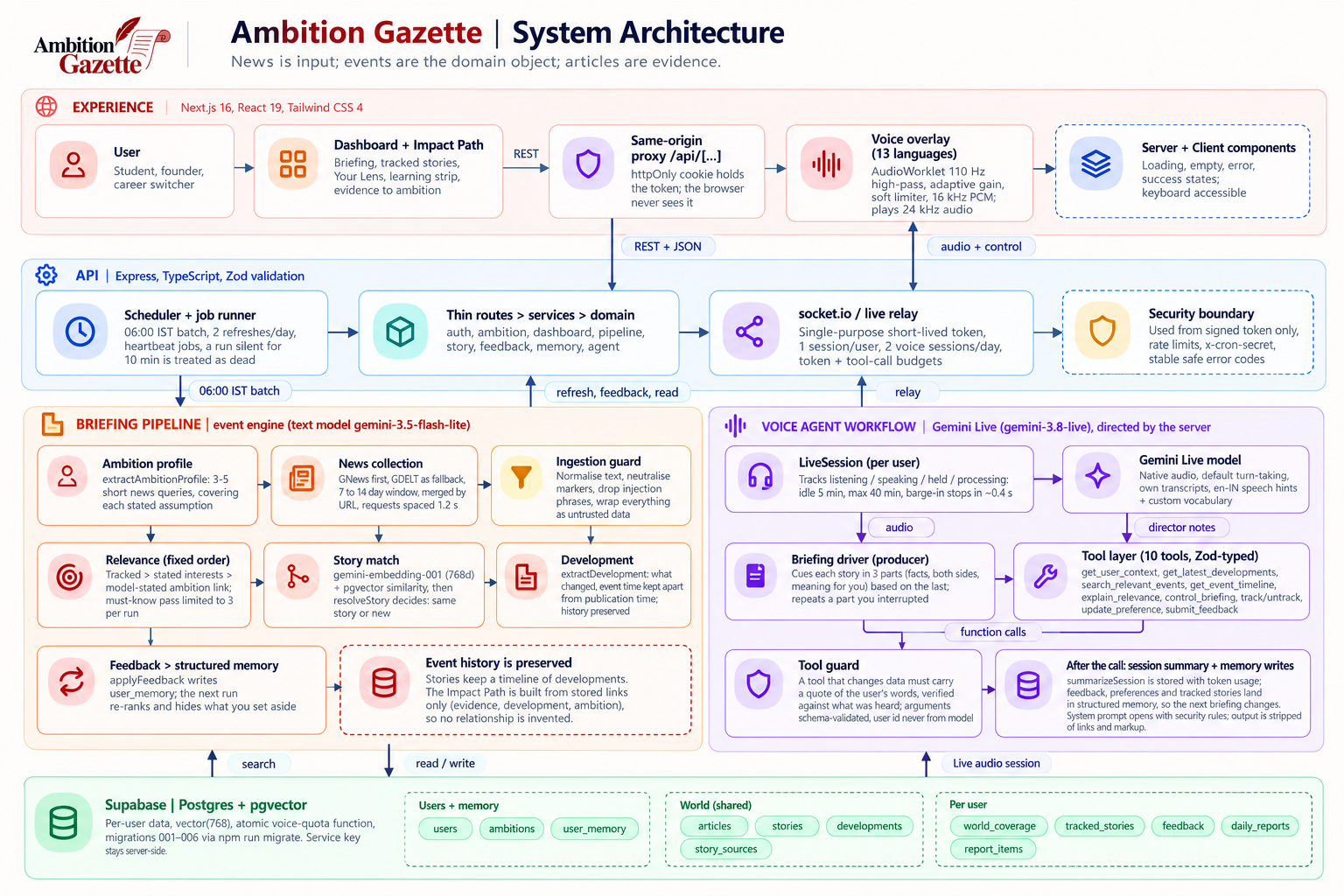
Ambition Gazette Architecture






Ambition Gazette — Devpost Submission Story
The Problem No One Is Naming
Every AI product built in the last three years answers the same question: "What do you want to know?"
Search engines answer it. Recommendation feeds answer it. AI assistants answer it. Summarizers, chatbots, briefing tools — all of them start from your query or your history and give you more of what you already looked for.
That is a solved problem. And it is the wrong problem.
The real threat to anyone executing a long-term plan — a founder, an investor, a researcher, a student building a career — is not information they searched for and didn't find.
It is information they had no reason to search for.
A regulatory decision in Brussels. A demographic reversal. A supply chain shift in Southeast Asia. A quiet policy change that invalidates a business model assumption. Nobody Googles for those. Nobody's feed surfaces them. And by the time the downstream consequences are obvious enough to search for, the window to adapt has already closed.
This is the problem Ambition Gazette solves.
What We Built — And What Makes It Different
Ambition Gazette is not a news reader. It is not an AI assistant. It is not a personalized feed.
It is a plan-aware intelligence layer that watches the world on behalf of what you are trying to accomplish.
You give it your ambitions. You give it the assumptions your plan depends on. It does the rest — not by summarizing headlines, but by tracing whether actual world developments challenge the ground your strategy stands on.
The output is never "here's today's news." The output is:
"This assumption behind your plan was challenged today — here is the evidence chain."
Or, just as importantly:
"Nothing changed your plan today — here is what we checked."
That second answer is as valuable as the first. Silence is a feature, not a failure.
The Technical Architecture That Makes This Possible
Persistent Stories, Not Isolated Articles
Most AI systems treat every article as an independent event. This is architecturally wrong for strategic intelligence.
The same real-world development produces dozens of articles over weeks. Ambition Gazette clusters incoming developments into persistent, evolving stories using vector similarity combined with model judgment. Each story carries a timeline. Each new article either extends that story or starts a new one.
This means when you ask "what happened with the EU AI Act," the system doesn't give you today's article. It gives you the full narrative arc — what changed, when, and how the picture shifted over time.
Three Signals, Deliberately Separated
Every intelligence system eventually faces a fork: optimize for engagement, or optimize for truth.
Engagement-optimized systems learn your click patterns and feed them back to you. That is how filter bubbles form. The system doesn't deceive you. It just learns that you respond to certain inputs, and narrows accordingly.
We built against this at the architecture level.
Ambition Gazette maintains three independent signals for every development:
- World significance — how consequential this event is, independent of any user
- Personal relevance — how directly it intersects with this user's ambitions and assumptions
- User interest — whether the user has historically followed this subject
These are not averaged. They are not blended. They are evaluated separately and surfaced according to explicit logic:
A development with high world significance and zero user interest can still surface — because the system asks "could this matter to your plan?" independently of whether you've ever clicked on this topic.
A development with low world significance but high personal relevance gets escalated — because it specifically threatens an assumption even if the world hasn't noticed yet.
This is what we mean by personalizing relevance without personalizing reality. Your ambitions determine what deserves explanation. They do not determine what the world is allowed to contain.
Evidence Chains, Not AI Assertions
The most dangerous part of any AI product is confident-sounding claims that aren't grounded.
Every "why this matters" in Ambition Gazette traces back through a stored evidence path:
Source → Development → Story → Assumption → Ambition → Explanation
If the system cannot construct that chain from stored evidence, it does not generate a relevance claim. The constraint is structural, not a prompt instruction. Model outputs are validated with Zod before entering the domain layer. Hallucinated connections cannot propagate into briefings.
The Outside-Your-Bubble Mechanism
The second discovery direction is the one conventional systems never build:
"Something important changed in the world — could this matter to you even though you weren't looking for it?"
We reserve a deliberate allocation of attention for developments that would not be selected by any preference signal. These are evaluated purely against world significance and cross-referenced against ambitions and assumptions — not against click history.
A user who follows AI startups extensively should not receive an endless stream of AI startup content because the system learned they engage with it. If a geopolitical shift, a demographic trend, or an infrastructure change intersects with an assumption in their plan, it surfaces — regardless of whether they have any recorded interest in geopolitics, demographics, or infrastructure.
This is not a feature we added. It is a design constraint we enforced.
The Voice Layer — Built for Thinking, Not Playback
Ambition Gazette includes a two-sided voice briefing powered by Gemini Live.
The naive implementation of AI voice briefing is: generate a summary, read it aloud, finish. This is a product that fails immediately when a user has a question.
We built a director-driven briefing system that delivers content in controlled sections. Each section can be interrupted. Each interruption is handled as a genuine conversational turn — the user can push back on the reasoning, ask why something matters, challenge the relevance judgment, or request more evidence.
After the question is answered, the director resumes from where it left off rather than starting over or losing thread.
More importantly: what happens in that conversation becomes structured memory. If you say "this doesn't matter to my plan," the system updates its relevance model for your ambitions. If you say "this matters more than you thought," that signal propagates into future evaluations.
The system learns your decision context — not simply your engagement pattern.
What We Actually Learned Building This
Personalization and filter bubbles are separable problems
This is the insight the entire product rests on. Most builders treat them as the same problem or assume they are in tension. They are not. You can give someone a deeply personalized experience of why something matters to them without giving them a narrowed view of what the world contains. The architecture has to enforce this separation deliberately. It does not happen naturally.
Negative outputs are undervalued
Conventional engagement systems are structurally incapable of saying "nothing worth your attention happened today." Ambition Gazette is not just capable of saying it — we built it as a primary output path. The ability to show your work and say "we evaluated these developments and none of them change your plan" is more valuable in a strategic context than manufacturing relevance to fill a slot.
Plans fail at the assumption layer, not the goal layer
Users can track their goals. They cannot track every assumption those goals depend on. The valuable question is not "has anything related to my interests appeared?" It is "has something invalidated a premise I'm building on?" Making assumptions explicit and evaluating them against world developments is the core mechanism that makes this different from every other information product.
Why This Category Doesn't Exist Yet — And Why It Will
Information products have optimized relentlessly for engagement, recency, and retrieval.
None of those dimensions are wrong. But they are all oriented toward the past — what you've clicked, what's new, what you asked for.
Strategic intelligence requires a different orientation: forward-facing, assumption-aware, reality-grounded.
Ambition Gazette is the first system we know of that evaluates world developments against the structural assumptions of a user's plan rather than their content consumption history.
It is not a reader. It is not an assistant. It is not a feed.
It is the system that tells you what changed in the world while you were executing your plan — and whether it matters to the ground you're standing on.
Stack
Frontend: Next.js 16, React 19, TypeScript, Tailwind CSS 4
Backend: Express, Node.js, TypeScript
AI: Gemini models (reasoning pipeline), Gemini Live (real-time voice briefing)
Data: Supabase / PostgreSQL with pgvector
World pipeline: GNews (primary), GDELT (fallback); semantic clustering with vector similarity and model judgment
Validation: Zod at all model output boundaries
What's Next
- Primary-source retrieval and full-text evidence depth
- Cross-ambition development matching (one event challenging multiple plans)
- Proactive assumption-challenge notifications
- Collaborative ambition tracking across teams
- Deeper world-event relationship mapping
- Multi-user scaling with organizational intelligence layers
Built With
- agents
- conversationalai
- express.js
- geminiliveai
- next.js
- node.js
- pgvector
- postgresql
- rag
- react
- semanticsearch
- supabase
- typescript

Log in or sign up for Devpost to join the conversation.