-
-
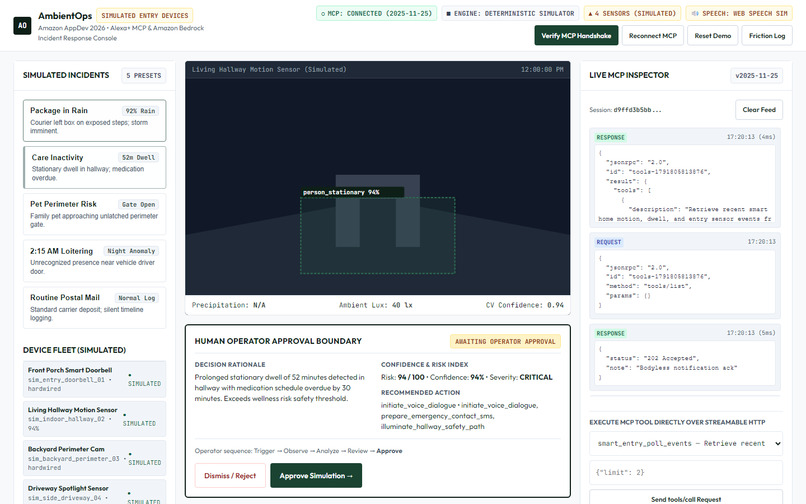
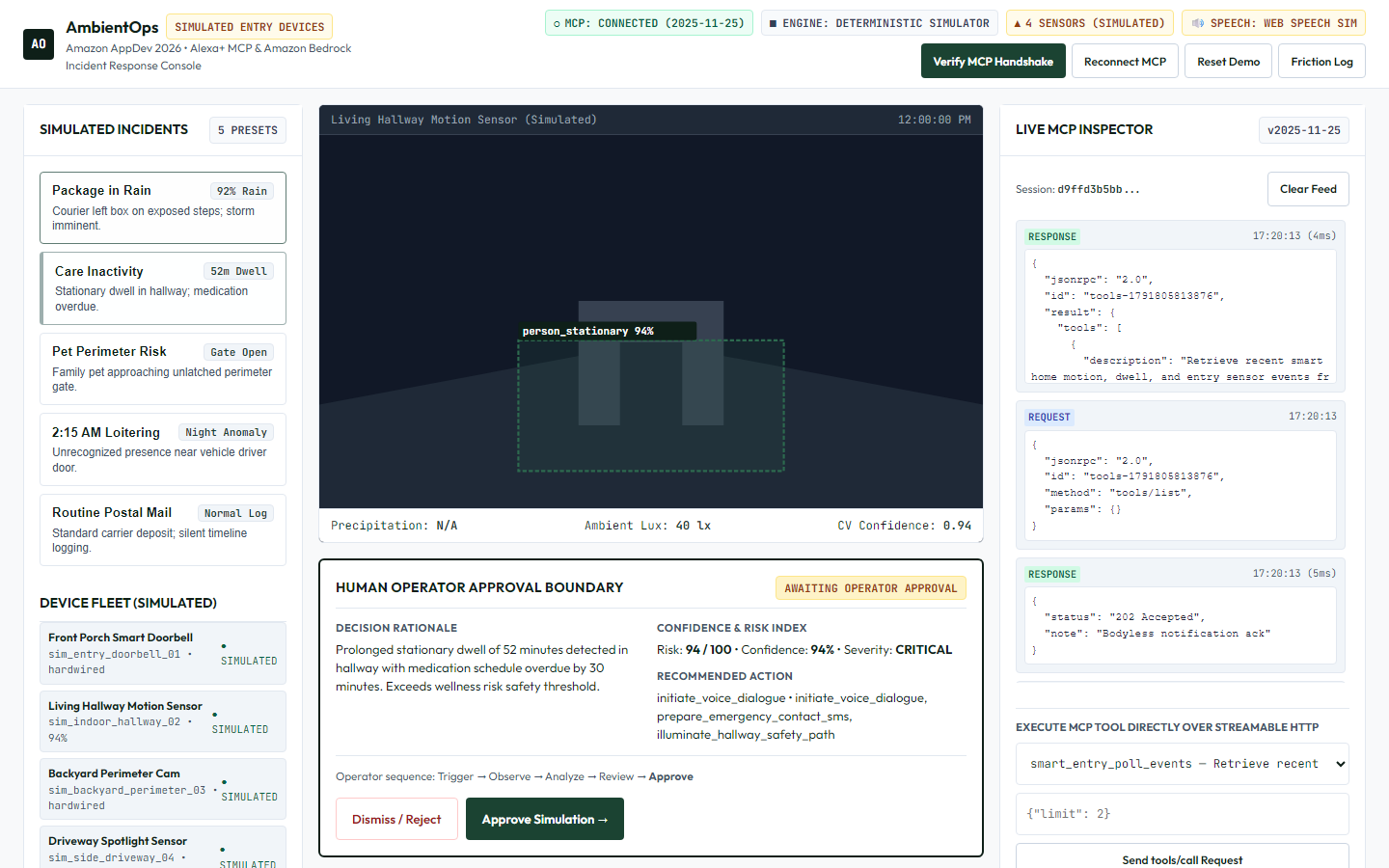
Care inactivity triage with critical-risk reasoning and next action
-
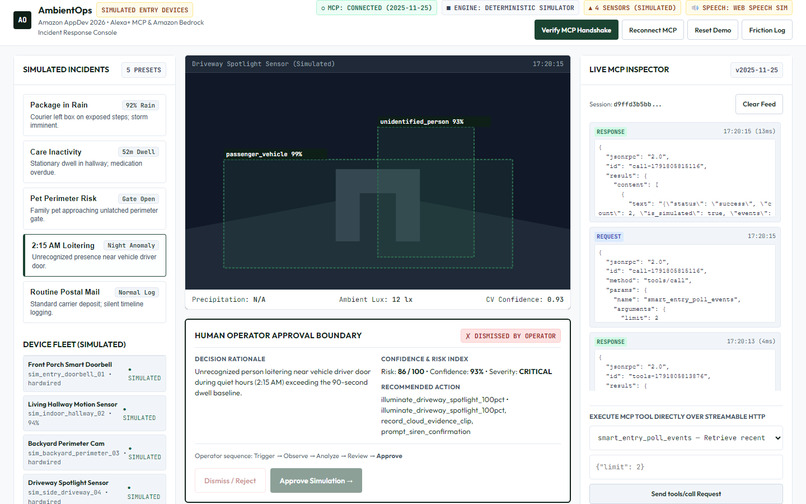
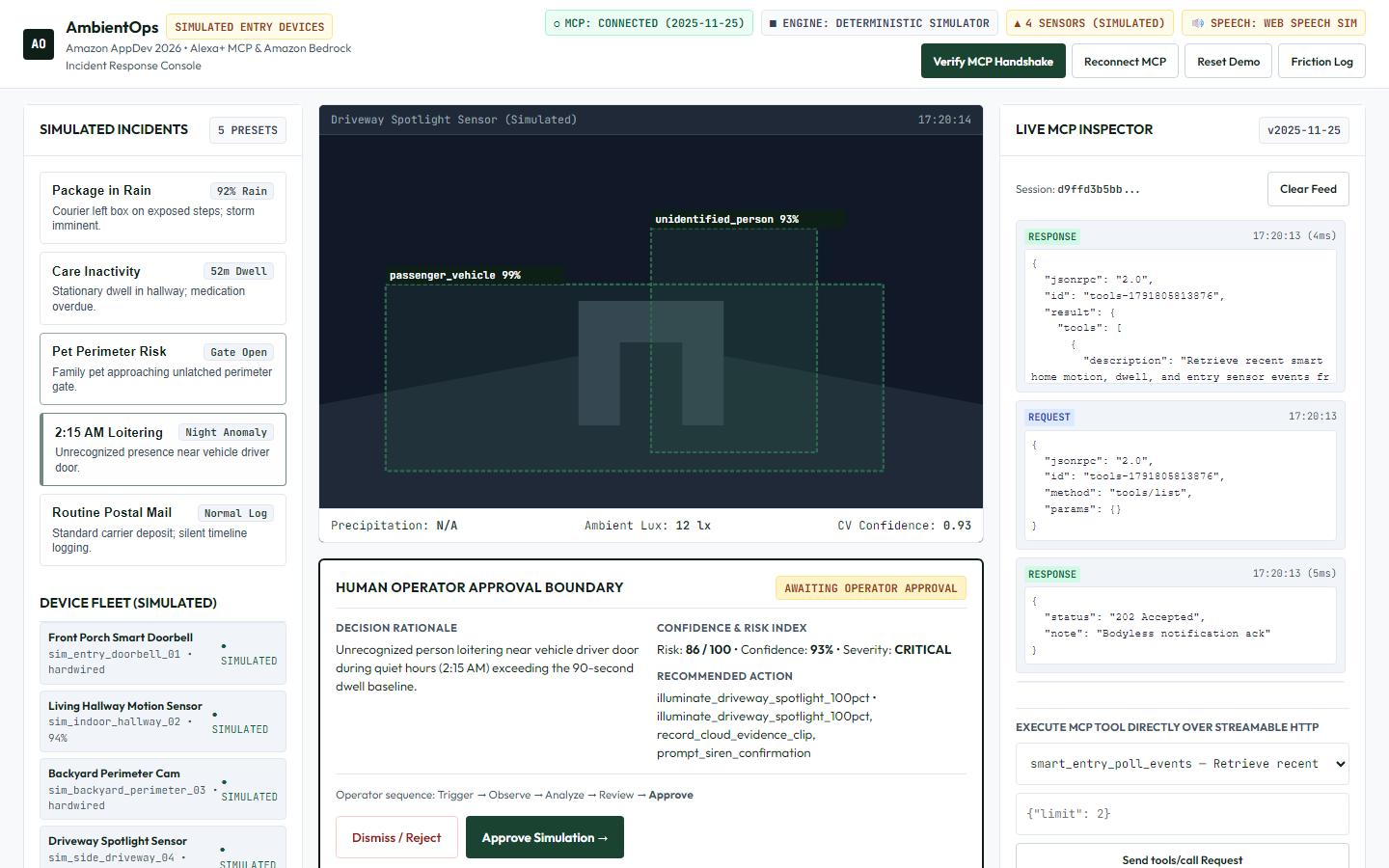
Live MCP protocol inspector showing real tool execution and responses
-
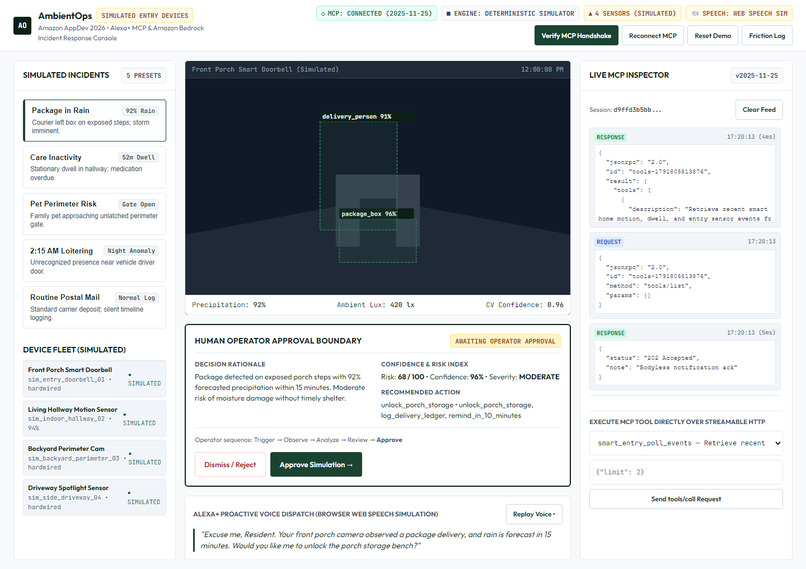
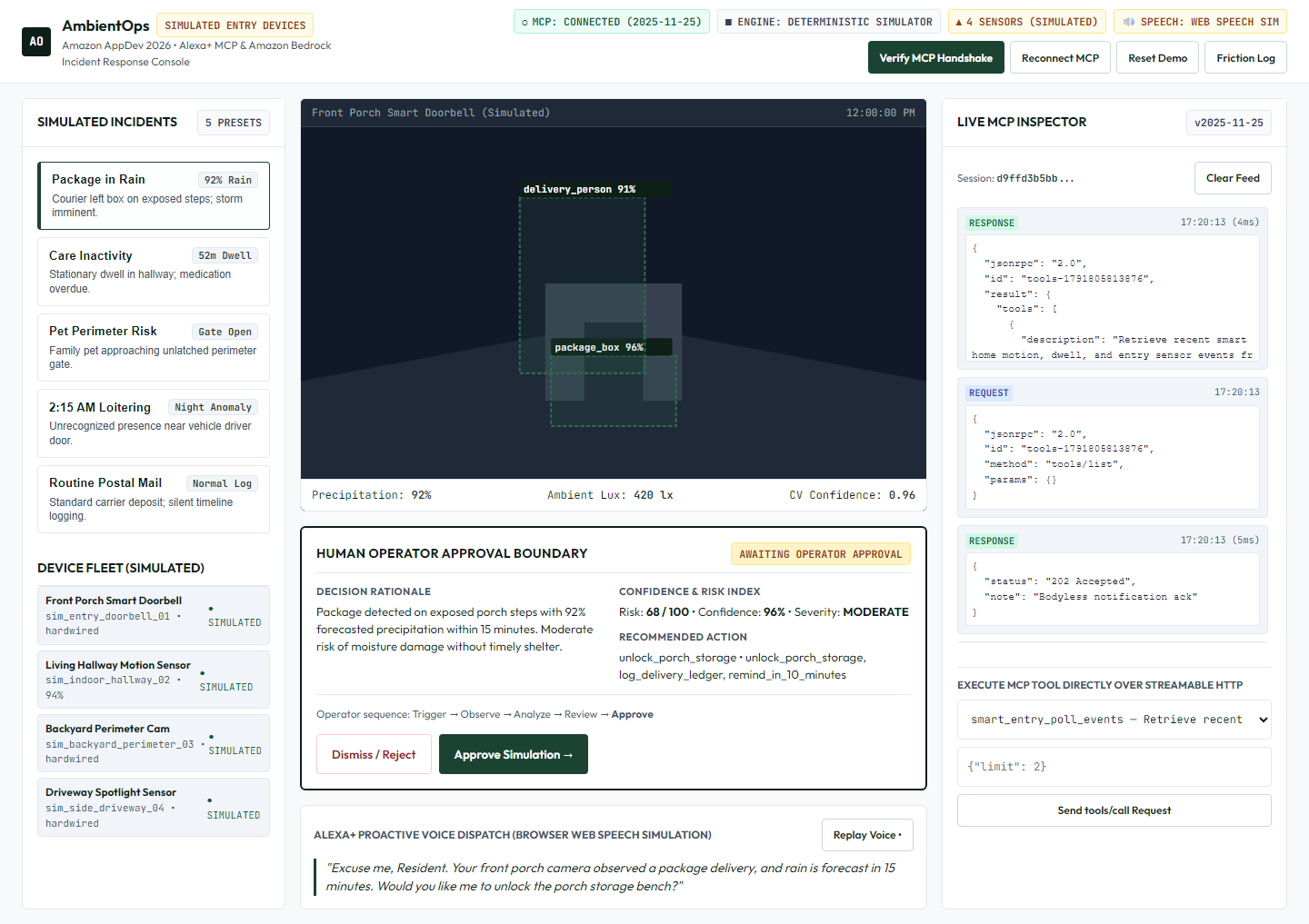
Calm Mission Control overview with evidence canvas and operator approval gate
-
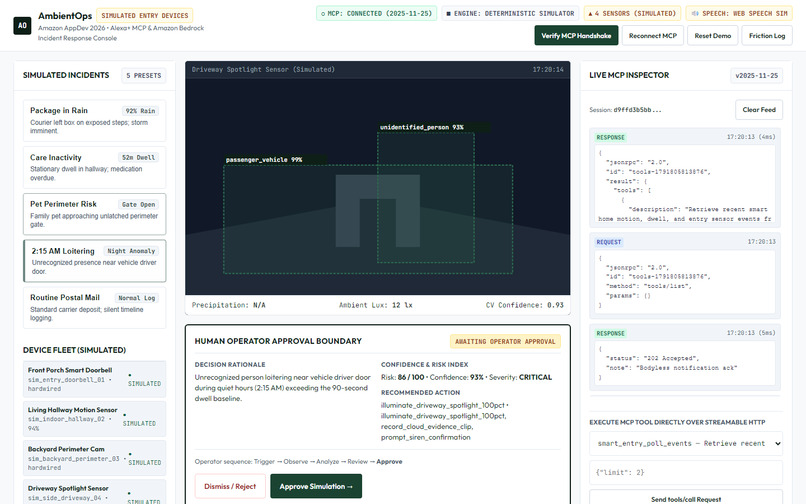
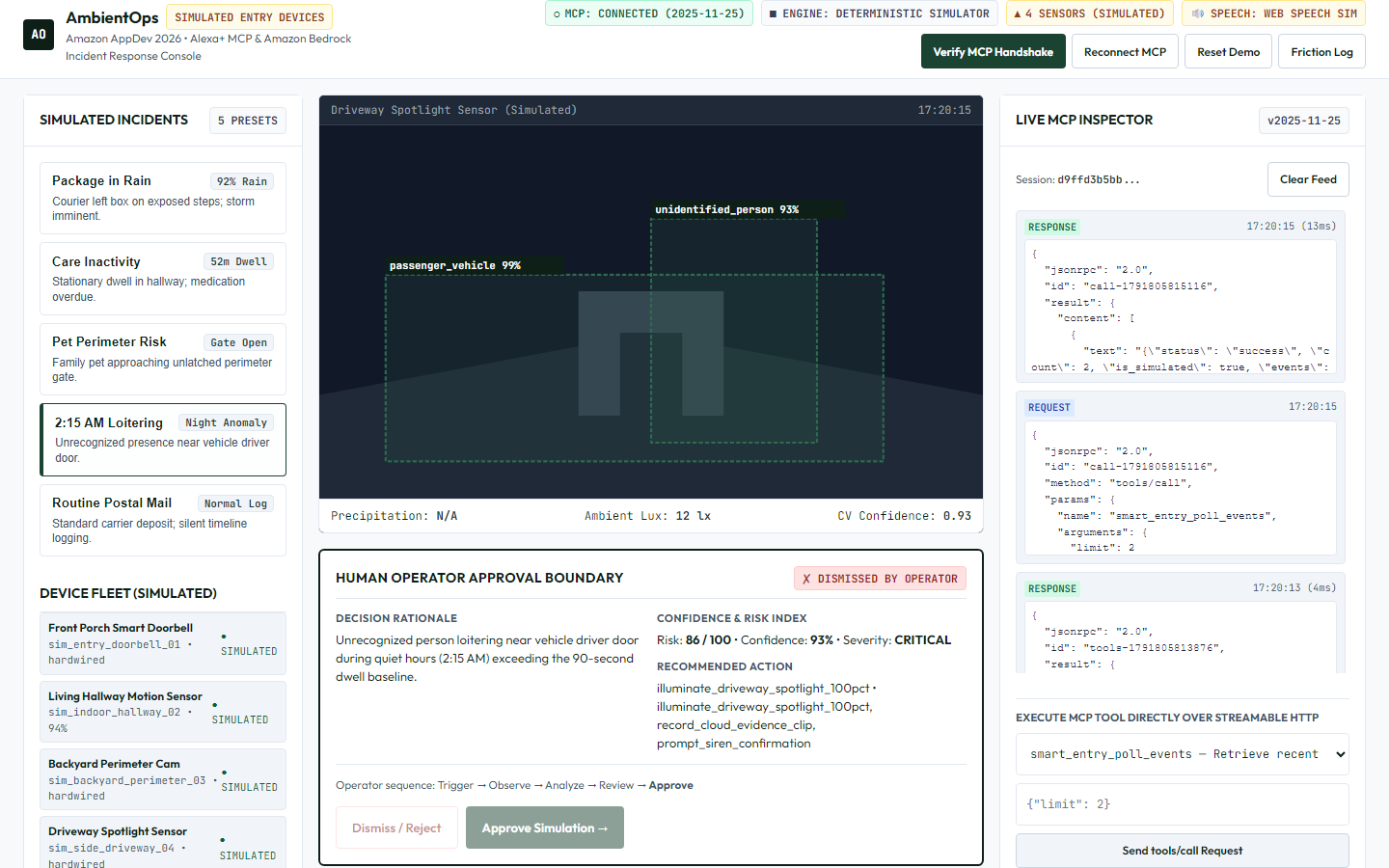
Night perimeter scenario with contextual lighting recommendation
Inspiration
Smart homes create notification fatigue: every motion event becomes another generic phone alert, even when context determines whether the right response is silence, a gentle voice prompt, or an urgent escalation. AmbientOps explores a calmer model for Alexa+: reason over structured household evidence, explain the recommendation, and require a human decision before any simulated action.
What it does
AmbientOps is an operator-in-the-loop incident-response console for Alexa+ and simulated smart-home sensors. It handles package-weather risk, care-recipient inactivity, pet escape, and night-perimeter scenarios.
- A deterministic simulator produces structured sensor evidence, including detections, confidence, weather, ambient light, and resident context.
- A triage layer uses Amazon Bedrock Converse when explicitly enabled, with a reproducible deterministic fallback used in the public demo.
- The console presents a risk score, decision rationale, and recommended response.
- Every household action stops at an explicit human approval boundary.
- Approved speech is demonstrated with the browser Web Speech API as an Alexa+ experience simulation, while outcomes are written to an auditable incident ledger.
- A live protocol inspector exposes the real MCP JSON-RPC exchange, including initialize, tools/list, and tools/call.
How we built it
The backend is FastAPI on Python 3.11 with the official MCP Python SDK. The self-hosted server implements MCP 2025-11-25 and canonical Streamable HTTP at /mcp, including Mcp-Session-Id, HTTP 202 notification semantics, JSON responses, and SSE frames. Five allowlisted tools cover event polling, scenario triggering, Bedrock triage, proactive voice dispatch, and approved action simulation.
The Bedrock adapter uses the Converse API with strict Pydantic schemas, PII scrubbing, bounded output, and explicit opt-in for live cloud calls. Default deterministic mode keeps judging reproducible. The responsive Calm Mission Control frontend uses semantic HTML, accessible keyboard interactions, and a high-contrast paper-and-forest visual system.
Challenges we ran into
The hardest protocol issue was supporting MCP Streamable HTTP across official Python clients and browser fetch: notifications require a bodyless HTTP 202 while requests may return JSON or SSE data frames. We also calibrated escalation so benign events remain quiet, actionable situations receive a concise voice suggestion, and no simulated physical remediation bypasses operator approval.
Accomplishments that we're proud of
- A real MCP 2025-11-25 Streamable HTTP implementation with five verified tools.
- A human approval boundary and allowlisted action state machine.
- 46 passing unit, integration, security, and Playwright tests with 87.5% statement coverage.
- Automated Axe checks with zero detected violations across mobile, tablet, and desktop viewports.
- A four-entry developer friction log in the requested seven-field format.
Potential impact
AmbientOps is designed for three concrete audiences: caregivers who need earlier, privacy-conscious awareness of unusual inactivity; busy households protecting deliveries, pets, and quiet hours; and property operators coordinating mixed sensor fleets without vendor lock-in. By escalating only when context makes action necessary, it can reduce alert fatigue while keeping high-risk events visible, explainable, and auditable.
Why it's different
Most smart-home automation maps one sensor threshold to one fixed action. AmbientOps reasons across structured evidence, explains why an intervention is recommended, exposes the complete MCP exchange, and stops at an explicit human approval boundary. That combination of open interoperability, calm interaction design, and operator control turns raw alerts into trustworthy incident response.
What we learned
Open protocols matter most when combined with safe interaction design. MCP makes tool discovery and orchestration composable, while calm technology and explicit approval make ambient AI understandable and trustworthy in the home.
What's next
Next steps include OAuth2 device authorization, physical smart-home integrations, production Alexa+ deployment, and richer privacy-preserving dwell telemetry for care scenarios.
Honest simulation disclosure
Smart sensors and household actions are simulated. Alexa voice output uses browser speech synthesis; no physical Echo endpoint is claimed. The public video uses deterministic triage and labels it as simulated. Amazon Bedrock Converse integration is implemented behind explicit opt-in with a live verification script.


Log in or sign up for Devpost to join the conversation.