## Inspiration
Doctor burnout is a critical issue in modern healthcare, with studies showing that physicians can spend up to two hours on administrative tasks for every one hour of direct patient care. A significant portion of this time is consumed by manual data entry into Electronic Health Records (EHRs). We were inspired by the Aether-Tech Hackathon's mission to automate healthcare workflows. Our goal was to build a tool that gives doctors back their most valuable resource—time—allowing them to focus on what truly matters: their patients.
## What it does
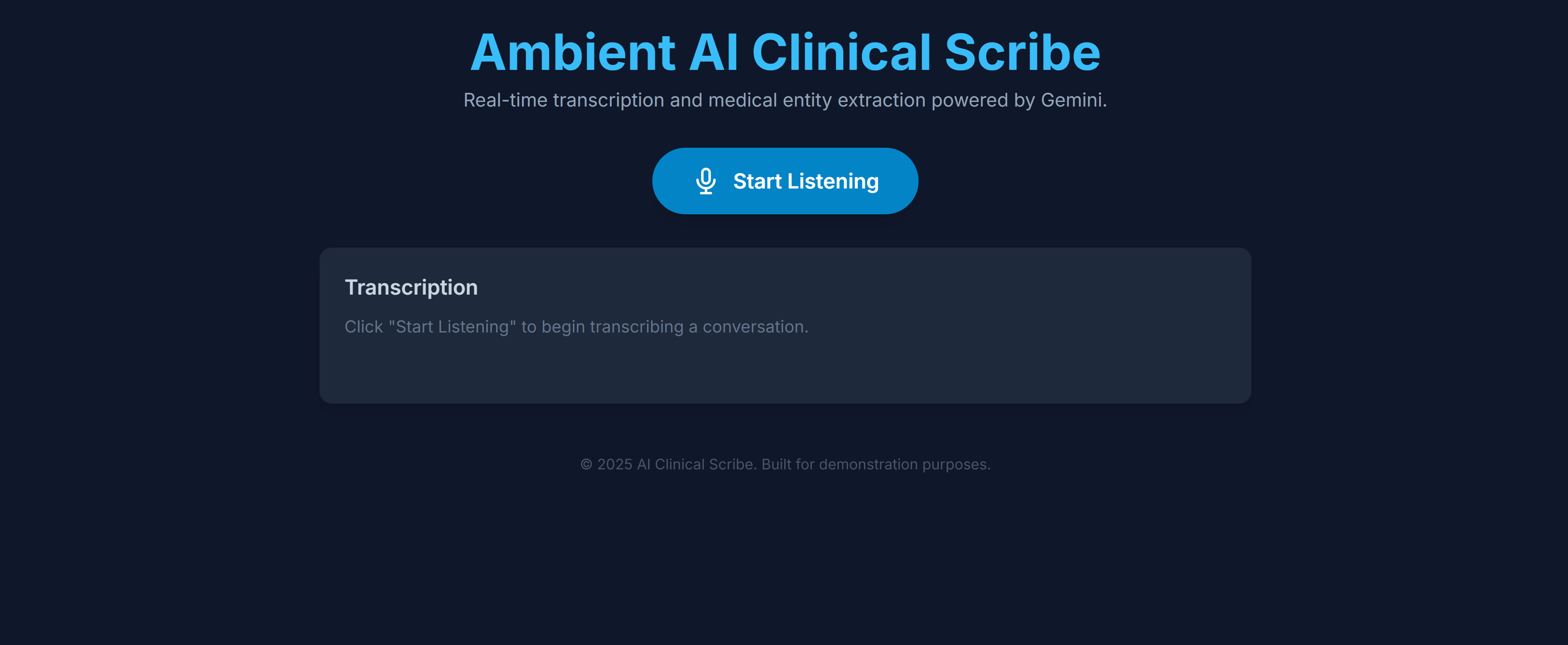
Ambient AI Clinical Scribe is an intelligent assistant that listens to natural doctor-patient conversations and automatically generates structured clinical notes.
Here's the workflow:
- A doctor clicks "Start" at the beginning of a patient consultation.
- The application uses the device's microphone to capture the conversation and transcribes it in real-time.
- Once the conversation ends, the complete transcript is sent to our AI backend.
- The backend uses a specialized Natural Language Processing (NLP) model to identify and extract key medical entities like symptoms, diagnoses, medications, and treatments.
- Within seconds, the extracted information is organized and displayed in a clean, structured "Mock EHR" form, ready for the doctor's quick review and approval.
It transforms a tedious, multi-minute data entry task into an effortless, automated process.
## How we built it
We built this project using a modern, decoupled architecture to ensure scalability and maintainability.
Frontend: The user interface was built with Next.js and TypeScript, leveraging the App Router for a fast, modern web experience. We used the browser's built-in Web Speech API for live voice transcription, which eliminated the need for heavy client-side libraries. The UI was styled with Tailwind CSS for a clean and professional look.
Backend: The backend logic is powered by a lightweight Python server using the Flask framework. We chose Flask for its simplicity and speed in creating a robust API endpoint to handle our AI processing.
AI & NLP Core: This is the heart of our application. The Python backend sends the transcribed text to the Hugging Face Inference API to run Named Entity Recognition (NER). We specifically chose the
d4data/biomedical-ner-allmodel, a transformer fine-tuned on biomedical data, for its high accuracy in identifying clinical terms. The backend then parses the model's output and structures it into a user-friendly JSON format for the frontend.
## Challenges we ran into
Transcription Accuracy: The built-in browser speech recognition can be sensitive to accents, medical jargon, and background noise. We had to engineer a solution to wait for the final, most stable transcript before sending it to the backend to ensure the highest quality input for our AI model.
Structuring Unstructured Data: The raw output from the NER model is simply a list of labeled entities. A key challenge was to write backend logic that could intelligently parse this list and group related entities into clinically meaningful categories (e.g., distinguishing a "Sign_symptom" from a "Diagnosis").
Real-time Responsiveness: Ensuring a seamless user experience required optimizing the communication between the frontend and backend. We worked to minimize latency so that the structured notes would appear almost instantly after the conversation ended.
## Accomplishments that we're proud of
A Fully Functional End-to-End Prototype: In a short timeframe, we successfully built a complete, working application that demonstrates the entire workflow from live speech to a structured, AI-generated clinical note.
Harnessing State-of-the-Art AI: We are proud of successfully integrating a powerful, specialized transformer model to solve a complex, real-world problem. It proves the immense potential of using targeted AI in clinical settings.
An Intuitive and Simple UI: We designed the application to be incredibly simple to use. With just a single click to start and stop, it requires virtually no training for a doctor to adopt into their workflow.
## What we learned
The Power of Domain-Specific Models: We learned that using a model fine-tuned for a specific domain (like biomedical text) provides vastly superior results compared to general-purpose NLP models.
Modern Full-Stack Architecture: We gained valuable hands-on experience in architecting a modern AI application with a decoupled frontend (Next.js) and backend (Python), which is a robust pattern for building scalable services.
Leveraging Browser APIs: We were impressed with the capabilities of modern browser APIs like the Web Speech API, which enabled us to build a core feature of our application efficiently.
## What's next for Ambient AI Clinical Scribe
We see this hackathon project as a strong foundation for a production-ready product. Our roadmap includes:
Direct EHR Integration: Develop secure API integrations with major EHR systems like Epic, Cerner, and Allscripts to allow doctors to commit the AI-generated notes directly to a patient's chart with one click.
Model Fine-Tuning & Customization: Fine-tune our own NER model on custom datasets to improve its accuracy for specific medical specialties (e.g., cardiology, pediatrics) and to recognize doctor-specific phrases and shorthand.
HIPAA-Compliant Deployment: Architect and deploy the application in a secure, HIPAA-compliant cloud environment to ensure patient data privacy and security.
Adding Diarization: Enhance the system to distinguish between different speakers (doctor vs. patient), which would allow for even richer and more context-aware note generation.
Built With
- css3
- gemini
- html5
- javascript
- next
- react
- tailwindcss
- typescript
