Inspiration
We started with a simple question:
Why do we think of a room as something static?
A space can be a living room today, a movie room tomorrow, and a dinner or event space the next day. But most people are limited by what they can currently see in front of them.
The problem isn't always the space itself. It's the lack of imagination, design knowledge, and tools to see what it could become.
We wanted to change that.
People already have strong cultural tastes. They know the movies they love, the music they listen to, the places they visit, and the aesthetics they connect with. But translating that taste into a physical space usually requires expensive design expertise.
That led us to Ambience Architect: an agent that understands both the person and the space, using Qloo's cultural intelligence to turn personal taste into new possibilities for physical environments.
What it does
Ambience Architect lets you give an AI agent a space, describe what you want to use it for, and tell it what you love.
The agent uses Qloo to understand the cultural relationships behind your taste, then translates those signals into a personalized spatial concept.
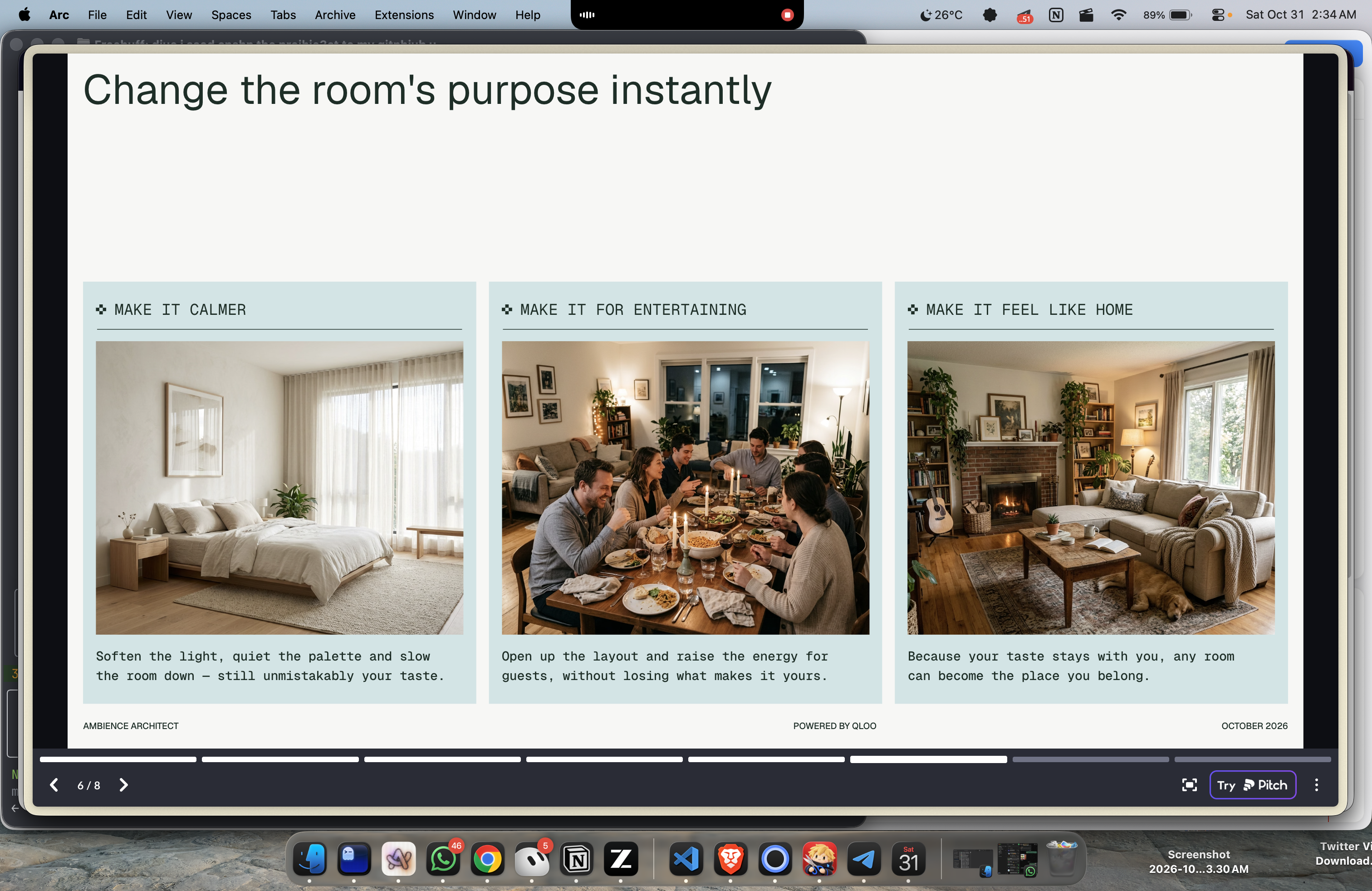
A room doesn't have to stay one thing.
Ambience Architect can help you explore the same space as:
- a movie setting
- a dinner setting
- a workspace
- a social gathering
- an event space
- or whatever experience you want to create
Instead of asking users to understand interior-design terminology, we let them start with what they already understand: their own taste.
How we built it
Ambience Architect combines an agentic workflow with Qloo's cultural intelligence.
The agent takes three main inputs:
The space — what the room currently looks like.
The taste — the movies, music, places, styles, and cultural references the user loves.
The experience — what the user wants the space to become.
Qloo provides the cultural layer, helping the agent understand relationships between the user's references across different cultural domains. The agent then translates those insights into spatial decisions and a new vision for the environment.
The core flow is:
Space + Taste + Intent → Qloo → Cultural Profile → Spatial Design
The important distinction is that Qloo isn't being used simply to generate a recommendation. It provides the cultural grounding that allows Ambience Architect to personalize the design around the individual.
This directly aligns with the Qloo hackathon's goal of building agents that are culturally grounded rather than relying only on generic LLM reasoning.
Challenges we ran into
The biggest challenge was making cultural taste useful outside of the domains where it normally exists.
Qloo can help us understand that certain movies, artists, places, brands, and aesthetics are related. But it doesn't directly tell us how many lights a room needs or what furniture to buy.
We had to build the translation layer between:
cultural preference → aesthetic signals → spatial decisions.
We also had to make sure the agent didn't simply generate a beautiful room. The result needed to feel connected to the person who requested it.
Accomplishments that we're proud of
We're proud that Ambience Architect changes the way we think about personalization in physical spaces.
Instead of starting with:
“What style of room do you want?”
we start with:
“What do you love?”
We also built the concept around a real-world problem with multiple audiences: homeowners, renters, real-estate professionals, interior designers, hospitality teams, and event spaces.
Most importantly, Qloo isn't decorative to the product. Cultural intelligence is part of the core transformation that makes the experience possible. That's important because the hackathon explicitly evaluates how deeply Qloo is used and whether the product would meaningfully work without it.
What we learned
We learned that personalization becomes much more powerful when you stop asking people to describe what they want in technical terms.
People may not know that they want “warm indirect lighting with low visual contrast.”
But they know they love late-night jazz, Japanese minimalism, or Blade Runner 2049.
Those cultural references can become a much more natural language for designing experiences.
We also learned that a physical space doesn't have to be treated as a fixed object.
The same room can become many different experiences depending on the person, the moment, and the intent.
What's next for Ambience Architect
Our next step is to move from visualizing possibilities to helping people actually create them.
That means connecting the generated designs to:
- real furniture and lighting
- smart-home systems
- renovation planning
- real-estate listings
- interior-design workflows
- hospitality and event management
Long term, Ambience Architect becomes a cultural intelligence layer for physical spaces:
understand the person → understand the space → understand the experience → transform the space.
Built With
- qlooo
- typescript

Log in or sign up for Devpost to join the conversation.