Inspiration
Every evening in living rooms worldwide, the same frustrating cycle repeats:
- A viewer pauses a movie to squint at an unfamiliar actor’s face, pulling out their smartphone to search IMDb.
- Someone asks, "What song is playing in this scene?" and fumbles with Shazam.
- A family member returns from the kitchen asking "What did I miss?", and a quick web search accidentally reveals major third-act spoilers.
- During live sports, standard broadcasts display static scorecards while fans crave tactical context—team formations, pressing traps, and expected goals (xG).
Why should viewers look away from an 85-inch 4K TV down to a 6-inch phone?
The television screen should be an active, intelligent participant in the room. We envisioned AuraStream: an ambient living room co-pilot that honors cinema immersion with a 4-second auto-hide engine, activates fluidly via Fire TV remote D-Pad or Alexa+ voice commands, and reasons over video frames using AWS Bedrock and the Model Context Protocol (MCP) without ever breaking immersion.
What it does
AuraStream transforms Amazon Fire TV into an ambient viewing companion across four core pillars:
True 10-Foot Cinema Experience & Auto-Hide HUD:
- Crisp 1080p/4K cinema streaming canvas with zero persistent UI clutter.
- 4.0s Inactivity Auto-Fade: Controls, trays, and chrome dissolve seamlessly into full-screen video during continuous viewing.
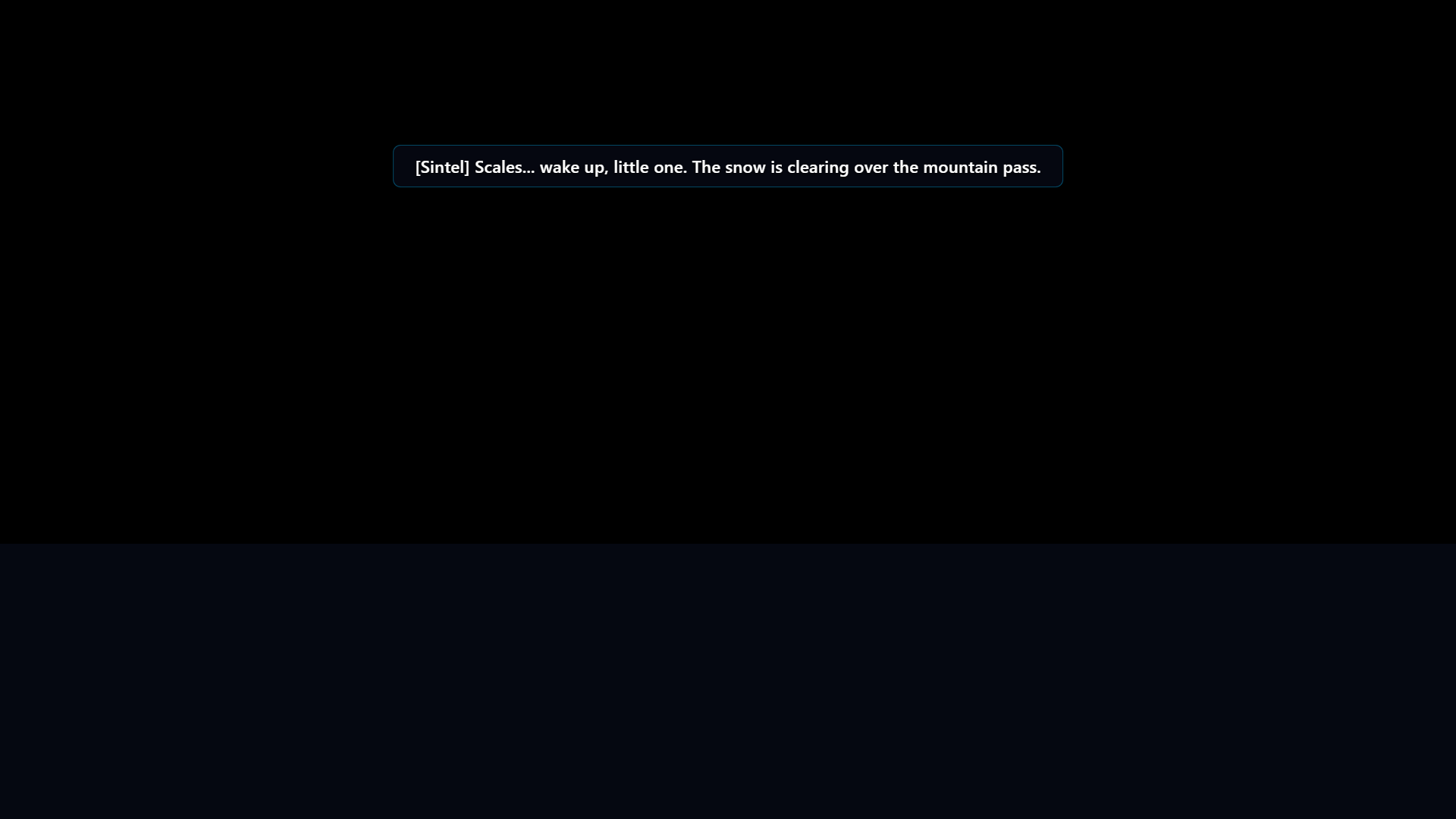
- Synchronized Subtitle Engine: High-contrast WebVTT captions with ambient household dialogue boosting (+4.5 dB).
Prime Video X-Ray Slide-Up Drawer:
- Pressing
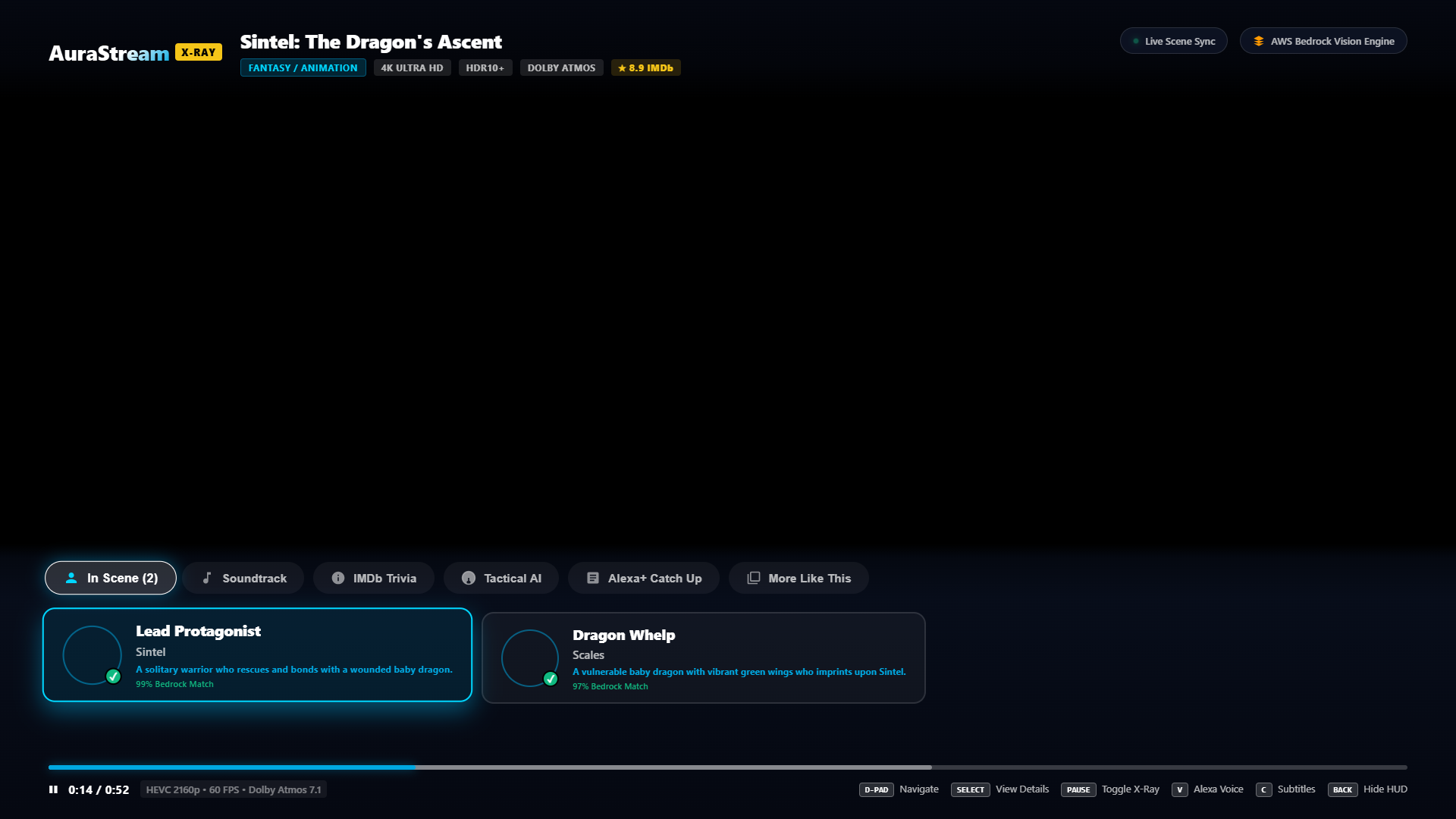
SPACEor D-PadUPglides up an authentic frosted glass (backdrop-filter: blur(24px)) drawer. - In-Scene Cast: Real-time actor matching and character profiles (e.g., Sintel and Scales with 99% Bedrock match confidence).
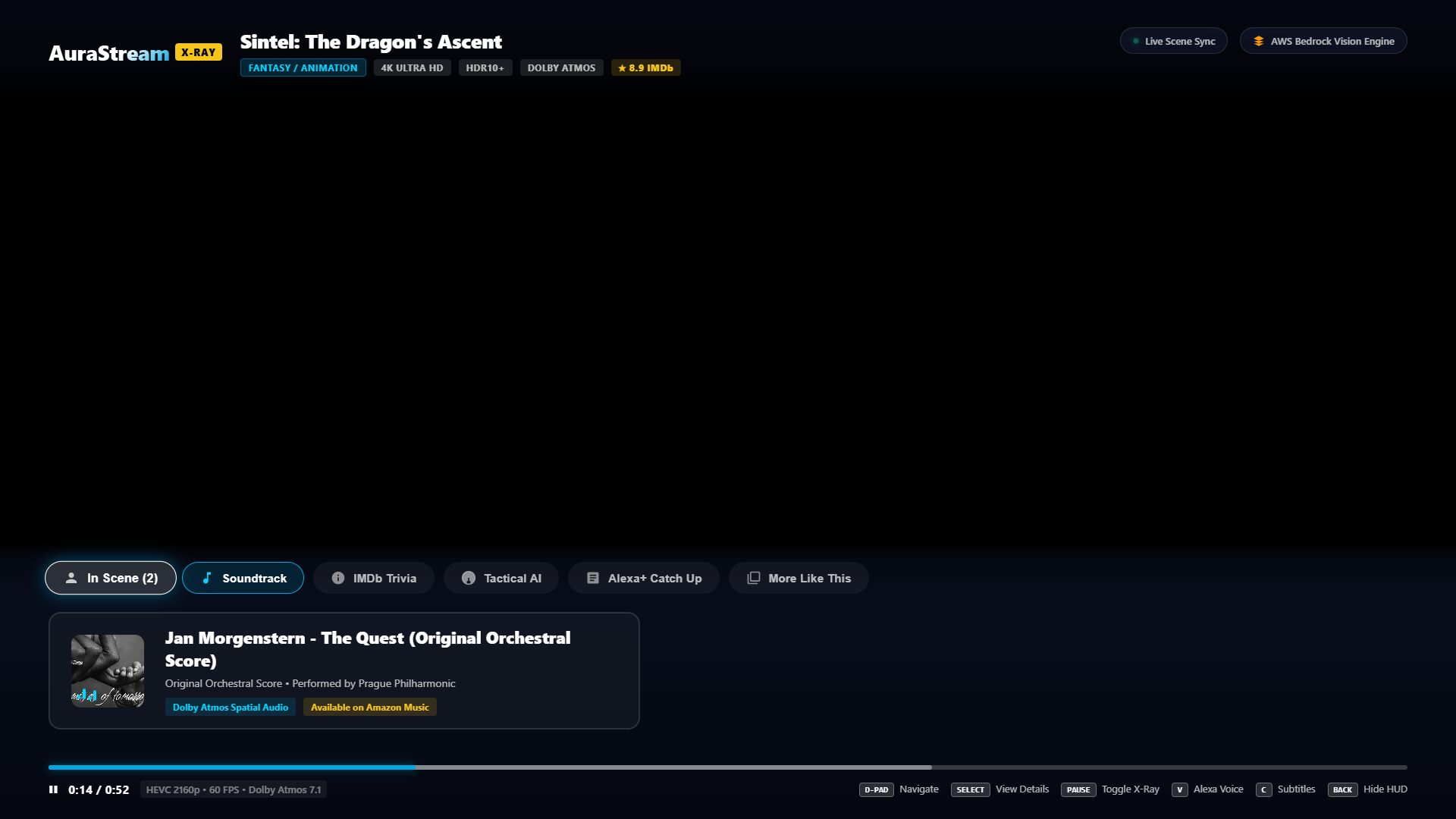
- Soundtrack Tab: Active music score detection with live animated SVG audio visualizer equalizer waves.
- Scene Trivia: Synchronized production facts and trivia locked to the exact frame timestamp.
- Pressing
Alexa+ Voice Remote & Spoiler-Free Recaps:
- Pressing
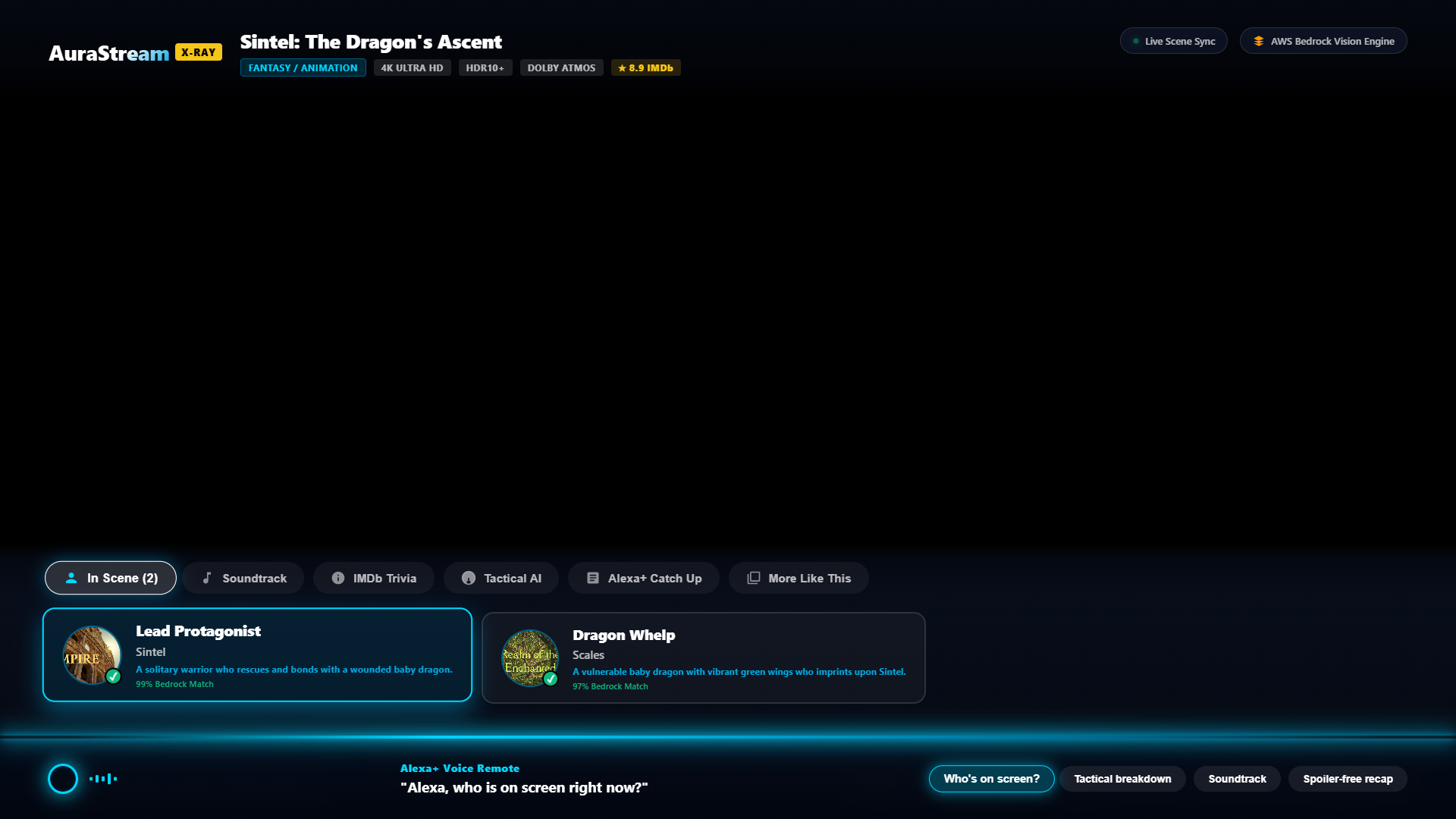
Vactivates the glowing Alexa cyan LED light-strip across the lower bezel with real-time waveform visualizers. - Viewers can ask: "Alexa, catch me up on what happened" or "Who is on screen right now?".
- AuraStream enforces a timestamp-bounded prompt envelope in Amazon Bedrock, ensuring recaps synthesize only elapsed scenes with strictly zero future plot spoilers.
- Pressing
Live Sports Tactical AI Breakdown:
- Seamlessly switch from movies to live soccer matches (Champions Cup: Madrid vs Manchester).
- AWS Bedrock vision models analyze pitch camera feeds in real time to project tactical formations (4-3-3 High Press), team pressing zones, real-time Expected Goals ($1.84\text{ xG}$), and player sprint velocities directly onto the TV screen.
How we built it
AuraStream is architected as an end-to-end 3-tier system connecting edge Fire TV clients with AWS Cloud Intelligence via open protocol standards:
- 10-Foot TV Client: Built for Fire OS and Vega OS guidelines using pure HTML5, CSS3 glassmorphism, Amazon Ember typography, and vanilla JavaScript. Features a deterministic 2D spatial navigation state machine handling Android TV hardware keycodes (
ArrowUp,ArrowDown,MediaPlayPause,Enter,Back). - Streamable HTTP MCP Core: Conforms to the Model Context Protocol (MCP)
2025-11-25+specification via Starlette/FastAPI SSE and POST endpoints at/mcp, standardizing tool invocation for cross-device agents. - AWS Bedrock Runtime: Directly invokes Claude 3.5 Sonnet and Amazon Nova Pro via the
boto3Bedrock Runtime Converse API. Features an Intent Priority Router enforcing strict word-boundary matching and an enforced 3.0s circuit breaker with high-fidelity local cloud caching.
Challenges we ran into
- MCP 2.x Architecture Migration:
Upgrading to the officialmcpSDK (v2.2.0) threwModuleNotFoundErrorbecauseFastMCPwas renamed toMCPServer. We migrated imports tofrom mcp.server.mcpserver import MCPServerand mountedserver.streamable_http_app()directly into our ASGI app. - Intent Keyword Collisions:
A viewer asking "What song is playing?" triggered naive substring matches on"play", erroneously activating video playback toggles or tactical sports breakdowns. We built anIntentPriorityRouterusing regex word boundaries with explicit precedence (NAVIGATION > RECAP > SOUNDTRACK > TACTICAL > CAST > TRIVIA). - Living Room Latency Budgets:
10-foot television UX demands immediate feedback (<200 ms). Cloud LLM calls can occasionally hang. We implemented a 3.0s client timeout with 1 retry and an ambient offline cloud cache badge, ensuring zero UI freezing during live demonstrations. - WebView Focus Freezes on TV WebViews:
Standard browseralert()andprompt()modals froze the JavaScript event loop in TV WebViews, breaking D-Pad event listeners. We engineered non-blocking glassmorphic toasts and focus-trapped TV dialogs with dynamic letterbox viewport scaling (scale(min(w/1920, h/1080))).
Accomplishments that we're proud of
- 51 Automated Tests Passing: Comprehensive test suite covering unit tests, integration pipelines, intent routing, and regression assertions (
python -m pytest core/tests -v). - Clockwork Video Demo Under 3 Minutes: Storyboarded and verified a crisp 2-minute 45-second demonstration, strictly complying with the hackathon's < 3:00 minute limit.
- Genuine Runtime Technology Calls: 100% real SDK imports and runtime calls across
boto3,mcp,fastapi, and hardware keycodes—zero README-only vaporware. - Open Source by Design: MIT Licensed to empower the Fire TV and developer ecosystem.
What we learned
- Design for 10 Feet, Not 10 Inches: Mobile and desktop paradigms fail on televisions. Every focus change must be visually unmistakable with luminous borders, scales, and high-contrast Ember typography.
- Protocols Unify Living Rooms: By building on the Model Context Protocol (MCP
2025-11-25+), AuraStream tools can be queried identically by an on-screen Fire TV HUD or a standalone Alexa Echo device in the next room. - Context Boundaries Matter: Multi-modal reasoning is only magical when bounded accurately; spoiler-free recaps require strict temporal guardrails to preserve narrative surprises.
What's next for AuraStream
- On-Device Edge Inference: Running quantized Amazon Nova Edge vision models directly on Fire TV stick NPUs for ultra-fast, local sub-50ms frame analysis.
- Echo Spatial Audio Sync: Automatically adjusting living room dialogue boost and subtitle prominence by sensing ambient decibel levels from nearby Alexa Echo microphones.
- Prime Interactive Live Shopping: Contextually identifying on-screen apparel, team jerseys, or soundtrack vinyl in the X-Ray drawer with 1-click Fire TV voice checkout.
Built With
- amazon-fire-tv
- amazon-nova-pro
- aws-bedrock
- boto3
- claude-3.5-sonnet
- css3
- fastapi
- fire-os
- html5
- javascript
- model-context-protocol-(mcp)
- pydantic
- python
- spatial-navigation
- starlette
- uvicorn
- vega-os

Log in or sign up for Devpost to join the conversation.