Inspiration
During COVID-19 pandemic a significant number of businesses moved from physical markets to online platforms. Right now the amount of online presence is increasing and it’s getting harder to prevent IP crime due to the sheer amount of new businesses and influencers that have appeared in the last couple of years. Recent IP Crime and Enforcement report 2020-2021 showed that the entertainment industry still has some issues with IP infringement - around 20 percent of IP infringement is seen in music and film industries. Some reports showed that 83 percent of UK adults pirated music just because of a lack of paid options. Other reports showed that the global movie industry’s revenue losses from digital piracy are between 40 and 97.1 billion dollars per year (GIPC, NERA Economic Consulting). It is clear that we have a huge problem with IP infringement, but we still lack effective solutions. In order to prevent IP crime we need to find more effective ways to protect IP, educate consumers about Fair IP use and make it easier for businesses and creatives to connect with original IP holders.
With the recent hype around NFTs, web3 and blockchain, a lot of startups tried to apply these new technologies to solve IP infringement, but it is still too early to tell if some of them will be able to significantly change those industries who struggle to reduce their IP crime. Some of the examples of NFTs applied to the film industry are the Matrix universe, Godzilla vs Kong, Pulp fiction NTF series and many others. But those are just some examples of NFTs, we need a place where it can be done easily on a large scale and it will be legally binding between IP holders and businesses/creatives.
Imagine ordering a feast straight from the Game of Thrones directly to your house party or you are making a movie night for the Bridgerton and you want to impress your friend with some dishes made with the exact same recipes from this show. For the fan community those details might be priceless. With the platform we are developing businesses will have a possibility to provide those experiences without breaking the IP law and their customers will have a chance to immerse themselves further in their favorite universe.
What it does
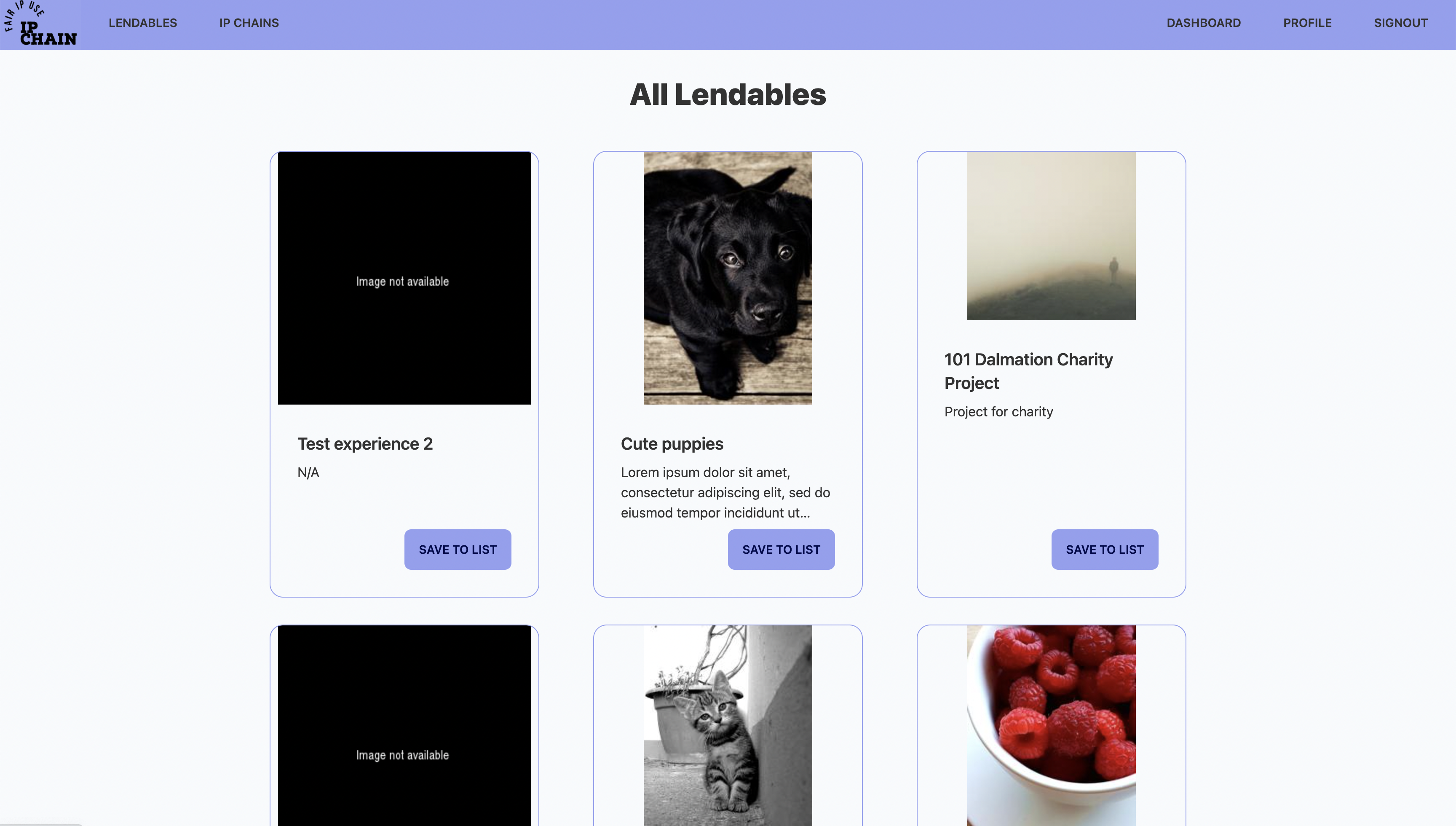
We wanted to create a place to connect original IP holders with businesses and influencers who would like to build experiences on top of their IP to reach a wider audience and help original IP holders to market their IP. Current solutions are quite costly and require a lot of time to find right people to connect with, especially in the film industry - sometimes it could take several months before you will be able to set up a first meeting and get to some agreement on how to use the IP. Our solution will make this process simpler and safer using web3 technologies. With our platform film studios no longer need to worry about IP infringement - they can simply turn their IP into NFTs, upload it to our NFT pool where customers/local businesses/restaurants/shops can use this IP to market their content to a wider audience. Those businesses, who will sign up with our platform, will have a special mark of Fair IP use, so their customers can be sure that their business is legitimate and they are not breaking any IP law. In this case we can encourage fair use of IP. It will be as simple as playing with lego blocks and it will help increase creativity without IP infringement. The companies who would like to borrow NFTs from the original IP holders will be able to subscribe to our platform where they can get access to the NFT pool. By choosing a certain number of NFTs they will be able to use them for a month in order to understand the engagement from the fans. Don’t think that NFTs are just some funny pictures that you don’t really know how to use after purchasing them. Our idea is proof that there is more to it and it is one of the ways to solve IP theft.
How we built it
Keeping to the principles of KISS, we kept the backend implementation light and used neon-js to communicate directly with the Neo ecosystem and kept most of the business logic in the frontend. We also used Firebase as a storage of the blockchain contents, to aid with things like search functionality.
Challenges we ran into
One of the issues we ran into was the submission deadline - on the major page it was written that the deadline was at 9pm CST on 9th of May, which is 3am GMT on 10th of May. But when we tried to submit it during the evening in London, UK on 9th of May (having several hours before the original deadline) - we were not able to do that. Please see the attached screenshot from the page with the deadline information. On the technical side, we had issues using the technology as we found the documentation lacking compared to the other Web3 alternatives in the ecosystem. On the plus side, the demos/examples were working and very thorough, so we figured out a few problems from that.
Another technical issue is related to the management of accounts. There was no quick and easy solution to integrate the Neo blockchain into a web application without making compromises on security. I think the ecosystem could really benefit from a more user friendly approach to managing the wallet that would not rely on a desktop application.
The Neo ecosystem is very diverse and has plenty of functionality to help developers get a head start on Web3. However documentation doesn’t quite match the standards that developers would expect for any Web3 project these days, which made it difficult to get started on.
Accomplishments that we're proud of
We were able to reach out to some major players in the film industry and local businesses to prove that the problem we are trying to solve is legit, giving us a green light to go forward.
We also managed to put together a prototype of the idea in a short time. We’ve only collectively worked on the project for about 3 working days over the last few weeks because of other engagements, so we were proud of our achievements nonetheless.
What we learned
The main difficulty we had was approaching some of the original IP holders and some businesses in order to find out if the problem we are trying to solve is real. During our original research in the film industry we found out that there are a number of startups and businesses (such as tour agencies) that are using IP from some major film studios without sharing their profit with them. When we had a call with EON productions and raised this issue by showing some James Bond tours which were more than £1000, they realized that they don’t have any connections to those companies and these companies are using their IP just for their own profit. From another perspective from businesses - we spoke with some restaurant owners who would consider creating some additional experiences just because some movies were filmed in their restaurant. This is why we realized that our solution will find its market.
Coming up with a satisfactory solution to the legal problem has been fun technically, but from experience it’s not always as simple as it appears. In the future we will need to seek professional legal help to address this problem.
What's next for Amata World IP-Chain
The next steps will be:
- Finish up the blockchain implementation end-to-end, there were a few parts that were cut short due to time constraints
- Work on a user-friendly onboarding step that is secure and easy to manage. Our target audience are not likely to be tech savvy enough to manage private keys securely. We will likely need to rely on a custodial wallet type service to provide this kind of experience.
- Legal consultations to understand if this system will solve the current IP issues
- Building it into our startup, Amata World, to manage IP for our customers
- Fundraising to build a team around this product
- Getting agreements with first film studios as our early adopters
- Marketing our solution to a wider audience


Log in or sign up for Devpost to join the conversation.