Inspiration
As young Kenyans, we have witnessed firsthand how quickly social and political tensions can escalate into violence, leaving communities fractured and economies damaged. The recent anti-tax protests served as a powerful and painful reminder of this reality. We saw authorities consistently in a reactive mode, responding with force when it was already too late, rather than with dialogue when it was most needed. Crucially, we recognized that in times of chaos, the most vulnerable suffer the most. Instability creates a shadow crisis of Gender-Based Violence (GBV), which often goes unreported and unaddressed. This inspired us to ask a more profound question: "What if we could not only predict chaos, but also predict its hidden impacts?" This drove us to create Amani Intelligence, a project born from the desire to build a system that protects everyone, especially those most at risk.
What it does
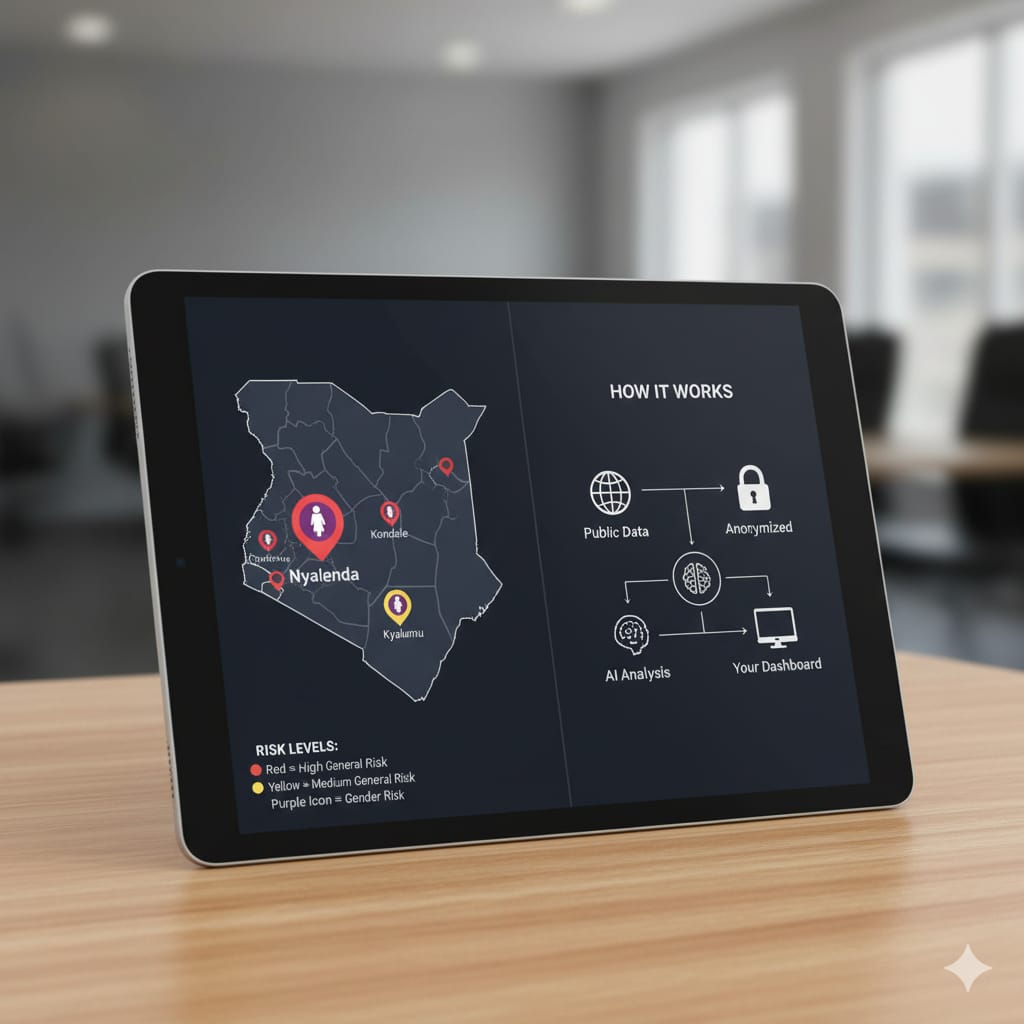
Amani Intelligence is an AI-powered, early-warning system designed to prevent conflict and protect vulnerable populations by providing an integrated view of public unrest and associated GBV threats. Our system works in a clear, three-step process:
- Analyzes Tensions: It continuously and anonymously monitors public data (news, social media, blogs) to detect rising tensions. Our model is uniquely trained on English, Swahili, and Sheng and other local language to capture the authentic voice of all communities.
- Provides Integrated Insights: It presents this data on an interactive dashboard. The core feature is an "Integrated Threat Report" for each locality, which analyzes two interconnected layers: 📢 General Chaos Risk: The likelihood of protests, crime, or general unrest. 🚺 Gender-Based Violence (GBV) Risk: This module specifically identifies indicators of increased risk to women and girls. It detects spikes in online misogyny, threats against female leaders, and chatter about unsafe public spaces that are known to correlate with rising GBV incidents.
- Enables Targeted Action: The system allows users to generate precision alerts. An alert for a high GBV risk, for example, is not just a general warning; it's a specific notification sent to stakeholders like women's advocacy groups, local chiefs, and the police Gender Desk, with recommendations tailored to protecting vulnerable individuals.
How we built it
We came into this hackathon with our core analytical model already developed in Python. Our primary goal for these 7 days was to design and build a high-fidelity, interactive prototype and produce a compelling video walkthrough to demonstrate our model's real-world power.
Our process was a streamlined, professional workflow:
- Simulating Model Output: We first fed our pre-built model with sample data to generate a realistic output CSV. This file, containing chaos_scores and gbv_risk_scores, became the "brain" that powered our visual prototype.
- UI/UX Design in Figma: We used Figma, the industry-standard tool for interface design, to build a complete, high-fidelity prototype of the Amani Intelligence dashboard. This wasn't just a set of static images; we designed the entire interactive user flow, from the main map to the clickable report panels and the final Action Hub, making it look and feel exactly like a real application.
- Recording the Video with Loom: To bring our prototype to life, we used Loom to record a narrated video walkthrough. We interacted directly with our live Figma prototype, explaining each feature and demonstrating the user journey from initial analysis to taking action. Loom enabled us to create a clear and professional presentation, which serves as the primary deliverable of our hackathon work.
Challenges we ran into.
Our biggest challenge during the hackathon was not technical, but strategic: effective storytelling. We had a powerful model, but we needed to distill its complex functionality into a short, clear, and compelling video that anyone, from a tech judge to a community elder, could understand. Building the high-fidelity prototype in Figma was time-consuming, as we were committed to making it feel realistic and data-driven. Ensuring the interactions were smooth and the data visualizations were clear required careful design thinking. Using Loom to record the narration also took several takes to get the pacing and tone right, ensuring our passion for the project came through in a professional manner.
Accomplishments that we're proud of
Our greatest accomplishment is successfully translating a complex AI model into an intuitive and accessible user experience through our high-fidelity Figma prototype and Loom video. We are incredibly proud of the final video, as it proves the real-world applicability and vision of our technology in a way that code alone could not. Specifically, we are proud that our prototype's design, showcased in the video, explicitly includes and highlights Gender-Based Violence. This commitment to protecting the most vulnerable is at the core of what Amani Intelligence stands for.
What we learned
This hackathon taught us the critical importance of user experience (UX) and communication. We learned that even the most brilliant AI model is useless if people can't understand or trust it. The process of designing in Figma and recording in Loom forced us to think deeply from the user's perspective, simplifying complex data into clear insights and actionable steps. It solidified our understanding that the final step of any data science project is effective storytelling.
What's next for Amani Intelligence
Our Figma prototype and video have laid the groundwork and proven the concept. To bring Amani Intelligence to life and create real-world impact, our roadmap is focused and requires strategic support. Our next steps are:
- Develop the Amani Intelligence Application: Our immediate priority is to move beyond the prototype and build the fully functional software. This involves:
- Connecting our existing Python-based AI model to a live, coded frontend.
- Developing the secure, scalable backend infrastructure needed to process real-time data.
- Pilot Program in Kisumu: Once the application is built, we will launch a targeted pilot program in our initial focus region, Kisumu. We will partner with a select group of community leaders, local NGOs, and women's advocacy groups to test the application in a real-world environment. This phase is crucial for gathering feedback to refine the AI and ensure the tool is genuinely useful and trusted by the community.
- Expansion and Scaling: Based on the success and learnings from the Kisumu pilot, our long-term vision is to expand Amani Intelligence to other identified hotspots across Kenya. The goal is to scale the platform into a sustainable, nationwide tool that empowers communities and authorities to work together for a more peaceful future.


Log in or sign up for Devpost to join the conversation.