-
-
Results
-
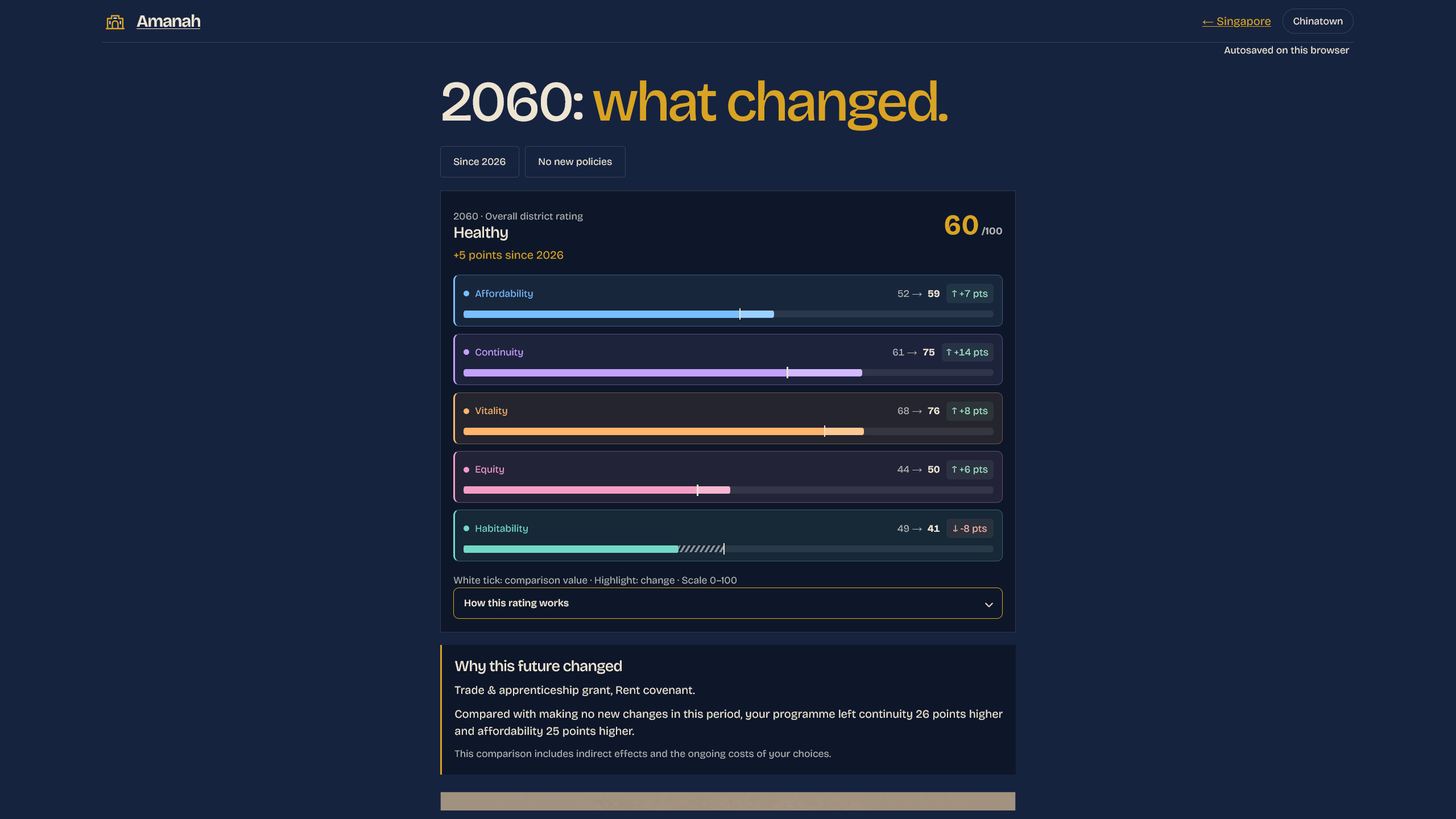
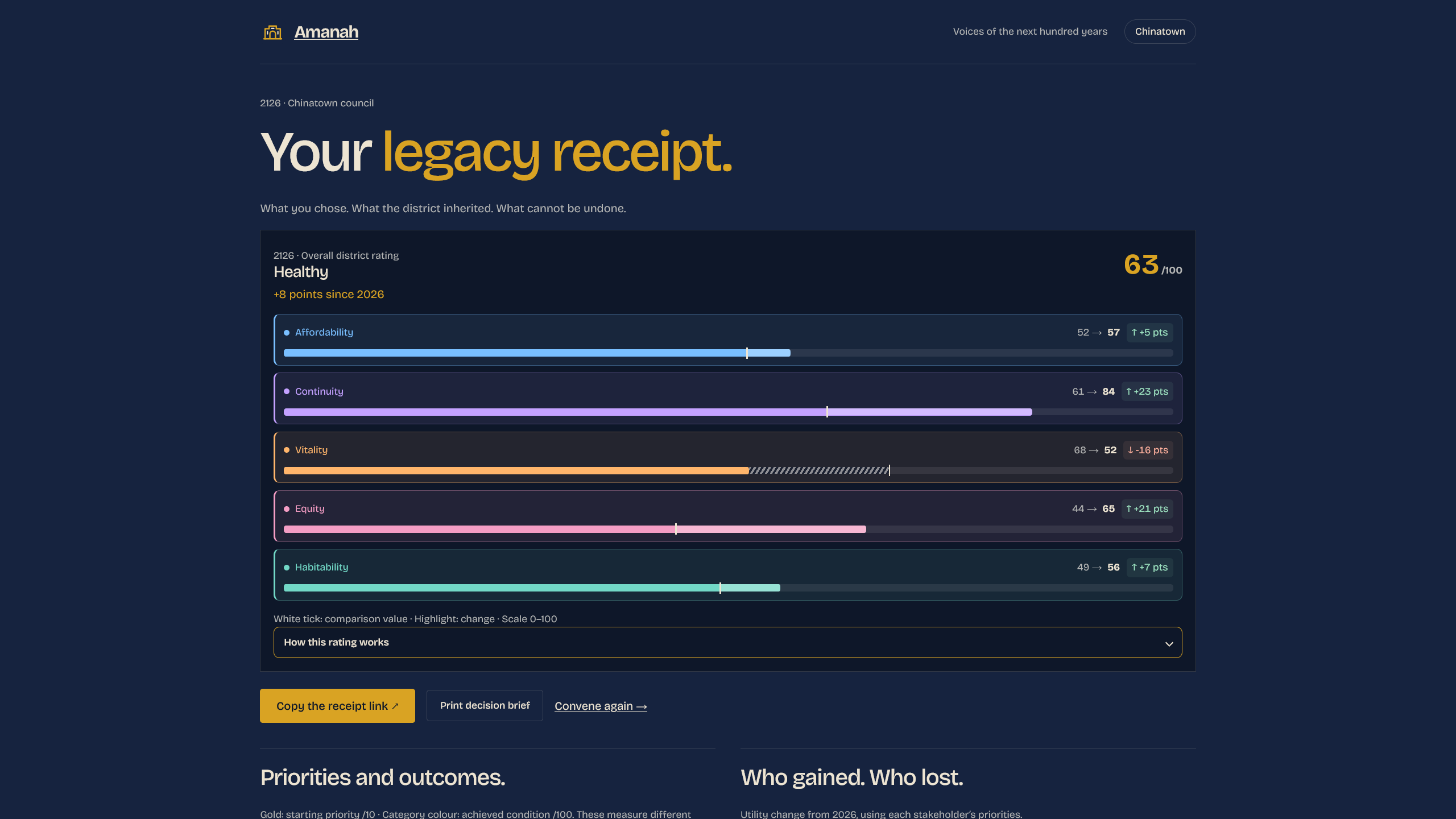
Receipt
-
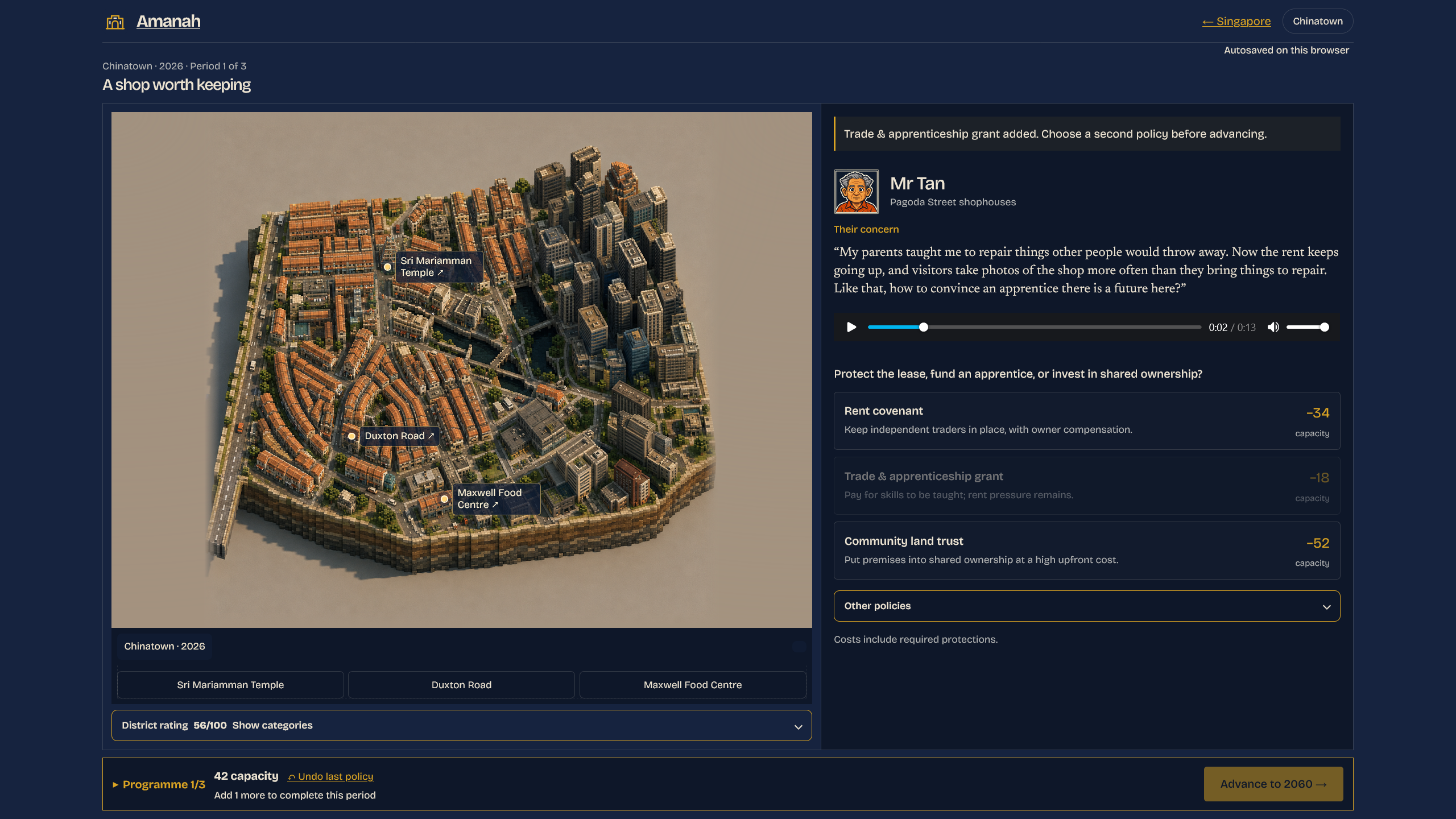
Game Screen
-
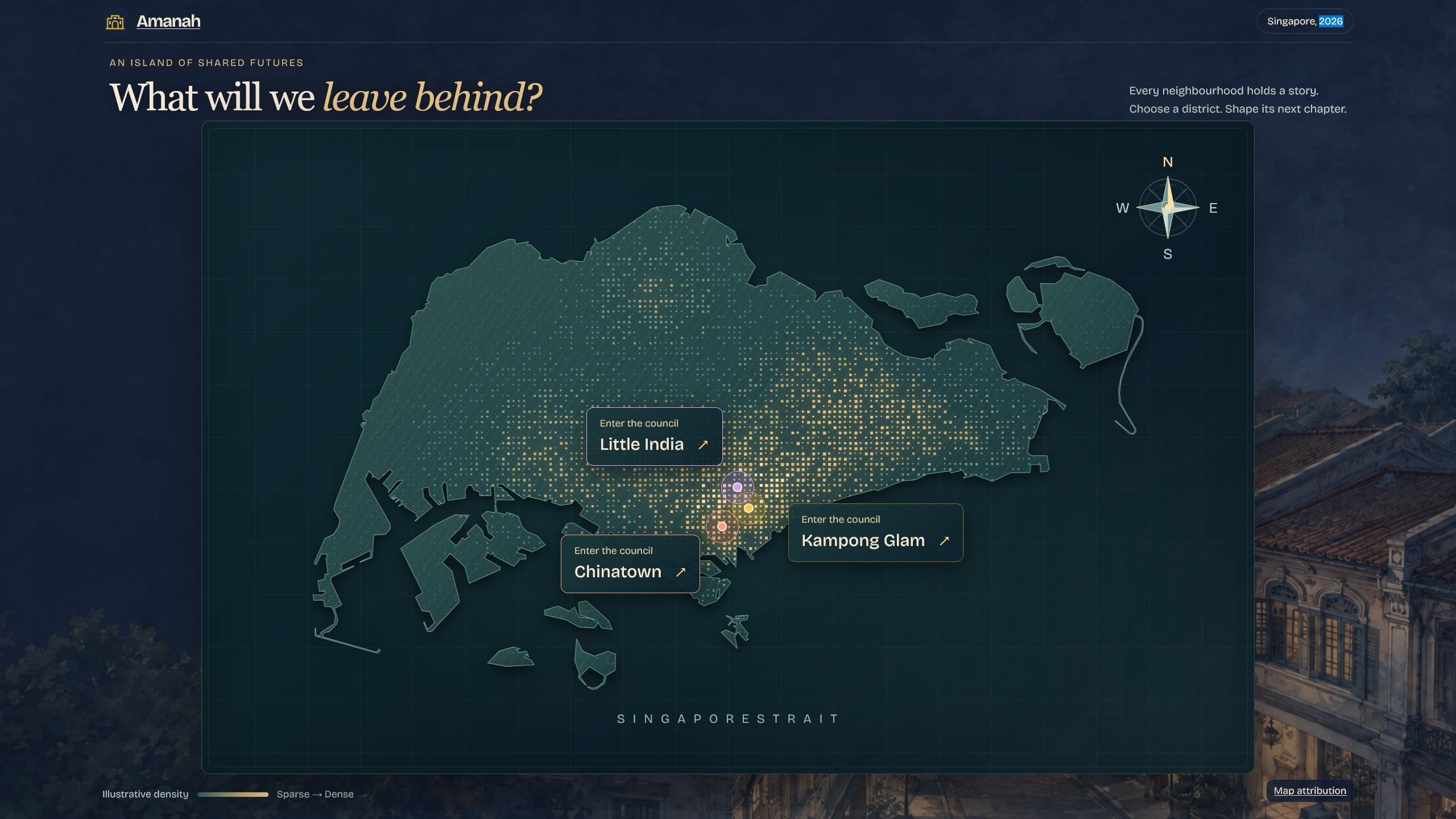
Home Page
Inspiration
Heritage is often presented as something to remember. We wanted young people to experience it as something they can help shape.
A historic building can remain standing while the trades, relationships, and everyday routines around it disappear. That led us to ask: what does preserving a neighbourhood really mean, and who gets to decide its future?
Amanah grew from that question. By giving players responsibility for familiar Singaporean neighbourhoods, we aim to turn passive awareness into curiosity, empathy, and a sense of ownership.
What it does
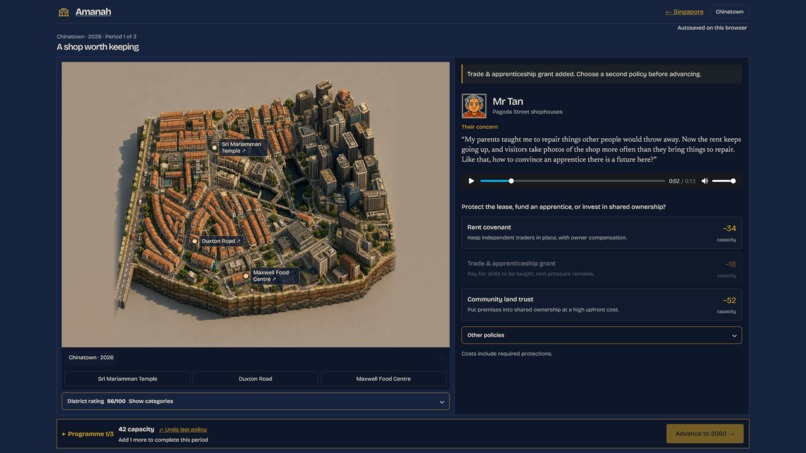
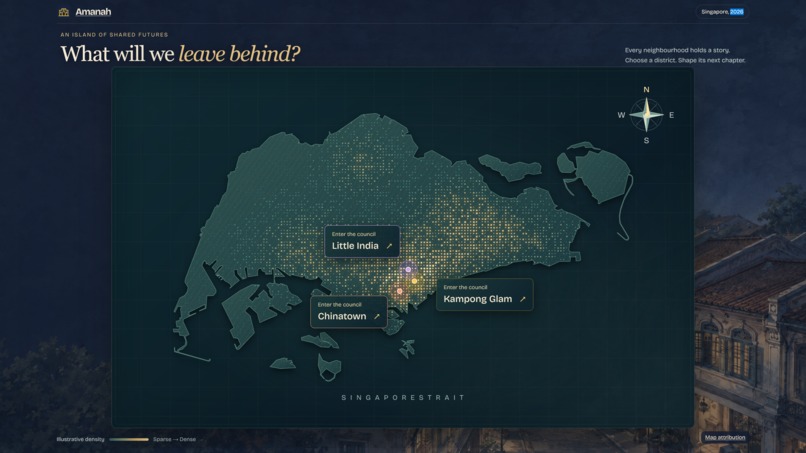
Amanah is an interactive heritage simulation set in Kampong Glam, Chinatown, and Little India. Players explore illustrated landmarks, meet fictional stakeholders, and hear their concerns through Singaporean voices and conversational Singlish.
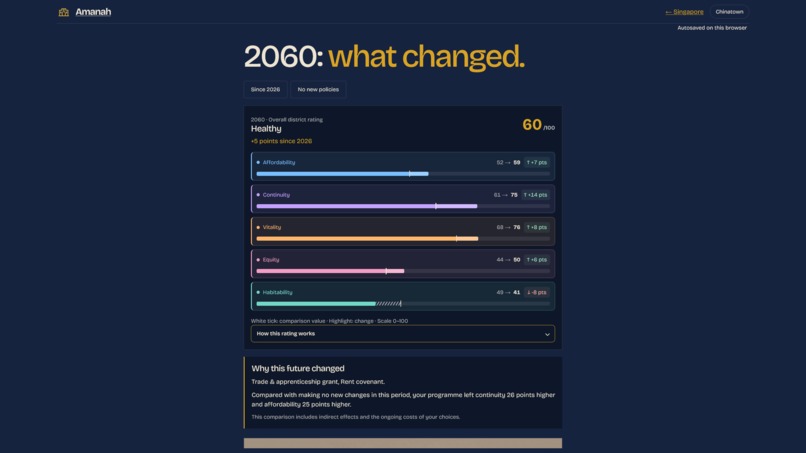
Players build policy programmes across three council periods—2026, 2060, and 2093—before seeing their legacy in 2126. Decisions balance five connected conditions:
- Affordability: Can people and businesses afford to stay?
- Continuity: Can cultural practices and skills survive?
- Vitality: Does the neighbourhood support economic activity?
- Equity: Are opportunities and benefits shared?
- Habitability: Is the neighbourhood comfortable to live and work in?
Some policies require negotiated protections before they can proceed. Players must also work within a limited capacity budget.
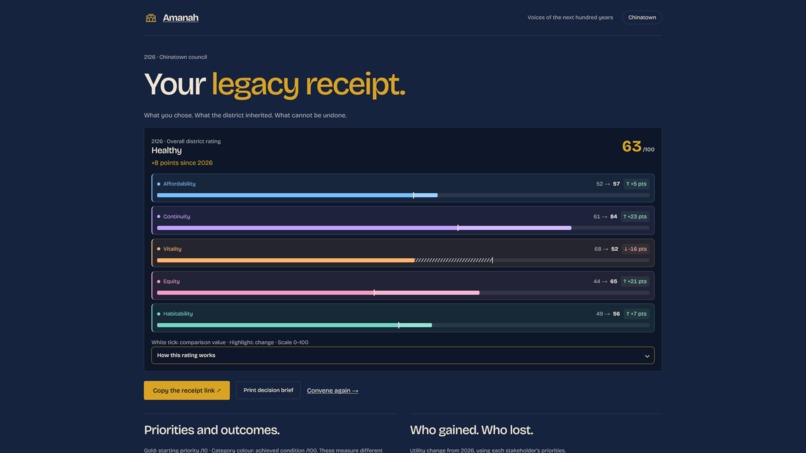
Artwork changes with the year and district score, while character expressions respond to conditions and agreements. A final legacy receipt shows the chosen policies, stakeholder outcomes, historical trends, and lasting harms. Players can share their results through a reproducible link.
How we built it
We built Amanah with React, TypeScript, and Vinext, using CSS and Tailwind for the interface and Motion for animated transitions.
The core is a deterministic simulation engine: the same decision record produces the same outcomes. Policies affect conditions immediately and over time, with maintenance costs, interactions between categories, and thresholds for lasting consequences.
We integrated supplied pixel-art assets into a shared district viewer with landmark buttons, zoom transitions, and artwork selection based on year and score. The opening map combines Singapore’s geographic outline with an explicitly illustrative density texture.
We used ElevenLabs to generate prerecorded character dialogue. Bundling those recordings lets concerns play without making live voice API requests. Portraits support happy, neutral, and sad expressions.
We collaborated through GitHub and used Codex to help implement, debug, and validate the app. The project is publicly hosted on ChatGPT Sites.
Challenges we ran into
One challenge was making a complex simulation understandable. Players needed to see the relationship between a policy, its cost, and its consequences without having to understand the underlying equations. Immediate previews, category ratings, and future comparison screens helped make those connections visible.
Another was presenting heritage as a living system. Preserving architecture alone does not guarantee that its communities can remain. We designed choices around rents, apprenticeships, shared spaces, comfort, and ownership to reflect those tensions.
The visual experience also required iteration. We refined cropping, background colour matching, label placement, and zoom transitions so players could explore the artwork clearly. Audio needed similar care: switching locations had to stop the previous voice, and recordings had to match the displayed dialogue.
Accomplishments that we're proud of
We brought three distinct neighbourhoods into one playable experience, each with local stories, characters, and landmark artwork.
We are particularly proud of connecting the human and mechanical sides of the game. A concern becomes a policy choice, that choice changes the simulation, and its effects become visible through ratings, expressions, future scenes, and the final receipt.
We also built a transparent foundation: outcomes can be replayed from shared decision records, and 40 automated tests cover areas including policy rules, district behaviour, artwork thresholds, and recording consistency.
What we learned
We learned that heritage education can become more engaging when people have a meaningful role in the story. Asking players to make difficult choices creates opportunities for reflection that a description of a landmark alone may not provide.
We also learned that clarity matters as much as complexity. A simulation is only useful when players can understand what changed and why.
Finally, we learned to distinguish an engaging scenario from a factual prediction. Amanah’s characters and future scenarios are fictional, and its coefficients are illustrative. Its purpose is to encourage exploration and discussion, rather than forecast Singapore’s future.
What's next for Amanah
Our next step is to test Amanah with young people and educators to understand whether it sparks curiosity about heritage and encourages further exploration.
We hope to collaborate with residents, heritage practitioners, and community organisations to deepen the stories and review how neighbourhood life is represented. Future work could include multilingual dialogue, more districts, classroom discussion activities, and links between in-game locations and real-world heritage visits.
Our ambition is for Amanah to become a starting point: an invitation to visit these places, listen to their communities, and take part in their future.
Built With
- educational
- elevenlabs
- game
- genai
- heritage
- sim
- singapore


Log in or sign up for Devpost to join the conversation.