-
-
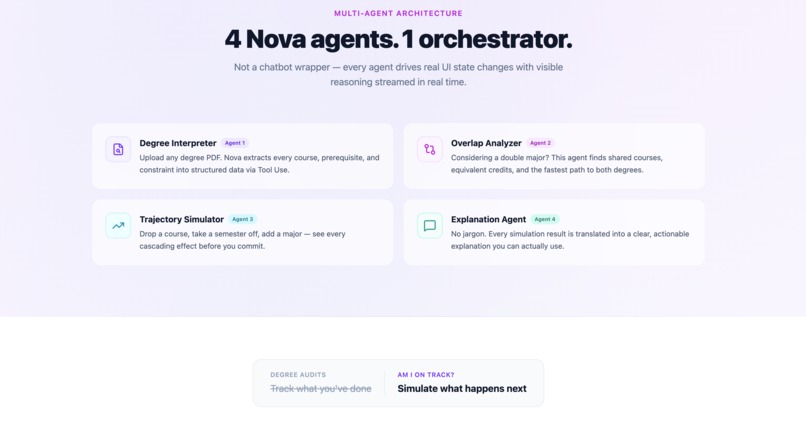
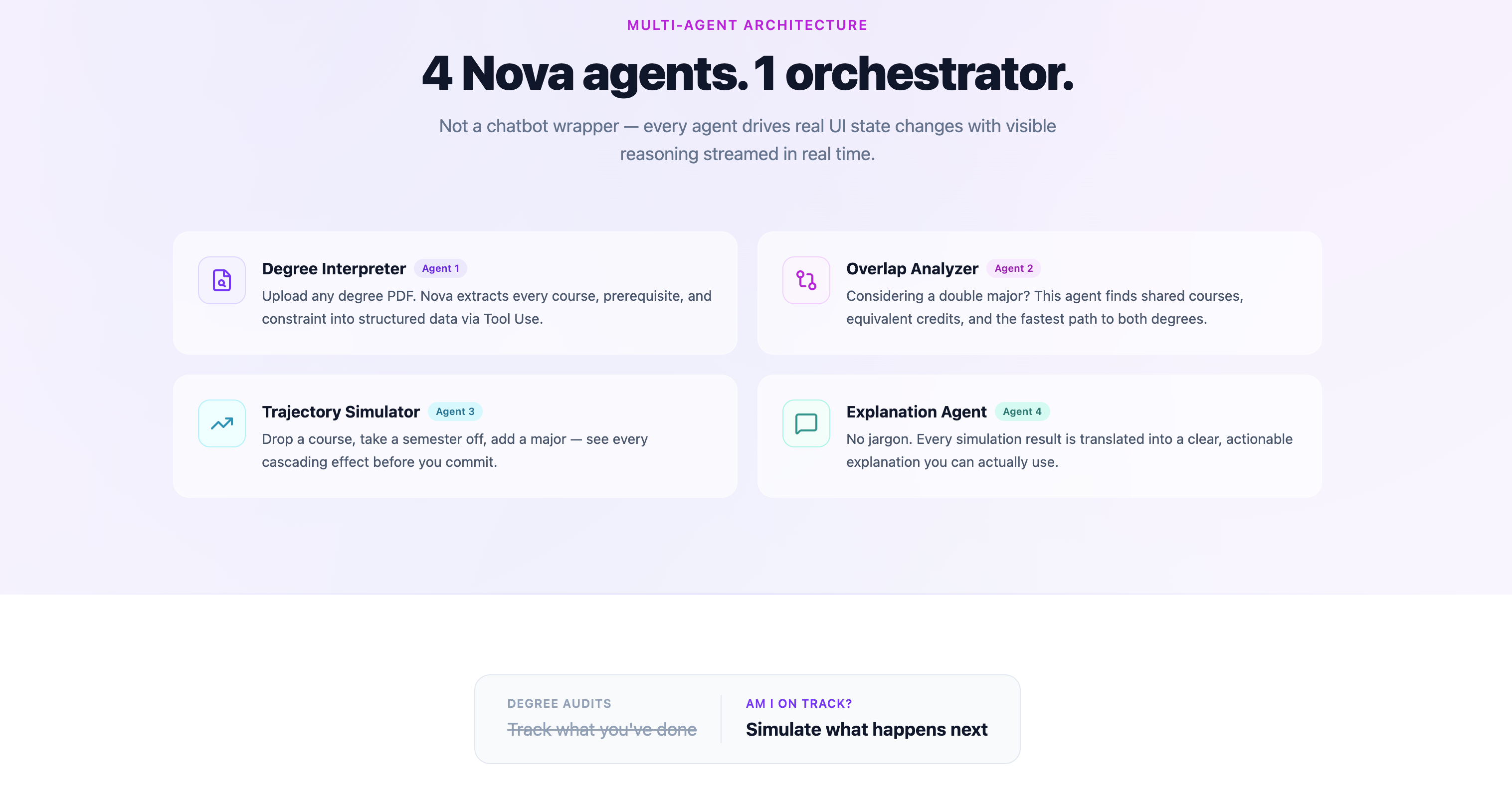
Agents in the application
-
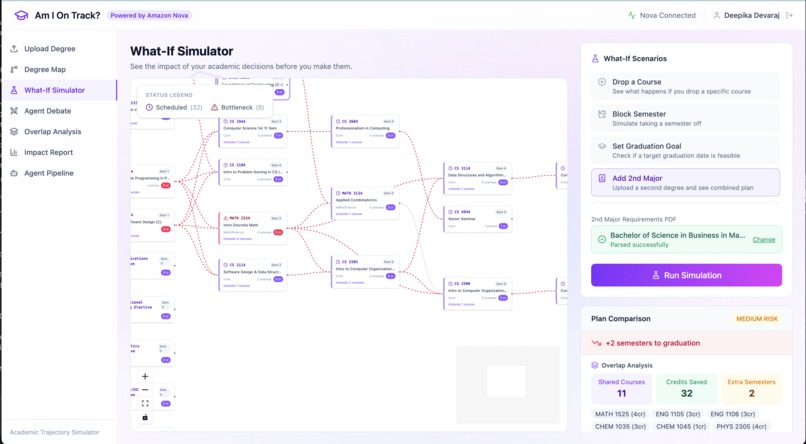
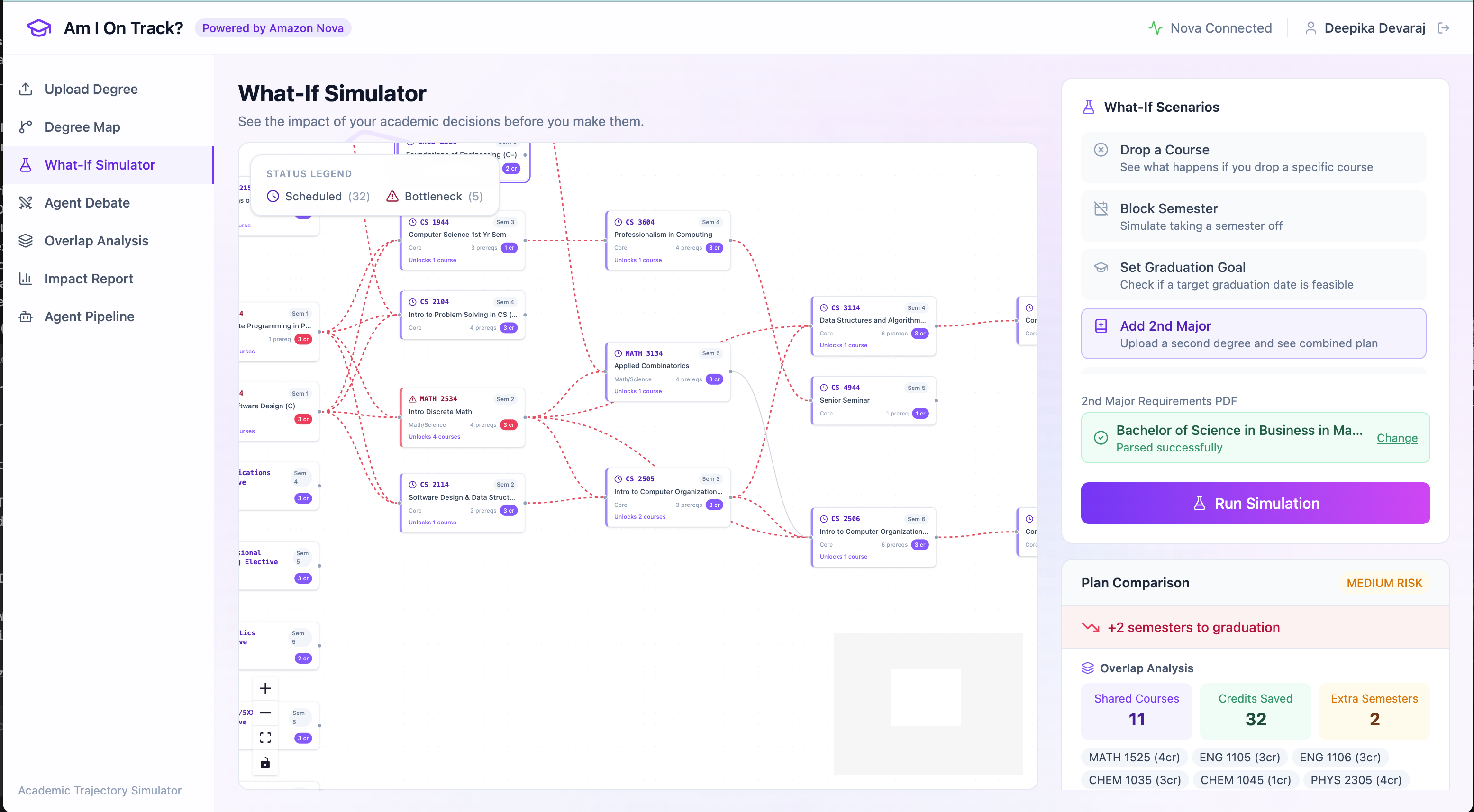
Live Dependency Degree Map
-
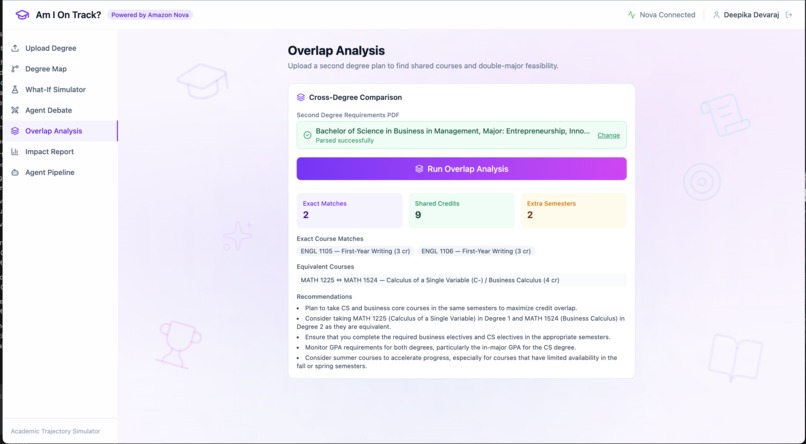
Degree Parsing
-
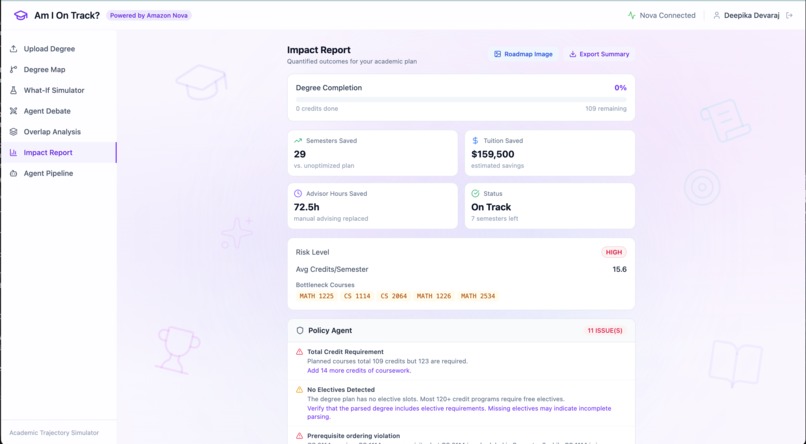
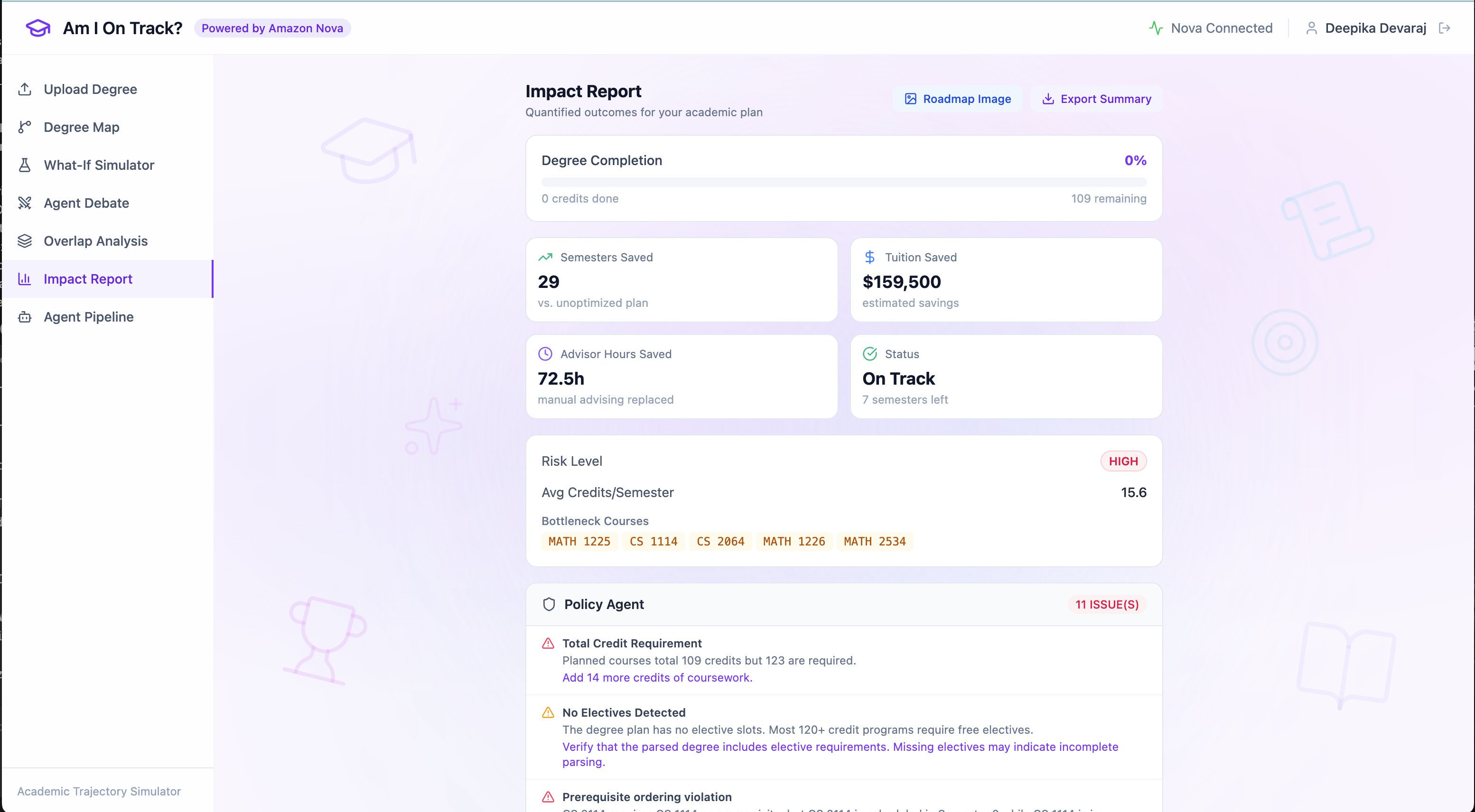
Impact Analysis Report
Inspiration
Academic advising often runs at 800:1 student‑to‑advisor ratios. A single scheduling mistake—like dropping one prerequisite—can silently delay graduation by a full year. I wanted to make those ripple effects visible before students commit, and give advisors leverage at scale.
What it does
Am I On Track? parses degree requirements, visualizes the full dependency graph, and lets students run what‑if simulations (drop course, block semester, add major/minor, co‑op, study abroad, goal date).
It then self‑corrects invalid plans, runs a debate between Fast Track vs Safe Path, and outputs a final recommendation plus quantified impact (semesters saved, tuition avoided, advisor hours saved).
Students can also generate a shareable roadmap image for advisor meetings.
How we built it
- Amazon Nova powers the multi‑agent system: tool‑use parsing, simulation, policy checking, debate + jury synthesis, and explanations.
- Nova Embed precomputes similarity vectors for instant related‑course lookups.
- Nova Canvas generates the roadmap infographic.
- A FastAPI backend streams agent events via SSE.
- A React frontend visualizes the degree DAG and simulation outcomes in real time.
Project Summary
Am I On Track? is an agentic AI academic trajectory simulator that helps college students predict the cascading impact of course decisions before they commit. Students upload their degree requirements (PDF, screenshot, or screen recording), and a pipeline of 10 specialized AI agents — powered by Amazon Nova via AWS Bedrock, parses the document, builds an interactive dependency graph, and runs what-if simulations (drop a course, add a minor, study abroad, co-op, gap semester).
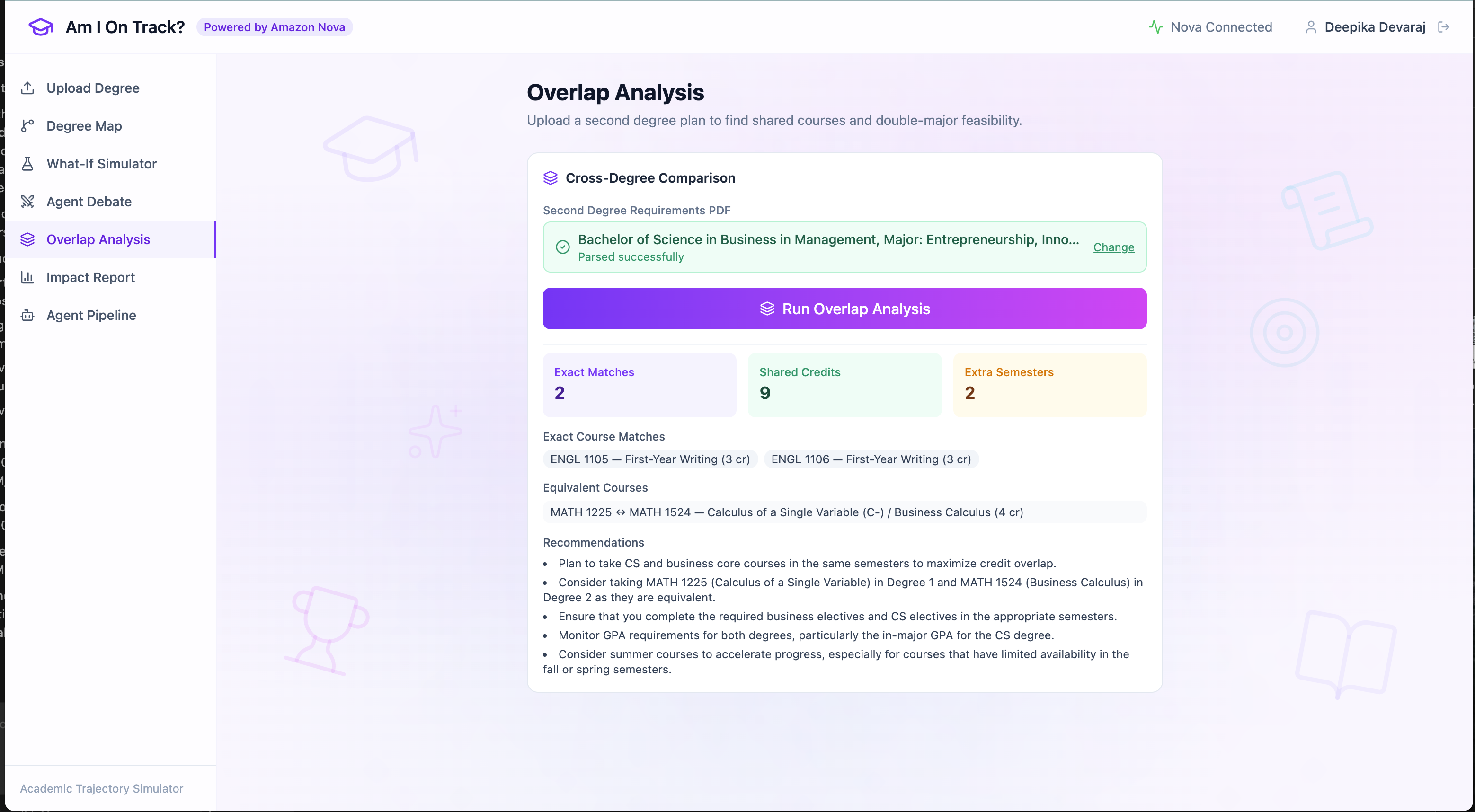
The system leverages Amazon Nova foundation models across 8 distinct capabilities: Converse with tool-use for structured output across 5 agents, ConverseStream for real-time token-by-token explanations, Nova Embed for precomputed course similarity vectors, multimodal document/image/video content blocks for flexible input parsing, multi-document comparison for dual-degree overlap analysis, dynamic model routing (Nova Lite for simple tasks, Nova Pro for complex reasoning), cross-session memory for evolving risk assessment, and Bedrock Guardrails for content safety.
What makes it truly agentic: a self-correction loop where the Policy Agent detects violations and feeds corrections back to the Simulator for automatic replanning, and a multi-turn debate where Fast Track proposes, Safe Path rebuts with specific risks, and a Jury agent synthesizes the optimal plan. All agent reasoning streams to the UI in real time via SSE.
Challenges we ran into
- Making LLM output reliable required tool‑use schemas + validation and fallback logic.
- Streaming multi‑agent pipelines without blocking the event loop took careful async orchestration.
- Comparing two degree PDFs required wiring raw document bytes end‑to‑end for multi‑doc analysis.
- Ensuring the project demos cleanly led to a DEMO_MODE that runs without AWS credentials.
Accomplishments that we're proud of
- A true self‑correction loop that fixes policy violations automatically.
- Multi‑agent debate + jury synthesis, not just parallel prompts.
- Real‑time SSE streaming so users see reasoning as it happens.
- Quantified impact metrics + shareable roadmap image.
What we learned
- Tool‑use is essential for trustworthy structured output.
- Agent orchestration is more than chaining prompts—feedback loops make it real.
- Demo reliability matters as much as technical depth in hackathons.
What's next for Am I On Track?
- University‑specific policy packs and registrar API integrations.
- Advisor dashboards with cohort‑level analytics and at‑risk triage.
- Transfer credit intelligence for community‑college pathways.
- Optional voice interaction for live advising conversations.
Built With
- postgresql
- pytest
- python
- react
- typescript
- vitest

Log in or sign up for Devpost to join the conversation.