Inspiration
We have some experience with other ML models, and wanted to try out an SVM since it seemed well suited for this challenge.
What it does it do
Our model classifies patients as either showing signs of Alzheimer's disease or as healthy controls. The classification is done using a support vector machine model (with a redial basis function kernel and a C-parameter (controls trade-off between generalizability and data fitting) equal to 10 ) fased on extracted features from a denoised-version of the patient 19-channel EEG data. Measures of classification strength, obtained from 5-fold validation of the training dataset: Accuracy: 0.8113 Precision: 0.7586 Recall: 0.8800 F1: 0.8148
How we built it
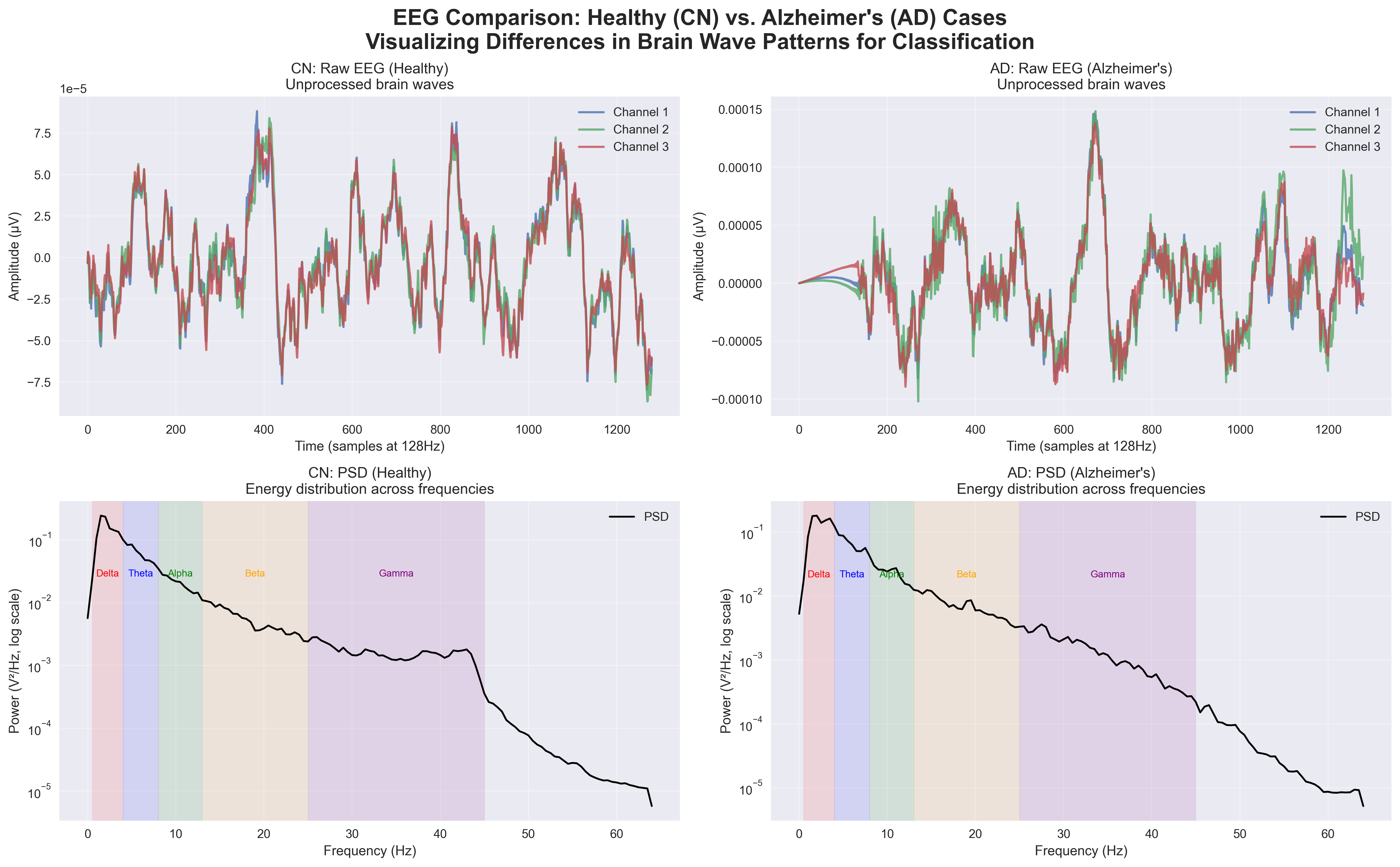
We denoised the data, removed movement artifacts, and extracted spectral features and coherence information from the data. We used Scikit-learn's SVM functionality, alongside Pytorch, Pandas, and Numpy.
Challenges we ran into
It was a challenge choosing the model we wanted to use; we considered building a simple neural net, using a CNN model, or some other classifier models.
Accomplishments that we're proud of
We are proud of tackling a challenge that was out of our comfort zone. We worked with naturalistic data, and challenges related to the noisiness of the EEG were rewarding to work through.
What we learned
We can accurately separate AD and CN data from a realtively limitted set of spectral features! Spicebros is so good!
What's next for Alzheimer's Disease Detection Support Vector Machine (EEG)
We would like to experiment with different features and feature extraction methods to improve the compute of our program.

Log in or sign up for Devpost to join the conversation.