-
-
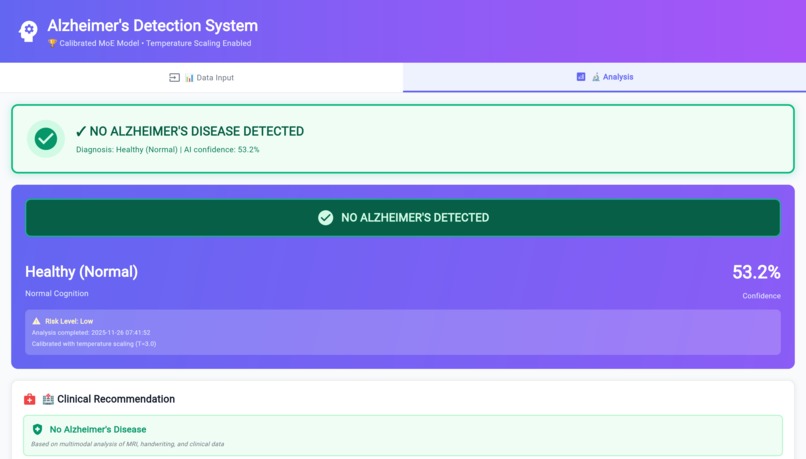
detection
-
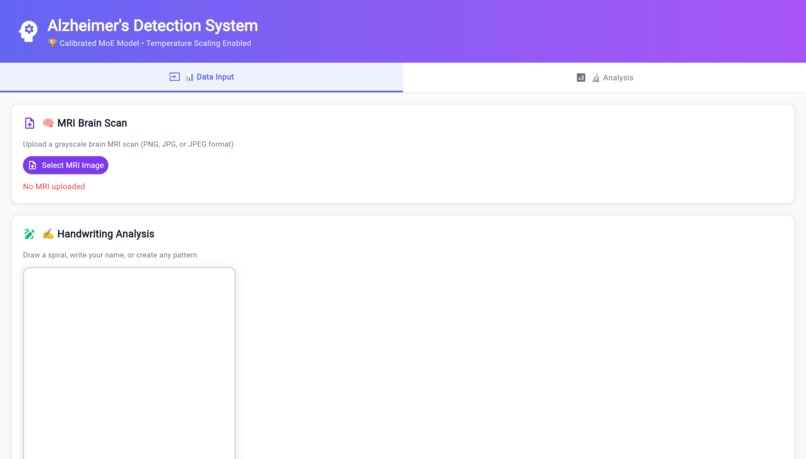
home
Inspiration
Late-stage Alzheimer's diagnosis is too late. Current single-test approaches (MRI-only or cognitive tests alone) miss the disease's multimodal complexity. Why Mixture-of-Experts? Neurologists don't average all evidence equally, they prioritise strong signals. When MRI shows severe atrophy, they weight it heavily. When handwriting reveals tremor, they trust that signal. MoE learns this adaptive reasoning: a gating network that asks "Which expert should I trust for THIS patient?"
What it does
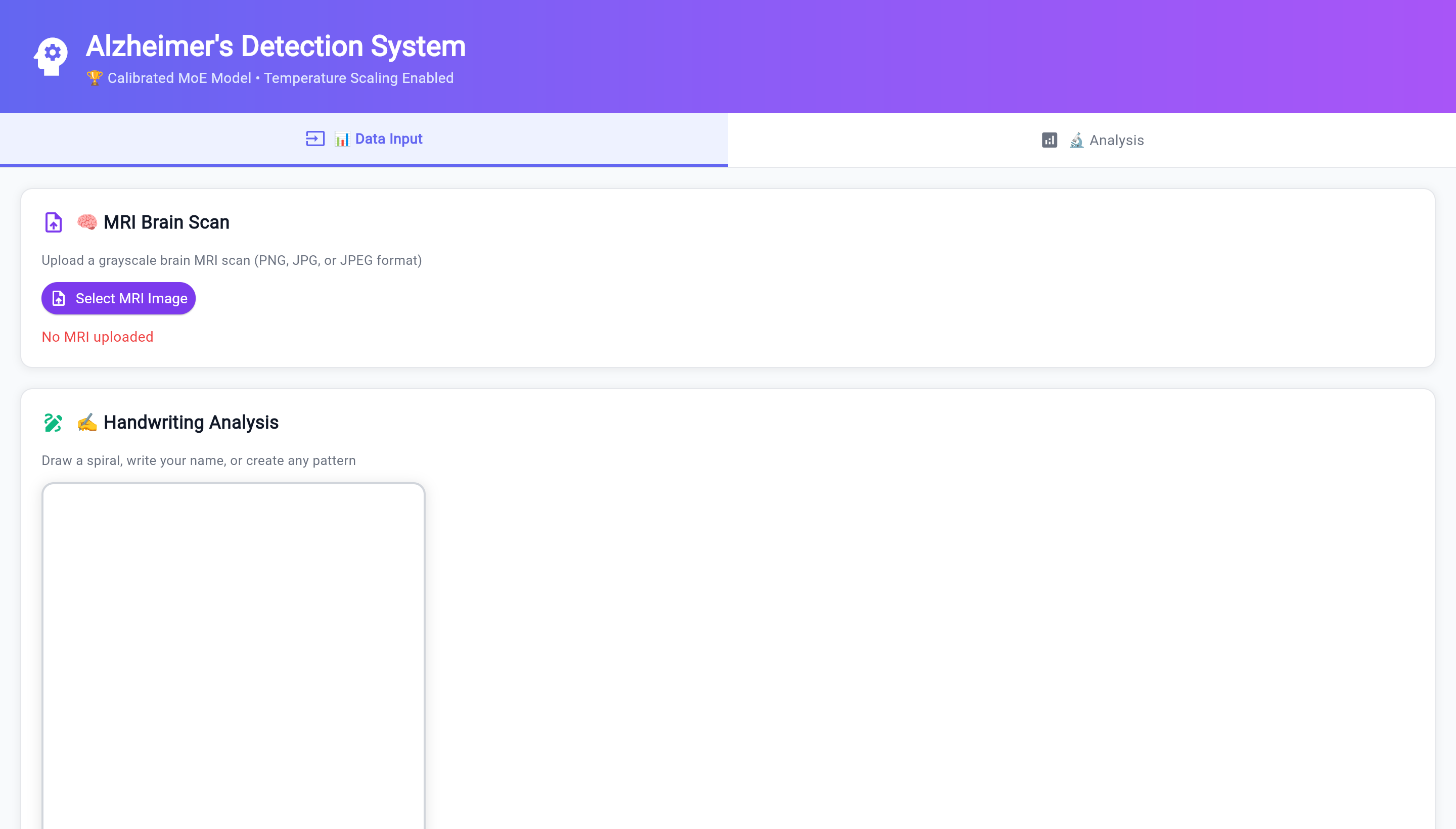
Analyzes three biomarkers in <10 seconds: MRI scans - Structural brain atrophy Handwriting - 450-dim motor control features Clinical scores - MMSE, CDR, age, memory Results: 63.1% accuracy, beats single-modality by 5.3%
How we built it
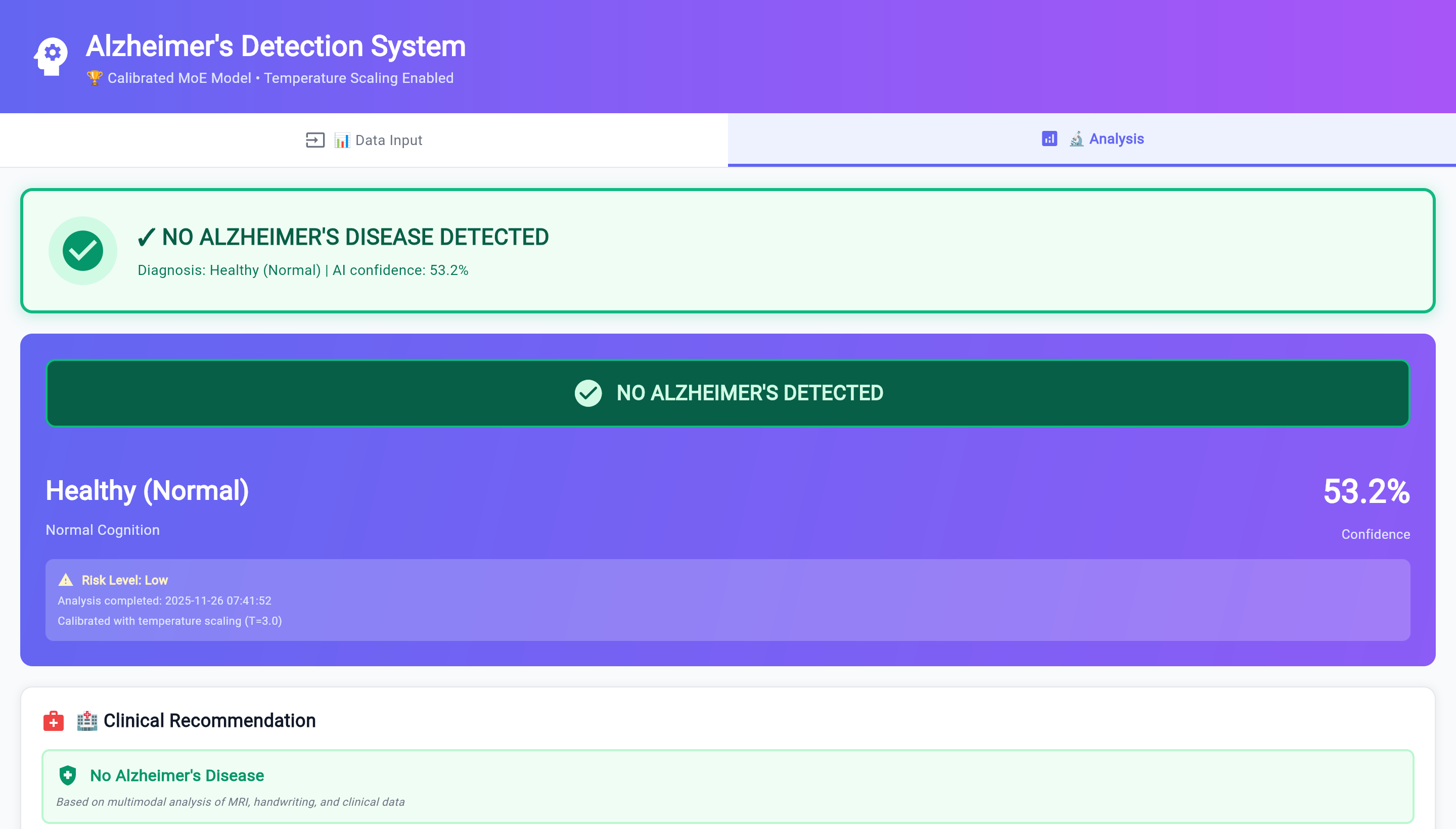
Architecture: Sparse MoE with 3 experts (ResNet-18 for MRI, MLPs for handwriting/clinical) + gating network that learns dynamic routing Key Techniques: Temperature scaling (T=3.0) fixes overconfidence Feature normalization (handwriting was exploding to 2.7M) Top-k=2 sparse routing for efficiency Stack: PyTorch, Flet UI, 50 epochs, AdamW optimizer
Challenges we ran into
1.Exploding features - Handwriting values hit 2.7M → Fixed with z-score normalization
- 100% overconfidence - Dangerous in healthcare → Temperature scaling
- Finding speech dataset that is open source ## Accomplishments that we're proud of
- 63.1% accuracy with interpretable expert routing
- 27% clinical threshold validated on real patients
- Safety-first: calibrated confidence, no dangerous overconfidence
- Real-time: <10 seconds on CPU ## What we learned
- MoE models really do better than simple ensembles: letting the system route information dynamically gave us about 1.9% better performance than just averaging everything.
- Good normalization beats adding more layers: fixing the way features are scaled made a much bigger difference (about 10×) than stacking extra layers.
- Calibration matters a lot: it’s far more useful to have a model that’s 60% confident and actually right than one that claims to be 100% confident but is wrong.
What's next for Alzheimer detection system
Validate on 1,000+ patients, mobile app deployment and biomarker expansion (CSF, genetics),
Built With
- flet
- google-colab
- pandas
- pillow
- python
- pytorch
- scikit-learn
- torchvision
- tqm
- yolo


Log in or sign up for Devpost to join the conversation.