-
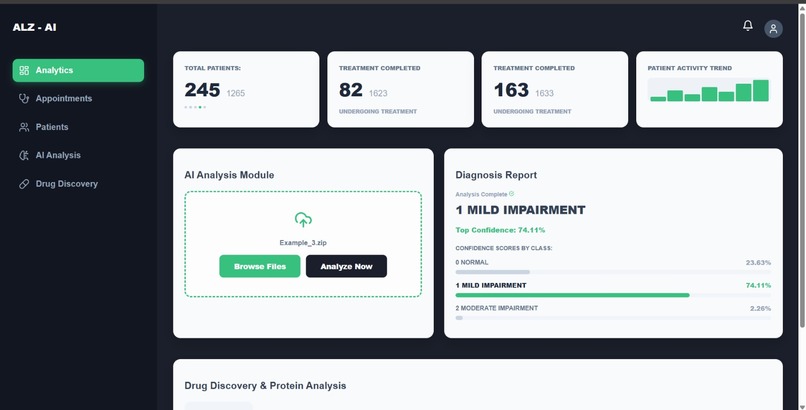
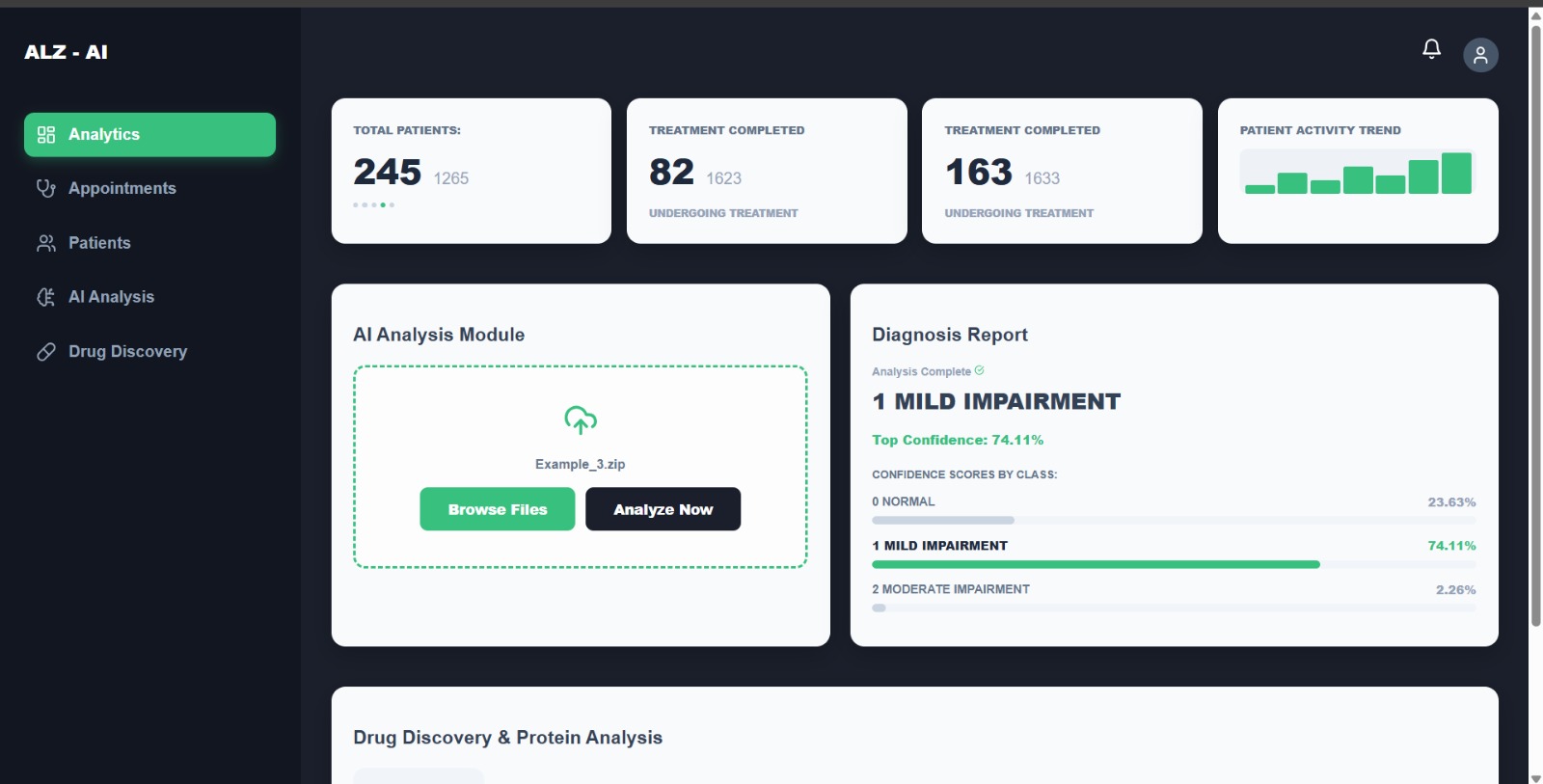
Analytics page
-
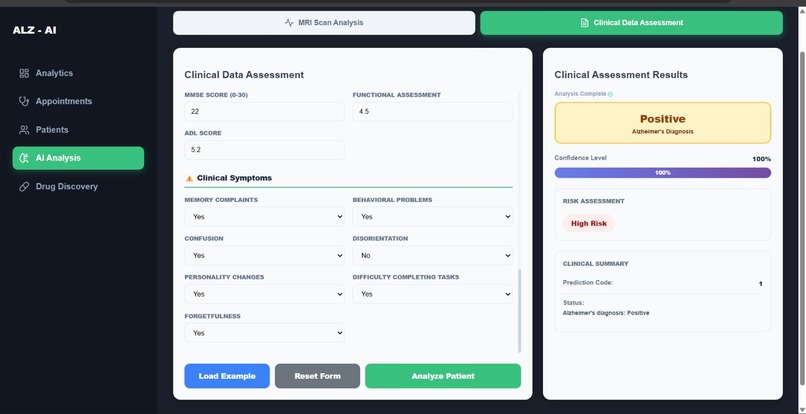
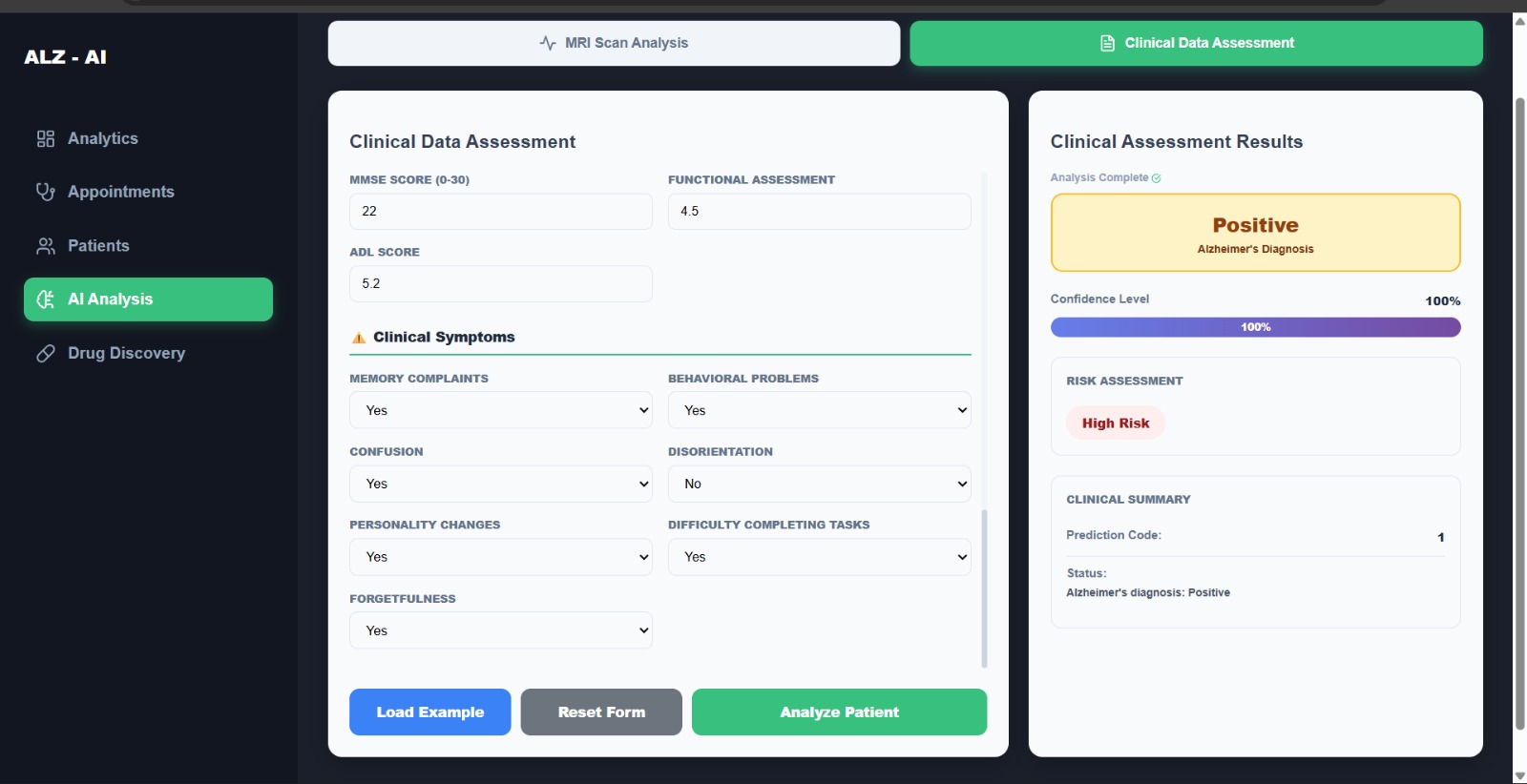
AI Analysis (Clinical Data Assessment) page
-
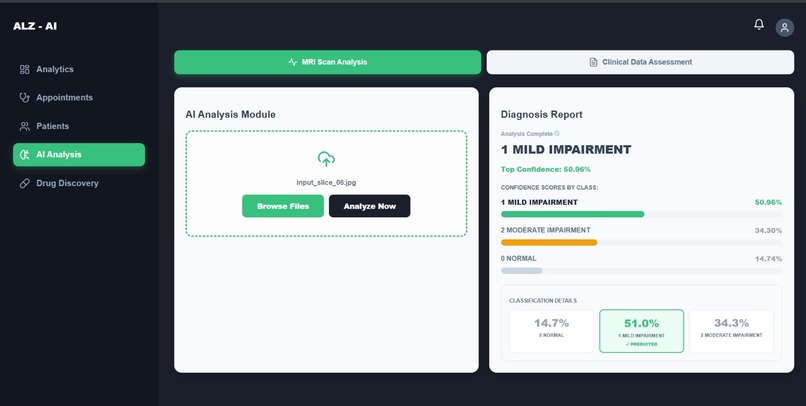
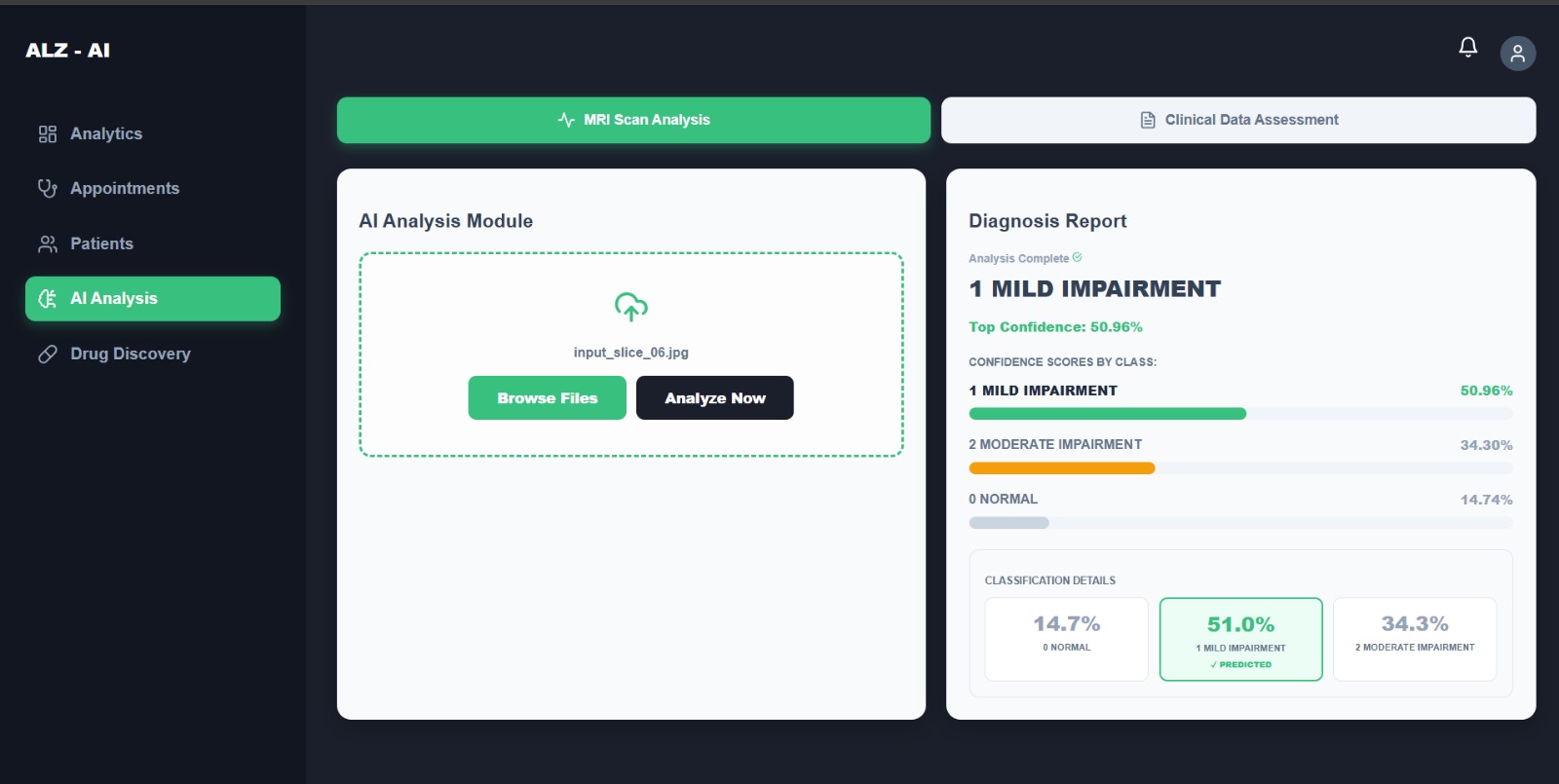
AI Analysis (MRI-Scans) page
-
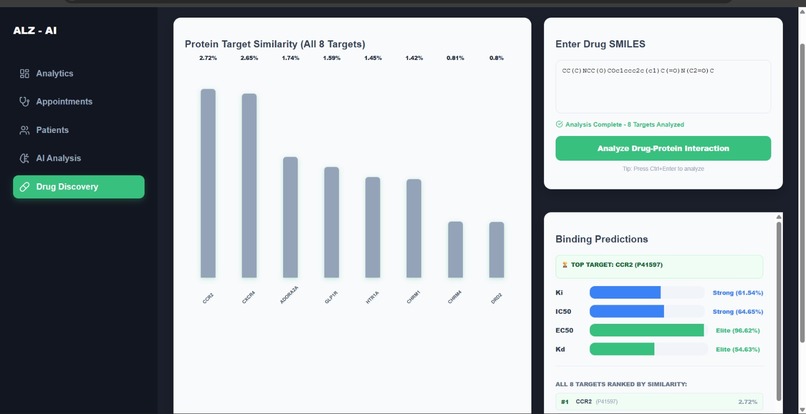
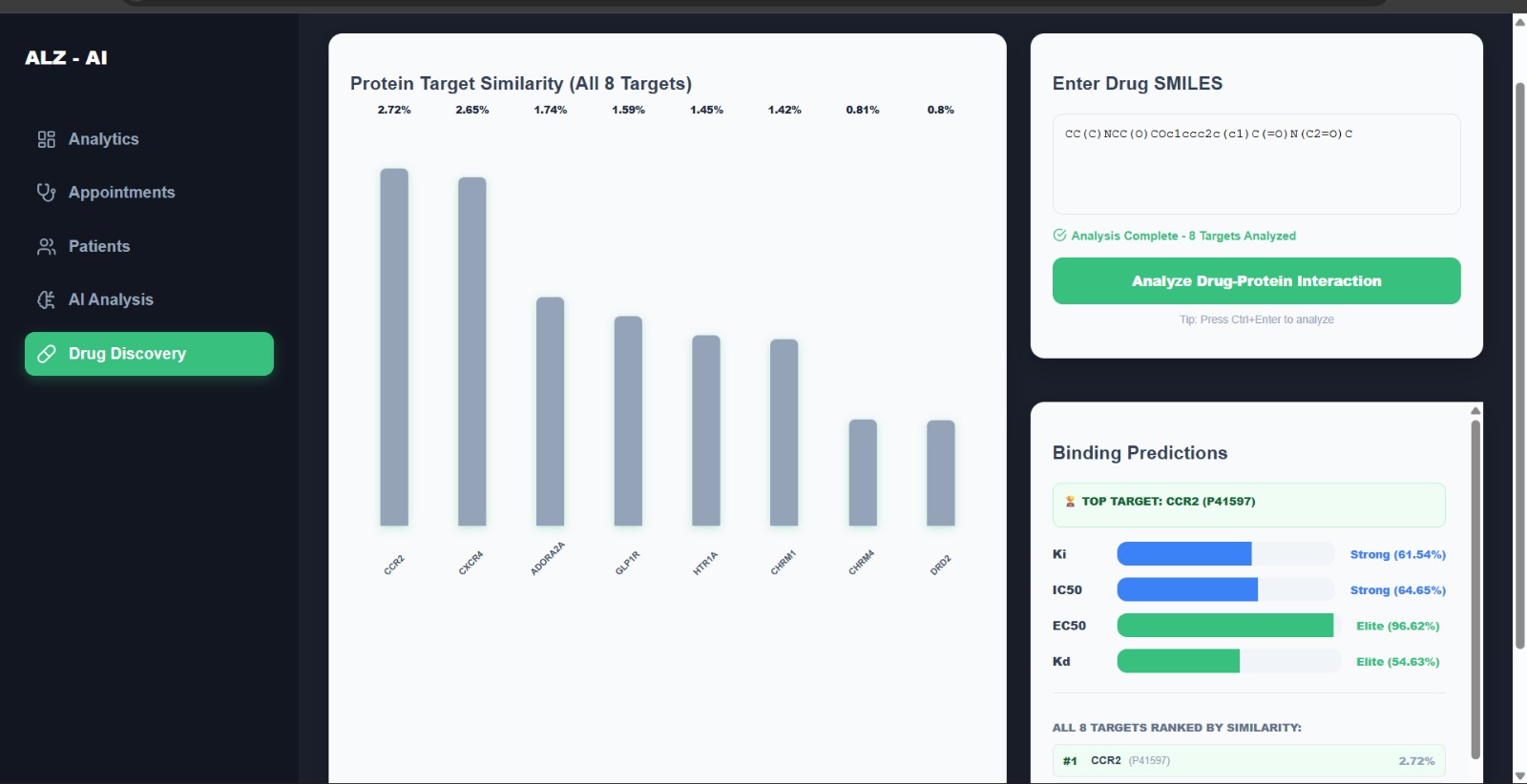
Drug Discovery page
Inspiration
Alzheimer’s disease is rarely caught early—not because doctors don’t care, but because early signals are subtle, time is limited, and access to specialists is uneven. While learning about neuroimaging and clinical workflows, we realized that most AI projects either overpromise diagnosis or ignore how doctors actually work. We wanted to build something realistic: a system that supports clinicians instead of replacing them, helps with early screening, and opens doors for research exploration through drug repurposing—without making medical claims it cannot justify.
What it does
The project is an integrated, clinician-aligned system with three core components:
a. Early risk screening using brain MRI scans and structured clinical data. b. Computational drug repurposing to prioritize existing drugs that show molecular association with Alzheimer’s-related proteins. c. A unified patient–doctor web platform that embeds the AI into a real clinical workflow Patients can search hospitals, book appointments, and consult doctors through a secure interface. Doctors access a dashboard with appointments, diagnostic status, and hospital-verified MRI and clinical reports. The AI provides risk estimates and research signals, not diagnoses or treatment decisions.
How we built it
We designed the system as a modular pipeline:
- Neuroimaging module: MRI scans are preprocessed and analyzed using convolutional neural networks to detect structural patterns associated with Alzheimer’s disease. Clinical data module: Structured demographic and cognitive data are modeled using interpretable machine learning algorithms to provide contextual risk signals.
- Drug repurposing module: Existing drugs are represented using molecular embeddings, while Alzheimer’s-related proteins (APP, BACE1, MAPT) are represented using pretrained protein language models. Association scores are computed in representation space: Score=Similarity(Drugembed,Proteinembed)\text{Score} = \text{Similarity}(\text{Drug}{embed}, \text{Protein}{embed})Score=Similarity(Drugembed,Proteinembed) These scores are used only for research prioritization, not medical recommendations.
- Web platform: A role-based system supports patient login, doctor verification via hospital credentials, appointment scheduling, video consultations, and hospital-controlled access to MRI and clinical reports.
Challenges we ran into
a. Avoiding overclaiming: It was tempting to frame outputs as diagnoses or treatments, but doing so would be medically irresponsible. b. Dataset heterogeneity: MRI and clinical datasets vary significantly in labeling and quality. c. Clinical realism: Designing workflows that respect hospital data ownership and clinician responsibility required constant rethinking. d. Scope control: Balancing screening, drug repurposing, and platform design within hackathon constraints was non-trivial.
Accomplishments that we're proud of
- Building a clinically defensible system, not just technically impressive.
- Clearly separating screening, research exploration, and medical decision-making.
- Integrating AI into a realistic patient–doctor workflow.
- Explicitly stating limitations instead of hiding them. ## What we learned a. Medical AI is as much about what you don’t claim as what you build. b. Interpretability and workflow alignment matter more than raw accuracy. c. Drug repurposing can be framed as hypothesis generation, not prediction. d. Systems that respect clinicians gain more trust than systems that try to replace them.
What's next for Untitled
- Clinical validation with real healthcare professionals.
- Longitudinal analysis to track progression over time.
- Improved uncertainty estimation and confidence reporting.
- Deeper integration of research feedback loops for drug prioritization.
Built With
- docker
- docker-compose
- fastapi-(python)
- gsap-(animations)
- lucide
- lucide-icons.-?-backend:-fastapi-(python)
- pytorch
- react.js-(vite)
- rest-api.-?-ai/ml:-pytorch
- scikit-learn
- tailwind-css
- torchvision
- transformers
- uvicorn


Log in or sign up for Devpost to join the conversation.