Inspiration
Many students keep studying longer even when fatigue, circadian misalignment, and cognitive overload make learning inefficient or harmful. Most productivity tools encourage more work, but very few help users recognize when they should stop.
This project was inspired by research on circadian rhythm, cognitive load, and diminishing returns in learning.
What it does
Always-On Study Mode is a prototype system that passively estimates the risk of diminishing or negative learning efficiency during a study session.
When enabled, it runs quietly in the background and:
- Allows studying to continue when learning efficiency is likely sufficient
- Warns the user when efficiency begins to decline
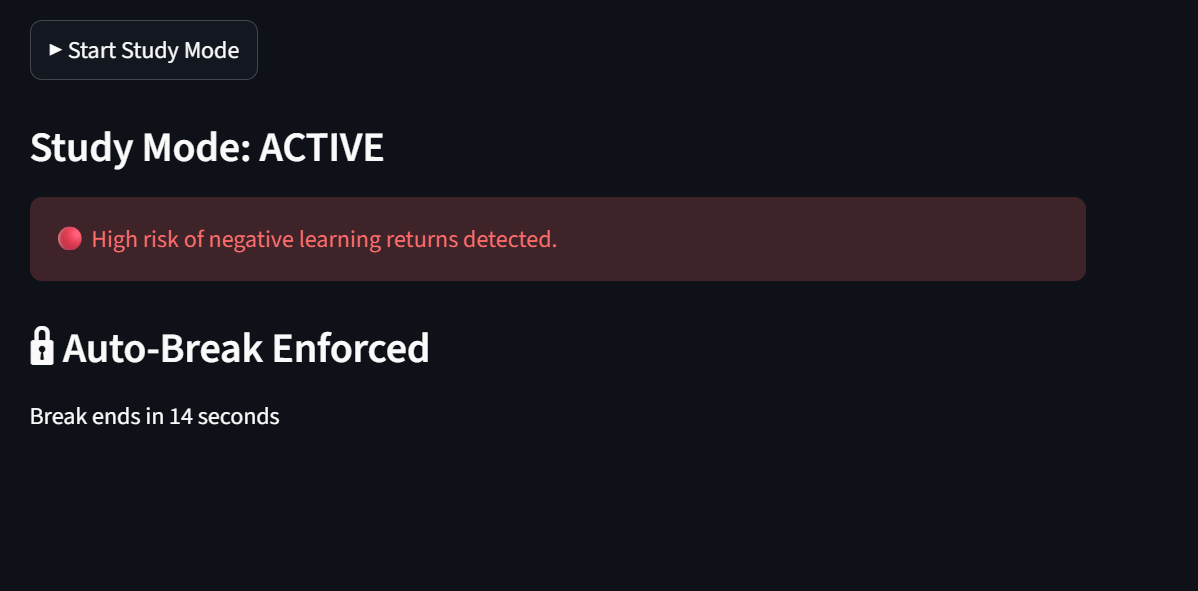
- Optionally enforces a short break as a form of pre-commitment when continued study is likely counterproductive
The goal is not to study more, but to stop studying when it stops helping.
How it works
The system combines multiple weak signals rather than relying on any single metric:
- Circadian context (time of day)
- Session fatigue (current session duration)
- Cumulative exposure (device-on duration)
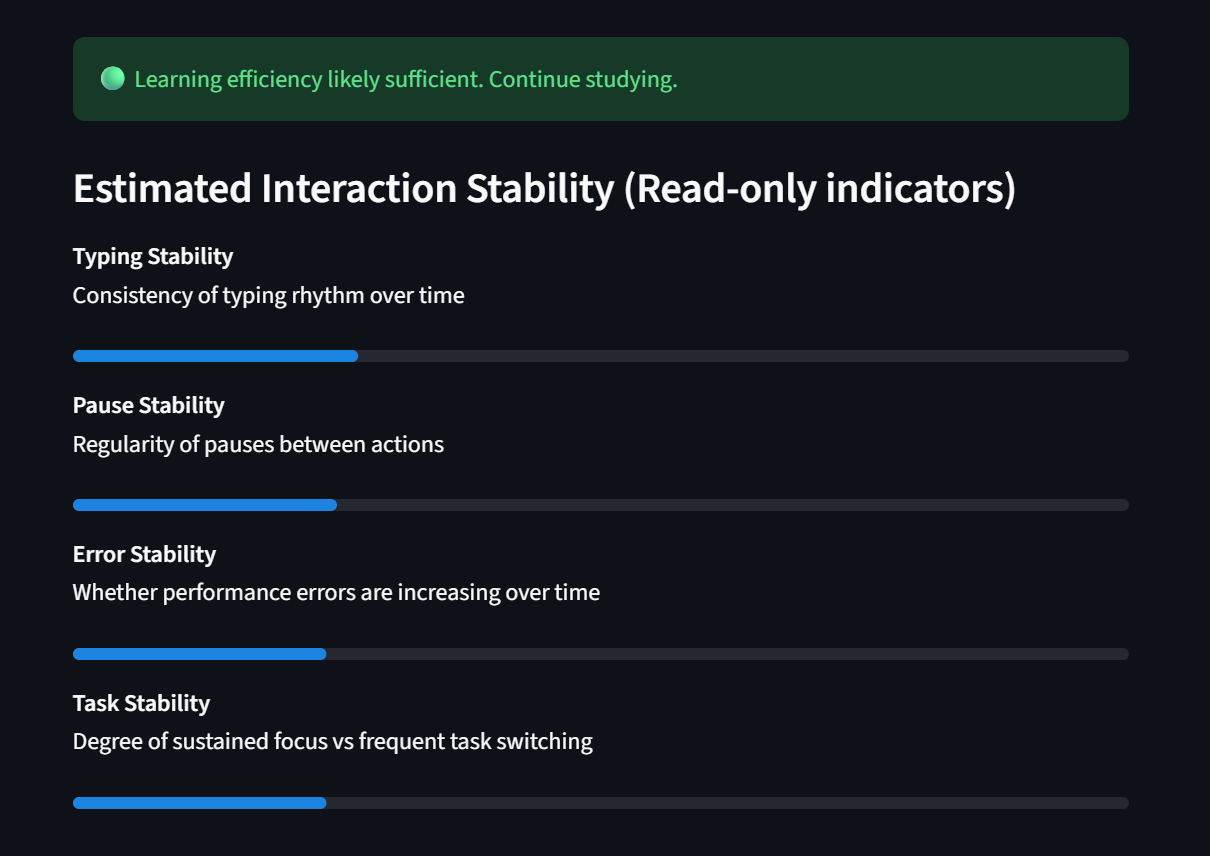
- Interaction stability estimates, including:
- Typing stability
- Pause stability
- Error stability (performance degradation trend)
- Task stability (focus vs task switching)
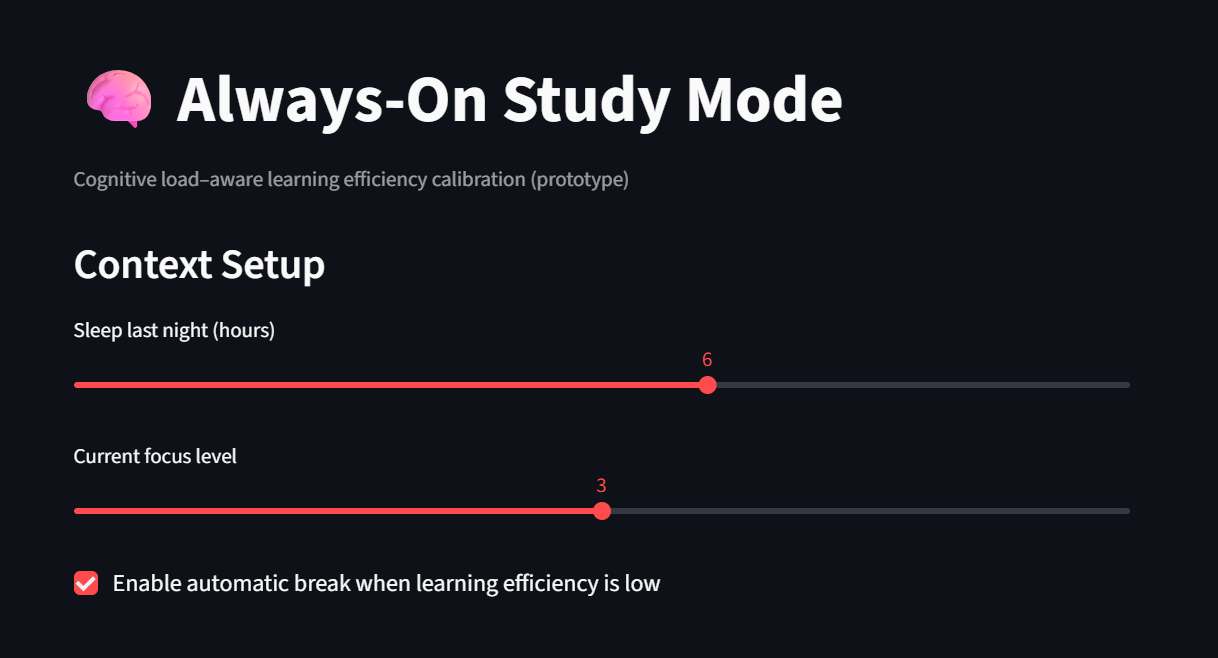
- Optional self-reported context (sleep and focus)
These signals are combined using a lightweight machine learning model trained on a synthetic dataset designed to reflect known relationships from cognitive science research.
No content, keystrokes, biometrics, camera, or microphone data are collected.
How we built it
The prototype was built using Python and Streamlit for the interface, with scikit-learn powering a simple, explainable classification model.
Interaction stability signals are simulated to demonstrate fatigue-driven degradation over time. In a real deployment, these would be derived from passive timing patterns without intrusive monitoring.
Challenges
The main challenge was balancing realism, ethics, and feasibility within a short timeframe. Capturing real behavioral data would introduce privacy and technical complexity, so we focused on a transparent, simulation-based prototype that clearly demonstrates the system logic.
Ethics & privacy
- No content monitoring
- No keystroke logging
- No camera or microphone
- No biometric data
- Advisory system, not diagnostic
The system is designed to be privacy-preserving, explainable, and user-controlled.
Built With
- numpy
- pandas
- python
- scikit-learn
- streamlit

Log in or sign up for Devpost to join the conversation.