-
-
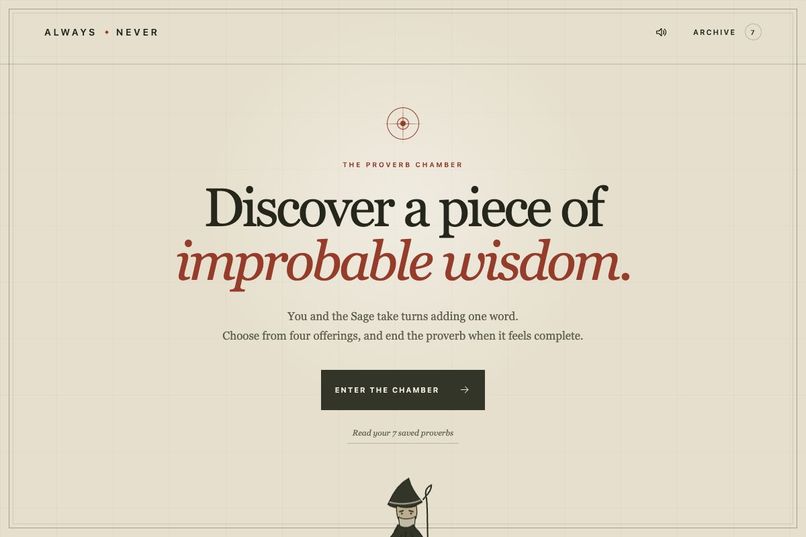
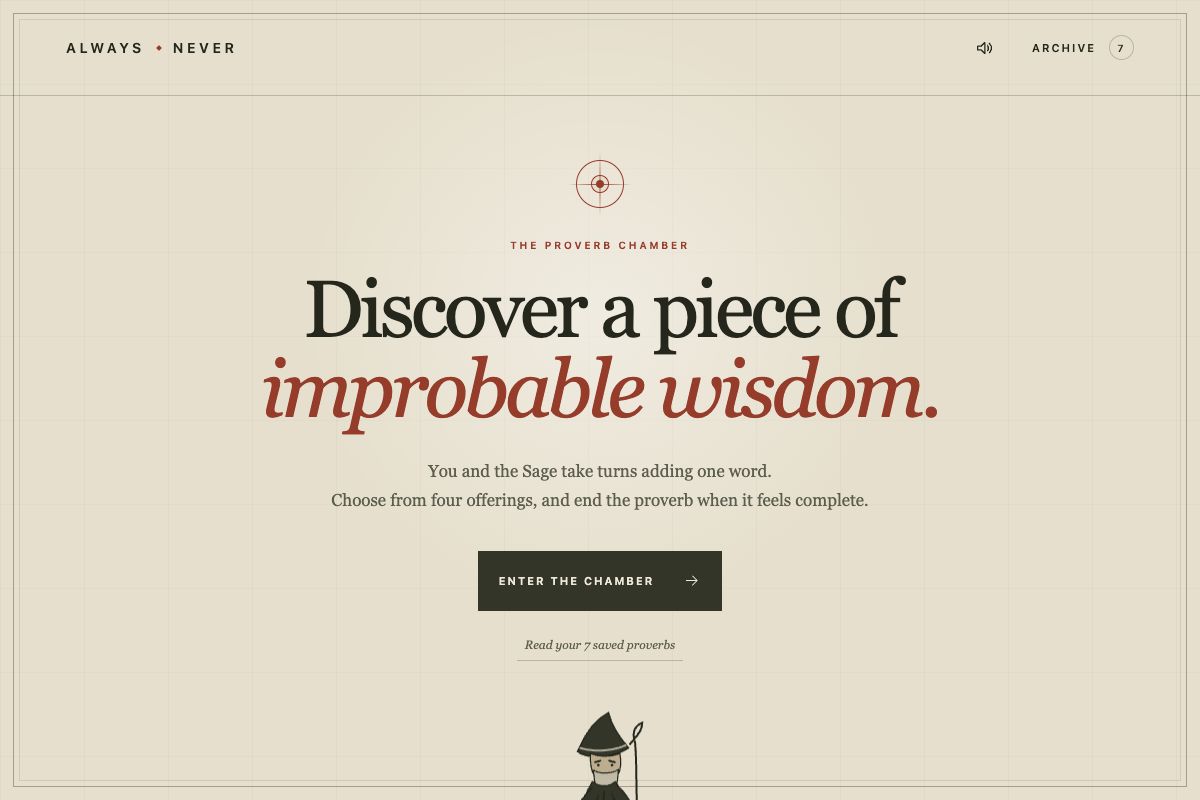
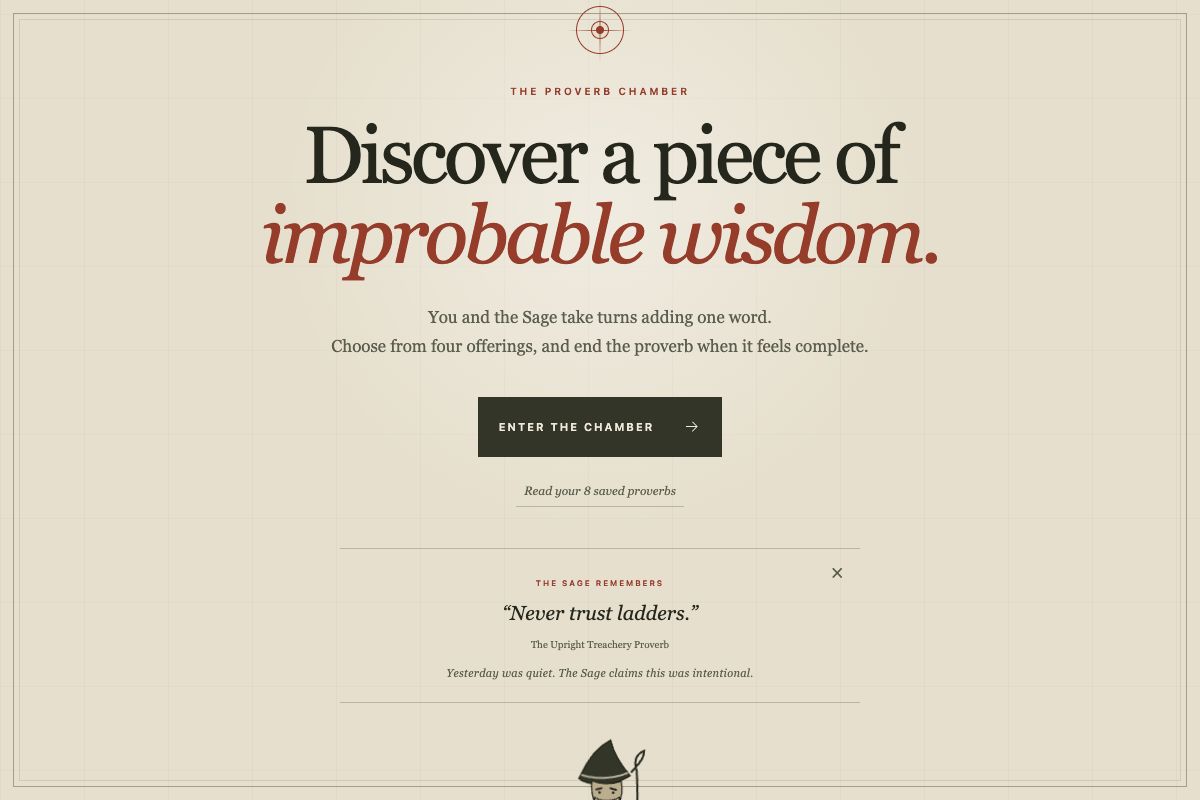
The Sage is waiting
-
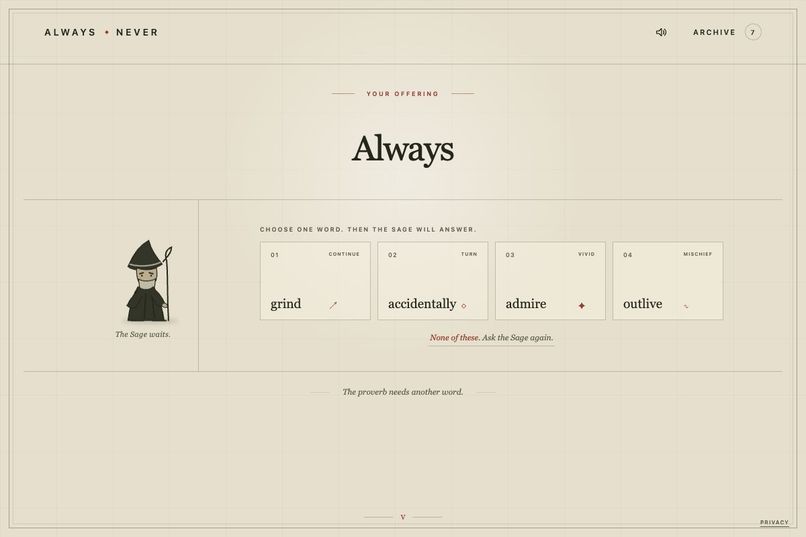
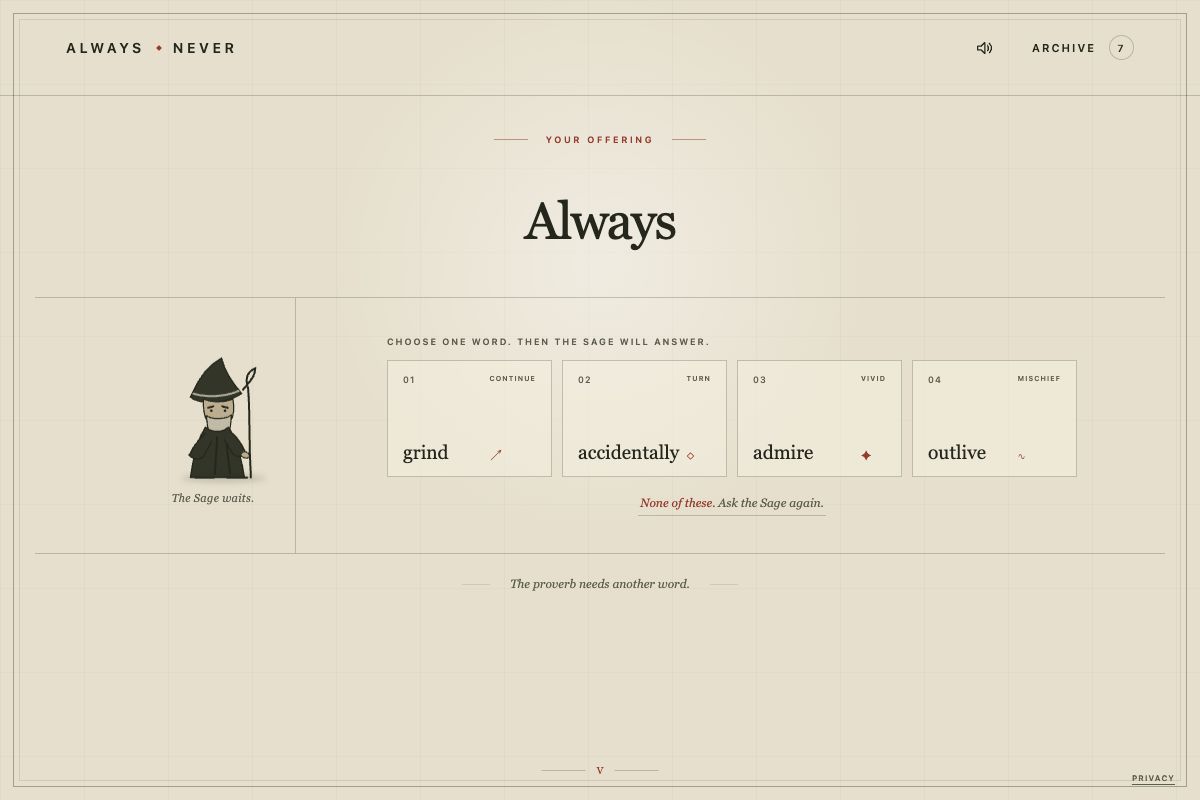
Four directions
-
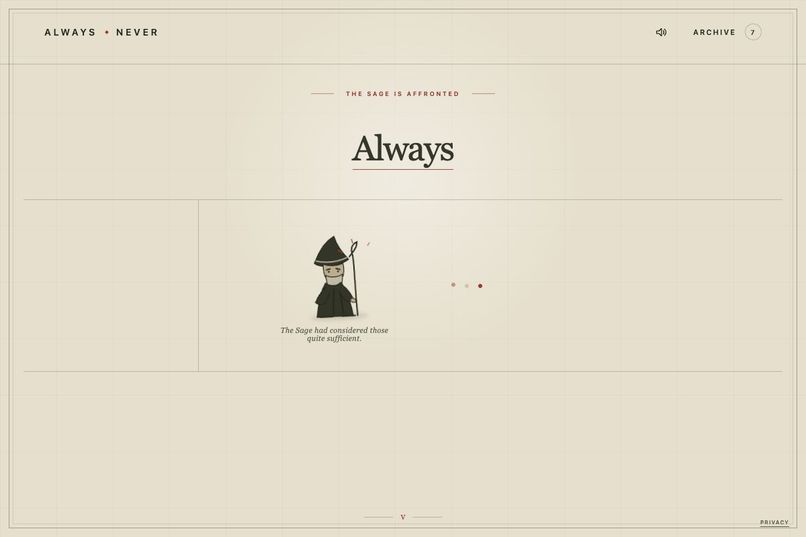
Defy the Sage
-
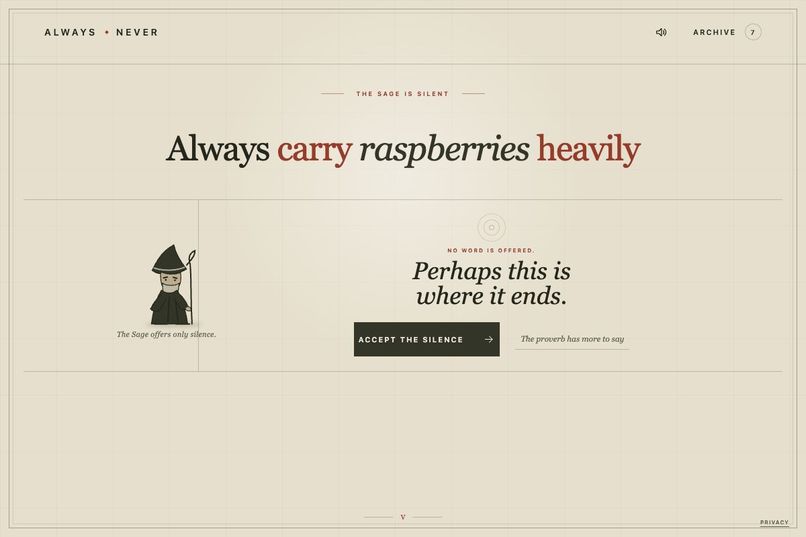
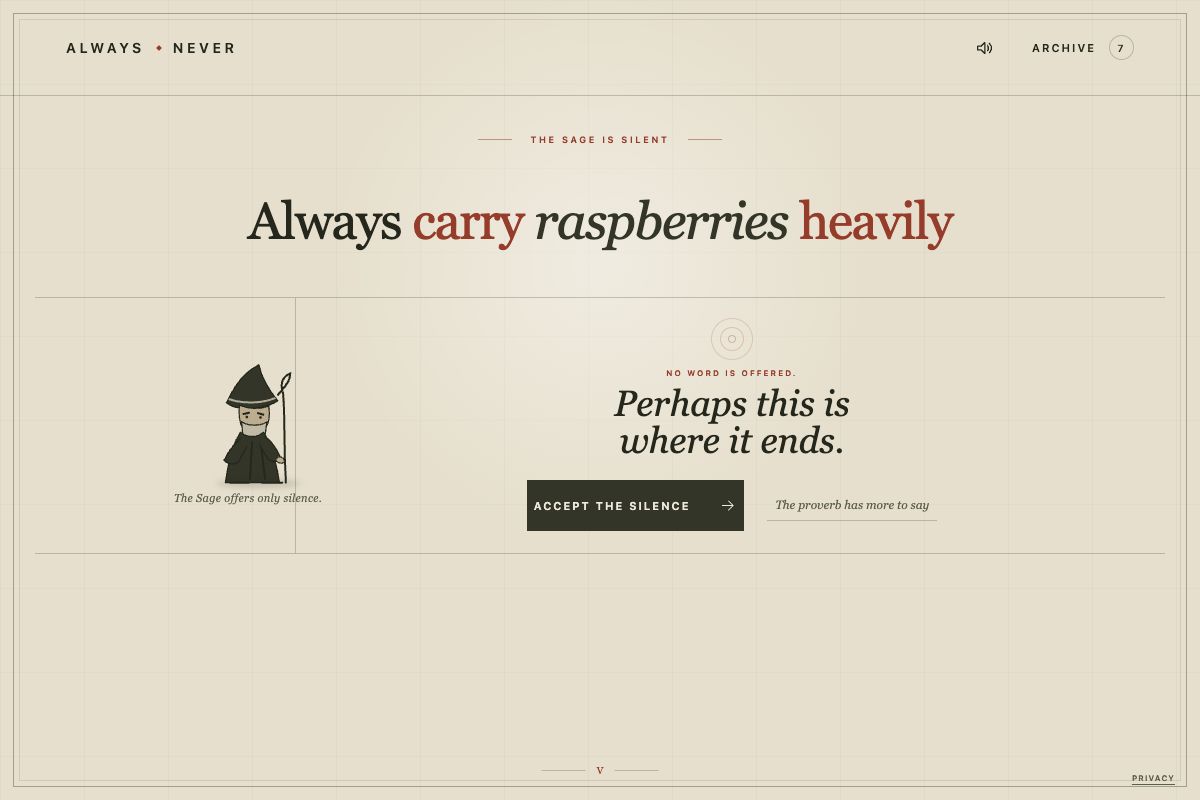
The Sage is silent
-
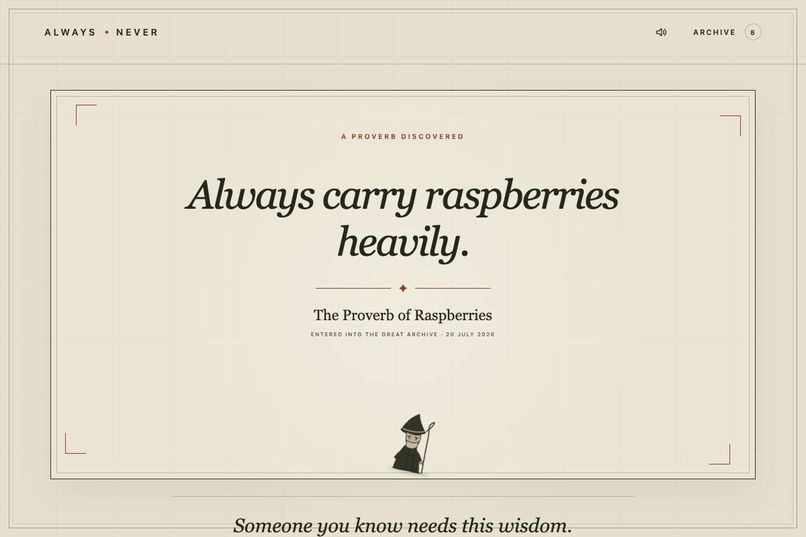
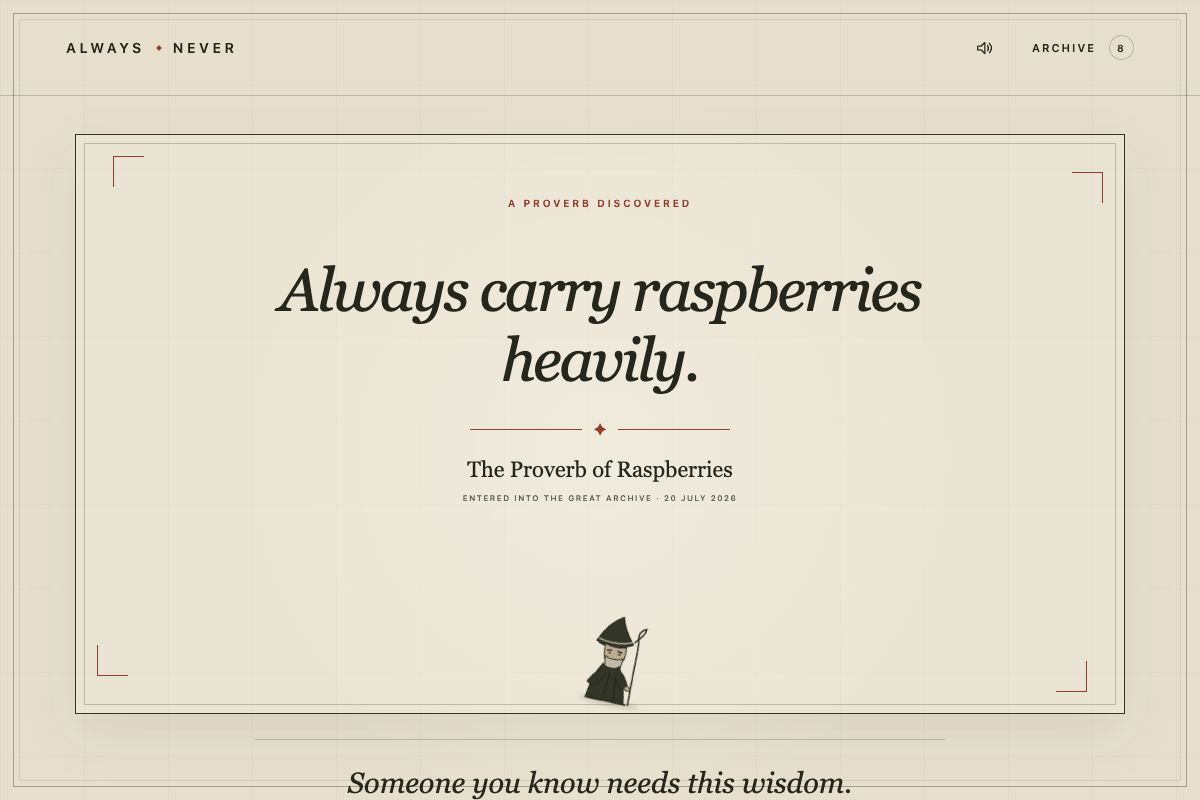
A proverb discovered
-
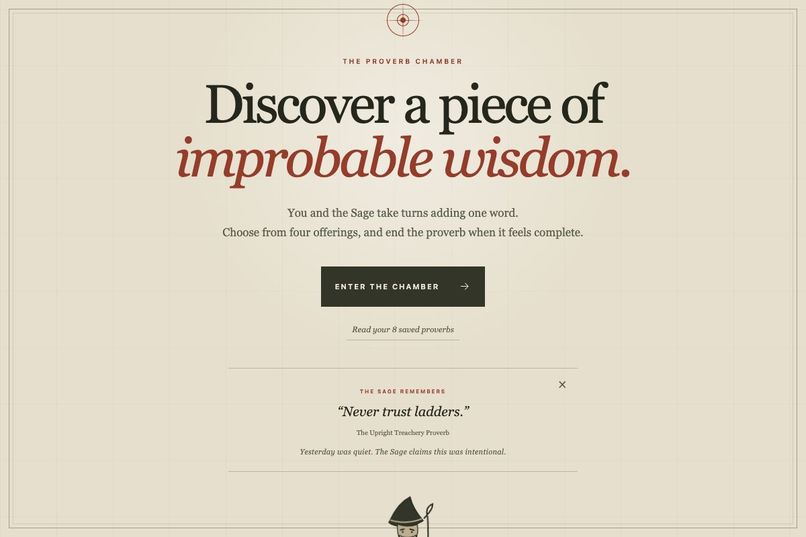
The Sage remembers
Inspiration
Hi, I’m Anthony, and I make small games.
Always Never grew from word-at-a-time improv games, where two people build a sentence without knowing where the other person will take it. I love the negotiation in that: the struggle to preserve meaning while embracing the unexpected. Moments of surprise, rescue and delightful near-nonsense.
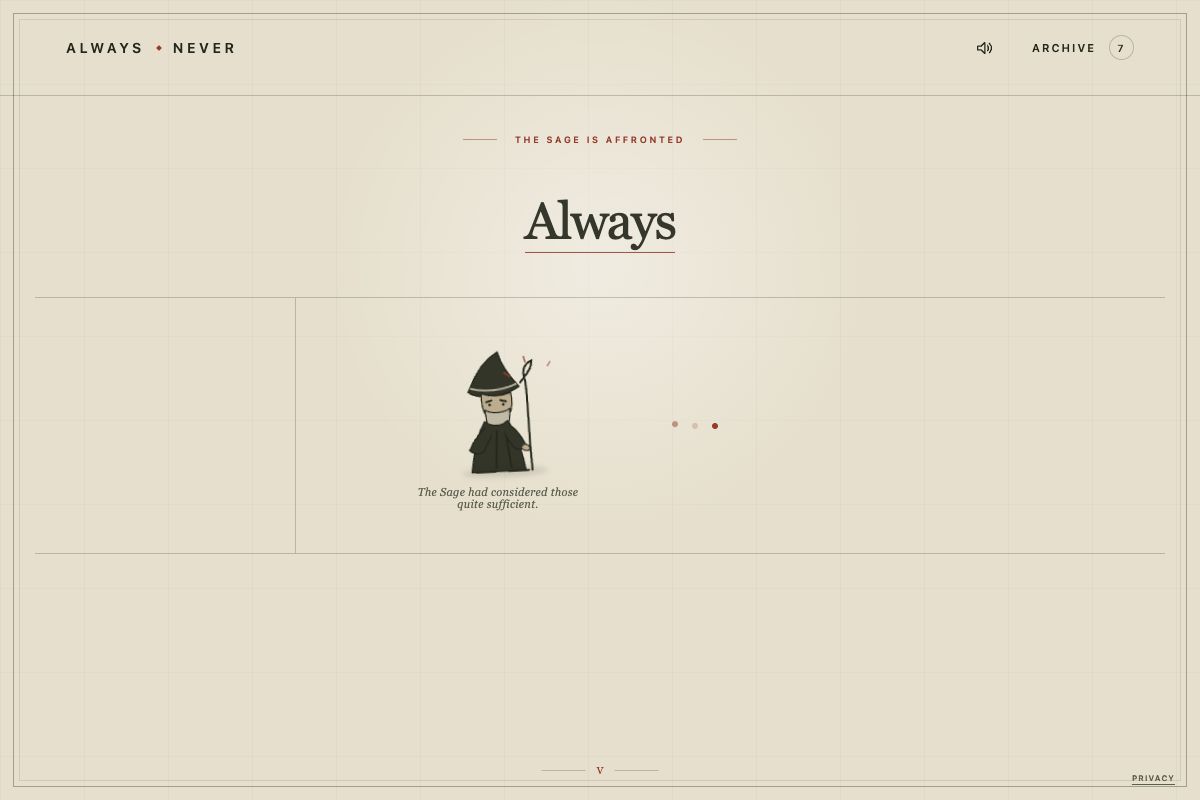
I wondered whether that relationship could work between a person and a strange software character. Not a chatbot waiting for a complete prompt, and not an AI that writes the joke for you, but an ancient Sage with opinions. He contributes one word. You choose the next. He may approve, become ruffled, fall meaningfully silent, or remember that you rejected his advice earlier.
The result is part word game, part comic relationship and part tiny ritual for stumbling across improbable wisdom.
What it does
Every proverb begins with Always or Never. The player and the Sage then take turns adding a single word. On each player turn, four choices offer different possible directions. If none feels right, the player can push back and ask the Sage for another offering—but risks incurring his wrath.
The Sage speaks. You choose. The Sage speaks. You choose.
Knowing when the proverb is ready is a matter of intuition. Once the opening exchange is complete, the player can end whenever it feels right—even with something as short as “Never trust ladders”—or accept the Sage’s own suggestion of completion when he offers silence. The finished proverb is sealed using the ancient tradition of five yeses and a bow.
It then receives an unexpected title and a permanent link. The player can keep it privately in My Proverbs, share it with a friend, or freely offer it to the public Great Archive. Shared links have proverb-specific preview cards, so the punchline can travel rather than arriving as a generic homepage.
For returning visitors, the Sage becomes a continuing character. His mood reflects the previous day’s anonymous activity, and once a day he remembers one stand-out proverb from the public archive.
How I built it
I built Always Never through one long conversation in OpenAI Codex, using GPT-5.6 Sol. I would play an iteration, bring back a proverb that felt awkward or a moment where the Sage seemed emotionally wrong, and describe the experience in ordinary language. Codex helped turn those observations into working browser and Worker code, tests and deployments. Early-player messages and screenshots became part of that same loop. It felt less like specifying a product in advance and more like yes-anding the game into existence.
The word engine itself is deliberately constrained. A local system tracks parts of speech, clause shape, agreement and what kinds of noun a verb can sensibly accept. It builds a safe pool of candidates; optional server-side AI ranking may arrange approved words, but it cannot simply take over and write the proverb. The player and the Sage must still discover it one word at a time.
GPT-5.6 also has a small live role. Each day, a conservative local filter shortlists up to eight promising public proverbs. GPT-5.6 acts as a restrained editor: it chooses one supplied entry for the Sage to single out and spotlight, classifying his reaction to it. The call uses a strict schema, short timeout, one-call daily budget and deterministic fallback, and the feature can be switched off independently.
The public game runs on Cloudflare Workers, with Cloudflare D1 holding permanent unlisted proverbs, voluntary Great Archive entries and daily selections. Players can sign, withdraw or permanently delete their own work without creating an account. Privacy-conscious activity events are folded into anonymous daily totals rather than stored as personal histories.
Challenges
The biggest challenge was making the dialogue feel grammatically plausible without squeezing out the ridiculous. Grammatically valid random words are still random words. The Sage needs to recognise when a verb expects a person rather than an object, when a preposition could unlock “in summer”, and when silence is wiser than one more strained adverb.
But a perfectly sensible Sage would ruin the game. Some of the funniest proverbs are defiant, sprawling or only just holding together. The aim is not perfect English. It is the playable tension between sense and delightful near-nonsense—and the player must retain the freedom to take things somewhere the Sage would never have chosen.
The other challenge was turning a tiny interaction into something worth keeping. The five yeses, the bow, the invented title, the permanent inscription and the Great Archive all emerged through iteration. They give a fleeting joke the feeling of a discovered object.
Every AI feature also needed a clear failure and cost story. Strict schemas, canonical server validation, short timeouts, rate limits, budgets, deterministic fallbacks and separate off switches mean the complete game remains playable if all OpenAI calls are disabled.
What I learned
The clearest lesson was that character comes from boundaries. The Sage became more convincing when he was allowed to do less: contribute one word, object briefly, become ruffled or offer silence. AI was most interesting here as a constrained comic collaborator, not an answer machine. Interestingly this mirrors a known improvisation principle: most improv games explore a space of possibilities within a deliberately constrained structure. The boundaries (and stretching them to the limit) are what create the playful possibility.
I also learned how valuable the language of real players is. “This word feels like sabotage”, “I want to defy him” and “this should feel like an archive” were better design instructions than a request to “improve the AI”. Codex let me translate those reactions into small, testable changes while the feeling of the moment was still fresh.
Accomplishments
- A complete, responsive game with a distinctive character and ceremony.
- More than 1,300 structurally and semantically tagged words.
- A grammar-aware Sage that preserves meaning without eliminating mischief.
- Permanent, controllable proverb archives and specific social-sharing cards.
- A privacy-conscious, browsable Great Archive and once-daily GPT-5.6 editorial choice.
- Independent fallbacks and cost controls for every OpenAI-powered feature.
- A live Cloudflare deployment backed by 75 automated tests.
What’s next
The next chapter is collective play: several people constructing one proverb with the Sage in a shared room. I also want to explore a restrained editorial rhythm around the public archive—proverbs that tickled, troubled or affronted the Sage—without cluttering the quiet first-time experience.


Log in or sign up for Devpost to join the conversation.