-
-
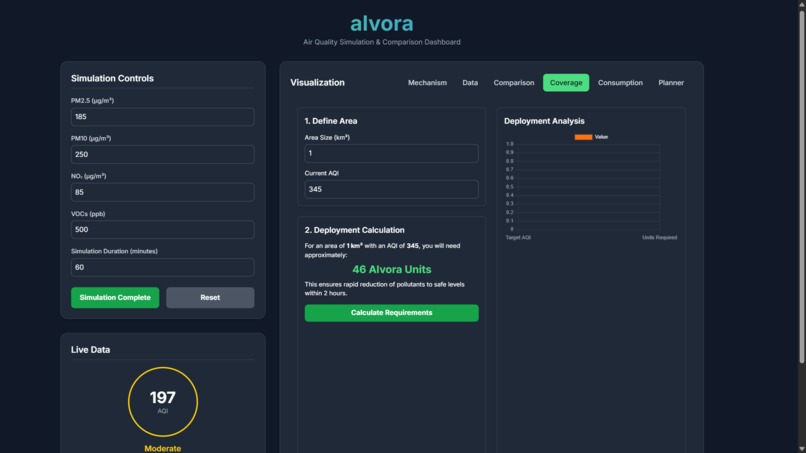
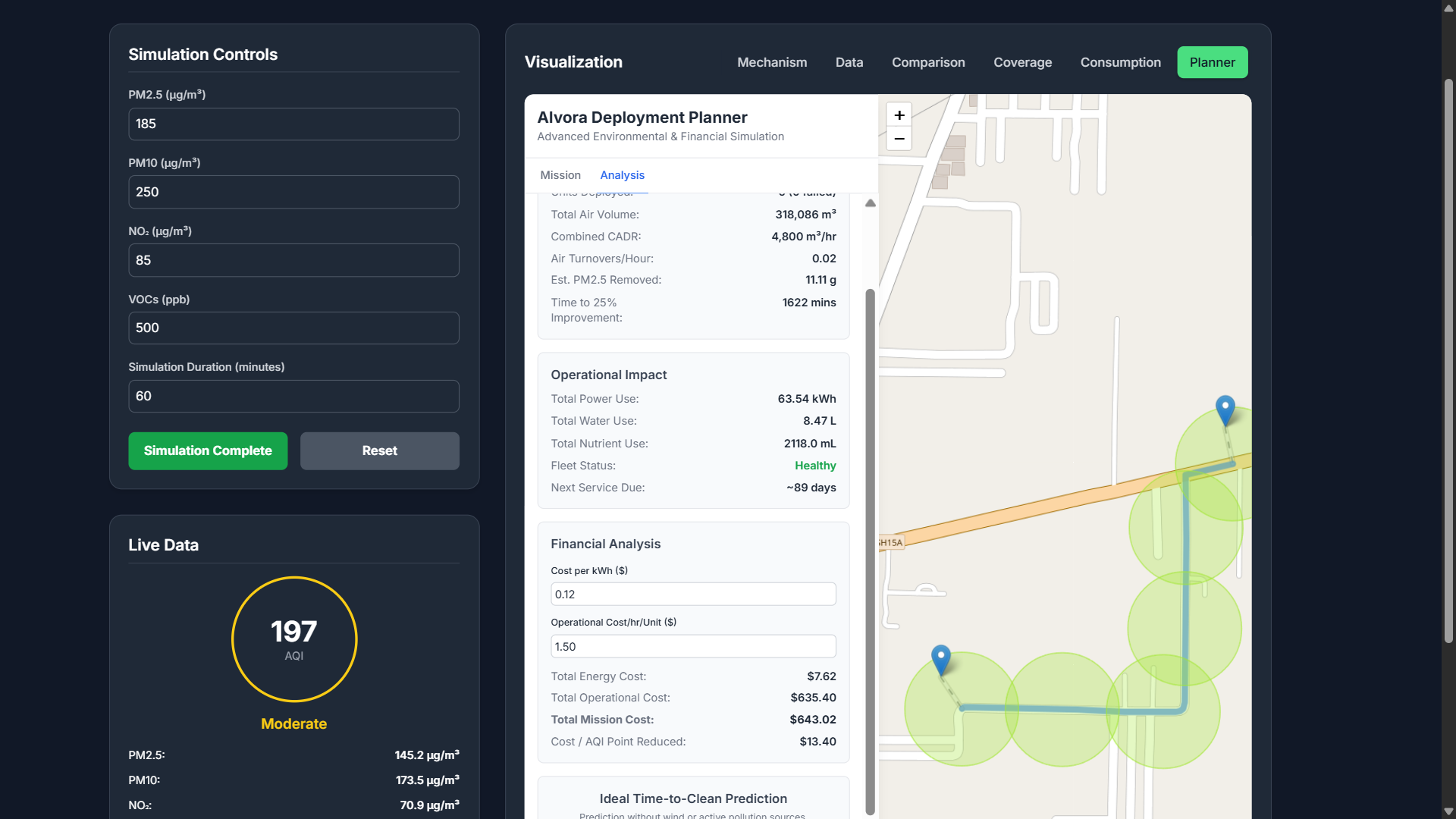
enegery consumption
-
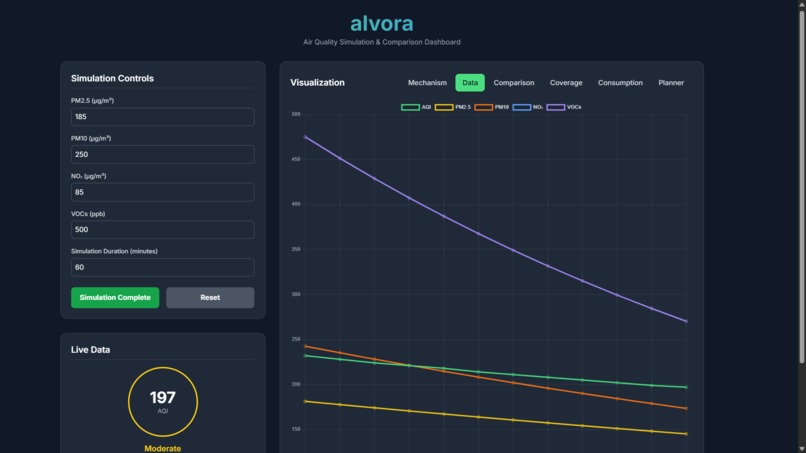
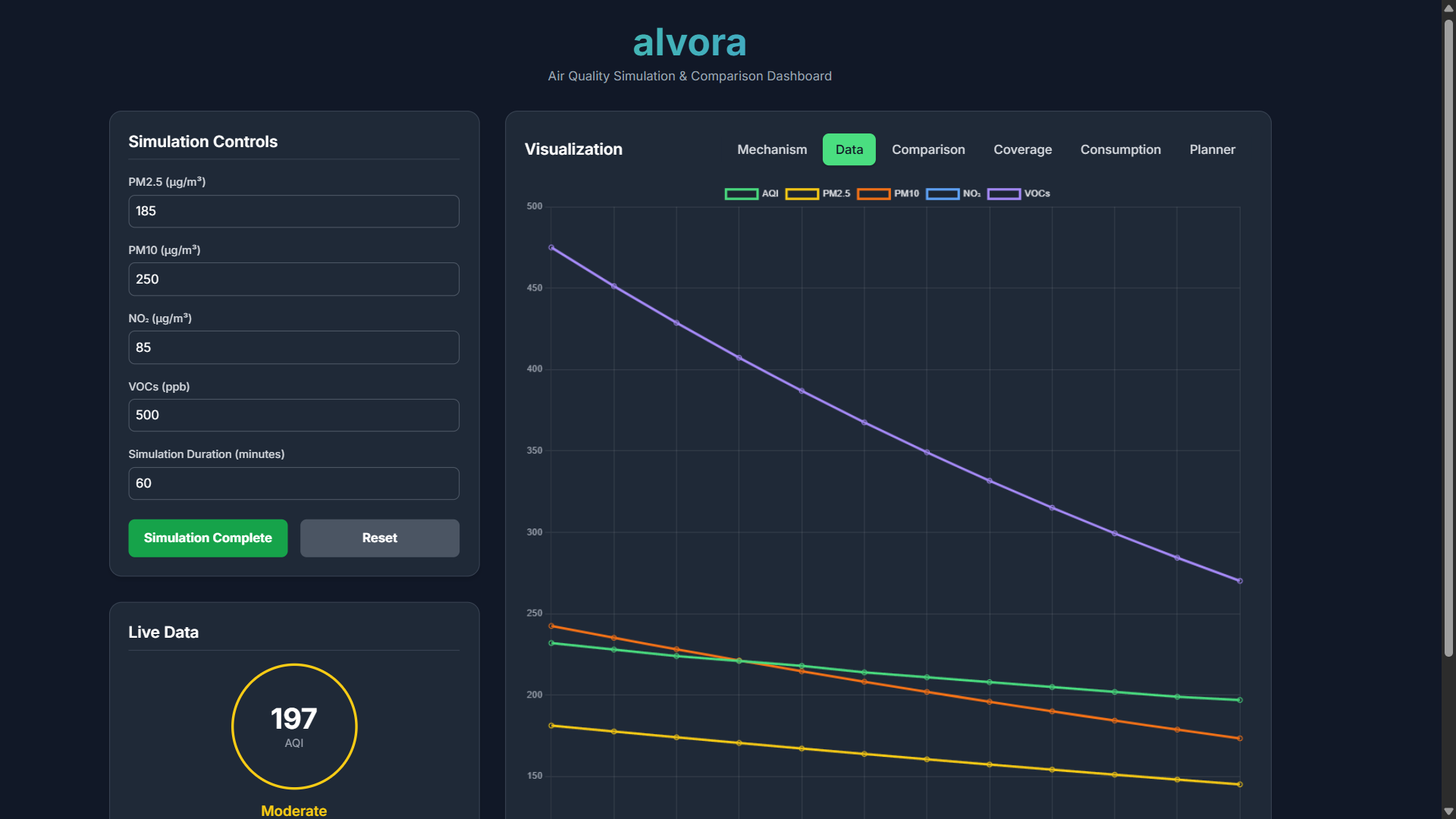
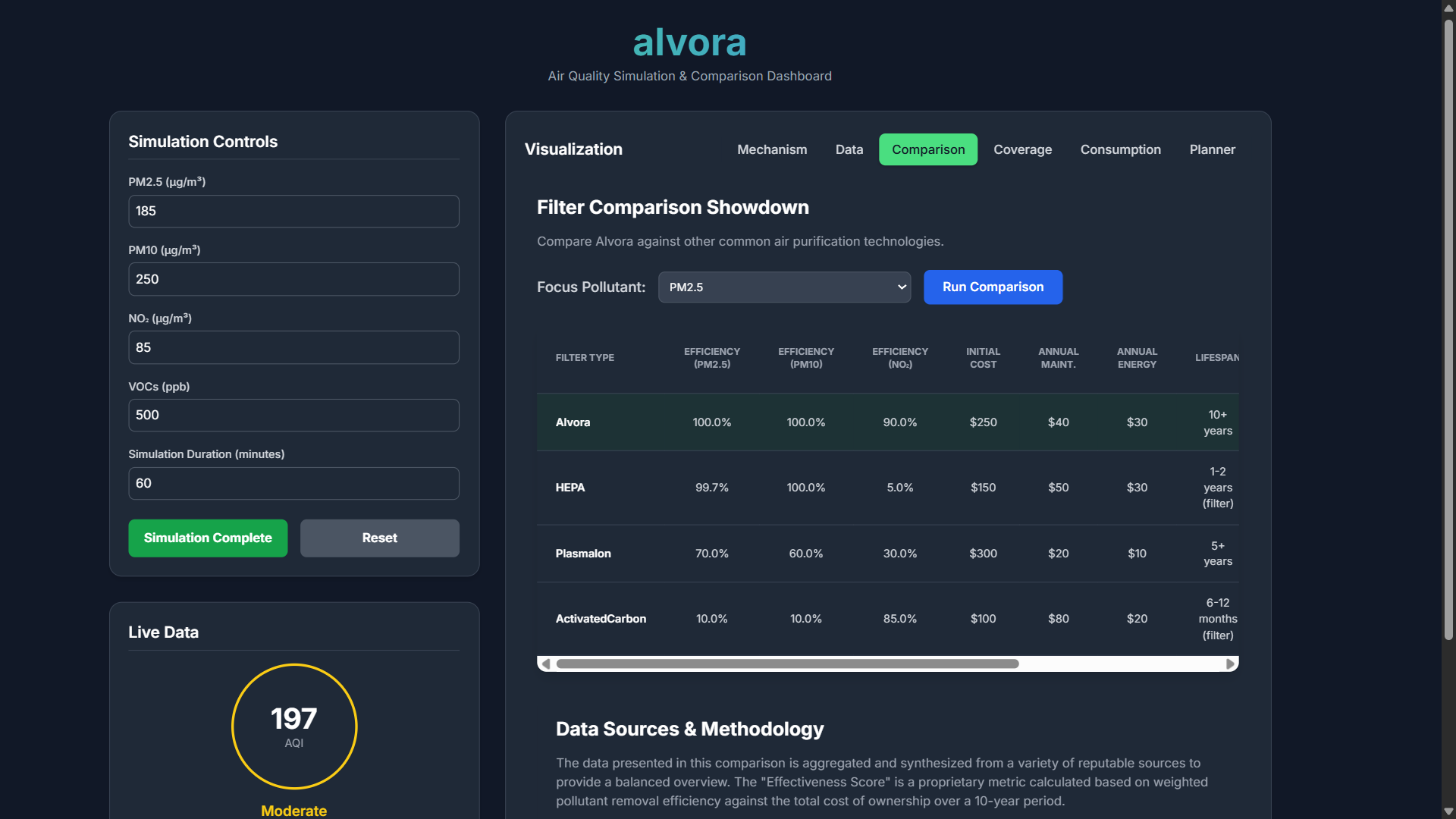
graphical analysies
-
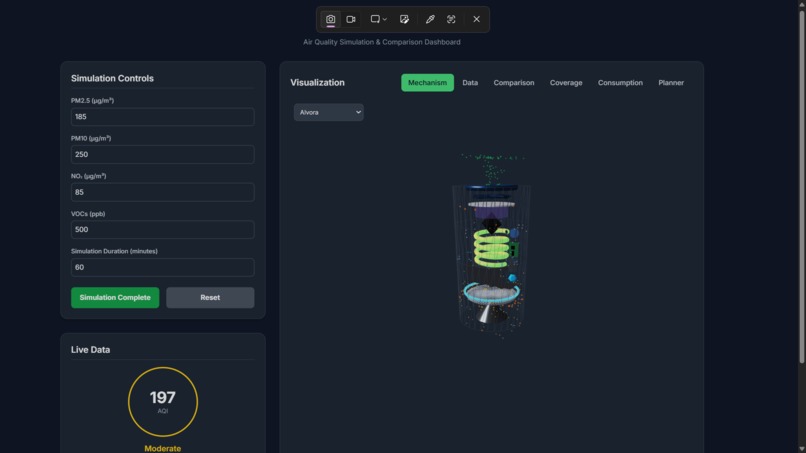
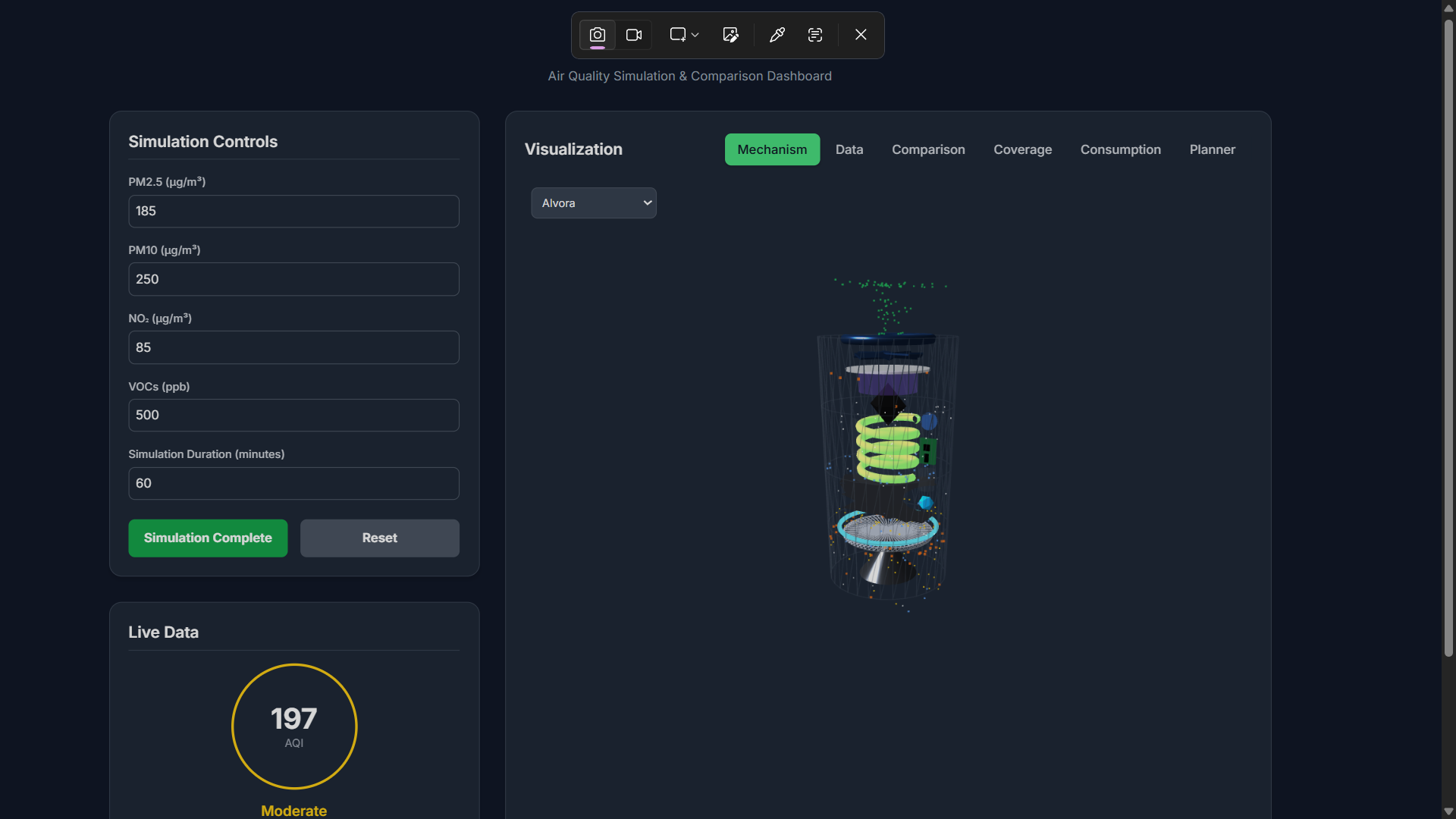
Main dashboard
-
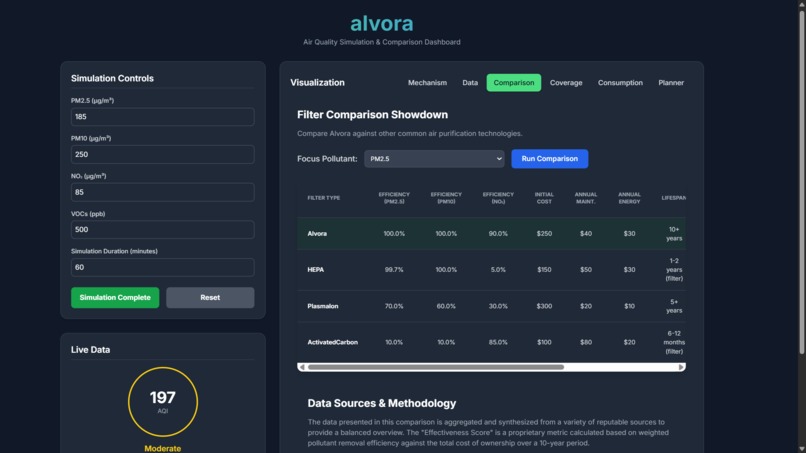
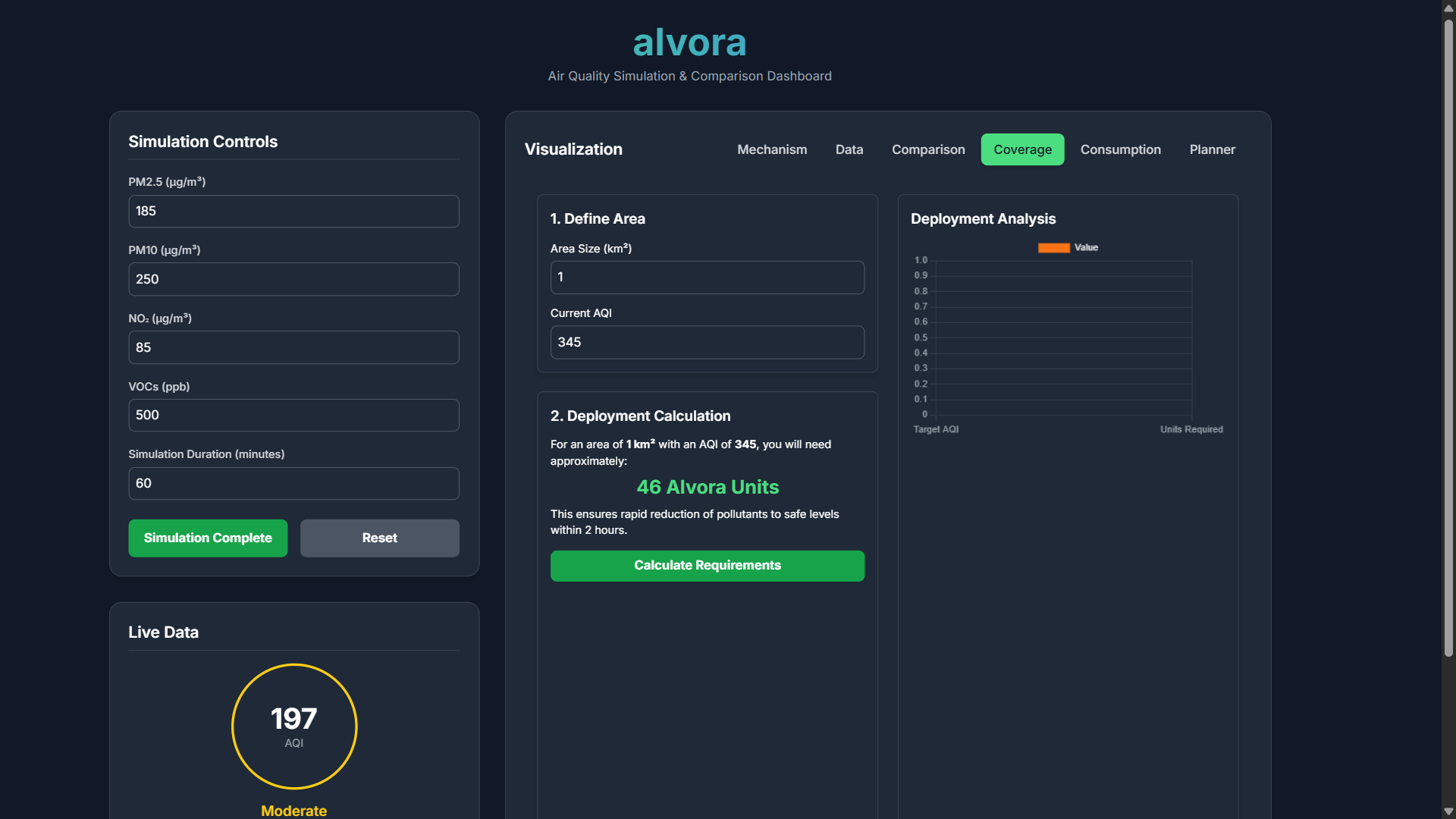
comparison table
-
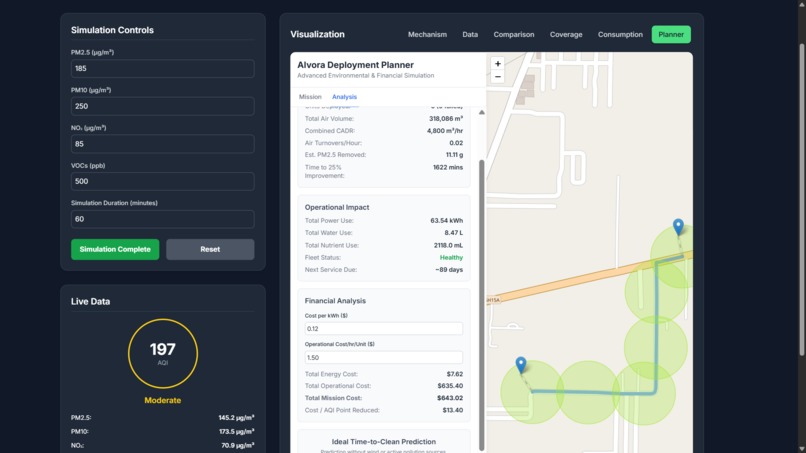
plantation planner
Air pollution kills over 7 million people annually according to WHO estimates — yet most purification solutions rely on energy-intensive filters, synthetic chemicals, or unsustainable manufacturing processes. The irony is stark: we're consuming more resources to fix a problem caused by consuming too much. The inspiration for ALVORA came from a simple observation — algae, one of Earth's oldest and most resilient organisms, performs photosynthesis at nearly 10–50× the efficiency of terrestrial plants. It absorbs CO2CO_2 CO2, releases O2O_2 O2, and thrives on what we consider waste: light, water, and carbon emissions. The question wasn't can algae purify air — science already confirmed that. The question was: can we engineer a system smart enough to make it practical?
What it does ALVORA is a bio-integrated air purification system combining living algae bioreactors with real-time environmental monitoring and IoT-based control logic. The system operates across three layers: LayerComponentFunctionBio LayerAlgae BioreactorCO2CO_2 CO2 absorption, O2O_2 O2 generationSensing LayerIoT SensorsTemperature, humidity, CO2CO_2 CO2, light monitoringControl LayerAutomated LogicNutrient dosing, light cycling, flow regulation Photosynthesis efficiency is actively maximized by monitoring and tuning key biological parameters: Photosynthesis Rate∝I⋅[CO2]Km+[CO2]\text{Photosynthesis Rate} \propto \frac{I \cdot [CO_2]}{K_m + [CO_2]}Photosynthesis Rate∝Km+[CO2]I⋅[CO2] Where II I is light intensity and KmK_m Km is the half-saturation constant. A real-time dashboard tracks composite air quality: AQIcomposite=f(CO2, PM2.5, VOC, O2%)AQI_{composite} = f(CO_2, \, PM_{2.5}, \, VOC, \, O_2\%)AQIcomposite=f(CO2,PM2.5,VOC,O2%)
How we built it Phase 1 — Biological Design Selected Chlorella vulgaris and Spirulina platensis as primary strains due to their high photosynthetic efficiency, rapid growth cycles, and tolerance to variable indoor conditions. Phase 2 — Hardware Integration Designed a compact bioreactor housing with:
Controlled LED grow lighting (λ=660nm\lambda = 660nm λ=660nm red + λ=450nm\lambda = 450nm λ=450nm blue spectrum) Continuous air bubbling for CO2CO_2 CO2 delivery and circulation Temperature regulation maintaining an optimal range of 25°C±2°C25°C \pm 2°C 25°C±2°C
Phase 3 — Monitoring & Control System Deployed sensor nodes feeding live data into an IoT dashboard, enabling automated responses to environmental fluctuations without manual intervention. Phase 4 — Research Validation Conducted controlled experiments measuring purification efficiency across varying algae densities, light cycles, and airflow rates — findings documented and submitted as a research paper.
Challenges we ran into Biological stability was the hardest problem. Algae cultures are sensitive — pH drift, contamination, or temperature spikes can crash a culture overnight. Designing failsafes and recovery protocols took significant iteration. Sensor-bioreactor feedback loop tuning required balancing response latency against measurement accuracy. Early prototypes overcorrected nutrient dosing, causing instability cycles that had to be damped algorithmically. Shifting audience perception was an unexpected challenge. Most people default to assuming air purifiers must be mechanical. Making the data compelling enough to overcome that assumption required rethinking how we communicate performance metrics entirely.
Accomplishments that we're proud of
🏆 SIH 2025 National Finalist — validated at one of India's most competitive student innovation platforms 📄 Research paper documenting purification efficiency with experimental data ⚙️ Built a fully functional prototype integrating biological, hardware, and software layers 📊 Developed a real-time AQI monitoring dashboard from scratch 🌱 Demonstrated that a living system can match or outperform conventional mechanical filters under controlled conditions
What we learned
Biological systems demand redundancy thinking that most engineers apply only to software — a single point of failure can kill a culture The intersection of synthetic biology and IoT is severely underexplored for climate applications despite massive potential Real-world constraints — space, maintenance burden, cost — matter as much as peak performance numbers Interdisciplinary execution (biology + hardware + software + research) is harder to coordinate than any single domain alone, but produces solutions no single domain could reach
What's next for Alvora: Sustainable Air Tech
🏠 Miniaturized form factor targeting residential deployment 🔗 Integration with smart home ecosystems — Alexa, Google Home, Matter protocol 🤖 ML-based algae growth modeling for strain-specific optimization and predictive maintenance 🌆 Pilot deployments in high-pollution urban corridors across India 📦 Modular scaling architecture — from desktop units to building-level installations 🤝 Partnerships with urban municipalities exploring green infrastructure mandates
ALVORA isn't a product that fights nature — it's a product built from it.

Log in or sign up for Devpost to join the conversation.