Alula
Team Members: Ephrem Adugna, Giselle Rein-Hagen, and Rianna Goenka
The Problem
PCOS—recently renamed polyendocrine metabolic ovarian syndrome (PMOS)—is a hormonal and metabolic condition that affects up to 18% of women of reproductive age. It is one of the most common chronic conditions among women, yet no drug has ever been FDA-approved specifically to treat it.
Without an approved treatment, women largely manage their own care, relying on lifestyle changes as their primary form of treatment. More than 70% turn to supplements, often based on advice from social media rather than a clinician.
The difficulty is that PCOS is highly individual. It presents as several distinct subtypes, and what improves one woman’s symptoms may do nothing for another. Effects can take months to appear and are influenced by diet, sleep, stress, and the menstrual cycle. As a result, most women cannot determine which parts of their routines are helping and which are not.
This leads to:
- Years of trial and error
- Recurring spending on products that may not work
- A condition that remains poorly understood by the women living with it
Supplement companies face the other side of the same problem. Once a product is sold, they have almost no visibility into whether it works—or for which women.
Clinical studies can cost hundreds of thousands to millions of dollars, enroll relatively small groups, take a year or more to complete, and become outdated by the time they are published. Reviews and testimonials do not count as evidence. Brands are also legally required to substantiate their health claims, and they increasingly need proof to compete.
Without real-world outcome data, brands cannot:
- Demonstrate what their products do
- Improve their formulas
- Identify the women most likely to benefit
Our Solution
Alula is a free, AI-powered digital twin for PCOS.
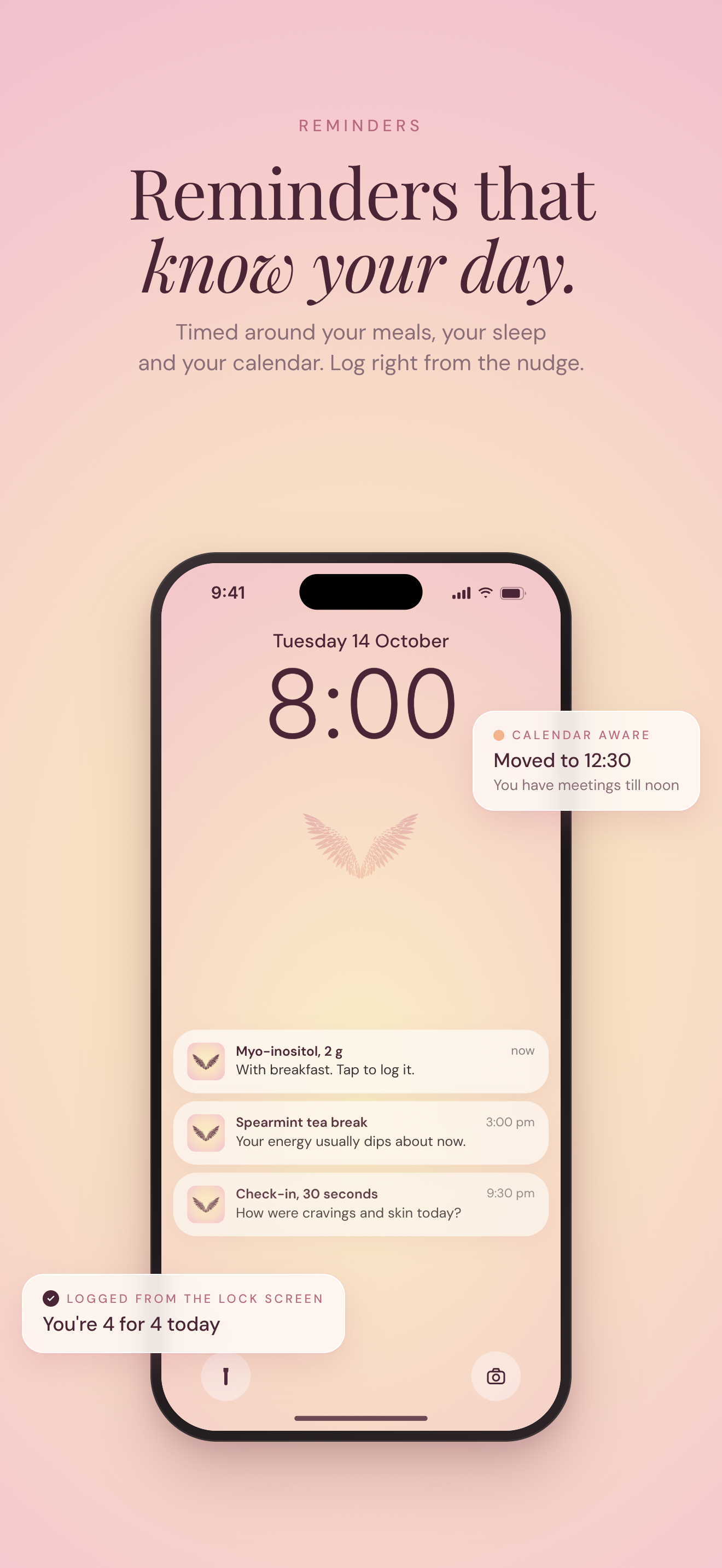
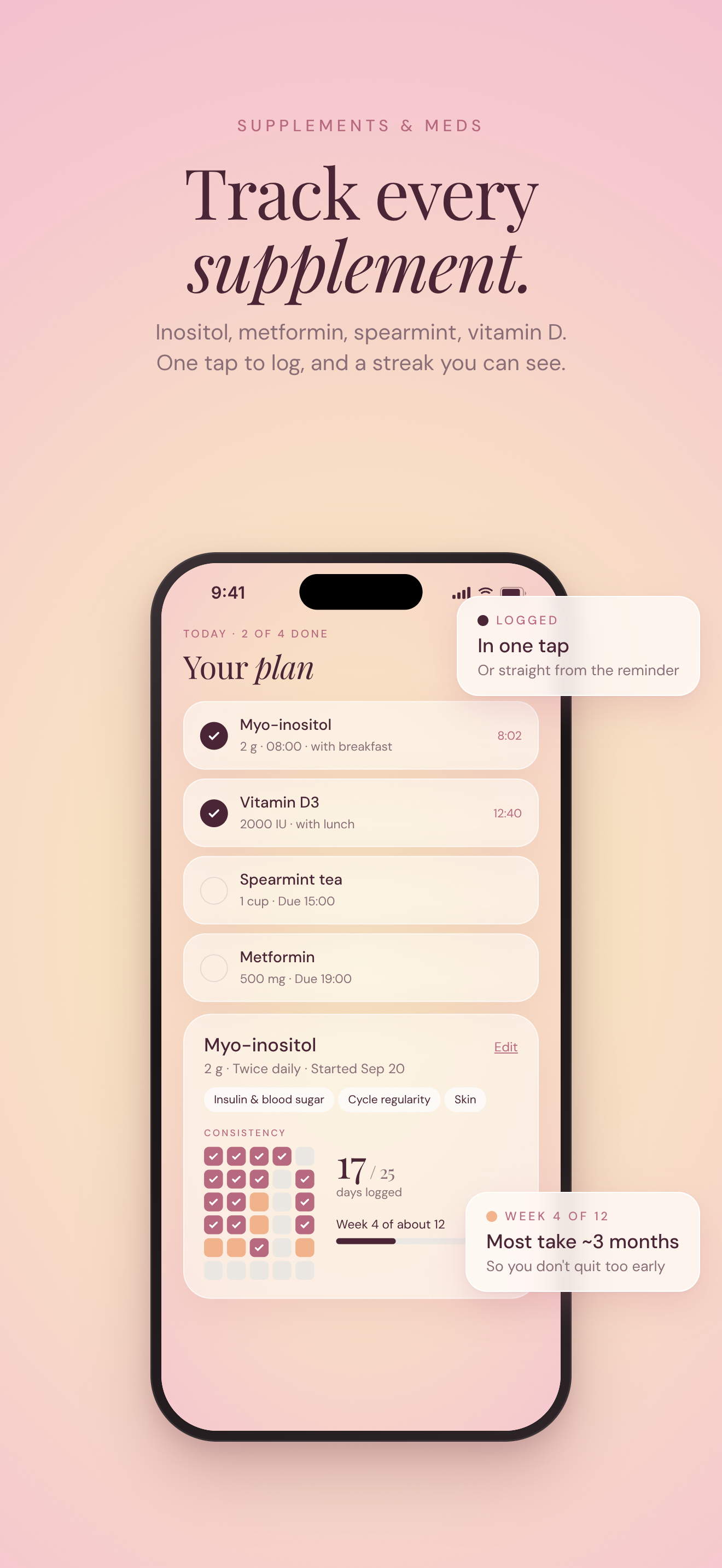
Alula automatically pulls data from Apple Health and lab results. Women can log supplements with one tap and describe their food and symptoms through voice or text.
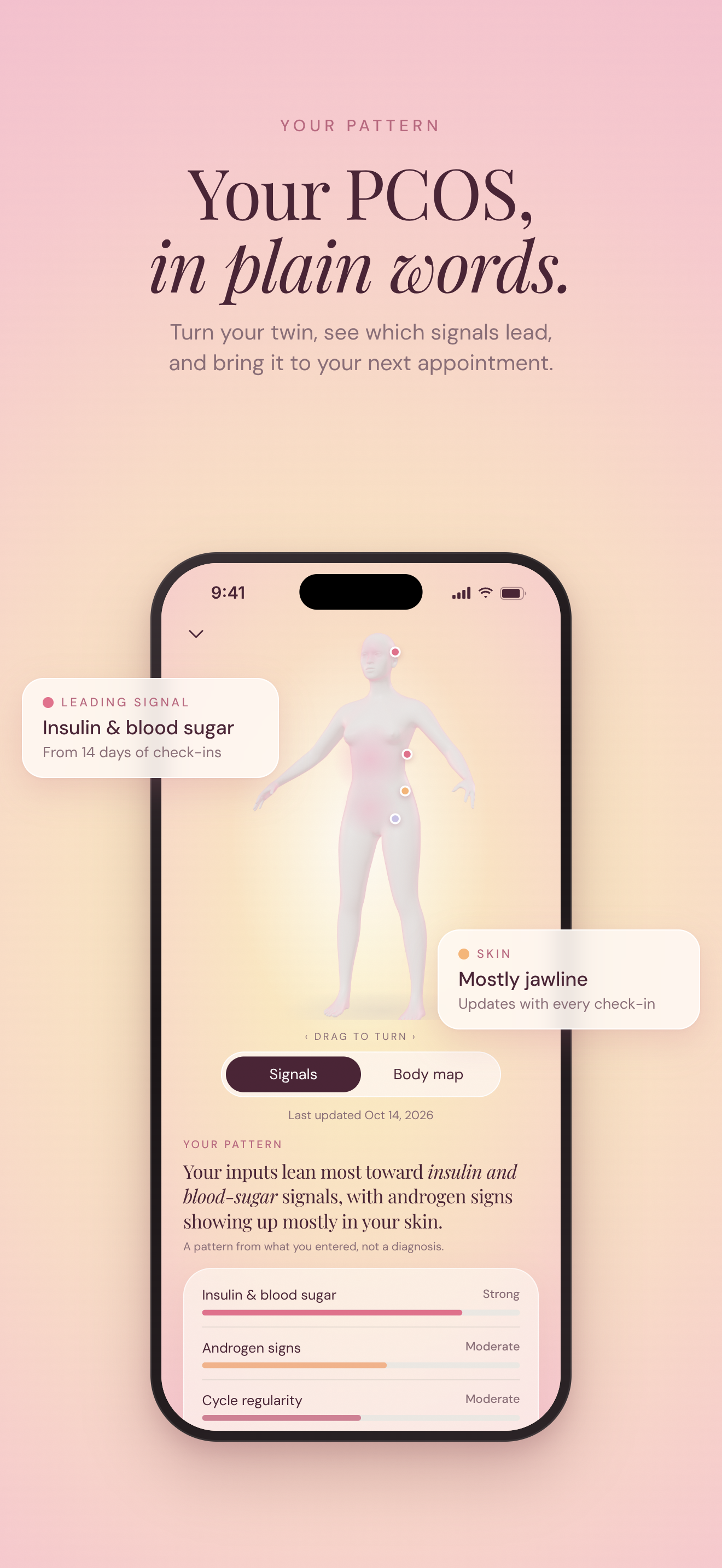
Alula’s AI structures every entry and correlates symptoms, diet, and supplements against each woman’s personal baseline. It surfaces patterns such as:
“Bloating rises the day after dairy.”
Every insight is accompanied by a clear confidence level.
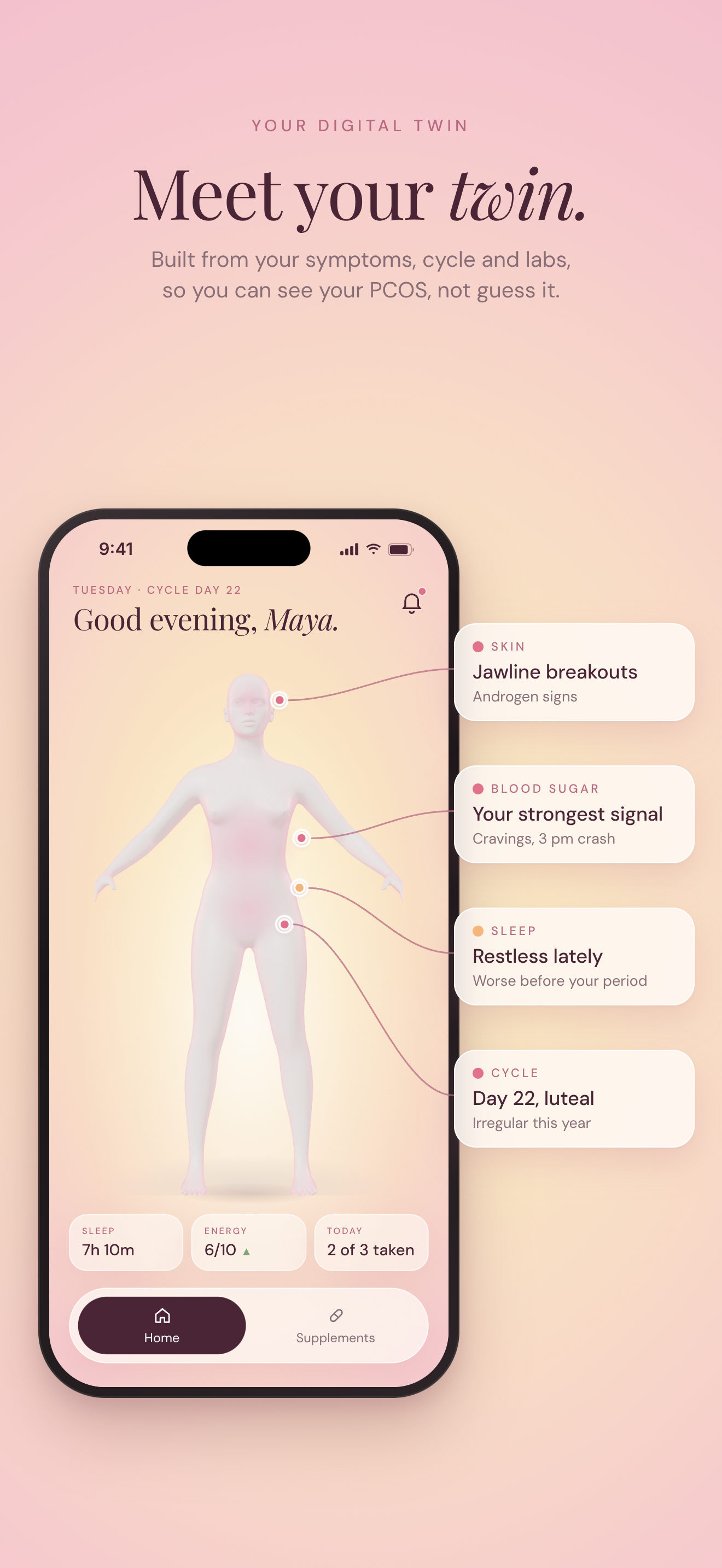
At the center of the experience is a digital twin: a visual model of each woman’s body built from her own data. She can view her hormone markers, ask how a supplement or meal may affect her, and watch the twin highlight the areas of her body most likely to respond.
Complex PCOS science becomes something she can see and understand.
With consent, anonymized patterns are pooled across the community so that every woman can benefit from what has worked for others with a similar profile.
Every log contributes to a de-identified, longitudinal dataset showing what works, for whom, in women’s health. Supplement brands and researchers pay for aggregate access to these insights.
Track: Continual Learning
PCOS has no universal treatment—only treatments that work for particular individuals. A static product cannot solve this problem.
A 2025 Nature Medicine study of more than 40,000 women identified four distinct PCOS subtypes, yet responses still vary widely within each subtype. Rule-based tools provide uniform guidance. Only a system that learns about each person over time can identify what is working for that individual.
Alula is designed to find that answer through continual learning.
Learning From Each User
Each user’s digital twin begins with her baseline data and improves with every log. Over time, it learns how her symptoms respond to:
- Specific foods
- Supplements
- Sleep
- Stress
- Menstrual-cycle changes
The result is a personalized model that becomes more precise with continued use.
Because a user’s physiology changes with new medications, lab results, weight shifts, and hormonal cycles, the model updates continuously. Its insights reflect the user’s current state rather than her state at sign-up.
Learning Across Users
The learning also compounds across the community.
With consent, de-identified patterns are pooled by profile. Each new user’s twin can begin with knowledge Alula has already gained from women with similar profiles, allowing it to become accurate sooner.
User corrections feed back into the models as labeled training data, while every brand study contributes to an evidence map showing how specific products perform for specific phenotypes.
A Compounding Data Asset
As Alula scales, the value of its dataset grows faster than its user count.
We are building a consented, longitudinal, phenotype-stratified record linking interventions to outcomes in women’s health—one of the least-researched areas in medicine.
Each additional user:
- Improves predictions for women with similar profiles
- Deepens the dataset’s statistical power
- Expands the range of products and conditions Alula can evaluate
Track: Scalability — Most Scalable to $1B
PCOS costs the U.S. healthcare system approximately $8 billion annually. The women’s health supplement market was valued at $34.2 billion in 2025 and is projected to reach $70.4 billion by 2035.
The larger opportunity is that brands, researchers, and pharmaceutical companies across women’s health lack individual-level outcome data. Alula is built to generate it.
Business Model
Alula is a two-sided data business:
- The app is free for women, maximizing the volume, diversity, and depth of its data.
- Enterprise customers pay for the aggregate insights that the platform produces.
Path to Scale
1. Build the User Base
Our initial goal is to reach 500,000 U.S. women with PCOS, representing roughly 10% of the affected population.
2. Generate Revenue From Supplement and Nutrition Brands
Brands purchase aggregate, de-identified evidence through independent, real-world outcome studies.
3. Expand Into Personalized Women’s Health Infrastructure
Alula’s pattern engine, digital twin, and data pipeline do not depend on any single condition. Each new vertical reuses the same platform while adding both users and buyers.
Potential expansion areas include:
- Endometriosis
- Perimenopause and menopause
- Thyroid disorders
- Fertility
- GLP-1 and metabolic health
With software margins and a compounding data asset, Alula has a credible path to more than $100 million in annual recurring revenue and a billion-dollar valuation.
Existing Demand
Demand already exists, with an established willingness to pay. Supplement brands increasingly compete on evidence and spend heavily to produce it.
Examples include:
- Milamend, a PCOS supplement brand, is funding a 225-woman decentralized PCOS study through People Science.
- Ritual has spent more than $5 million on clinical studies.
- AG1 has committed $20 million to research.
Today, each of these studies is a one-off project: expensive, slow, and outdated once published.
Alula produces comparable real-world evidence continuously and at scale, using data from women who are already engaged with the app.
Why Now
The timing is driven by four major shifts:
Science
The 2025 Nature Medicine subtype research established that PCOS requires personalized, phenotype-specific care.
Regulation
The FDA’s January 2026 general-wellness guidance widened the opportunity for consumer health software.
Artificial Intelligence
Large language models can now transform voice-first, unstructured journaling into structured health data at near-zero marginal cost. This removes the logging burden that previously made consistent tracking unrealistic.
Market
Evidence has become a competitive necessity for supplement brands, which are shifting budgets from marketing claims toward proof.
Track: Design — Best Visual Design
Design is how Alula earns its data.
The platform’s value depends on women logging consistently for months, so every design decision serves two goals:
- Make tracking effortless enough to sustain.
- Make a complex condition easy to understand.
Better design drives higher retention, and higher retention produces richer data for both users and enterprise customers.
Daily Logging
Daily logging is designed to take only seconds.
- Supplements appear as one-tap checkboxes, prefilled from the user’s supplement stack with scheduled times attached.
- Everything else goes into a single “Tell me about your day” field, which the user can type into or complete by voice.
- The AI automatically sorts each entry into symptoms, diet, and supplements, eliminating forms and multi-field daily surveys.
- Photo prompts for skin or hair can appear daily or weekly on a schedule chosen by the user, accompanied by gentle reminders.
- Past entries remain one tap away in the journal calendar.
- Missing a day never breaks the user’s progress.
- Wherever possible, data is collected passively through Apple Health.
Alula also offers a check-in call that can replace typing entirely. During a short, scheduled conversation, the user simply talks through her day and the app logs it for her.
She controls:
- The timing
- The frequency
- How the call appears on her phone
The Digital Twin
At the center of the experience is a personalized 3D model of each woman’s body, built from her measurements, lab results, and logged data.
Hormone levels and other key markers appear directly on the body as labeled readouts. The view adapts to the symptoms on which the user is focused.
She can ask the twin questions such as:
- “How might magnesium affect me?”
- “What could a weekend of alcohol do to my symptoms?”
The twin then highlights the areas of her body most likely to respond and provides an answer based on her own data.
PCOS involves hormones, metabolism, and symptoms that are difficult to understand in the abstract. The digital twin turns them into something the user can see.
Women learn about their condition visually and personally rather than through generic clinical text.
A Design Built on Trust
Every insight is labeled with a confidence level and presented as a pattern found in the user’s own logs—not as definitive proof.
Clear “not medical advice” guidance appears wherever recommendations are shown. Women understand Alula as a tool for having more informed conversations with their doctors, not as a replacement for professional medical care.
Privacy is visible and remains under the user’s control:
- Apple Health data stays on her device.
- Sharing anonymized data requires explicit opt-in consent.
- Consent can be withdrawn at any time.
Visual Identity
Alula uses:
- A warm palette ranging from cream to rose
- Deep-plum text
- Playfair Display serif headings
- Clean DM Sans body text
- A winged logo
- An auric background
The experience is intended to feel calm, warm, and personal—a deliberate contrast to the clinical blue-and-white aesthetic common among health applications.
