-
-
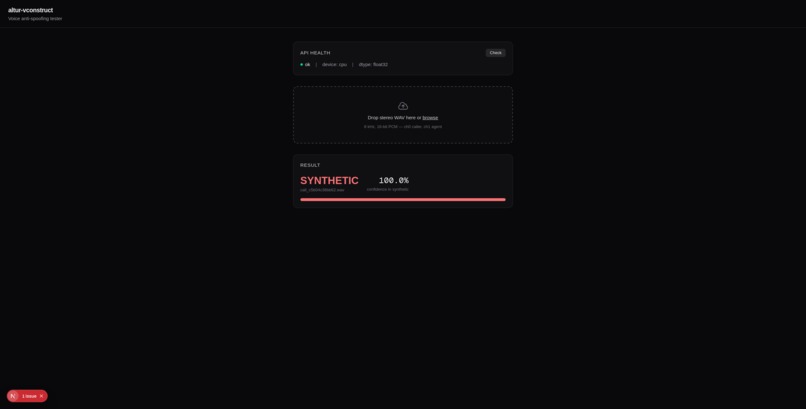
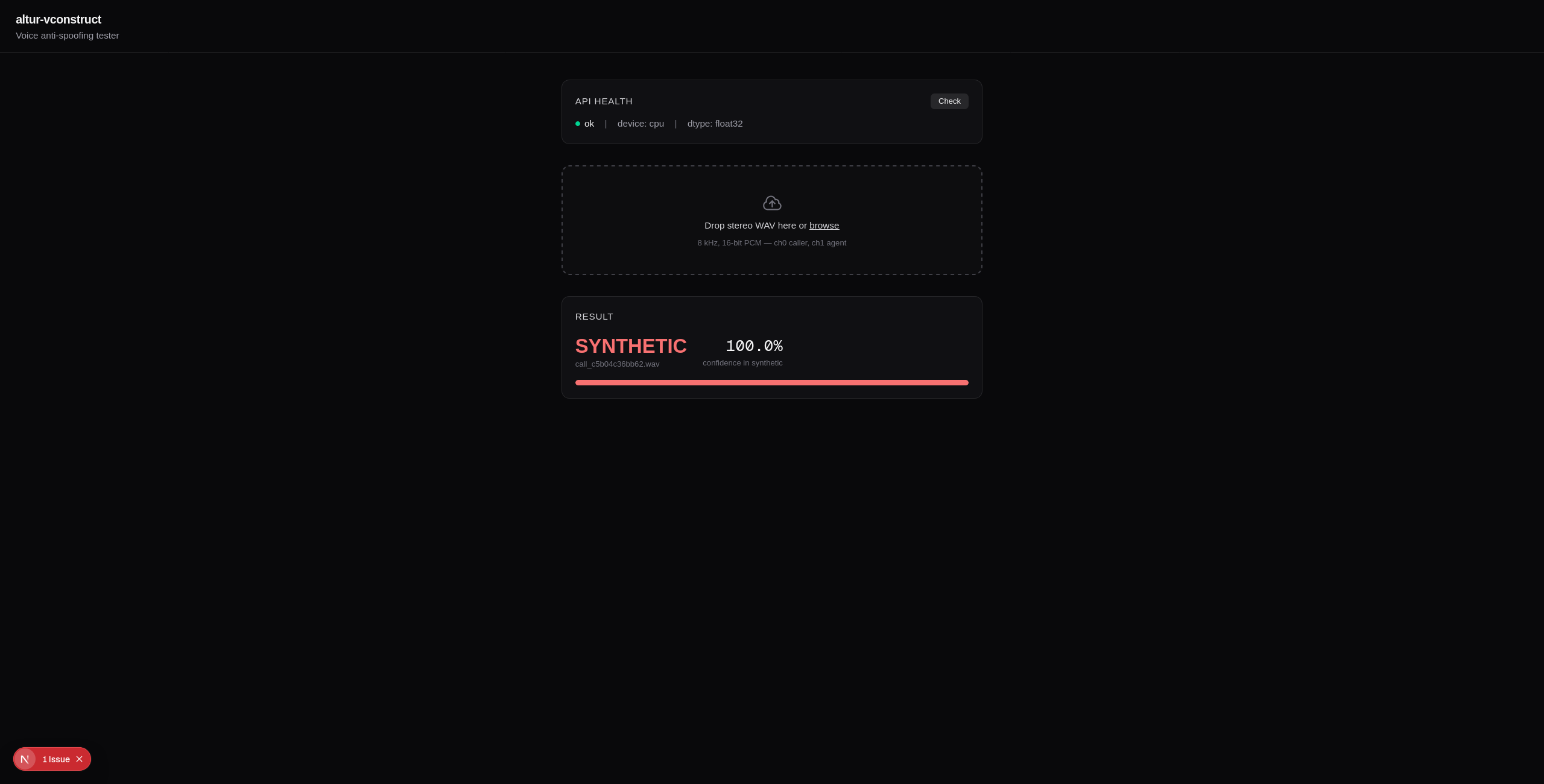
Analysis UI detecting a synthetic voice.
-
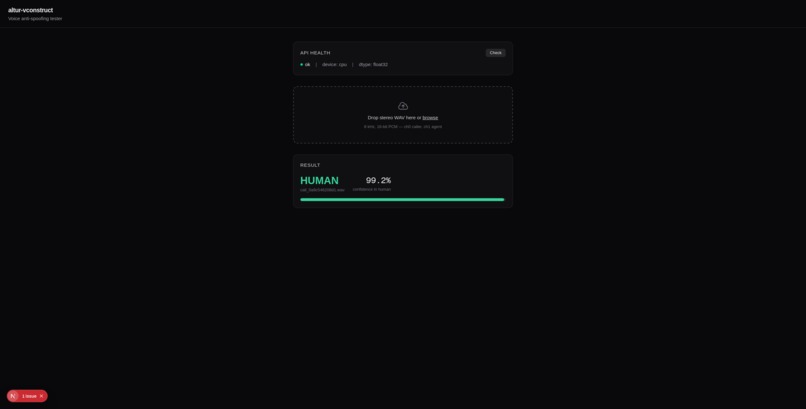
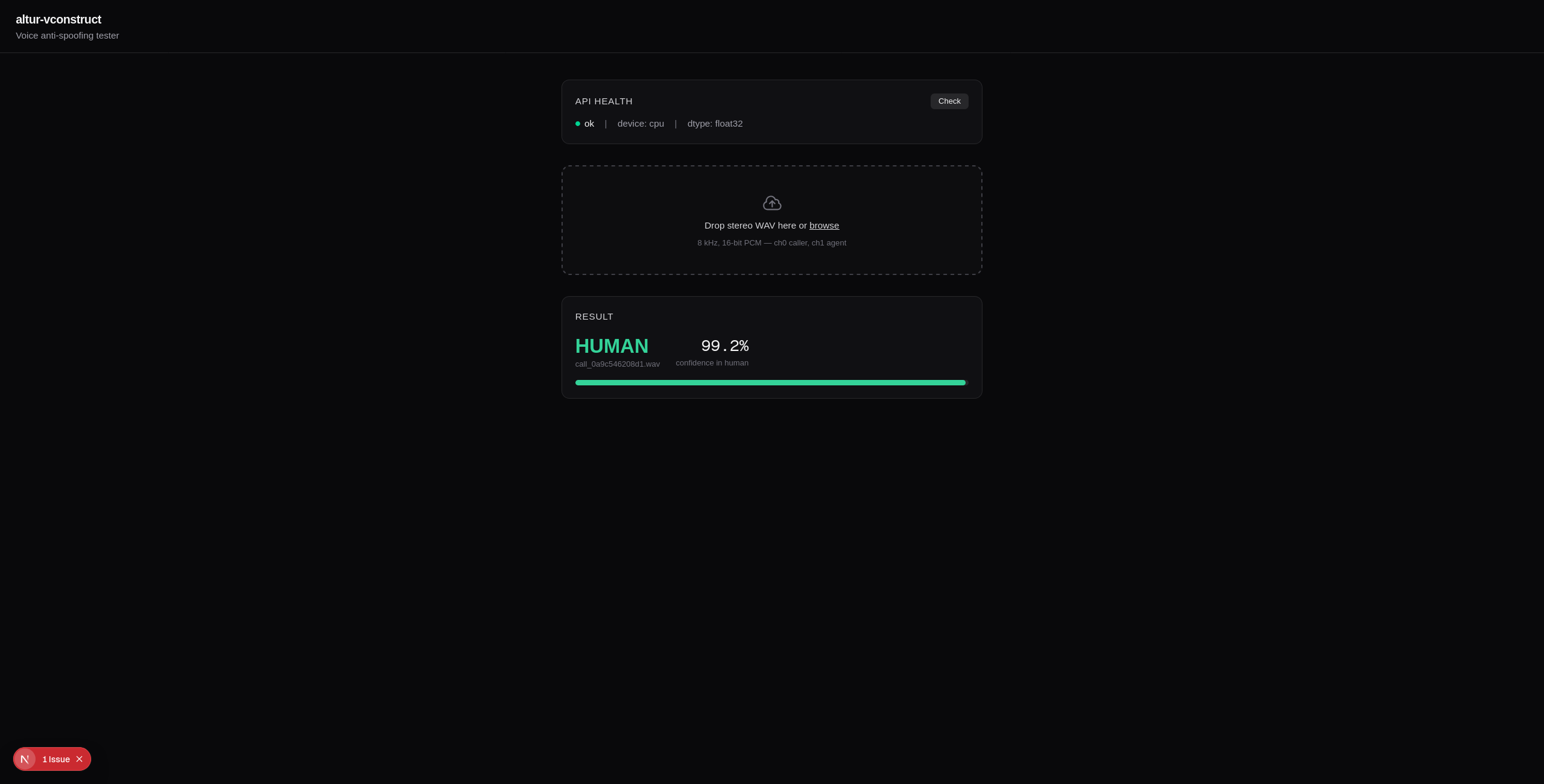
Analysis UI detecting a human voice.
altur-vconstruct
Tagline: Reality has a voice. We know it.
Inspiration
Voice deepfakes are reshaping fraud. A synthetic caller can impersonate a bank's own agent, a family member, or a government official, and the victim hears a perfectly human voice. Altur builds AI voice agents for banks across Latin America, handling millions of real calls. If synthetic voices infiltrate those calls, trust collapses.
We asked ourselves: can a model learn the subtle acoustic fingerprint that separates a real human vocal tract from a neural vocoder?
The answer is yes — and it can do it in about half a second per call on CPU.
What it does
altur-vconstruct is a voice anti-spoofing API. Given a stereo phone call recording, it determines whether the incoming caller is a real human or a synthetic voice (TTS deepfake).
POST /detect
  Body:  {"audio_base64": "<stereo 8kHz WAV>"}
  Resp:  {"is_synthetic": false, "confidence": 0.92}
The system works on real telephony audio — 8 kHz, compressed, noisy — not clean lab recordings. It's designed to sit in-line with Altur's call infrastructure and score every call. A small Next.js UI ships with it for dragging in a WAV and seeing the verdict, the confidence and the endpoint's health.
How we built it
SSL + MLP two-stage architecture:
WavLM-large (Microsoft, 300M params) as a frozen self-supervised backbone: it extracts 1024-dimensional acoustic embeddings from 4-second audio windows during training, and from a single 3-second window at inference. We chose WavLM over wav2vec2 and XLS-R because it achieves the lowest EER (2.29%) on ASVspoof 2021, the standard anti-spoofing benchmark.
3-layer MLP classifier (1024 → 256 → 128 → 1, ~296K params) with BatchNorm and Dropout — trained on frozen embeddings. With only 282 training calls, we couldn't fine-tune the backbone without overfitting. The MLP trains in seconds, enabling rapid iteration.
Telephony augmentation of the training set — our
apps/datasetmodule generates deterministic variants of every training call (caller/agent latency shift, gain + 18-30 dB noise, packet-loss dropouts with clock-rate drift). That takes the training pool from 282 calls to 846 augmented calls (~800+ training calls), so accuracy holds up no matter which condition the judge's audio carries. Validation audio is never augmented.Isotonic calibration — maps raw classifier scores to well-calibrated probabilities. The challenge uses
confidencefor tie-breaking, so arbitrary sigmoid outputs weren't acceptable.ONNX Runtime — we export WavLM to ONNX at Docker build time, cutting inference latency ~2x on CPU versus PyTorch. The Docker image is lean: no transformers, no GPU libs.
Key insight: Instead of scoring all ~119 overlapping windows from a 3-minute call, we score the single highest-energy caller window. A human sounds human everywhere; a synthetic voice sounds synthetic everywhere. Picking the window by caller-channel energy keeps that one extraction away from silence or greetings.
Challenges we ran into
Small dataset, big model. 282 training calls with a 300M-parameter backbone. Fine-tuning was a trap, the model memorized speakers instead of learning spoof patterns. Frozen embeddings + lightweight head was the answer.
Too little clean audio. The dataset is small and comparatively clean compared with real phone traffic. Rather than hope the judge sends the same conditions, we built a deterministic augmentation module and grew the training pool to ~800+ calls with noise, gain, packet-loss and latency-shift variants.
8 kHz telephony audio. WavLM expects 16 kHz. The 8 kHz → 16 kHz resampling step is mandatory and adds a dependency (torchaudio). Getting the resampling right without introducing artifacts was non-trivial.
Latency is a scoring criterion. Every design decision had to pass a latency budget. Window sampling, ONNX export, lazy model loading, all driven by the constraint that judges would time the endpoint.
Confidence calibration. Raw sigmoid outputs are not probabilities. Platt scaling assumed a logistic shape that didn't match our bimodal score distribution. Isotonic regression solved it, but fitting it correctly required careful validation-set handling.
Docker image size. Full PyTorch + transformers is ~2GB. The multi-stage build (download + ONNX export in builder, copy only ONNX model to runtime) cutting the image to a fraction of that.
Accomplishments that we're proud of
- ~0.5-0.6s average inference per call on CPU, down from ~1.0-1.2s before window selection and ONNX thread tuning, with well-calibrated confidence scores
- Robust by data, not by size — ~800+ augmented training calls from a 282-call split, so accuracy survives noise, level differences, packet loss and latency shifts
- Clean architecture — frozen SSL backbone, cached embeddings, separate train/API modules, ONNX runtime path
- Thorough benchmarking — PyTorch vs ONNX comparison, per-stage pipeline breakdown, latency profiling across audio durations
- Production-ready deployment — Docker multi-stage build, GHCR images, health endpoint, web UI, env-driven config, integration tests, plus a judge-style harness that scores the live endpoint the way the judges will
- Honest documentation — every design decision has a rationale, alternatives considered, and trade-offs acknowledged
What we learned
- Frozen SSL embeddings are surprisingly powerful. You don't always need to fine-tune. With the right backbone and a small head, you can get strong results on tiny datasets.
- Latency constraints shape architecture. The single high-energy window trick was born from a scoring rule, not from ML theory, but it works because spoof signals are consistent across time.
- Calibration matters more than accuracy. A well-calibrated 90% confidence is more useful than a poorly-calibrated 99%. Judges notice.
- ONNX is worth the export hassle. 2x CPU speedup with zero accuracy loss is a free lunch for deployment.
- Speaker-disjoint splits are non-negotiable. Without them, the model learns "which speaker" not "human vs machine."
What's next for altur-vconstruct
- Conversational features — use both channels (caller + agent) to detect response latency patterns, interruption behavior, and silence handling. The turn JSONs are already there.
- Multi-engine robustness — test against more TTS engines (Bark, XTTS, Parler, F5-TTS) to ensure the model generalizes beyond what Altur provided.
- Streaming detection — score incrementally as the call progresses, returning a verdict as early as possible instead of waiting for the full recording.
- Model compression — explore distillation or quantization to shrink WavLM for edge deployment.
- Real-time integration — plug into Altur's call pipeline as a middleware filter, flagging suspicious calls before they reach human agents.
Built With
- ai
- docker
- google-cloud
- ml
- multilayer-perceptron
- onnx-runtime
- python
- ssl
- wavlm


Log in or sign up for Devpost to join the conversation.