Inspiration
STEM education is great at teaching facts and terrible at teaching systems. Students learn Newton's laws, then meet the real world — classrooms, ecosystems, economies, epidemics — where nothing has a single clean answer and everything has second-order effects. Ban phones to raise focus, and conflict moves to the hallway. Change one variable in a complex system and three others you weren't watching shift too. That intuition — that systems push back — is the heart of biology, economics, climate science, and engineering, and almost no classroom tool lets you feel it.
The other gap is the scientific method as a verb. Textbooks describe controlled experiments; students rarely get to run one. What does it actually mean to "hold variables constant," "change one thing," and "measure the difference"? You need a reproducible world to even ask.
AltiVerse was built to make both tangible. The metaphor is simple enough for a 13-year-old: fork a decision the way you fork a git branch, and watch the alternate worlds drift apart. Underneath, the student is doing real computational science — running a controlled experiment on an agent-based model and interpreting the data it produces.
And it had to be accessible to anyone: free, no account, no install friction, and runnable fully offline on a low-end laptop — because the students who most need ambitious tools are the least likely to have a paid API key or a fast connection.
What it does
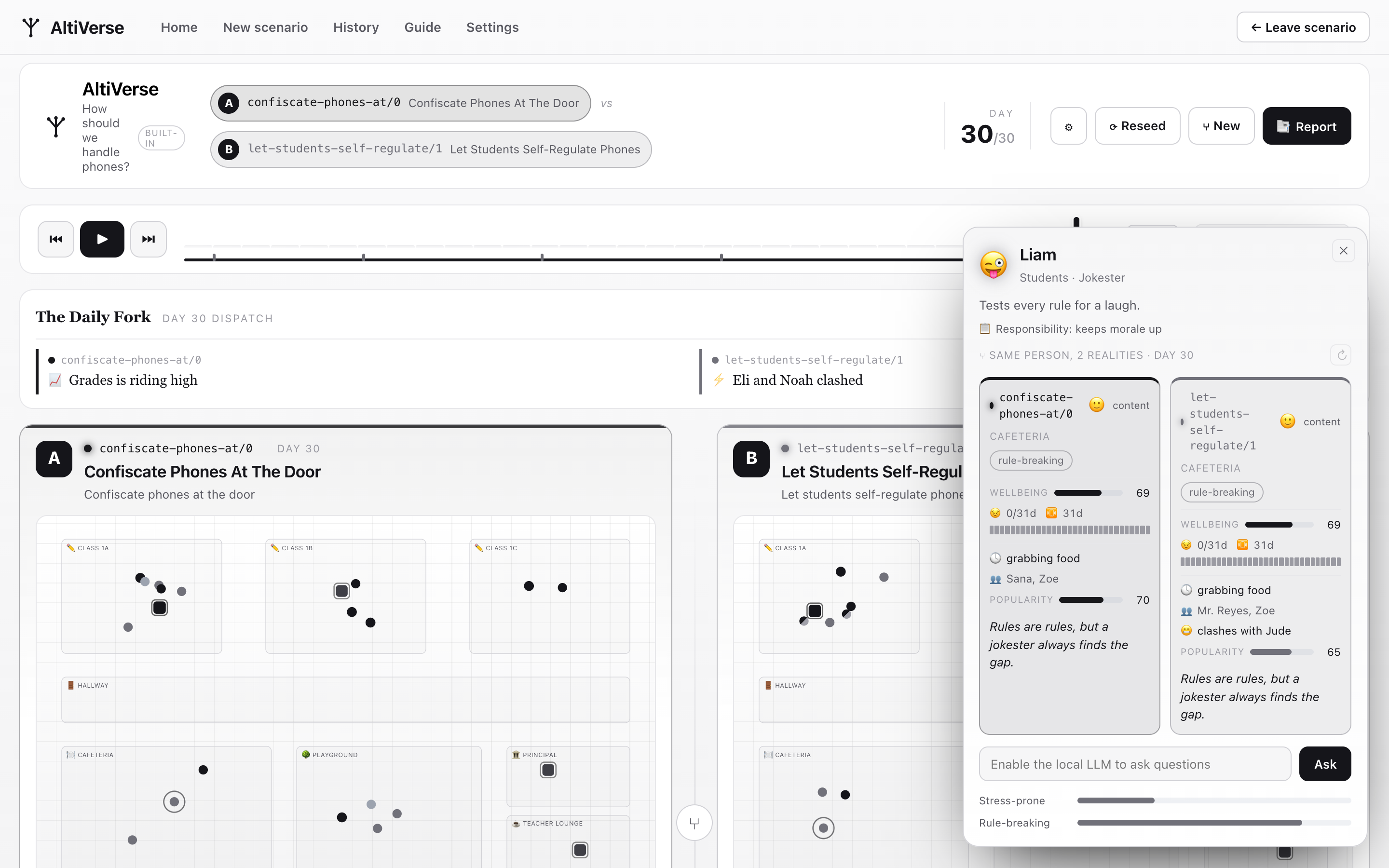
A student takes one decision — a school phone ban, 8- vs 12-hour shifts, a 4-day week — and forks it into 2–4 alternate realities. Each becomes a small living world of up to ~1,000 simulated people with personalities, moods, friendships, and rivalries, who move through rooms and react to the policy. The student then does science on it:
- Hypothesize — "I think banning phones raises focus but increases conflict."
- Run a controlled experiment — the same seed produces a byte-identical world, so the only difference between two realities is the policy. That's a textbook controlled variable, made real.
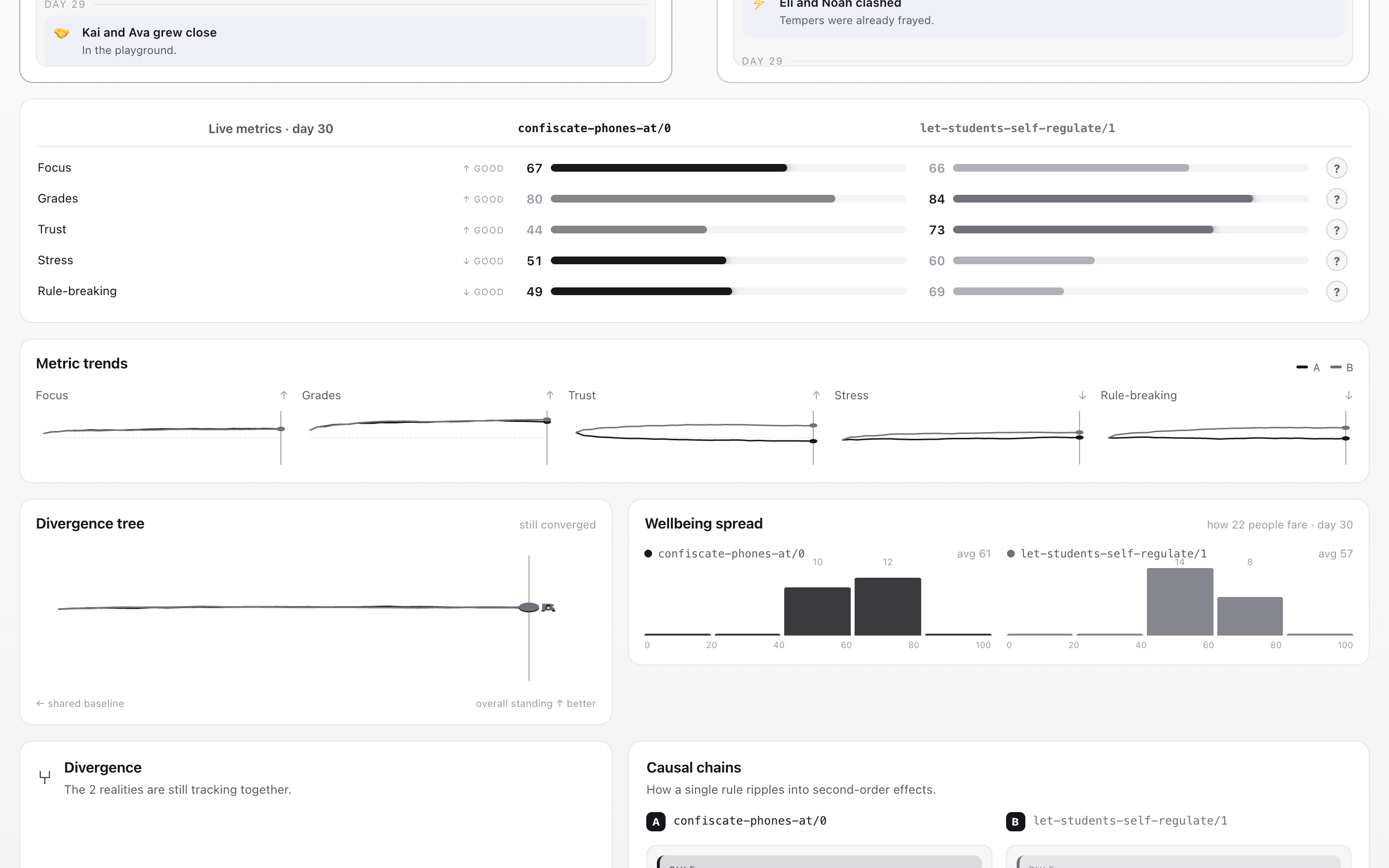
- Observe & measure — live metrics (0–100), trend sparklines, a divergence tree showing the exact day the worlds split, a wellbeing histogram (distribution, not just the average), and per-reality causal chains (rule → consequence → second-order effect).
- Interrogate — click any single person to see how that individual fares across every timeline, then ask them questions in character.
- Conclude — export a report with a recommendation, and Reseed to test whether the result was robust or just one lucky world.
The pedagogical core: every number is deterministic; only the prose is AI. The simulation is a seeded engine (same seed → identical world, every time), which is what makes it a legitimate experimental instrument. An optional LLM layer — any OpenAI-compatible endpoint, local (Ollama, LM Studio, llama.cpp) or online (OpenAI, Groq, …) — only narrates: in-character thoughts, interviews, headlines, the final report. Turn the model off and the science still works.
Why this fits AI × STEM Education: the AI lowers the barrier to expressing an idea (type "a hospital choosing between 8- and 12-hour nursing shifts" and it builds the cast, metrics, and environment), while the deterministic engine teaches the discipline of experimentation. AI for accessibility, real math for rigor.
How I built it
Stack: Vite + React + TypeScript, no backend, no build step required to run
(npx github:LeoTheAIDev/Altiverse boots it). State lives in localStorage.
The heart is a tiny deterministic engine. Every world is driven by a Mulberry32 PRNG, and each branch runs on a derived seed ($\text{seed} + i \cdot 1013$) so realities stay independent yet reproducible — the formal basis of the "controlled experiment."
Each metric (Focus, Stress, Trust, … on a 0–100 scale) evolves by exponential relaxation toward a per-reality attractor, plus noise — a first-order linear dynamical system students can actually reason about. For metric $k$ on day $t$:
$$ m_k(t+1) = \mathrm{clamp}_{[0,100]}!\Big( m_k(t) + \alpha\,\big(a_k - m_k(t)\big) + \xi_t \Big), \qquad \alpha = 0.09 $$
where $a_k$ is the reality's attractor and $\xi_t$ is roughly-normal noise (a sum of three uniforms, centered, scaled by $1.3$). A policy's causal chain injects discrete "kicks" on scripted days — the same pull with a larger coefficient $\kappa$:
$$ m_k \leftarrow \mathrm{clamp}!\big( m_k + \kappa\,(a_k - m_k) \big), \qquad \kappa \in {0.16,\,0.22,\,0.28} $$
so "policy enacted" lands a hard shove and its ripples land softer ones.
Divergence — the headline lesson, when do the worlds split? — is the average spread across branches, normalized to $[0,1]$:
$$ D(t) = \frac{1}{100\,|K|} \sum_{k \in K} \Big( \max_b\, m_k^{b}(t) \;-\; \min_b\, m_k^{b}(t) \Big) $$
The worlds are declared to have "split" on the first day $D(t) \ge 0.16$, and the top drivers are the metrics with the largest final gap — teaching students to attribute an effect to its causes.
People are the other half — a hands-on intro to agent-based modeling. A persona has
fixed traits in $[0,1]$ (stressProne, ruleProne, burnoutProne) and the same persona
exists in every reality. Whether they're visibly stressed on a day is a threshold against a
metric-derived pressure score $s$, direction-aware via a "badness" function
$\beta(m, v) = v/100$ if lower-is-better else $1 - v/100$:
$$ \text{stressed} \iff \text{stressProne} \le s, \qquad s = \beta(m_{\text{stress}}, v) $$
That's why the anxious overachiever cracks under a policy the weary veteran shrugs off — identical world, different individual. The social layer is a bounded random walk on pairwise affinity, seeded from an FNV-1a hash of each id-pair, drifting in $[-1,1]$ as people bond, clash, or pass rumours that spread through co-located agents and decay once everyone's heard them. Popularity emerges as $\mathrm{clamp}(50 + 14\,(\text{pos}-\text{neg}))$, summarized in $O(\text{interactions})$ — not $O(n^2)$ — so it stays smooth at ~1,000 agents.
The LLM client is deliberately dependency-light: plain fetch against /chat/completions,
a timeout, and jsonrepair to salvage the malformed JSON small local models love to emit. The
engine never depends on it — so a student with no key, no internet, and a slow laptop gets the
full experience.
Challenges I faced
- Determinism vs. life. A reproducible engine (needed for controlled experiments) and a world that feels alive (needed to engage a 13-year-old) pull in opposite directions. The fix was to push all randomness through seeded PRNGs derived from one master seed — so "Reseed" explores a genuinely new world while a shared seed is bit-for-bit identical.
- Trusting a small model with structure. Local 3B models cheerfully return broken JSON.
Instead of threatening the prompt, I made the parser forgiving: slice to the matching brace,
jsonrepair, retry once. Robustness at the boundary beat strictness in the prompt — essential when the target user is running whatever tiny model fits on their machine. - 1,000 agents at 60fps in a browser. Per-frame React re-renders die at that scale. Agent motion is spring-physics written straight to the DOM, outside React's render loop — so it runs on a Chromebook, not just a gaming laptop.
- The zero-backend, accessibility-first constraint. No server meant the browser talks
directly to the model (hence CORS and the
OLLAMA_ORIGINS=*note) and the API key lives only inlocalStorage, sent only to the provider the student picked. Every "make it private and free" decision had a real engineering cost to pay. - Teaching, not predicting. The honest framing — this models second-order dynamics, it does not predict the future — had to be enforced by the architecture (deterministic mechanics, AI only narrates), not just claimed in the copy. A STEM tool that pretends to be an oracle teaches the wrong lesson.
What I learned
- Separating mechanism from narration was the whole game. Numbers from a deterministic engine, language from the LLM: more honest, more debuggable, and pedagogically correct — the model can never silently invent a statistic, so students learn to trust the data, not the prose.
- Simple math, well-composed, reads as emergence. There's no agent "AI" here — just relaxation toward attractors, threshold flags, and a bounded affinity walk. Layered together they produce rivalries and rumours that feel authored. That is the lesson of complex systems, and it's cheaper to build than it looks.
- Accessibility is an architecture decision, not a feature. "Runs offline on any laptop with no account" isn't a checkbox you add later — it's what forced local-first, determinism, and a dependency-light client, which turned out to be the best parts of the project.
- Lowering the barrier and raising the rigor aren't opposites. AI handles the messy part (turn a sentence into a full scenario); the engine enforces the disciplined part (controlled, reproducible, measurable). That balance is exactly what AI × STEM education should be.


