INSPIRATION
Even in 2025, most visual change detection tools remain domain-specific and limited to simple before-and-after comparisons without meaningful context.
Across sectors like manufacturing, infrastructure, and F1 design, teams face recurring problems:
- Subtle visual changes often go unnoticed or misclassified.
- Lighting and environmental noise produce false detections.
- Valuable historical insights are not reused to prevent repeat issues.
This inspired Alterra — a platform that combines computer vision, retrieval intelligence, and human-like explanation to make visual inspections smarter and more actionable.
WHAT ALTERRA DOES?
Alterra is an AI-powered Visual Insight Engine that:
- Automatically detects and highlights changes in time-series images using OpenCV and AI models.
- Explains changes in natural language using LLM reasoning (via LangChain + Hugging Face).
- Retrieves similar past cases from a ChromaDB vector store for context-aware insights.
- Generates reports with both visuals and explanations for decision-making.
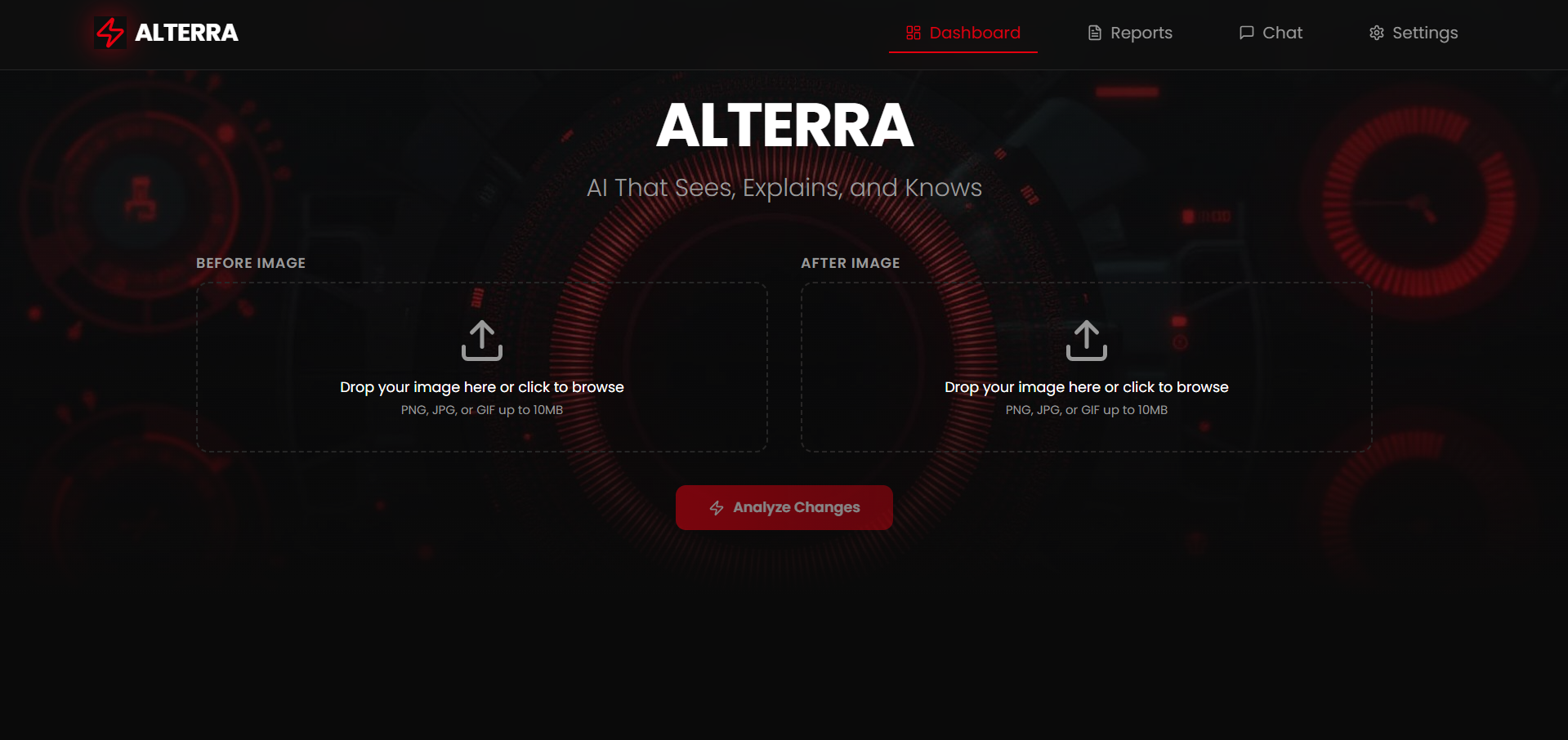
- Provides a simple React dashboard for image upload, visualization, and interactive chat.
In short, Alterra converts raw image differences into intelligent, explainable, and interactive insights.
CORE INNOVATIONS
1. Causal Intelligence
Alterra doesn’t stop at detecting what changed — it helps explain why it changed. By comparing the detected visual differences against semantically similar past cases stored in ChromaDB, it provides cause-based insights.
Example:
“Crack widened by 3 mm since last scan — similar pattern previously linked to thermal stress.”
This transforms Alterra into a reasoning-based diagnostic system.
2. Interactive AI Inspector
Users can chat directly with Alterra through the React interface.
Example queries:
“Explain the highlighted region in image 2.” “Show similar corrosion cases from the past.”
This conversational layer (built with LangChain’s ConversationalRetrievalChain) delivers human-like interactivity and accessibility.
TECHNICAL ARCHITECTURE
1. Image Analysis (OpenCV + Python)
- Preprocess and compare images using OpenCV (grayscale conversion, thresholding, contour detection).
- Highlight areas of change using bounding boxes or heatmaps.
- Generate structured data describing the detected regions (e.g., size, location, type of change).
2. Embedding & Retrieval (ChromaDB + Hugging Face)
- Convert visual and textual descriptions into embeddings using Hugging Face embedding models (e.g., sentence-transformers/all-MiniLM-L6-v2).
- Store past inspection data in ChromaDB.
- Retrieve the most similar cases for contextual understanding and reasoning.
3. Reasoning Layer (LangChain + Hugging Face Inference Model)
- Integrate LangChain to manage the conversation flow and reasoning logic.
- Use a Hugging Face inference model (e.g., distilGPT2 or Llama-3) for generating natural-language explanations.
- Merge OpenCV results + retrieved context → generate user-friendly insight.
4. Frontend (React)
- Provide a simple UI to upload images, view detected differences, and chat with the AI inspector.
- Display side-by-side comparison images and highlighted differences.
- Optional: Integrate a voice input (later phase) using browser-based speech recognition.
FEASIBILITY & 24-HOUR PROTOTYPE SCOPE
Within 24 hours, a proof-of-concept focusing on a single sector (e.g., infrastructure inspection) is both feasible and demonstrable.
Prototype Workflow
- Upload two images (e.g., bridge surface scans).
- Detect and highlight changes (OpenCV).
- Retrieve similar past cases (ChromaDB + embeddings).
- Generate natural-language summary (LangChain + Hugging Face).
- Display results and allow user queries via chat interface (React).
ANTICIPATED CHALLENGES & MITIGATIONS
Limited Training Data: May reduce RAG accuracy. → Use a few curated sample cases as initial knowledge base.
Lighting and Noise Variation: Can cause false detections. → Apply preprocessing (histogram equalization, blurring).
Latency in Inference: LLM responses may take time. → Use lightweight Hugging Face inference models locally.
Frontend Integration: Synchronizing backend APIs with React may need time. → Use a minimal working Flask API for quick data exchange.
PLANNED ACHIEVEMENTS
- Integrate OpenCV-based difference detection.
- Implement ChromaDB retrieval using Hugging Face embeddings.
- Generate AI explanations through LangChain pipeline.
- Create a simple, clean React interface for demonstration.
- Demonstrate causal reasoning through context-based outputs.
EXPECTED LEARNINGS
- Cross-domain adaptability can be achieved through modular embeddings and visual logic.
- Even a limited AI + RAG prototype can deliver meaningful visual insights.
- Explainability increases user trust in visual AI systems.
- A focused, well-executed proof-of-concept outperforms incomplete multi-domain demos.
WHAT’S NEXT FOR ALTERRA
- Sector Expansion: Extend the pipeline to manufacturing, automotive, and aerospace domains.
- Voice Integration: Enable natural conversation with inspectors through speech input and audio feedback.

Log in or sign up for Devpost to join the conversation.