-
-
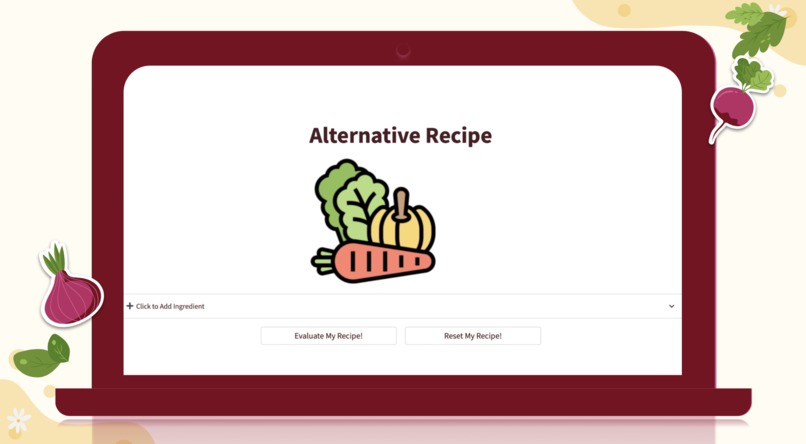
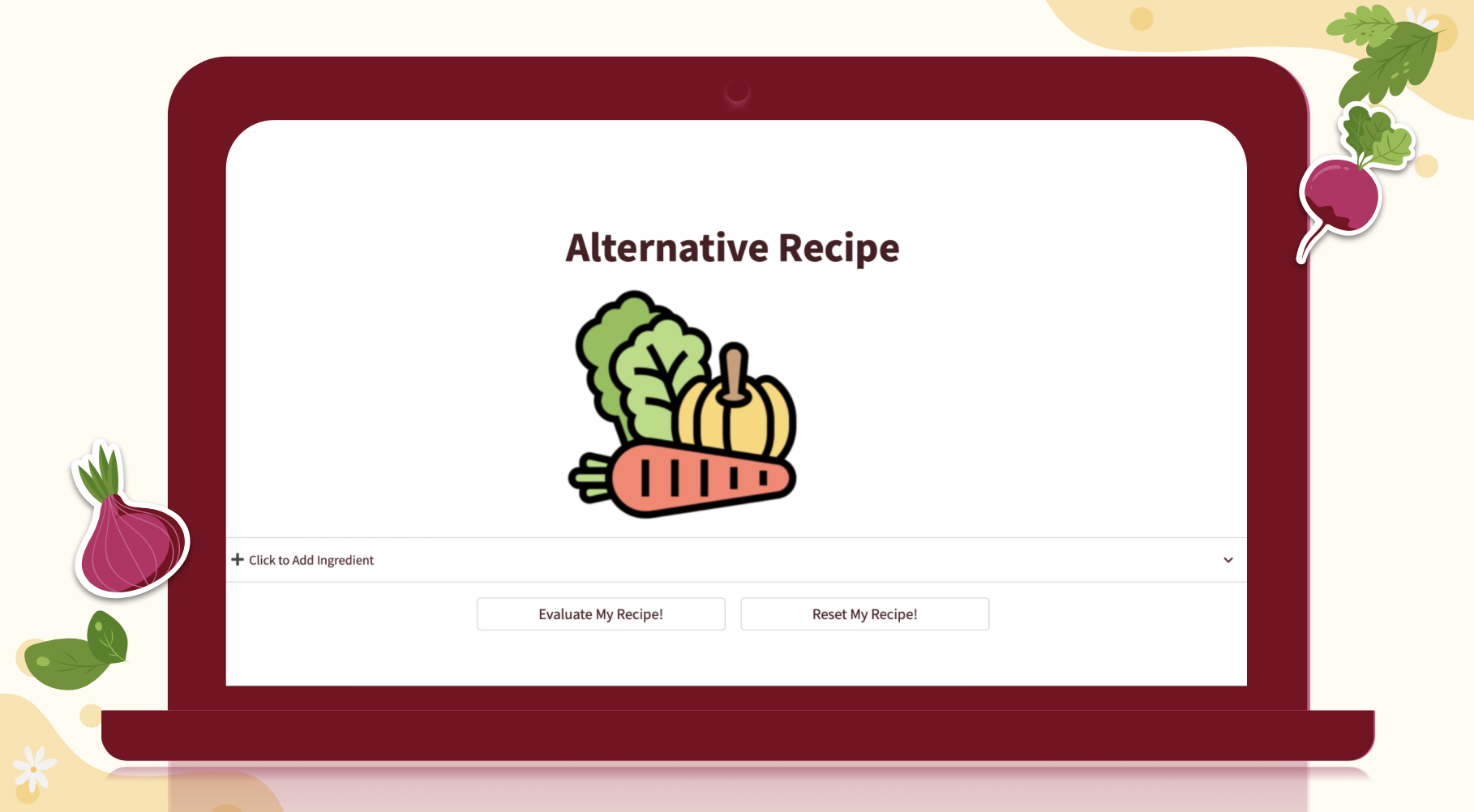
Main Page
-
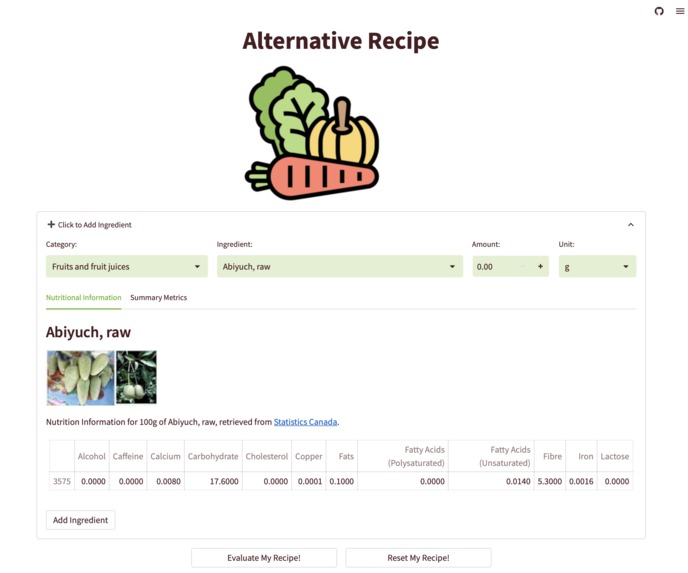
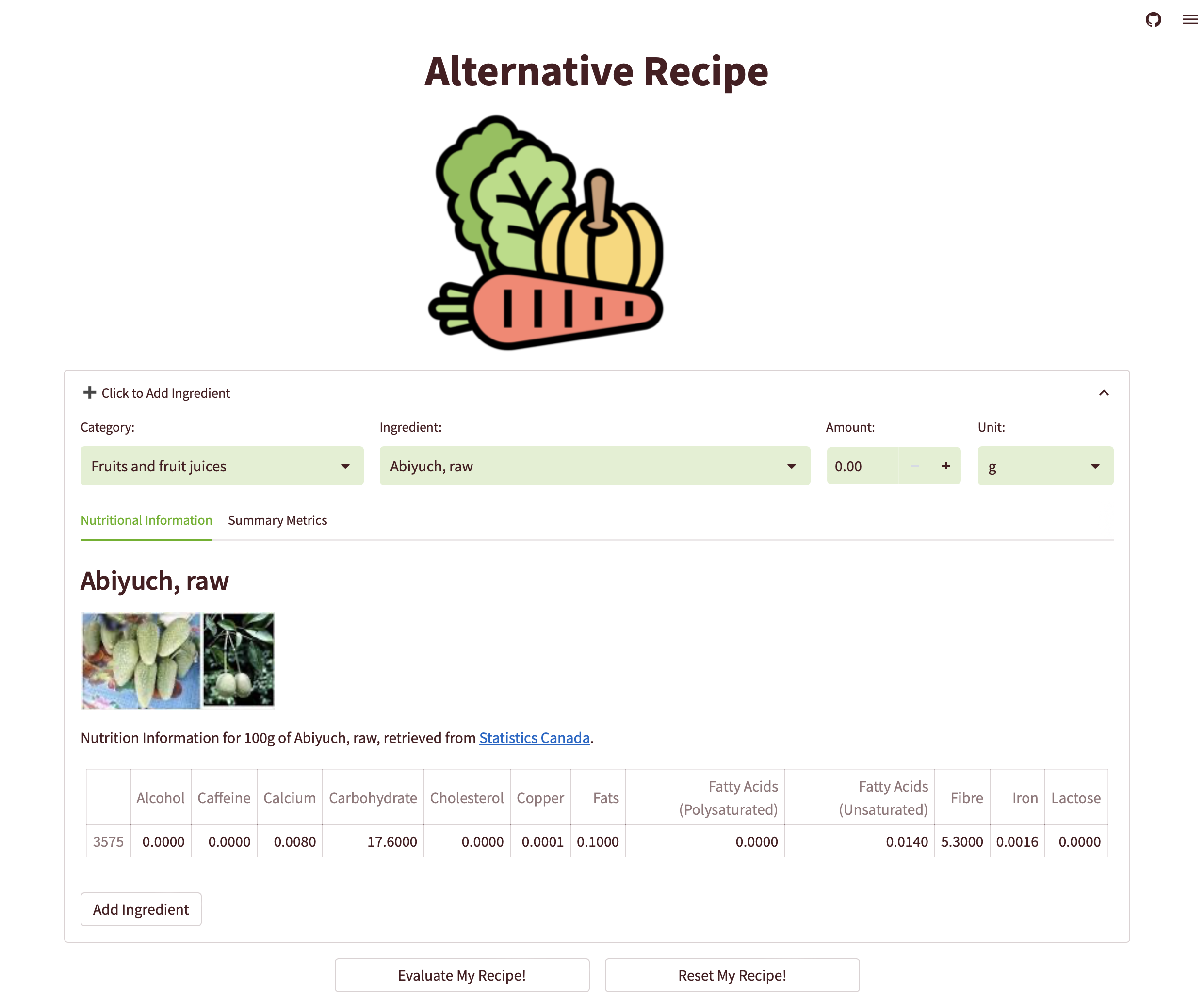
Choose Ingredient
-
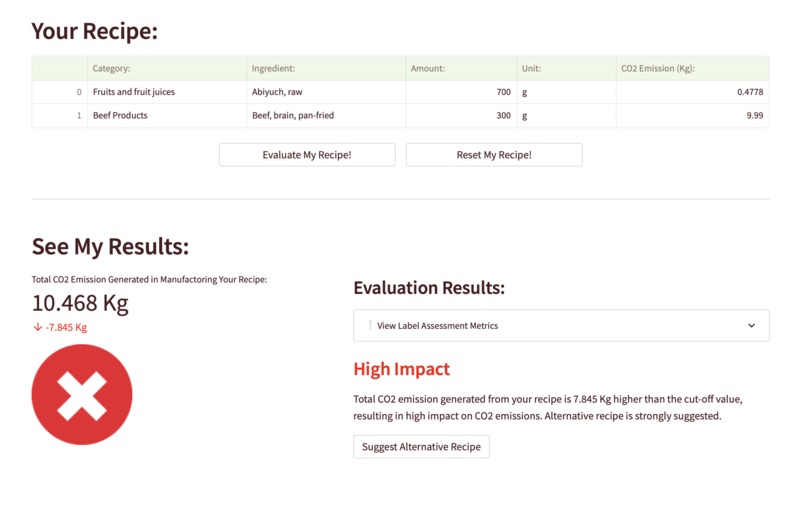
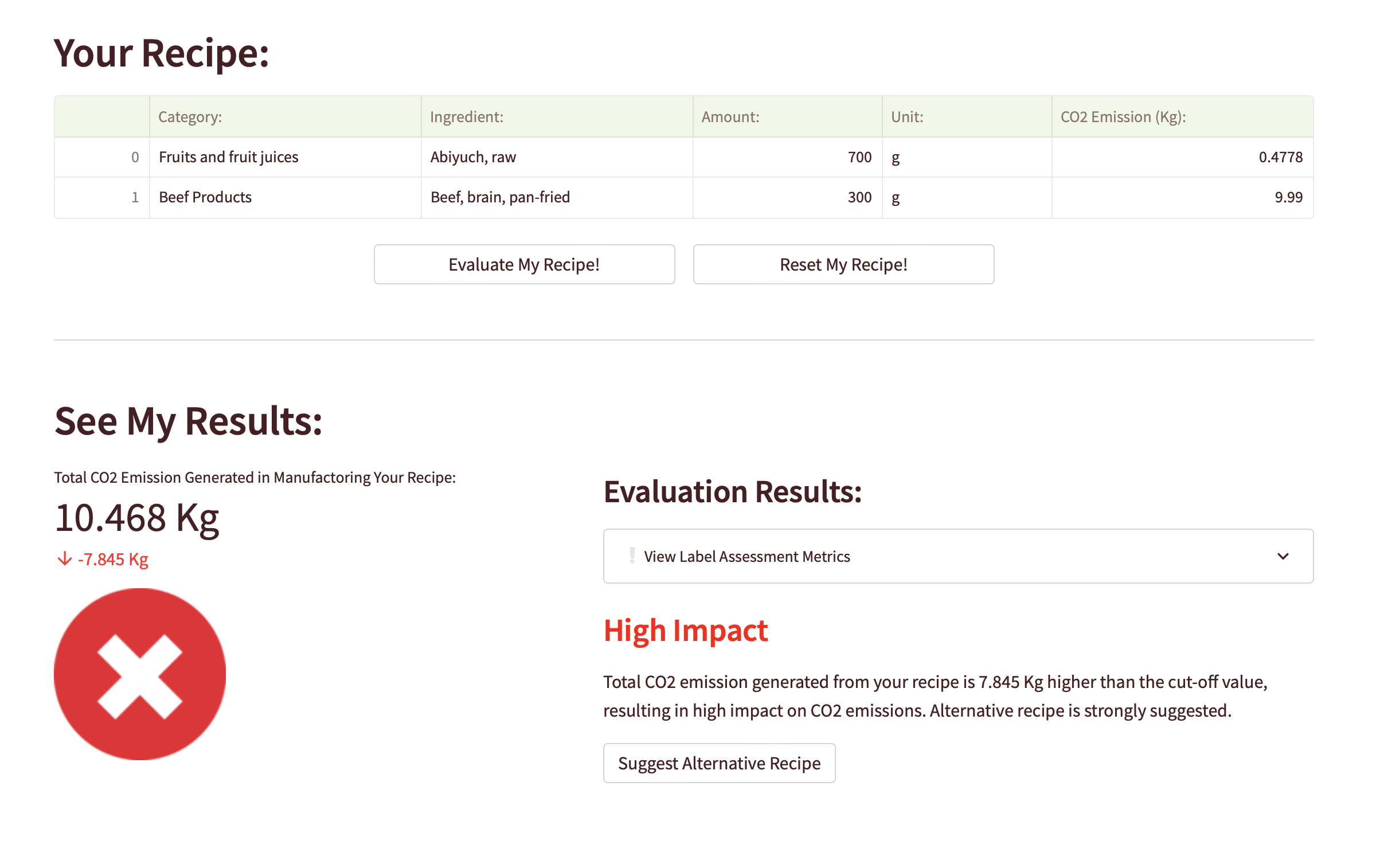
Recipe Evaluation
-
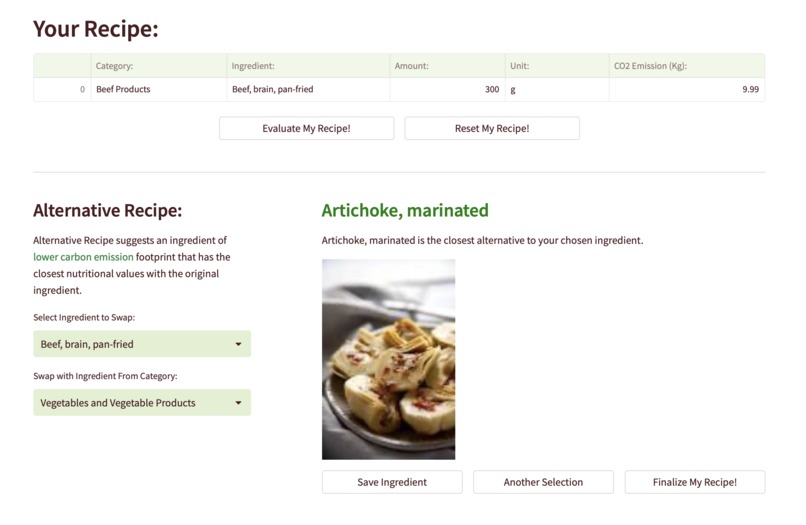
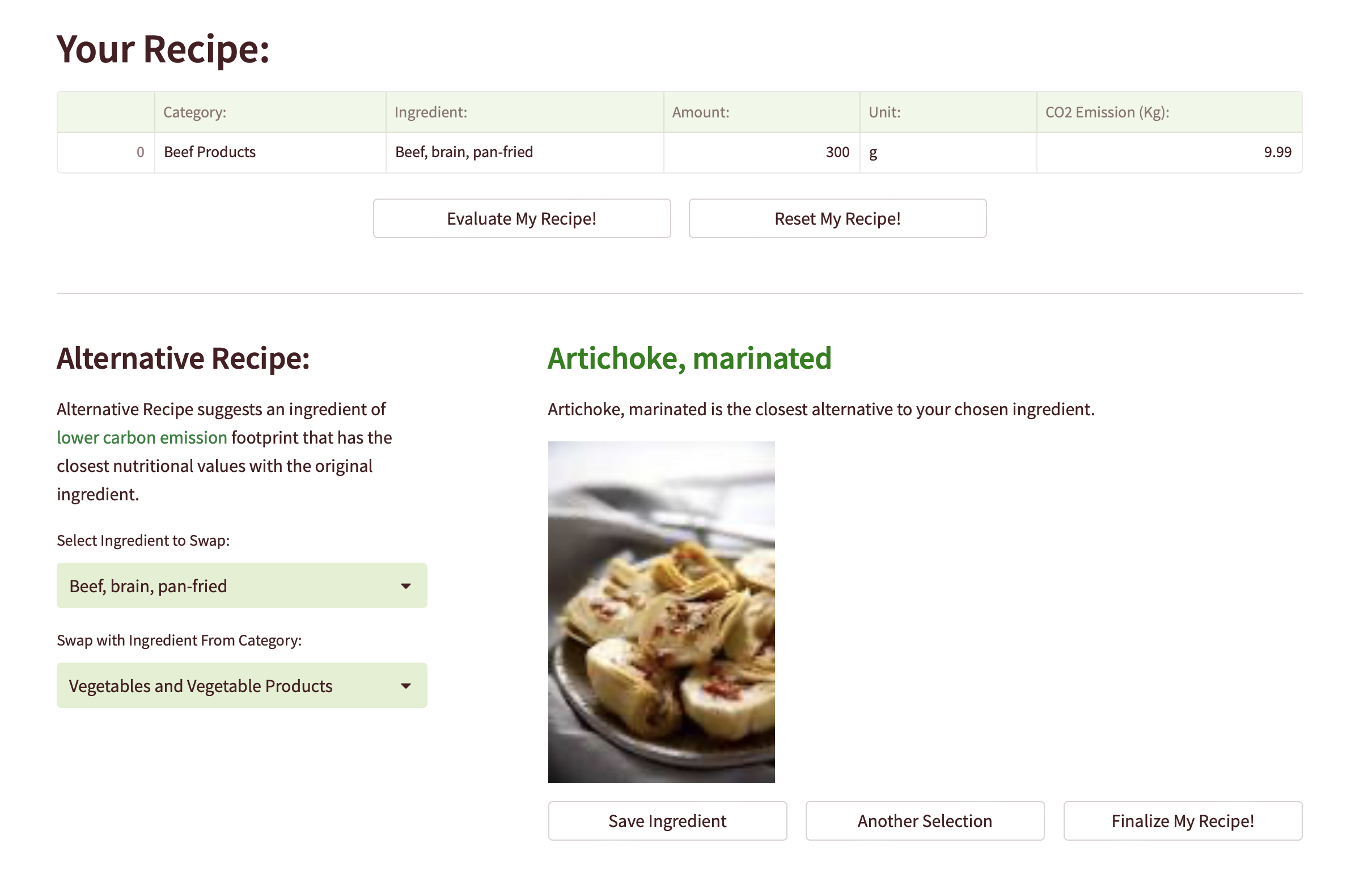
Alternative Recipe Suggestion
-
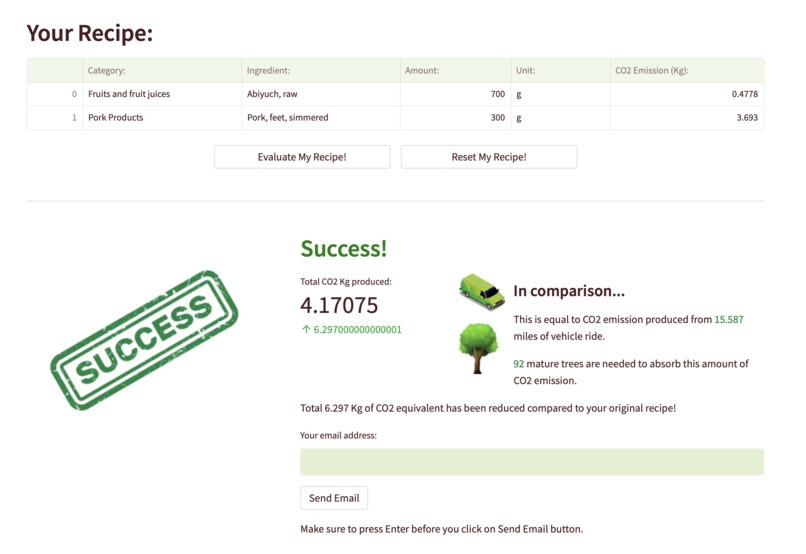
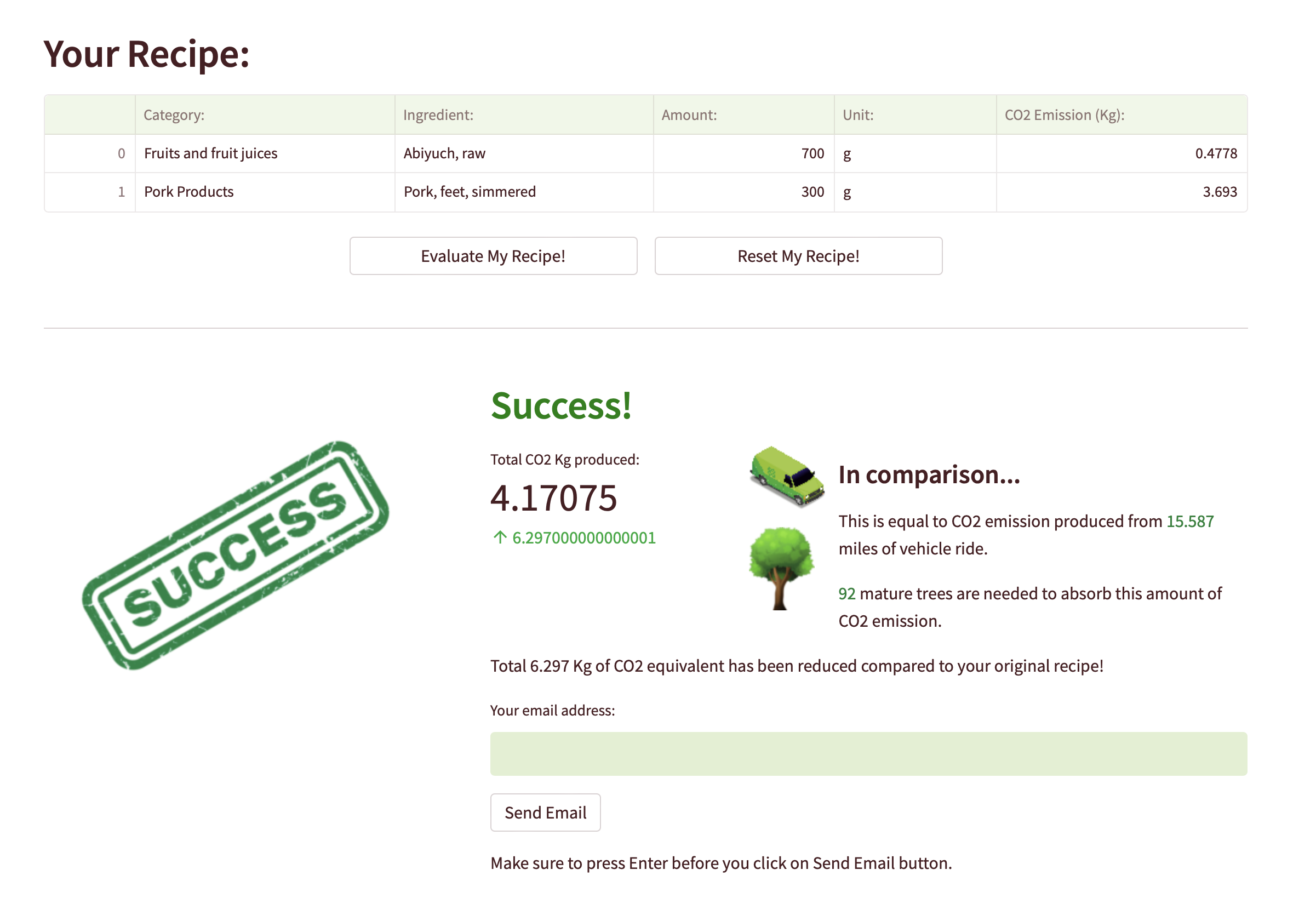
Alternative Solution Made
-
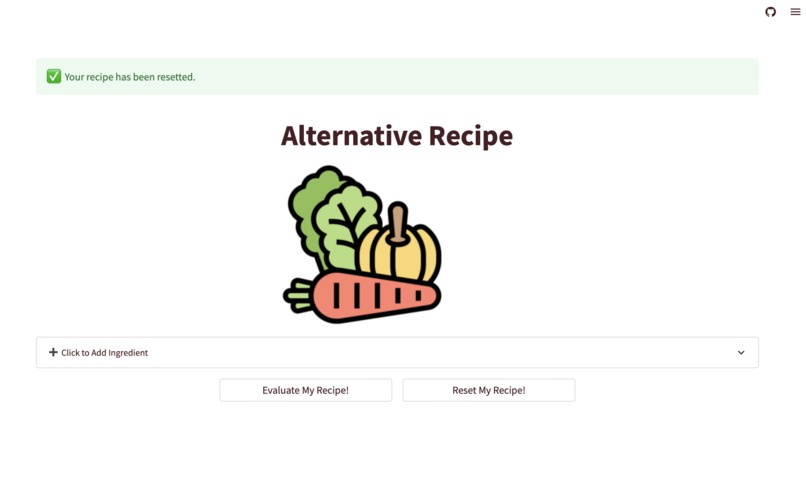
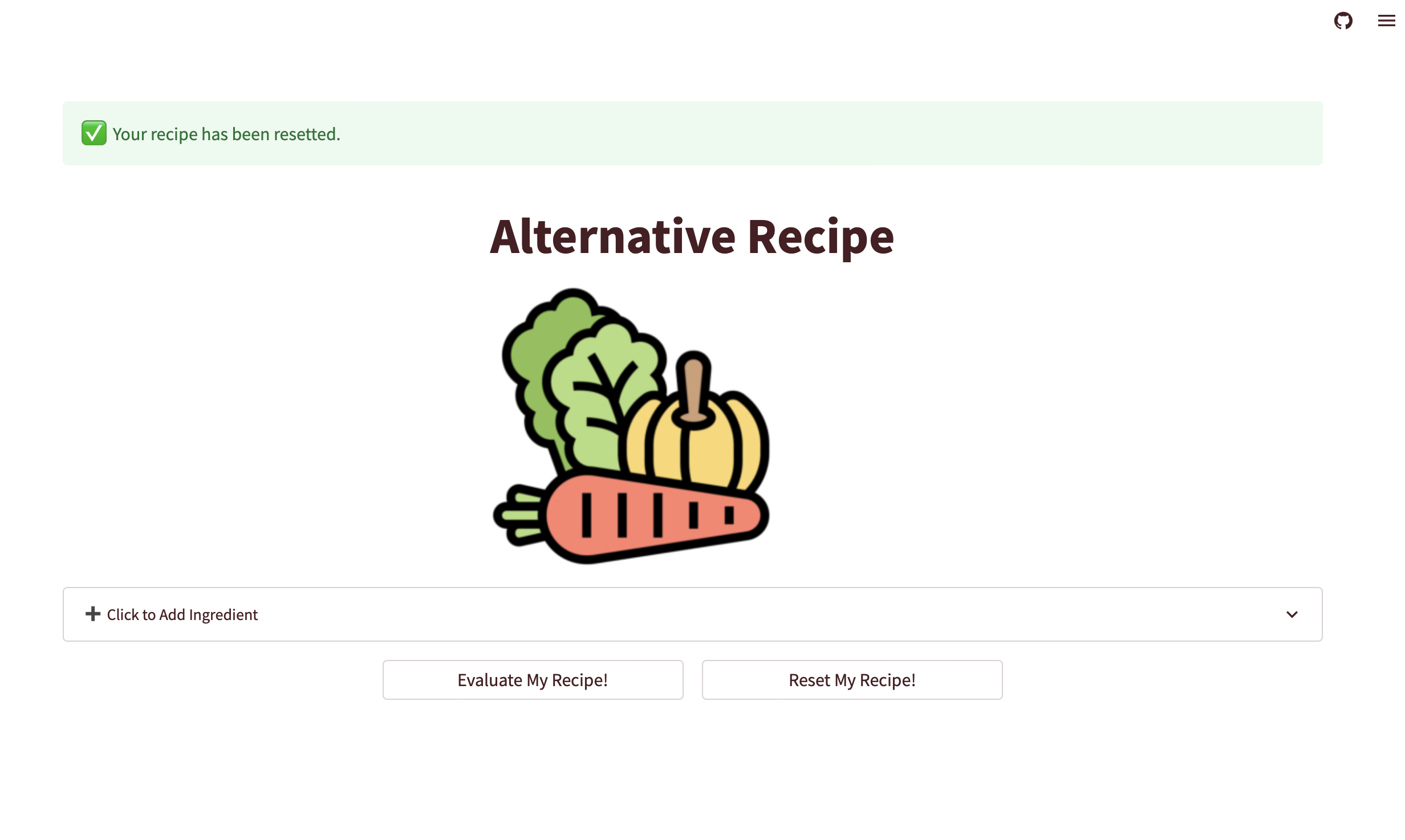
Reset Selection
🌿 Inspiration
What can we do to help fight the climate crisis? Well-known solutions would be to ride bicycles or use transit services instead of personal vehicles to reduce gas emissions and save energy at home by using less electricity. However, one of the simplest actions, but less well-known, is to change your diet - to a more sustainable diet such as eating plant-based foods.
Greenhouse gases act as “blankets” that cover the Earth’s surfaces and trap the Sun’s heat. Ever-rising surface temperatures change weather patterns dramatically. Carbon dioxide (CO2) accounts for nearly 80% of global greenhouse gas emissions. What’s more, CO2 emissions from food production are responsible for 26% of all CO2 emissions. In number, this is approximately 15.9 gigatonnes of CO2-equivalent. Contributors to emissions from food production include the food supply chain, livestock and fisheries, crop production, and land use.
If the trend continues, the surface temperature is expected to rise by 0.6 degrees Celcius in the next 80 years, solely from the CO2 emissions produced by food production. Including nitrogen oxide and methane emissions, the surface temperature is suspected to rise by more than 2.0 degrees Celcius. If it were to happen, the sea level would rise by 10 to 30 inches, putting 10 million people at risk from coastal storms and flooding. Thus, imposing threats from CO2 emissions requires our immediate attention.
At the beginning of this write-up, I mentioned that changing dietary habits is one of the simplest and easiest actions that we can take to fight the climate crisis. How so? The answer lies in our solution, Alternative Recipe.
🌿 What it does
 🔗 Alternative Recipe is a web-based application that takes carbon footprints of each food category and computes the total kilogram worth of CO2-equivalent a meal would produce at the end.
But the zest of the application is that it suggests an alternative option for more sustainable recipe. It allows users to reform their original recipe by using more environment-friendly ingredients. It offers an alternative ingredient closest to the original by comparing nutritional values. Alternative suggestions made by the application will lower the total CO2 emission a meal would be produce at the end.
It is also possible for the users to request their altered recipes to be sent to their emails, making the application more practical.
🌿 How we built it
Alternative Recipe retrieves all of its data from reliable, approved sources such as Statistics Canada. All data sources are compiled at the end of the write-up.
Python programming language was used to complete data cleaning, data preprocessing and application development. Streamlit API was used to design the front-end UI/UX of the application.
🌿 Challenges we ran into
Finding the right dataset from reliable sources was challenging. We browsed many websites to find the most suitable, trustable data. It was especially challenging to find the nutrition dataset of various food items was difficult.
We had to derive the carbon footprints dataset from two sources and later combined them. One is from a study conducted by Poore & Nemecek (2018) and the second one is from Cool Food Calculator.
In terms of building the application, it was our first time building a web-based application through Streamlit and it took us some trials and errors to understand all features of the Streamlit API.
🌿 Accomplishments that we're proud of
We feel proud that we have successfully devised an effective solution to fight the climate crisis. Our solution is effective in that anyone can use it, and it only takes a small effort to contribute to addressing concerns with climate change. I especially believe that people of the younger generation can be empowered by using the Alternative Recipe. Changing dietary habits using the Alternative Recipe provides them with tangible solutions that could be taken as their first step in fighting against climate change.
In Broader Landscape of Action
Let’s expand on the idea of alternative. Just like how we found alternatives for sustainable foods, it would be possible to think of alternatives for other factors to fight against increasing global temperature.
The uniqueness of our idea comes from the fact that it chooses an alternative option based on nutritional values of the original ingredient. This way, we can keep our food nutritions relatively constant while keeping our diets sustainable.
We could also look into how our actions can directly impact the biodiversity. For example, we can start by looking into how changing temperature impacts biodiversity in a lake. We can let the users save their data, record how much CO2 emissions they have helped to reduce so far, and compare that value to how many biodiversity they have saved with their sustainable diet.
🌿 Four Lenses to Consider
Practical Lens
Alternative Recipe is a fully-built, ready-to-use web application. It is hosted on Streamlit cloud which is free of charge, using public data from Statistics Canada. Anyone can start using it now by simply clicking a few buttons. Alternative Recipe can greatly assist to reduce CO2 emissions produced from a meal. For example, using pork intestines instead of ground beef, which is the closest alternative to ground beef among ‘pork’ category, will reduce the CO2 emissions produced from a hamburger by 15.1 kg of CO2-equivalent. Anyone can take a step forward to fight the climate crisis, at anytime.
Scientific Lens
Survey conducted by University of Michigan revealed that people in the age between 18 to 29 years are most concerned about the climate change among all age groups. Young individuals reported that they feel insecure about the rising concerns regarding climate crisis, and do not feel that the upper generations have taken appropriate actions to address these concerns. The Alternative Recipe exists to empower younger generations and help them to easily contribute to fight the climate crisis. It is as easy as simply changing a few ingredients in your recipe to more earth-friendly, sustainable ingredients. The Alternative Recipe is designed for anyone to take first steps to contribute to suspend rising global temperature. Remember, no action is pointless.
Equity and Justice Lens
Indigenous people from around the world revere certain traditional foods as sacred. Like salmon in the Northwest U.S. and Canada, corn or maize has, for millennia, been the most important food for indigenous communities, in Mexico and Central America. (Retrieved from the Conversation)
Alternative Recipe supports the Indigenous community and their sacred food. By using Alternative Recipe, we can find close alternatives that can be used instead of the sacred food. We can show our respect towards Indigenous food and lands by preserving certain traditional foods.
🌿 What we learned
Before we started researching the impacts of food production on global CO2 emissions, even we were unaware that it could have detrimental effects on climate change. We have learned some valuable information on the future of climate crisis and how to address it through different approaches.
On the technical side, we learned how to design a web-based application through Streamlit. One exciting feature included in the application is retrieving the first Google image that pops up with a given query keyword. I am proud that we successfully implemented this feature.
🌿 What's next for Alternative Recipe
 Image derived from Love Food, Hate Waste
🚪 Gaps:
A study conducted in 2017 found that more than 30% of food waste comes from vegetables, while only 6% of food waste comes from meat. In this case, replacing High Impact ingredients, generally classified as ‘meats,’ with vegetables would not help reduce food waste. As CO2 emissions from food waste are also a serious concern, our next step would be to work towards improving the Alternative Recipe in a direction that could also lower food waste.
💪 Points of Improvement:
So far, we have only looked into CO2 emissions from food production. As a next step, we could incorporate other greenhouse gases that are produced from food production, such as nitrogen dioxide and methane. After searching for nitrogen dioxide and methane footprints, we can include options in our application to choose what greenhouse gas the users want to focus on. (E.g., a user can select nitrogen dioxide, and the application will provide alternatives focused on producing less nitrogen dioxide emissions.)
In technical aspects, we can make a login page and allow the users to keep their records of how much CO2 emissions they have reduced so far with Alternative Recipe. Currently our Send Email button is a bit unstable since we are using a free version of the API. If we upgrade it with a professional version with additional function, Send Email button will be more stable.
📌 Data Sources
- Food Nutritions Data: Statistics Canada
- Carbon Footprints Data: Data World, Cool Food Calculator
- Canadian CO2 Emission Generation Sources: Statistics Canada
Built With
- database
- python
- streamlit


Log in or sign up for Devpost to join the conversation.