Overview
Alpine Guard is a risk intelligence platform built on the Hazard Cascade Threat Score (HCTS), a new predictive risk index that visualizes the cascading threat from melting glaciers as a live heatmap, enabling automated parametric insurance and pre-emptive disaster response.
Inspiration
Our planet is sending a concerning signal. In just two years, Swiss glaciers lost 10% of their total volume, a rate once unimaginable. This is the prologue to a new and dangerous chapter of climate risk. We were inspired by the stark reality that the primary threat from a melting glacier is not always the ice itself, but the cascading hazard it unleashes.
We see an accelerating pattern, from the 2017 Piz Cengalo disaster, where a rockfall on a glacier triggered a catastrophic debris flow, to the devastating collapse of the Birch Glacier in May 2025. This recent tragedy, which buried the village of Blatten under a massive avalanche of ice and rock, is a dramatic demonstration of the forces we are dealing with. While a timely evacuation saved hundreds of lives, the event still caused immense destruction and highlighted a critical protection gap: we can sometimes save people, but we are still failing to protect livelihoods and communities from the inevitable economic disruption. We were inspired to build a new kind of shield, a tool of foresight to make this invisible, cascading threat visible, actionable, and ultimately, insurable.
What it does
Alpine Guard is a risk intelligence platform designed to predict and visualize the cascading threat originating from melting glaciers in Switzerland. It works by:
- Fusing Data: The platform ingests multiple real-time data streams, including meteorological data from MeteoSwiss/openmeteo, FEON hydro, and foundational geospatial data from swisstopo.
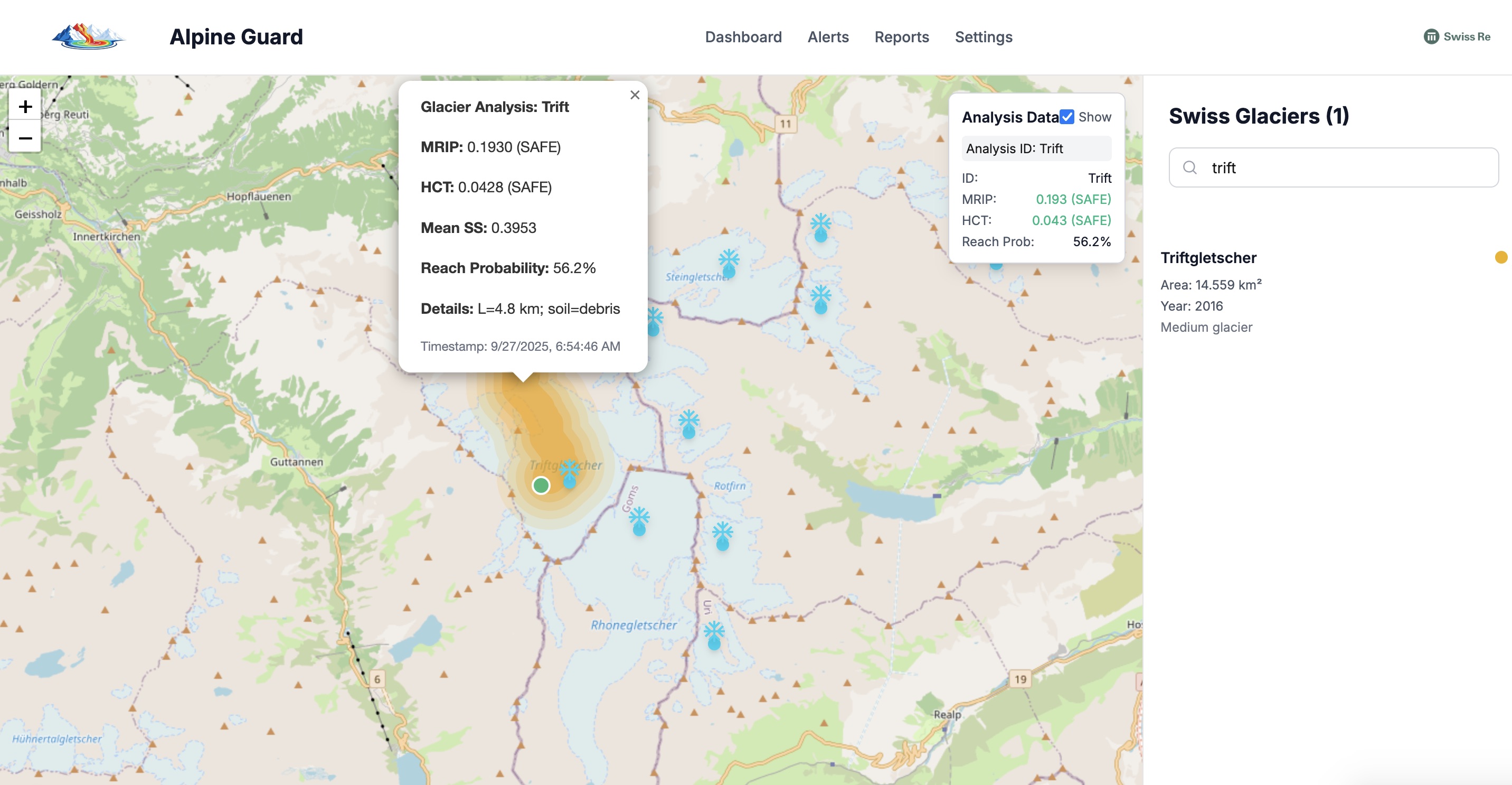
- Predicting the Cascade: At its core is the Hazard Cascade Threat Score (HCTS), a new predictive index that models the dynamic link between glacier melt and potential hazard. It continuously assesses the stability of each major glacier and the susceptibility of the downstream landscape.
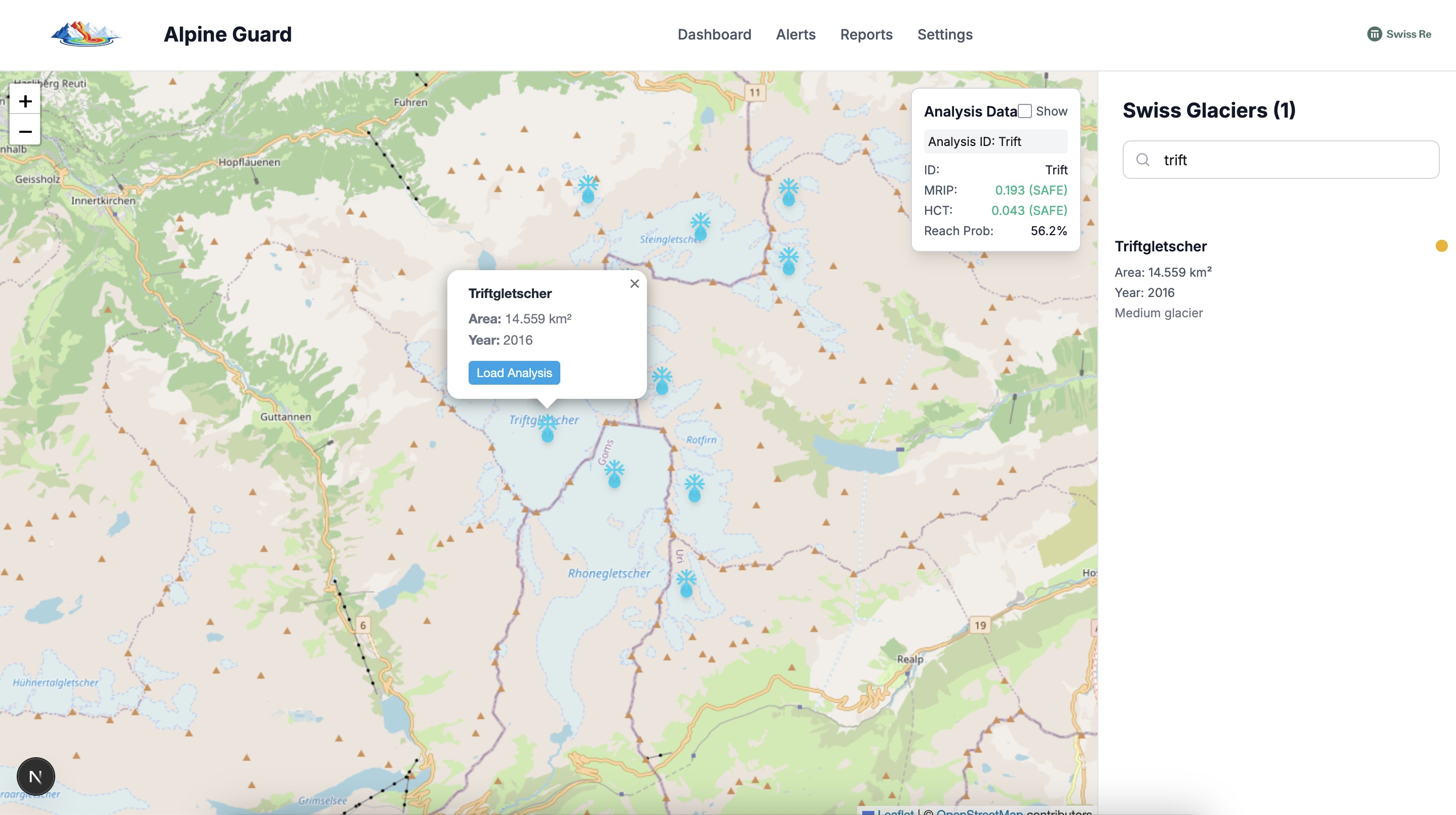
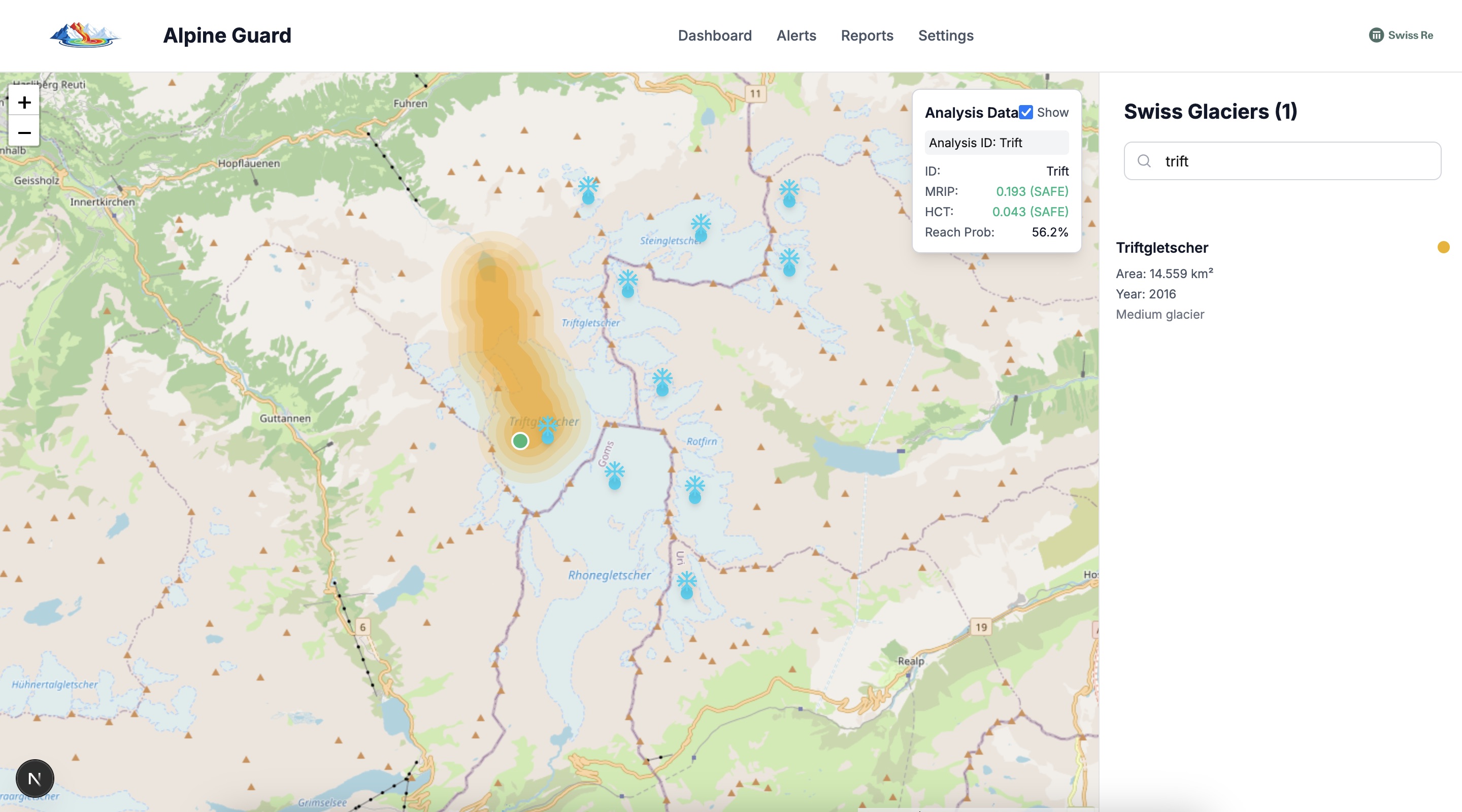
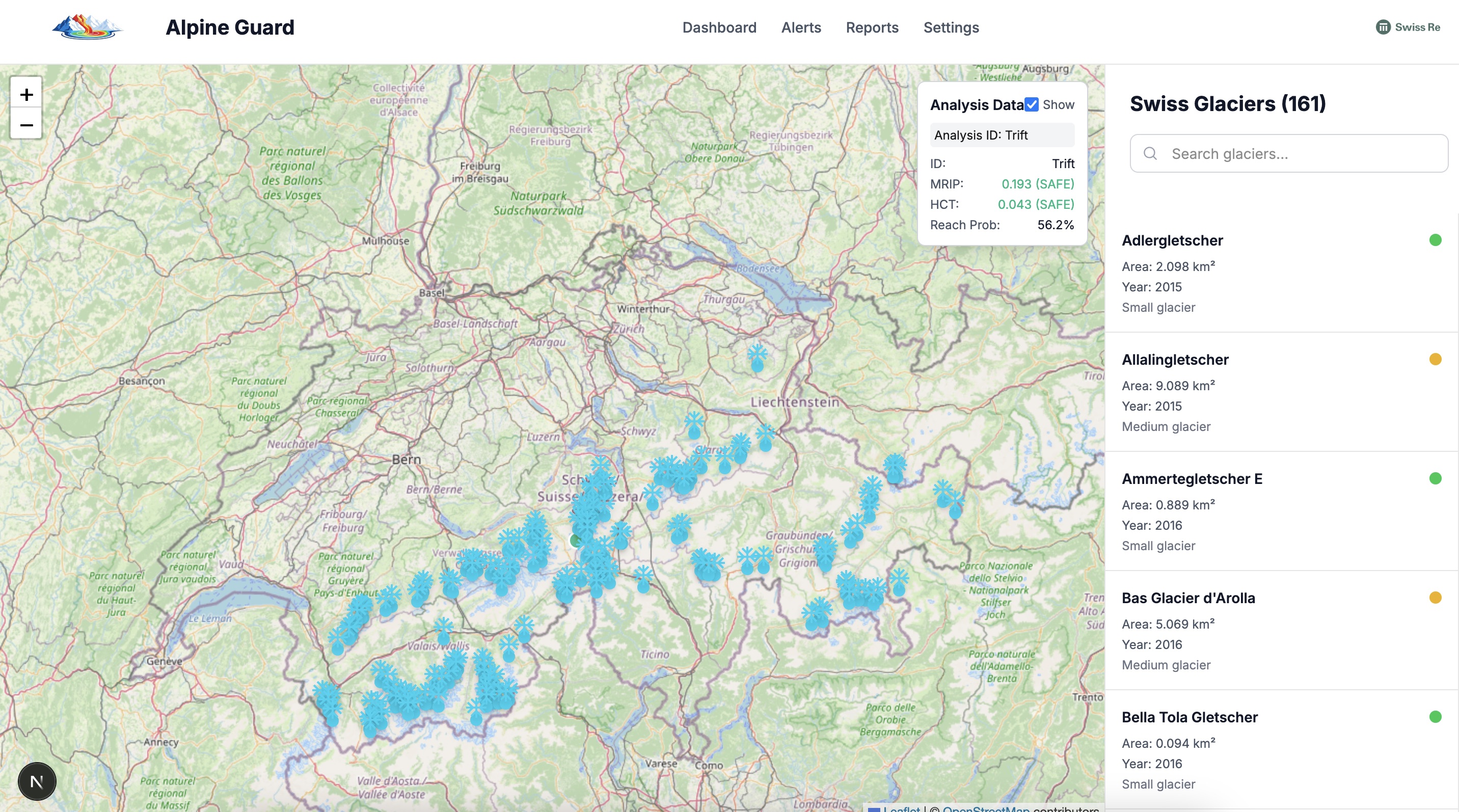
- Visualizing the Threat: The HCTS is displayed on an intuitive 3D map. The landscape is colored as a heatmap showing underlying hazard susceptibility, while each glacier is marked with a color-coded dot (Green, Yellow, Red) representing its real-time threat level. When a user selects a high-risk glacier, the platform instantly displays its pre-calculated Projected Impact Zone (PIZ), showing the precise path of potential destruction.
How we built it
We adopted a modular, full-stack development approach to bring Alpine Guard from concept to a functional prototype within the hackathon's timeframe.
1. Foundation & Architecture: We began by architecting the end-to-end system. We defined the logic for the Hazard Cascade Threat Score (HCTS) and designed the data schema for the parametric trigger. We chose a Python-based backend for its powerful data science ecosystem and a React front-end for its modern, interactive mapping capabilities.
2. Data Engine & Predictive Modeling: We established a pipeline to ingest and process diverse datasets from Open-Meteo, FOEN Hydro, and GLAMOS to retrieve training data from previous years and real-time data for predictions. Using the scikit-learn library, we processed this data to train a Random Forest model with customized class weighting to address the rarity of positive hazard events. The model predicts two key components of our index: (a) Meltwater & Ice Release Potential (MIRP) Score – quantifying the release hazard using predictors such as temperature, discharge, radiation, and snow conditions. (b) Slope Susceptibility Score (SSS) – quantifying terrain instability using slope degree, precipitation-derived saturation, snow load, wind, and humidity.
3. API & Visualization Layer: Our lightweight Flask API serves risk scores and PIZ data to a React-based frontend featuring interactive Leaflet maps, SSS heatmaps, and dynamic glacier status indicators. This creates seamless information flow from raw data input to actionable risk visualization.
4. Integration & Synthesis: The final step was integrating these modules. We connected the predictive engine to the API and the API to the front-end, creating a seamless flow of information. This allowed us to demonstrate a complete, end-to-end user journey: from raw data input to a clear, actionable visualization of the cascading risk.
Challenges we ran into
1. Rapid Alignment: As three strangers, our initial challenge was to quickly converge on a single, focused idea from a sea of possibilities. We overcame this by dedicating our first few hours to a structured process where each member pitched a vision, and we collectively scored them against the hackathon's core objectives, allowing us to commit fully to Alpine Guard.
2. Defining the "Cascade" Trigger: Moving from a conceptual understanding of the hazard cascade to a quantitative, code-based trigger was complex. We debated the nature of this phenomenon and weighted between the glacial events and the slope susceptibility to create a trigger that was both sensitive enough to be useful and robust enough to avoid false positives.
Accomplishments that we're proud of
1. Cross-Disciplinary Model: Our proudest accomplishment is the seamless integration of our skills as we team up. We created a solution where the data science model, the software architecture, and the business/product case are a single, cohesive collaboration.
2. Functional Prototype: In 24 hours, we built a working prototype that ingests data, runs a predictive model, and displays a meaningful visualization. We successfully demonstrated the core functionality of the status dots and the on-demand PIZ display.
3. Addressing a Real Challenge for Swiss Re: We are proud that our project is not just a technical exercise, but it is also a direct response to a real problem grounded in the reality of Swiss climate risk. We develop the engine for a new marketable parametric insurance product, directly addressing the "protection gap" for business interruption and providing the "superior risk insights" that are core to Swiss Re's strategy.
What we learned
1. Diverse Thinking Breeds Resilience: As a team, we learned that our different backgrounds were our greatest asset, where creative frictions led to a more resilient idea.
2. The Power of Fusion: We learned that the most powerful insights don't come from a single dataset, but from the fusion of many. Combining a weather forecast with other data points creates a predictive power far greater than the sum of its parts.
What's next for Alpine Guard
1. Validation and Calibration: The immediate priority is to move from a proof-of-concept to a validated model. This involves rigorously back-testing the HCTS against historical cascade events. By calibrating the model with real-world data, its predictive accuracy can be quantified, building the statistical confidence required for underwriting new insurance products based on its outputs.
2. Powering the Next Generation of Swiss Re Products: The ultimate potential of Alpine Guard lies in its ability to serve as the foundation for new and evolved insurance offerings for Swiss Re. The platform can be developed into a robust API, which would allow SwissRe to integrate the live HCTS data directly into its own internal risk management platforms. It can enable a new generation of parametric products with smarter reinsurance pricing and proactive loss prevention.
Built With
- existenz-api
- foen-hydro-station-index
- foen-hydro-station-index(dattaset)
- liflet
- pen-meteo-api
- python
- react-js
- swisstopo
- telwin-css


Log in or sign up for Devpost to join the conversation.