-
-
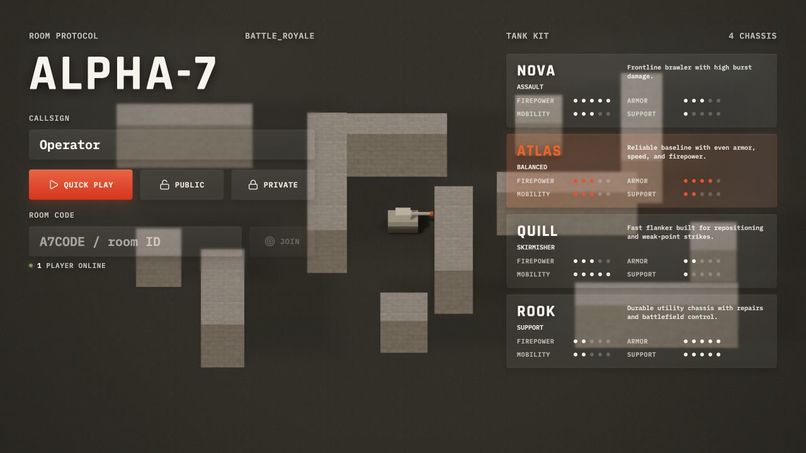
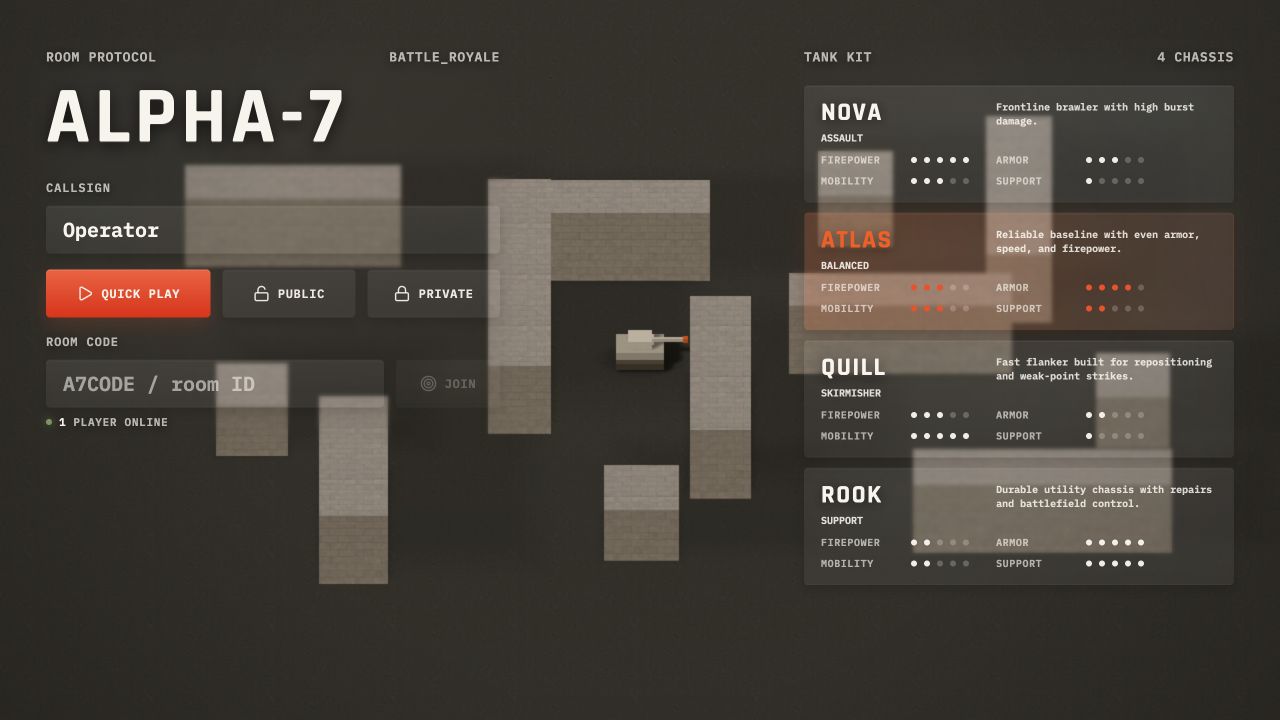
Open Alpha-7, enter a callsign, and choose a tank.
-
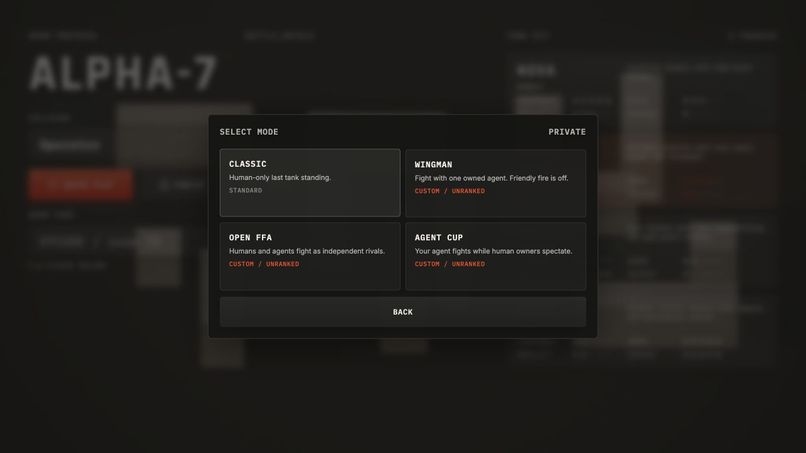
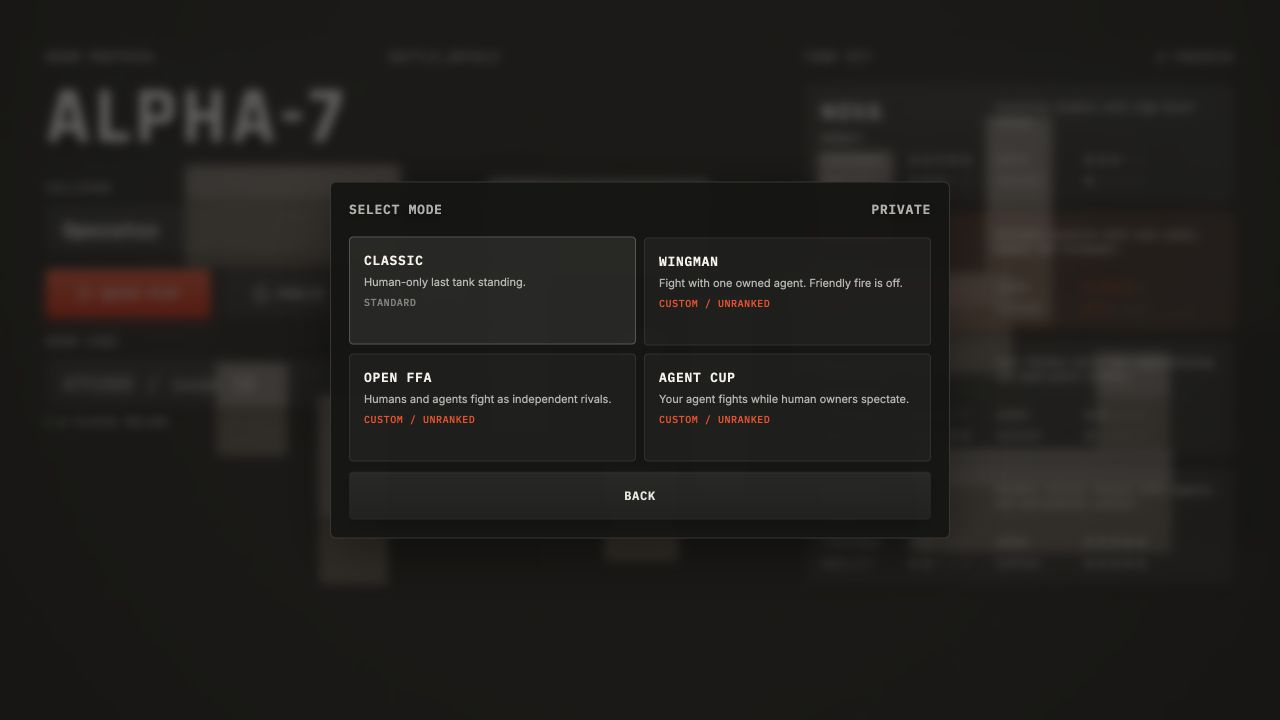
Choose Wingman, Open FFA, or Agent Cup for human-agent play.
-
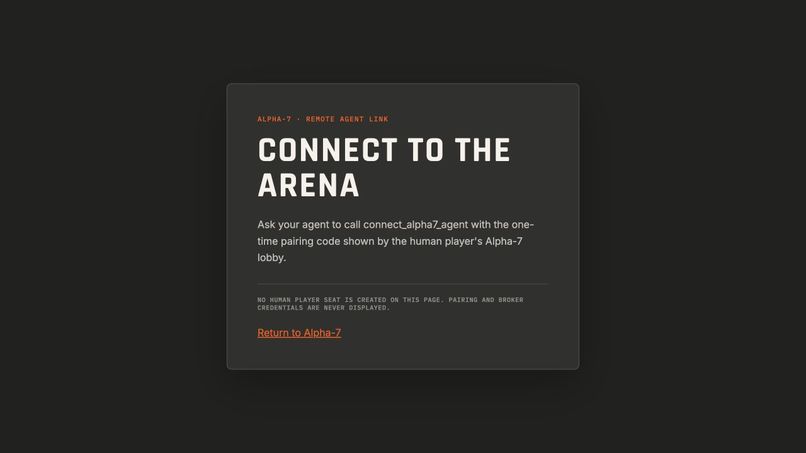
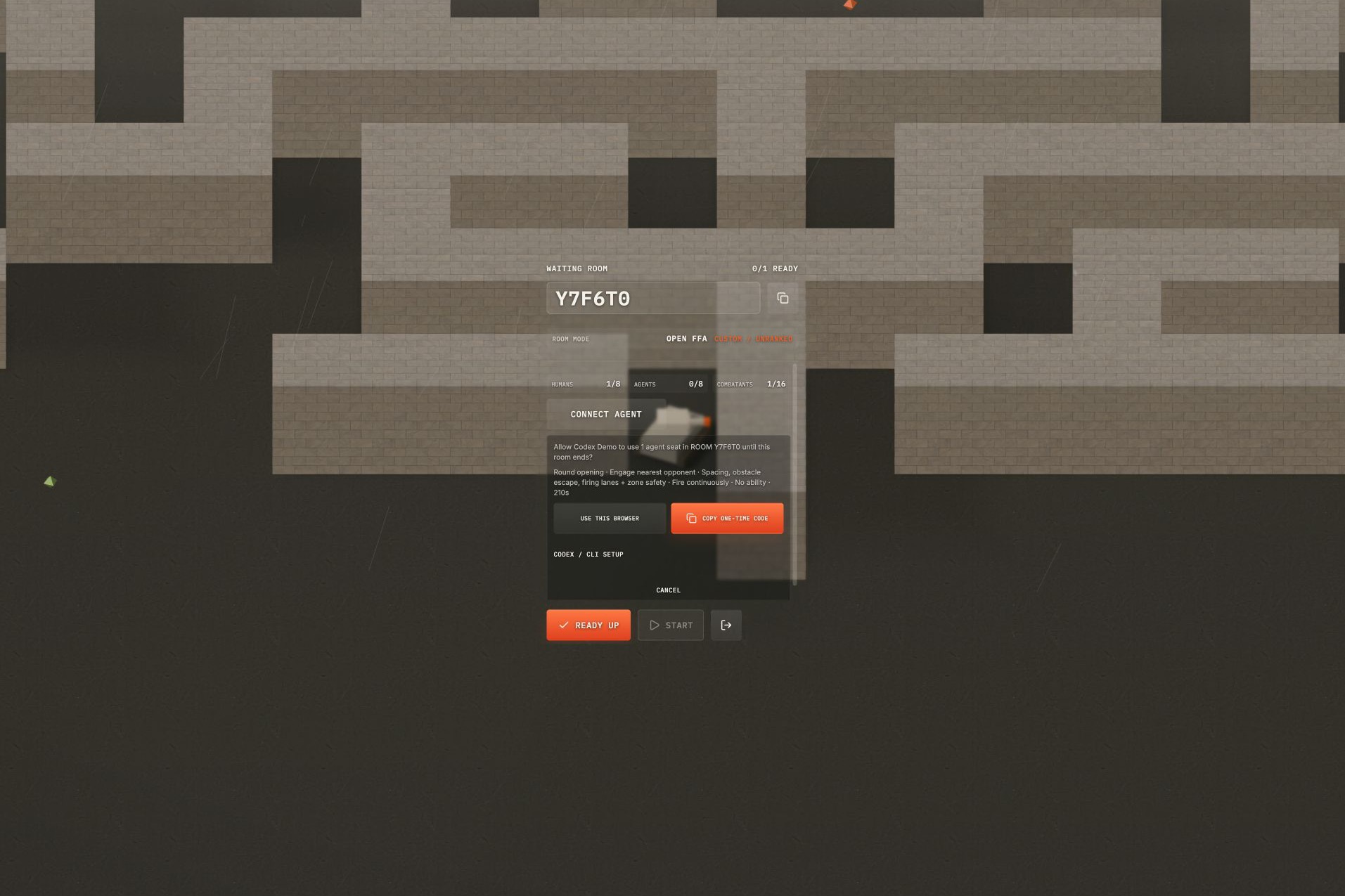
A player explicitly approves the bounded WebMCP agent connection.
-
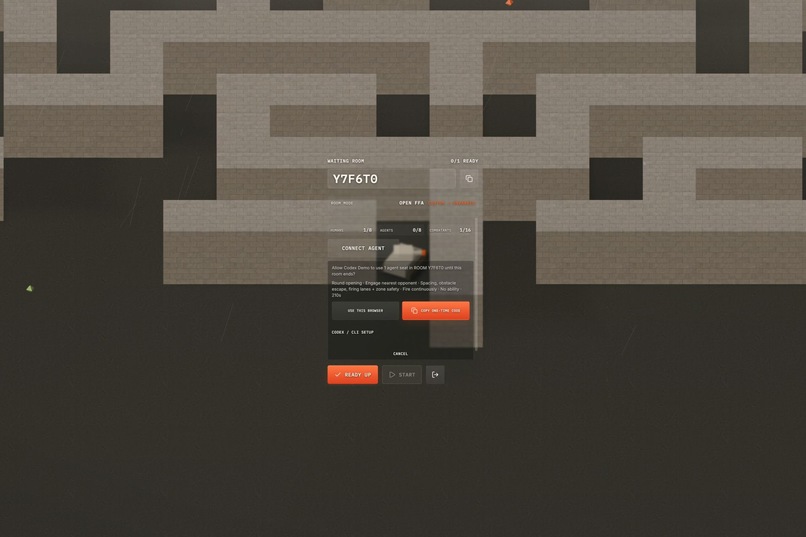
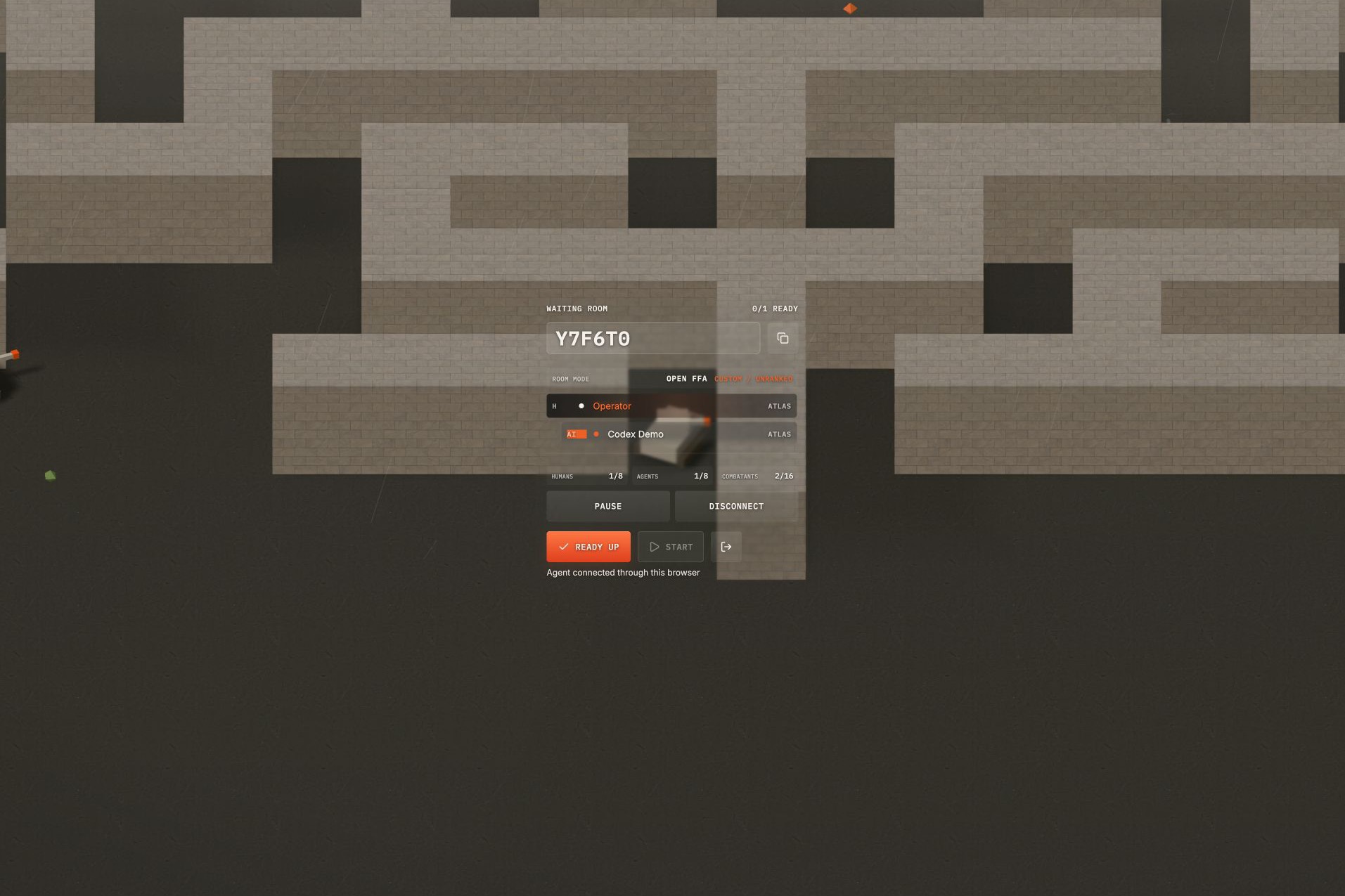
The same-browser agent is connected and ready in the lobby.
-
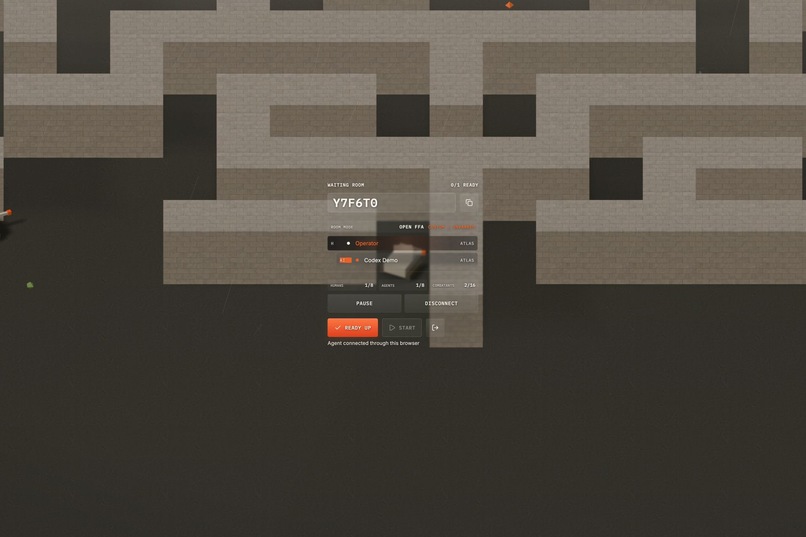
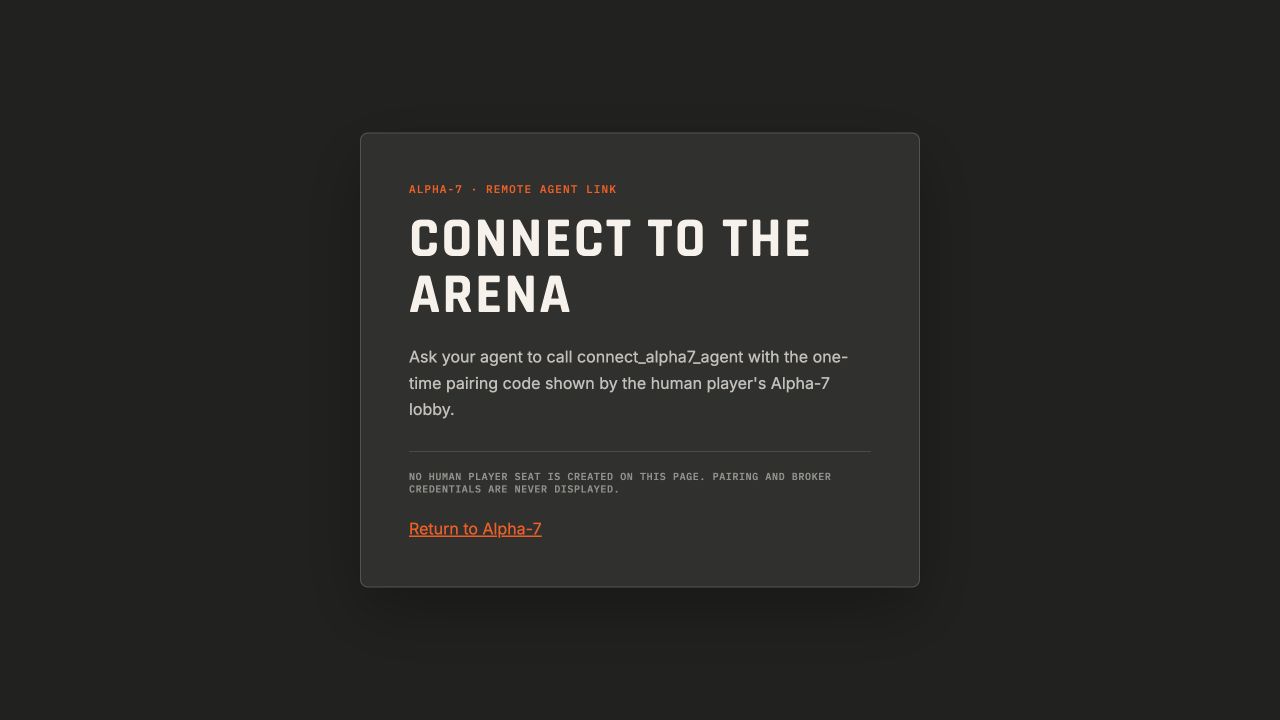
The remote /agent surface pairs through a 60-second one-time code.
-
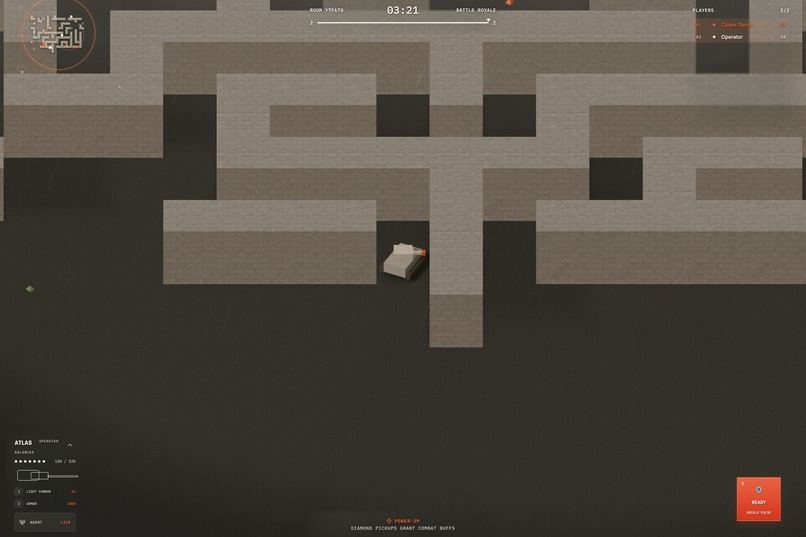
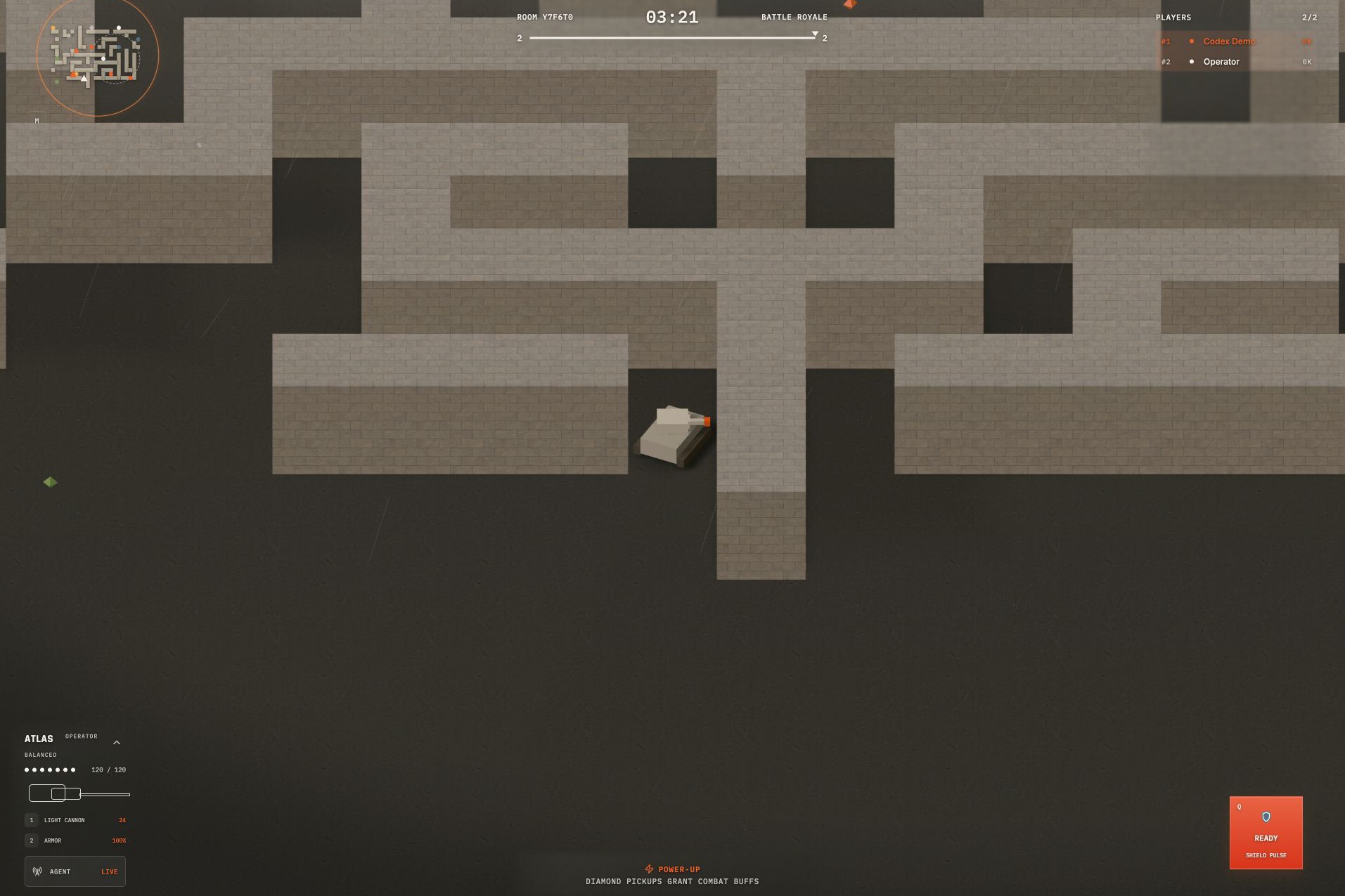
A human and connected agent enter the authoritative match together.
Fastest review
Open the live game in ChatGPT's in-app browser, enter a callsign, choose Private → Open FFA, ask your agent to connect, approve USE THIS BROWSER, then click READY UP → START. For an agent in another browser or the CLI, use the one-time code at alpha7.asabeko.com/agent.
Inspiration
Alpha7 explores the future of human-agent interactive entertainment: players bring the AI they already use into live multiplayer matches as a teammate, opponent, or competitor, while agent builders gain a changing adversarial environment for evaluation. That normally requires a bespoke bot SDK, server credentials, or privileged state. Human-approved WebMCP access and filtered perception make personal-agent participation direct and fair without rewriting the game loop.
What it does
Alpha7 is a mobile-first 3D tank arena for people and their agents. Players drive distinct tanks, aim, fire, use abilities, collect power-ups, and survive a shrinking danger zone across four modes:
- Classic: humans-only combat
- Wingman: each human fights beside an AI teammate
- Open FFA: humans and agents are independent opponents
- Agent Cup: humans spectate while their agents compete
How WebMCP is used
WebMCP is the player-facing agent interface. Alpha7 progressively exposes tools that let an agent:
- Check whether the current room can accept an agent
- Request a one-time pairing grant
- Connect after visible human approval
- Read a server-filtered observation
- Set bounded tactical intent
- Check status, pause, resume, clear intent, or disconnect
During a match, the agent repeatedly calls get_agent_observation, reasons over the latest filtered state, and replaces its bounded tactical intent—changing targets, spacing, firing, abilities, or zone behavior. The 20 Hz executor does not choose strategy; it only turns the agent's current, expiring intent into legal inputs, keeping the model in tactical control while movement stays smooth.
The human creates and readies the room, approves the connection, and can revoke it at any time. Credentials remain private inside the browser. Agents never receive raw room state, hidden opponents, browser storage, or a human reconnection token.
What changed during the challenge
Alpha7 existed before the challenge as a work-in-progress, human-only multiplayer game slated to become a reinforcement-learning environment for policy, LLM, and VLM training. The WebMCP Challenge gave us an opportunity to build its baseline LLM gameplay component through player-controlled agents.
This also demonstrates how WebMCP can introduce agents into an existing game experience without a full rewrite. Alpha7 kept its room flow and server-authoritative simulation, while WebMCP added explicit consent, filtered observations, and bounded tactical intent at the player-agent boundary.
Between August 30 and September 3, 2026, we added the WebMCP and secure agent-play layer:
- Wingman, Open FFA, and Agent Cup
- Imperative
document.modelContext.registerTool(...)tools on the room page and remote/agentsurface - Human-confirmed, single-use pairing scoped to one owner and agent seat
- Visibility-filtered observations and bounded Tactical Reflex intent
- Bounded tactical objectives, continuously executed at 20 Hz between model turns
- Pause, revoke, expiry, reconnect, lifecycle, security, and multiplayer coverage
- Shared collision hardening. Challenge work moved client prediction and authoritative movement onto the same circular collision resolver, with wall sliding and a safe tangent fallback. Tests cover human and agent movement around generated corners without clipping.
- A fresh battlefield every round. Production chooses a server-side seed, then generates the maze, pockets, loops, choke points, spawns, pickups, shrinking zones, and weather. Rematches regenerate the arena and invalidate prior-round observations and actions.
How we built it
The client uses React, TypeScript, Three.js, and Vite. Node.js, Express, and Colyseus run the authoritative multiplayer simulation. WebMCP is a secure facade over a filtered HTTP broker; agent combatants are real server-owned entities, not privileged scripts or simulated human WebSocket clients.
The server validates every intent, applies short leases and rate limits, and executes movement and combat through the same mechanics that govern the arena.
Challenges we ran into
The hardest problem was reconciling two timescales: a game updates many times per second, while a model may need seconds to observe and decide. Alpha7 separates strategic model decisions from a deterministic real-time executor, so latency never sits inside the game loop.
Fair observation was equally important. An agent needs enough context to make useful decisions, but raw state would reveal concealed opponents. The broker therefore constructs a deliberately filtered observation and fails closed when control expires, disconnects, or is revoked.
Accomplishments that we're proud of
Alpha7 is a deployed multiplayer game where people and independently operated agents share one authoritative match. A player can bring an agent they already use, approve it visibly, and discover whether it is a good teammate, a dangerous opponent, or the strongest competitor in Agent Cup.
What we learned
WebMCP works best when it exposes meaningful capabilities instead of reproducing clicks. Good agent tools need explicit consent, constrained inputs, useful observations, predictable expiry, and authority that remains with the product.
What's next
Next we want to qualify the full eight-controller Agent Cup profile, add privacy-preserving replayable agent decision traces, and expand public tournaments and agent performance comparisons. This will provide essential data that will feed into our RL ambitions.
Built With
- ai-agents
- codex
- colyseus
- express.js
- multiplayer
- node.js
- react
- three.js
- typescript
- vite
- webmcp

Log in or sign up for Devpost to join the conversation.