-
-

One press, and it tells you what's in front of you. And when it isn't sure.
-
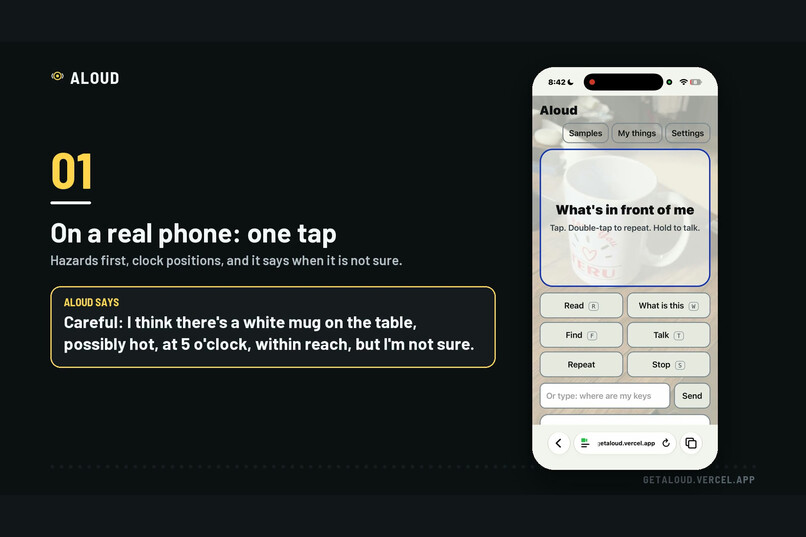
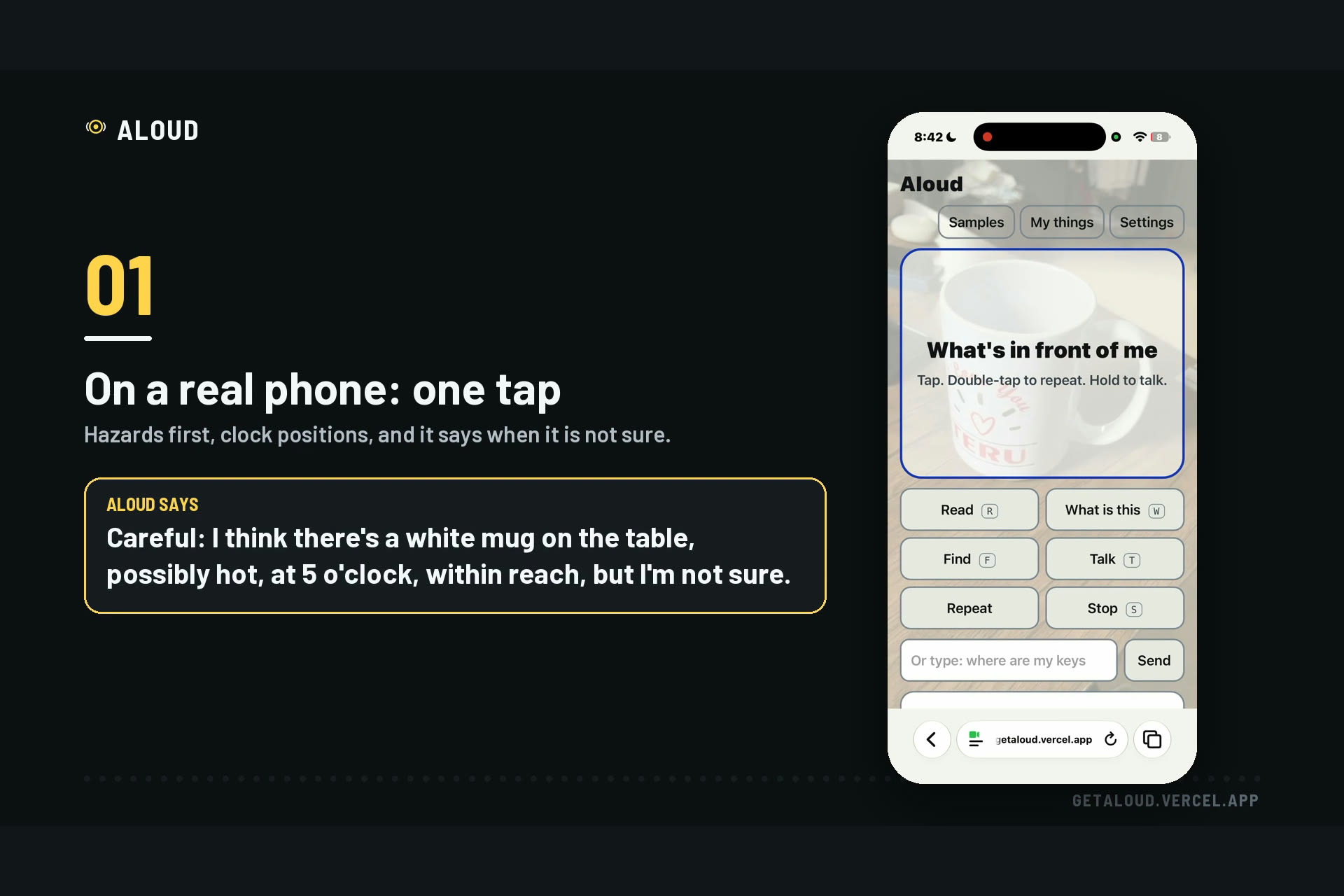
On a real phone: hazards first, with clock positions, and it says when it isn't sure.
-
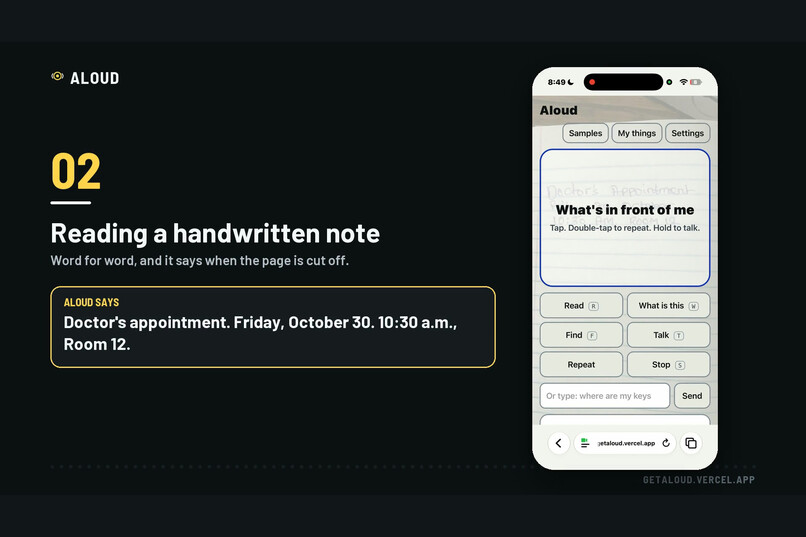
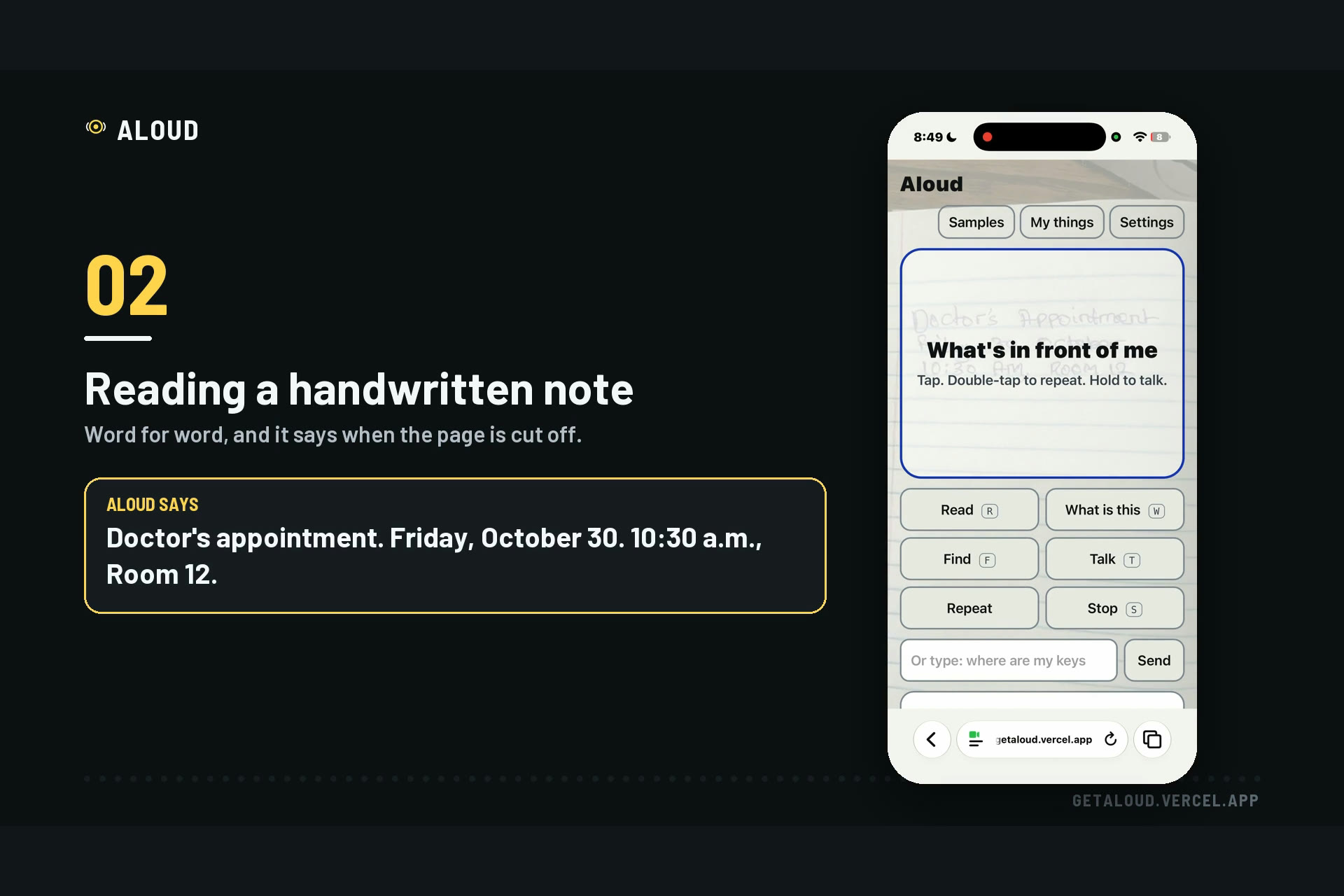
Reading a handwritten note word for word, and saying when the page is cut off.
-
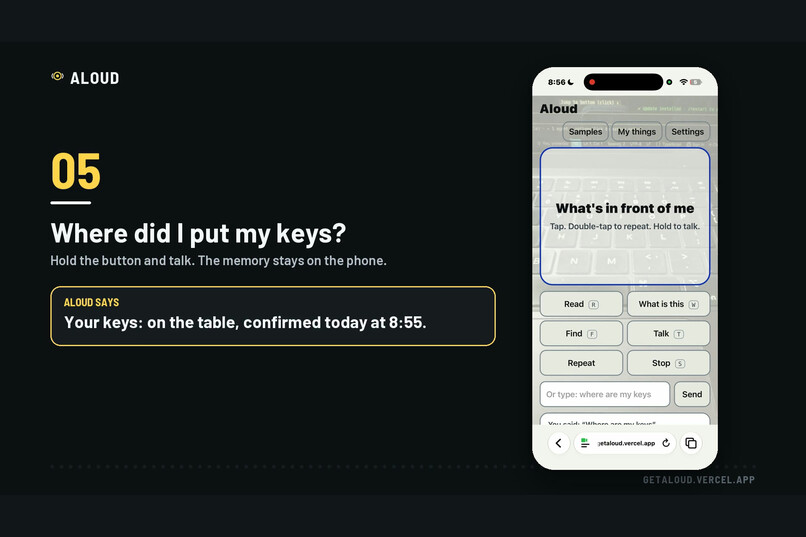
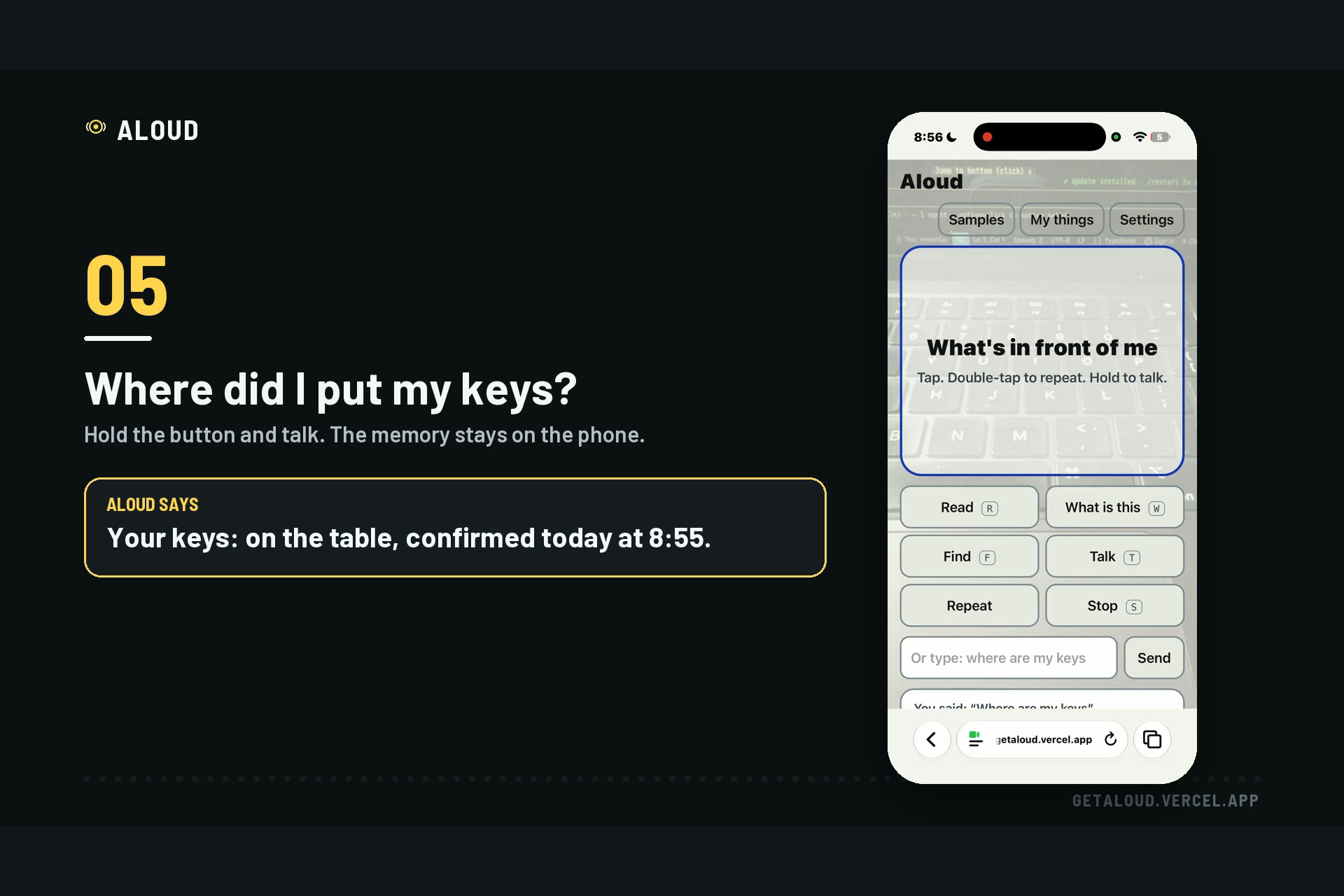
Where are my keys? The camera confirms each placement, and the memory stays on the phone.
-
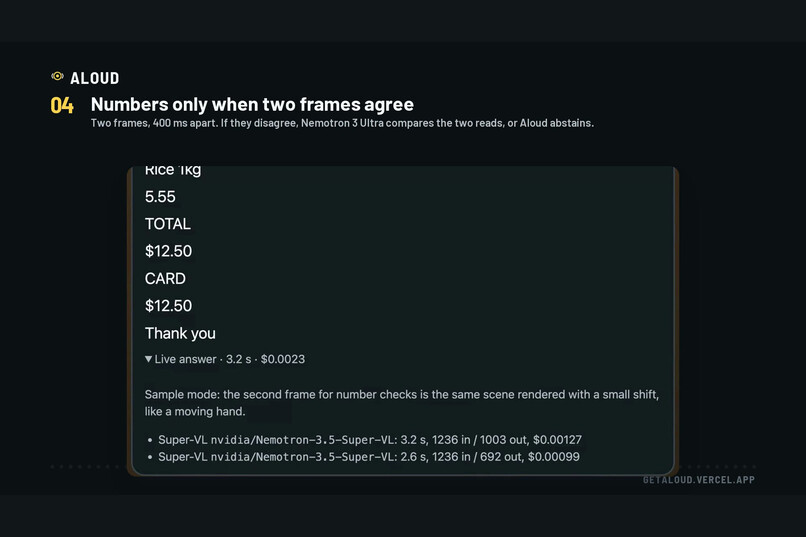
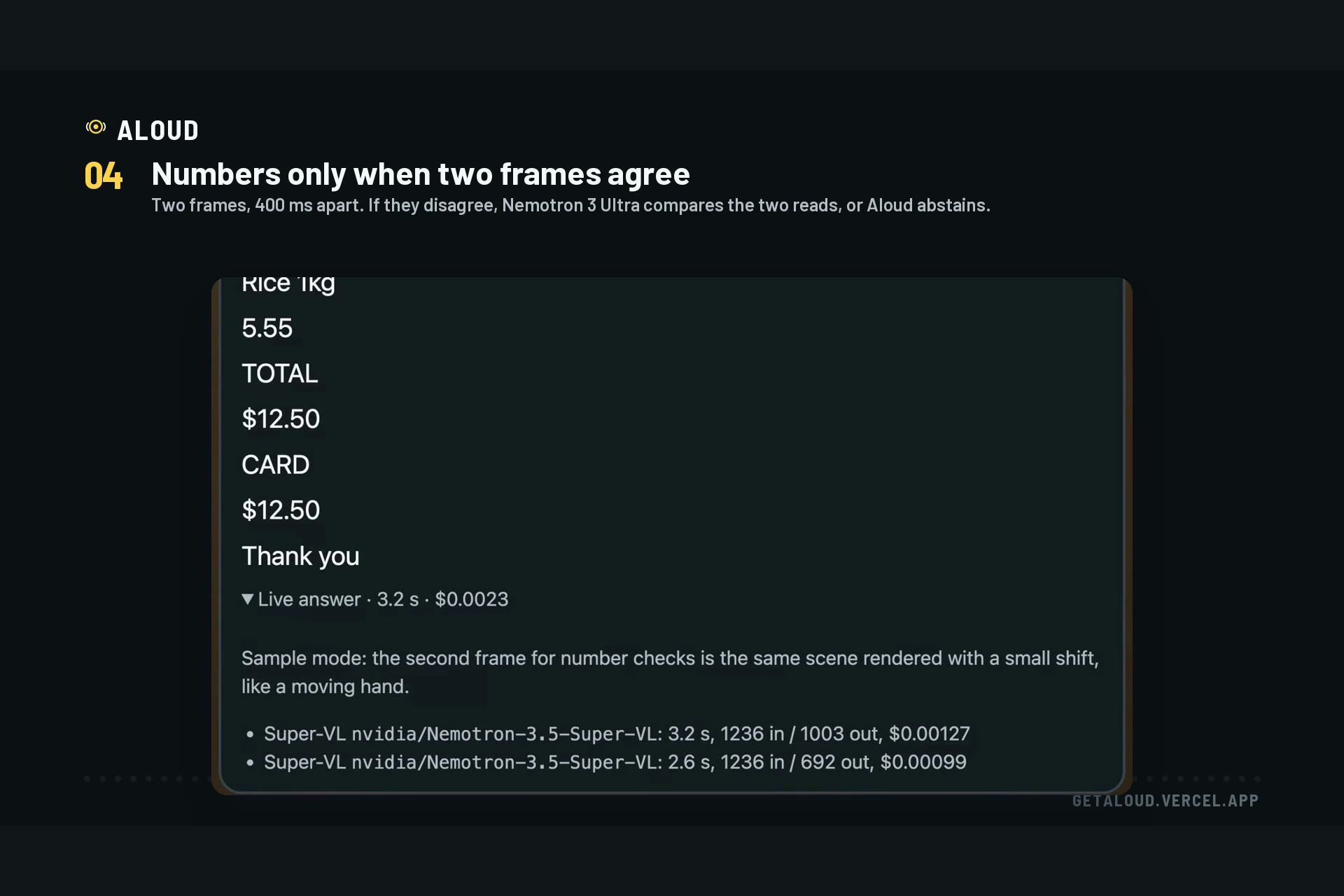
Numbers are spoken only when two frames agree. Otherwise Nemotron 3 Ultra compares the reads, or Aloud abstains.
-
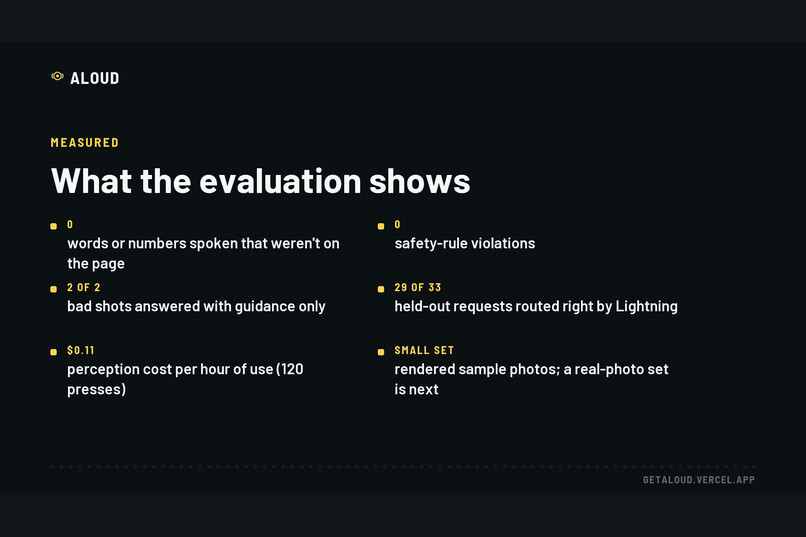
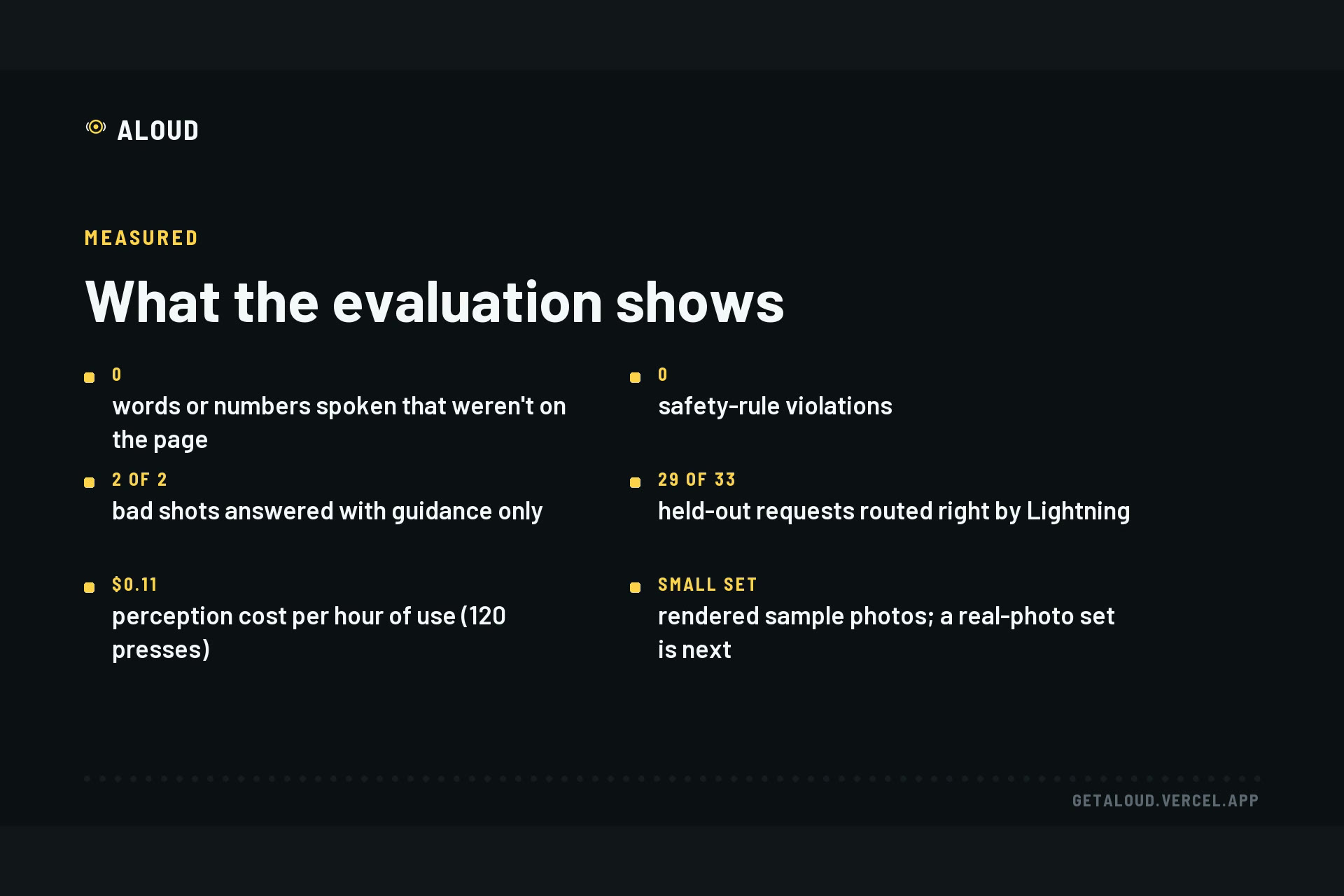
The evaluation reports every rate with its numerator and denominator, on dev and held-out splits.
-
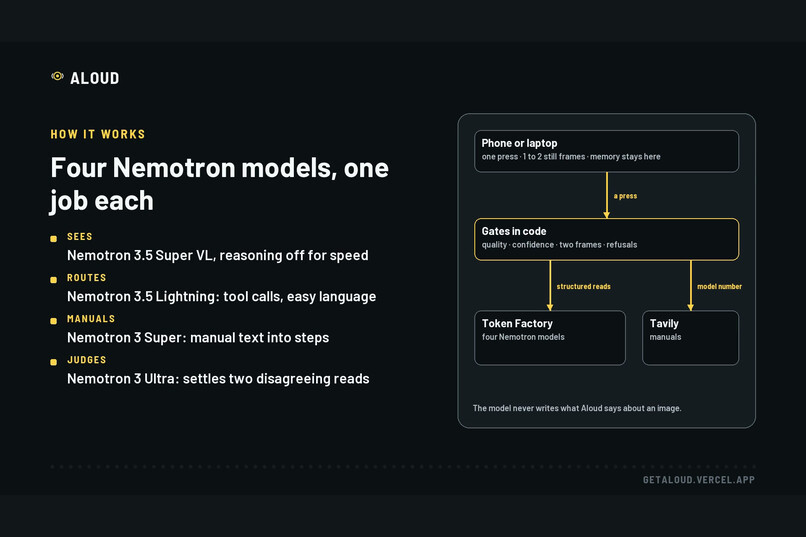
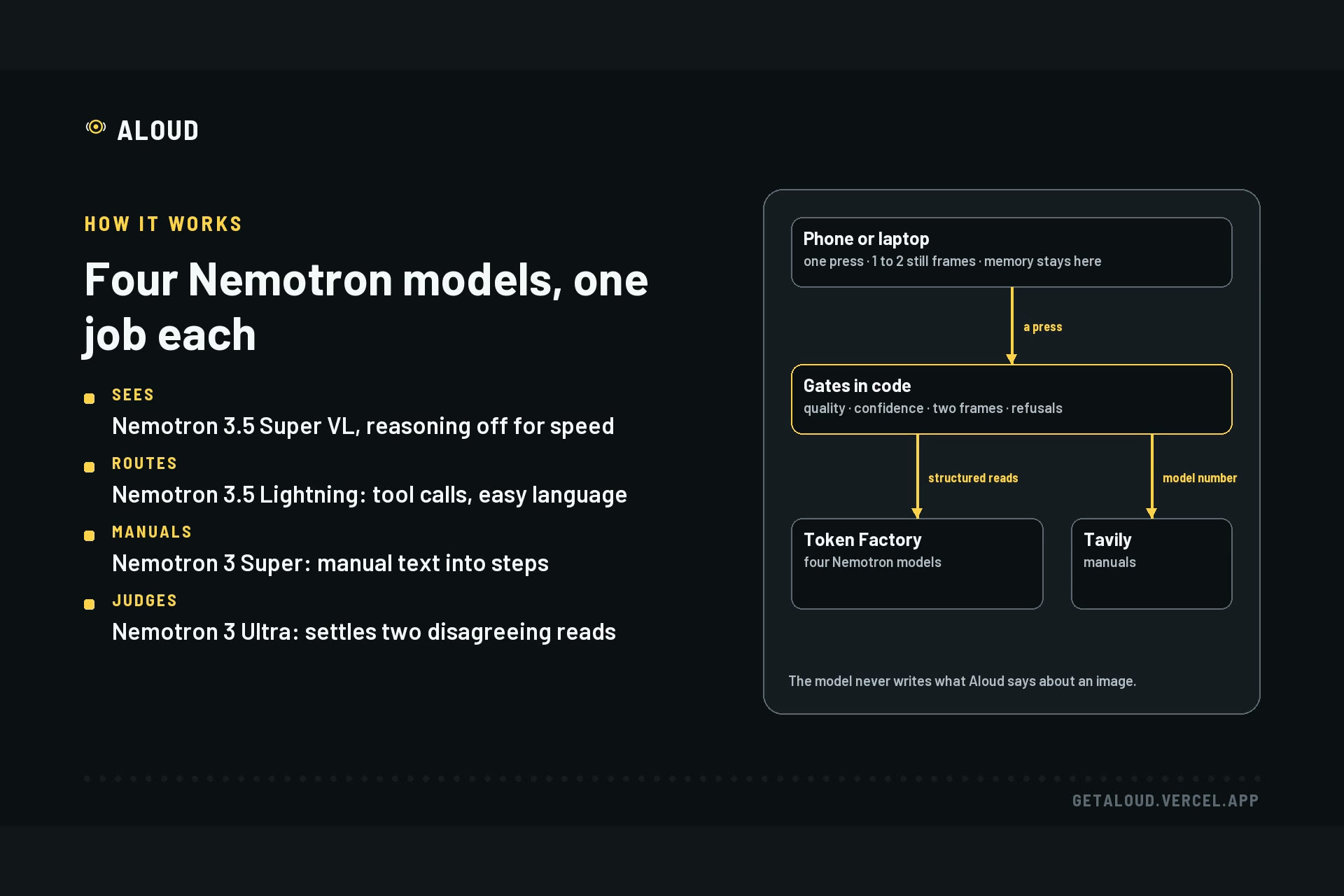
Four Nemotron models on Nebius Token Factory, one job each. Code, not the model, decides what is said.
Inspiration
About 2.2 billion people live with a vision impairment (WHO). Camera assistants already exist, but they share one habit that matters more than anything else for a blind user: when the picture is bad, they guess, and they say the guess in the same confident voice as a fact. If you can't see the label, you can't catch the mistake. A wrong price, a misread appointment time or an invented object is worse than no answer.
So we built Aloud around one rule: say what you see, say how sure you are, and when you can't tell, say how to get a better picture.
What it does
Aloud is a phone web app (PWA) with one big button. Wear the phone on your chest or hold it, and press.
- Describe: a few short sentences, hazards first, with clock positions and rough distance ("Careful: I think there's a white mug, possibly hot, at 5 o'clock, within reach").
- Read: text exactly as written, in reading order. A number is spoken as certain only when two frames agree. If the page is cut off, it tells you which way to move.
- What is this: the main object you're holding and its label.
- Remember and find: "I'm putting my keys on the table." The camera checks they really are your keys, and the placement is stored on the phone only. Later: "Where are my keys?" "Your keys: on the table, confirmed today at 8:55." It works offline too.
- Appliance helper: reads the model number, finds the manual with Tavily, and gives one step at a time, checking each step with the camera.
- Simple mode for people with cognitive disabilities: sentences of at most 15 words, one step per turn, encouragement, and "Did that work?"
- Look harder: re-reads the last picture with the vision model's reasoning turned on.
When the picture is too dark, blurry or cut off, Aloud doesn't guess. It never says a road is safe to cross, never identifies people, and never gives dosing advice. It has a screen-reader mode for VoiceOver and TalkBack, works with a Bluetooth clicker or a keyboard, and anyone can try every skill on a laptop with the bundled sample photos.
How we built it
Four NVIDIA Nemotron models on Nebius Token Factory, each with one job:
| Model | Job |
|---|---|
| Nemotron 3.5 Super VL | All perception, as strict JSON: quality flags, can_answer, and items with confidence, clock position and distance. Run with reasoning_effort: "none" on every press for speed; "Look harder" turns reasoning on. |
| Nemotron 3.5 Lightning | Intent routing with tool calling, easy-language rewriting and simple-mode plans. Cheap and fast for the everyday text calls. |
| Nemotron 3 Super 120B | Turns a messy manual page (found with Tavily search and extract) into 3 to 6 steps, each with a camera check. |
| Nemotron 3 Ultra | Settles disagreements between two vision reads of the same number, without seeing the images. Also the teacher for distillation data and the judge in our evaluation. |
The model never writes what Aloud says about an image. Code decides what is safe to say:
- Quality gate: if the model can't answer, Aloud speaks only fixed camera guidance ("Too dark. Try a light, or move toward the window.").
- Confidence wording: at 0.8 or above, said plainly; 0.5 to 0.8 becomes "I think …, but I'm not sure"; below 0.5 is dropped and counted.
- Two-frame numbers: Read takes two frames 400 ms apart. If they disagree, Ultra judges between the two structured reads, and code rejects any answer that neither frame produced. Otherwise Aloud abstains: "I see a number but can't confirm it. Move closer."
- Forbidden claims (people, traffic safety, medicine) are checked in code on every request and every output.
- Memory lives in IndexedDB on the phone. A placement becomes trusted only when the camera confirms the object.
Where Token Factory helped: one OpenAI-compatible API for all four models, so changing a model's role is changing an id. Strict json_schema and tool calling on the same endpoint. reasoning_effort control to keep vision fast. Usage in every response powers the per-answer cost shown in the app, the daily budget cap and the cost-per-hour in our evaluation.
Stack: React + Vite PWA, a stateless Hono API on Vercel, Tesseract.js for offline reading, Tavily for manuals, Vitest (229 tests) and an evaluation harness that prints every rate with its numerator and denominator, on a dev split and a held-out split.
Challenges we ran into
- Latency from West Africa. A TLS handshake to Token Factory took about 2.4 s from our connection, more than the vision read itself. On the deployed server, Describe takes 1.3 to 1.8 s server-side.
- Super VL thinks by default, spending 1.2K to 1.9K hidden tokens per call. Turning reasoning off made every press faster, and we kept reasoning as a deliberate "Look harder".
- Models add their own formatting. Lightning sometimes wrote
/1/or!\in front of steps, which a screen reader reads aloud. We now clean every step in code, with tests. - Honest abstention is hard to tune. Too strict and Aloud never answers; too loose and it guesses. The two-frame rule for numbers, with Ultra as a judge that can't invent a third answer, was the balance we found.
Accomplishments that we're proud of
- It works on a real phone: the demo video shows it describing a table, reading a handwritten note and finding keys by voice.
- In our evaluation, Read spoke zero words or numbers that weren't on the page, and there were zero forbidden-claim violations, on both splits. Perception costs about $0.10 per hour of use (120 presses).
- We publish the weak spots too: Describe struggles with abstract drawings, and every set is small and synthetic, so the numbers show the pipeline works, not that it's reliable.
What we learned
- A smaller set of things said with the right confidence is more useful to a blind user than a longer, confident description.
- Safety rules belong in code, not only in prompts: the model proposes, code decides.
- Giving each model one job made the system cheaper, faster and easier to test.
What's next for Aloud
- Train a Nemotron 3 Nano 4B fast lane on Nebius Serverless AI. The teacher data (949 examples, checked by code) and the job and endpoint scripts are ready; the training run hasn't happened yet.
- Test with blind and low-vision users and change Aloud based on what they say.
- A real-photo evaluation set of at least 40 phone photos.
- Run the distilled model on the phone, so routing and simple-mode plans work offline.
- More languages. Aloud is English only today.
Built With
- hono
- indexeddb
- nebius-token-factory
- nvidia-nemotron
- playwright
- pwa
- react
- tavily
- tesseract.js
- typescript
- vercel
- vite
- vitest

Log in or sign up for Devpost to join the conversation.