-
-
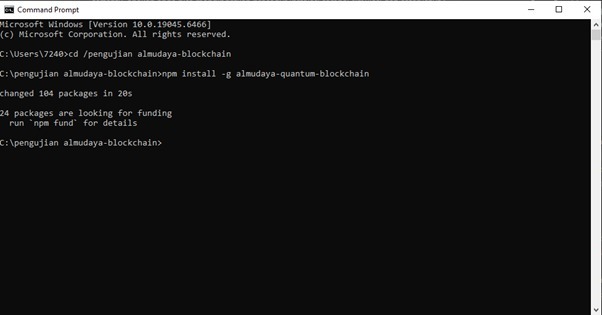
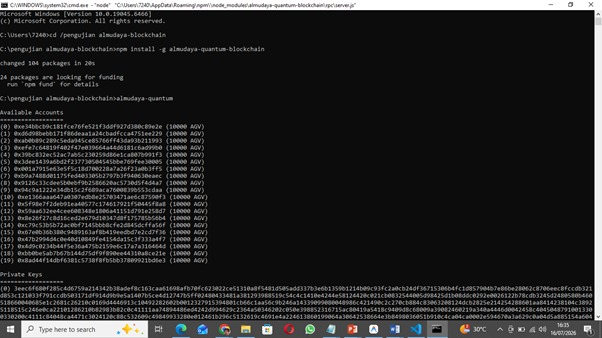
Install a post-quantum blockchain
-
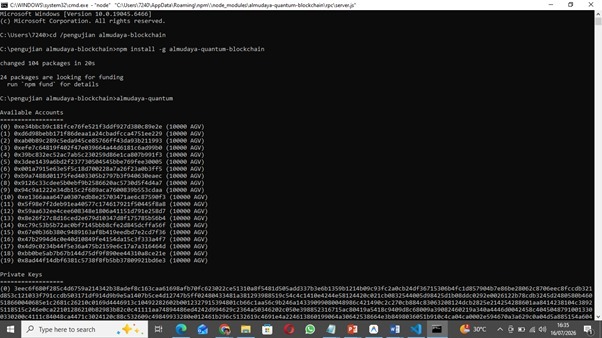
running a post-quantum blockchain
-
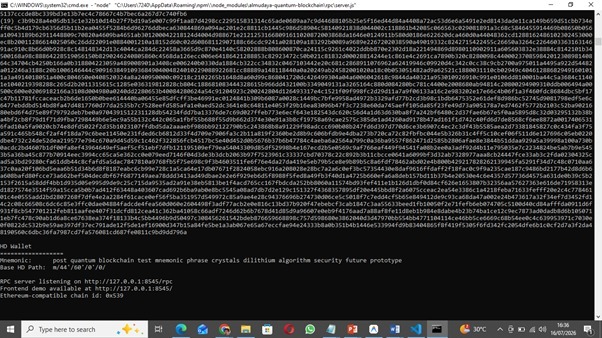
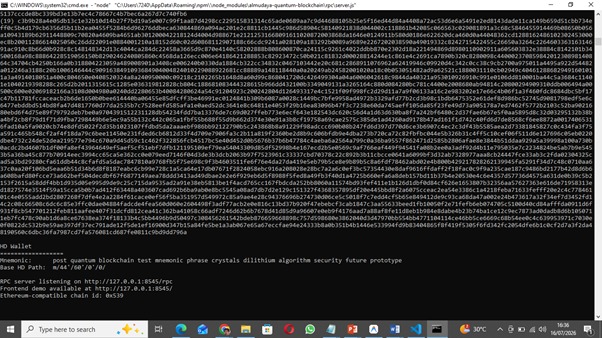
running a post-quantum blockchain
Inspiration
The rapid advancement of quantum computing raises a fundamental challenge for today's blockchain ecosystems, most of which rely on classical public-key cryptography. We were inspired by a simple question:
What would a blockchain development platform look like if it were designed from the beginning for the post-quantum era?
Instead of modifying an existing blockchain, we decided to build our own developer-oriented blockchain platform from scratch, inspired by tools such as Ganache and Hardhat, while making post-quantum cryptography a first-class design principle rather than an afterthought.
What it does
How we built it
Almudaya Quantum Blockchain is a lightweight blockchain development platform that enables developers to build, test, and experiment with quantum-safe blockchain applications.
The project introduces a blockchain infrastructure designed around post-quantum cryptographic primitives, allowing future integration of NIST-standardized algorithms while maintaining a familiar developer experience.
Our vision is to become a research and education platform where new quantum-safe protocols, consensus mechanisms, and smart contract technologies can be explored before deployment in production environments.
Challenges we ran into
The project began by designing the overall architecture through iterative specification and prompt engineering. We decomposed the blockchain into modular components—including networking, transaction processing, wallets, consensus, storage, APIs, and cryptographic interfaces—so that each subsystem could evolve independently.
Implementation was then carried out using AI-assisted software development tools, with the source code continuously refined, tested, and extended by the project author. As development progressed, the cryptographic layer was redesigned to support post-quantum algorithms, enabling the platform to evolve from a conventional blockchain prototype into a quantum-safe blockchain framework.
Throughout development, every AI-generated component was reviewed, integrated, and validated manually to ensure architectural consistency and functional correctness.
Accomplishments that we're proud of
Successfully built a working blockchain platform from scratch. Designed the system with post-quantum cryptography in mind rather than treating it as an add-on. Created a modular architecture suitable for research, education, and future industrial development. Demonstrated that AI-assisted software engineering can significantly accelerate the development of complex blockchain infrastructure while keeping human architectural oversight central to the process.
What we learned
This project reinforced an important lesson:
AI is becoming a powerful software engineering accelerator, but successful systems still depend on careful architectural planning, iterative refinement, and human decision-making.
We also learned that designing cryptographic abstraction layers early dramatically simplifies future migration toward post-quantum standards.
What's next for Almudaya Quantum Blockchain
Our roadmap includes:
Integration of standardized post-quantum cryptographic algorithms (ML-KEM, ML-DSA, SLH-DSA). A complete smart contract development environment. Developer SDKs and APIs. Cross-platform blockchain nodes. Performance benchmarking against classical blockchain implementations. Educational and research modules for universities. Future support for AI-assisted smart contract generation and verification.
Built With
- blockchain
- cli
- cryptography
- developer
- express.js
- git
- github
- javascript
- json
- ml-dsa
- node.js
- post-quantum
- quantum
- tools


Log in or sign up for Devpost to join the conversation.