-
-
ALMA DASHBOARD
-
-
-
Inspiration
In the cross-border Omo River–Lake Turkana basin between Ethiopia and Kenya, pastoralists, crop farmers, and fishers face a recurring, compound climate threat. Upstream rainfall accumulation in the Ethiopian highlands frequently coincides with emergency spillway releases from the Gibe III hydro-dam. When these two events overlap inside the same 24-hour arrival window downstream, flash floods devastate local livelihoods.
Traditional early warning systems broadcast broad, generic warnings over the internet or TV—completely failing to account for compound hazard timing and leaving both feature-phone users and smartphone users in remote drylands without actionable pathways to safety. We were inspired to build ALMA (Automated Land & Moisture Action) to bridge this "last-mile action gap"—turning complex satellite data and hydro-telemetry into hyper-local, sector-specific survival instructions delivered directly over WhatsApp, USSD, and voice.
Who It's Built For & Target Audience
ALMA is purpose-built to bridge two distinct operational worlds across cross-border dryland basins:
- Primary Users (Disaster Response Teams & Analysts):
- County Disaster Management Officers (e.g., Lodwar, Garissa, Marsabit) who need rapid, cross-border situational awareness between field deployments.
- Regional Hydro-Climate Analysts (ICPAC, CEWARN, Red Cross) managing multi-nation flood response protocols.
- Target Beneficiaries (Last-Mile Communities):
- Pastoralist Herders: Mobile herdsmen needing high-ground migration routes and satellite-verified forage/water locations before waters rise.
- Floodplain Crop Farmers: Agriculture-dependent families needing precise inundation windows to execute early harvests or clear drainage.
- Lake Fishers: Lake Turkana fisherfolk needing surge arrival times to anchor boats and evacuate shorelines.
What it does
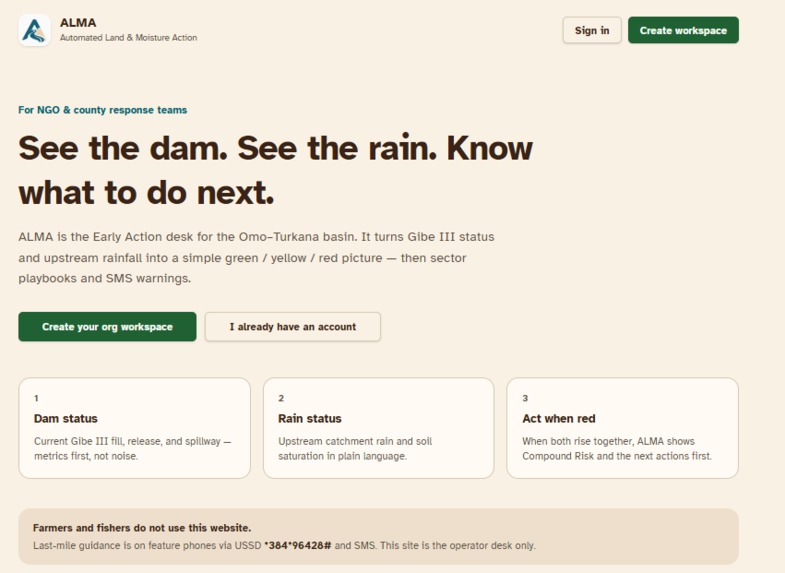
ALMA is an AI-powered, dual-trigger compound flood early action engine designed for cross-border river basins.
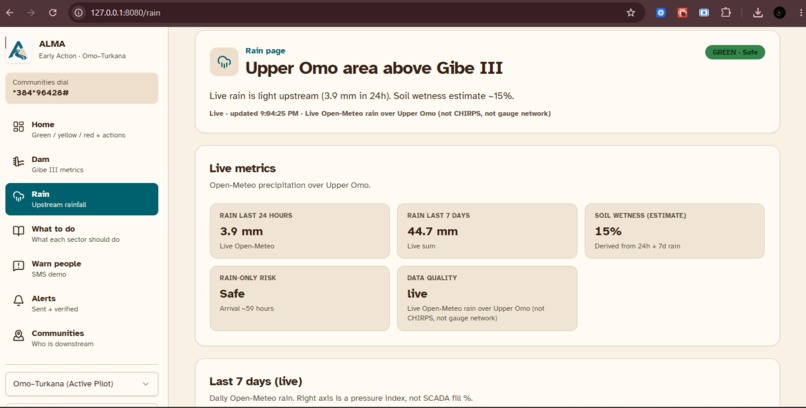
- Dual-Trigger Physics Engine: It continuously ingests upstream rainfall accumulation (CHIRPS/ICPAC) and dam discharge telemetry to calculate non-linear flood collision windows downstream.
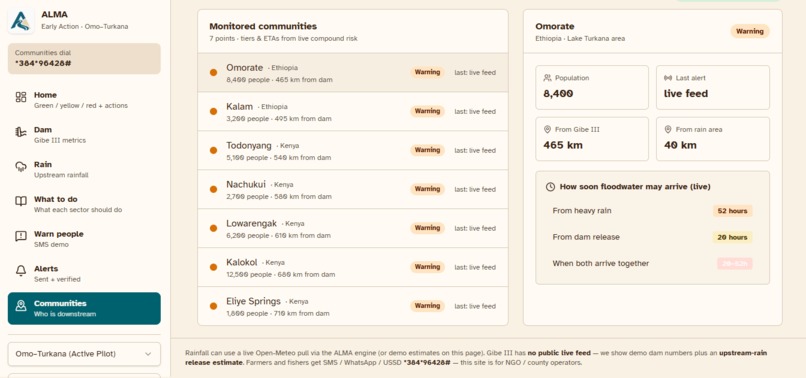
- Compound Risk Escalation: When a high-volume dam release intersects an incoming rainfall surge within 24 hours, ALMA automatically escalates the alert to a Compound Severe (Red) state using non-linear flood amplification math.
- Omnichannel Last-Mile Action Dispatcher: Rather than sending passive warnings, ALMA processes satellite vegetation (NDVI) and elevation profiles to calculate actionable playbooks:
- WhatsApp Bot Layer: Offers an interactive, rich-media conversational assistant (via WhatsApp Business API) for smartphone users to view map snippets, receive voice note advisories, and chat with ALMA.
- USSD & Voice Gateway (
*384*77#): Automatically acts as an offline zero-data fallback for feature phones ($15 Nokia devices) over 2G signal bars, guiding users with plain-text safe routes and automated IVR voice calls in local dialects.
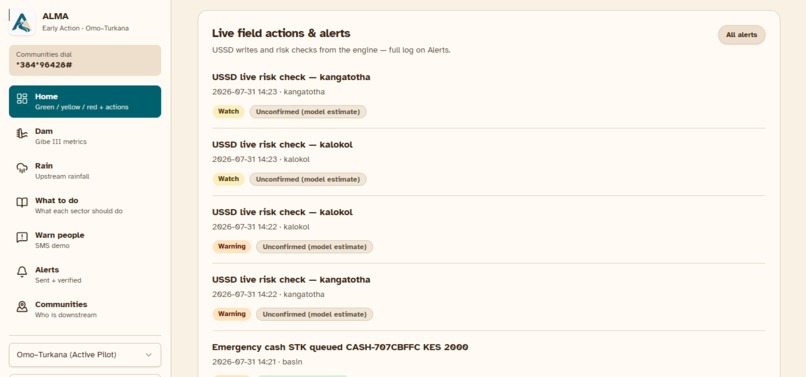
- Crowdsourced Verification: Local community members reply via WhatsApp or USSD/Voice to report ground-truth conditions, updating ALMA's real-time confidence scores on the responder dashboard.
How we built it
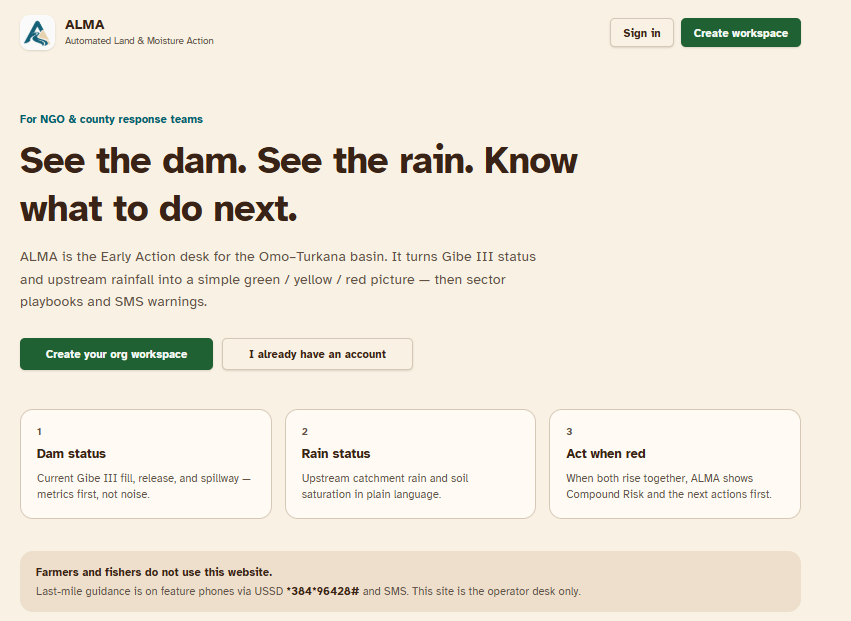
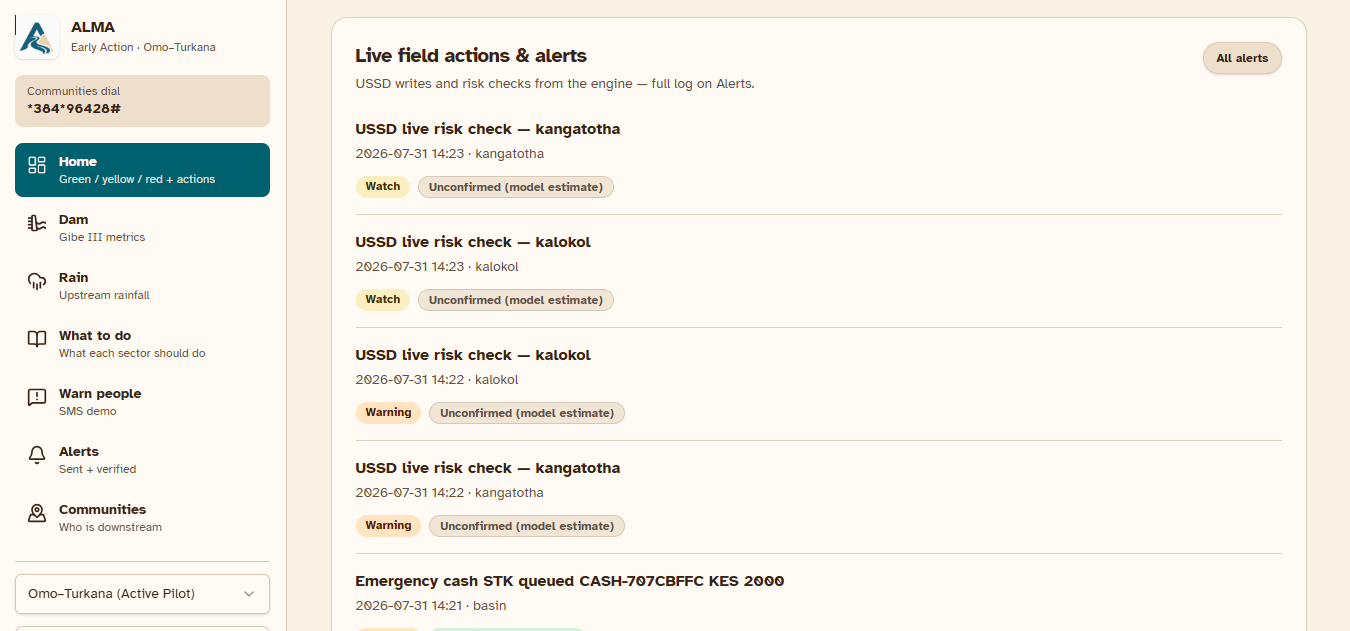
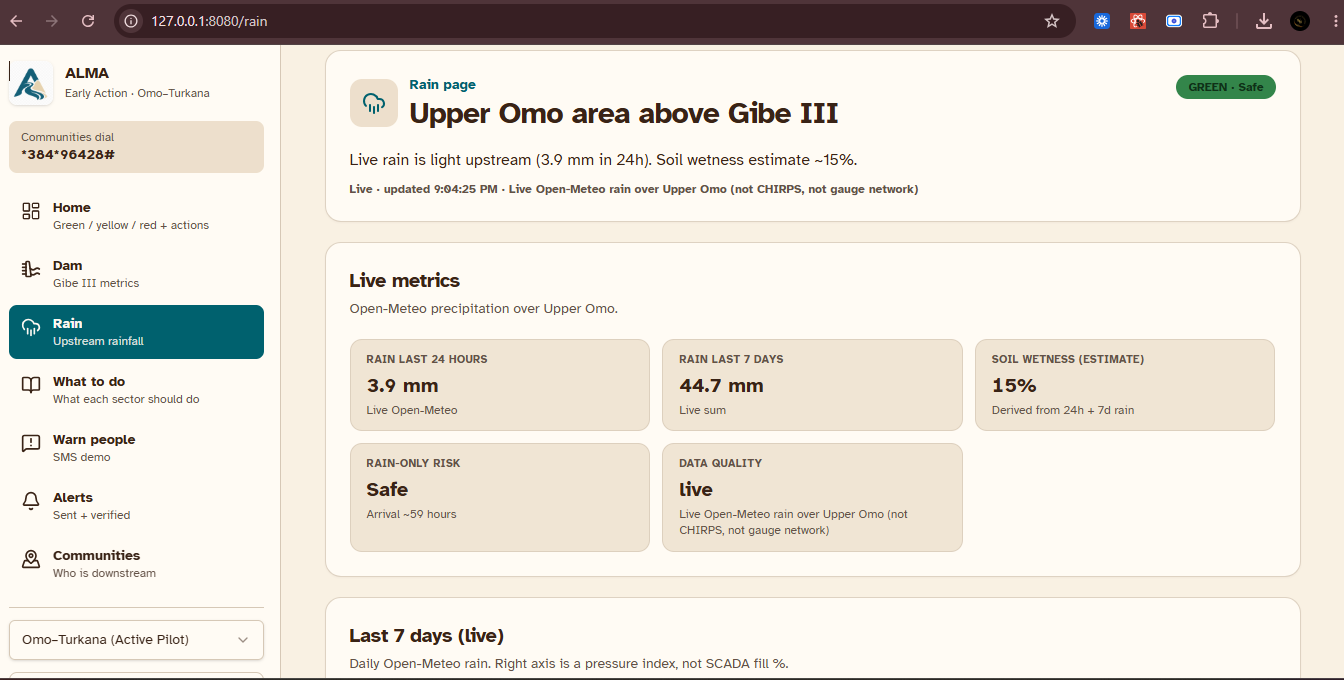
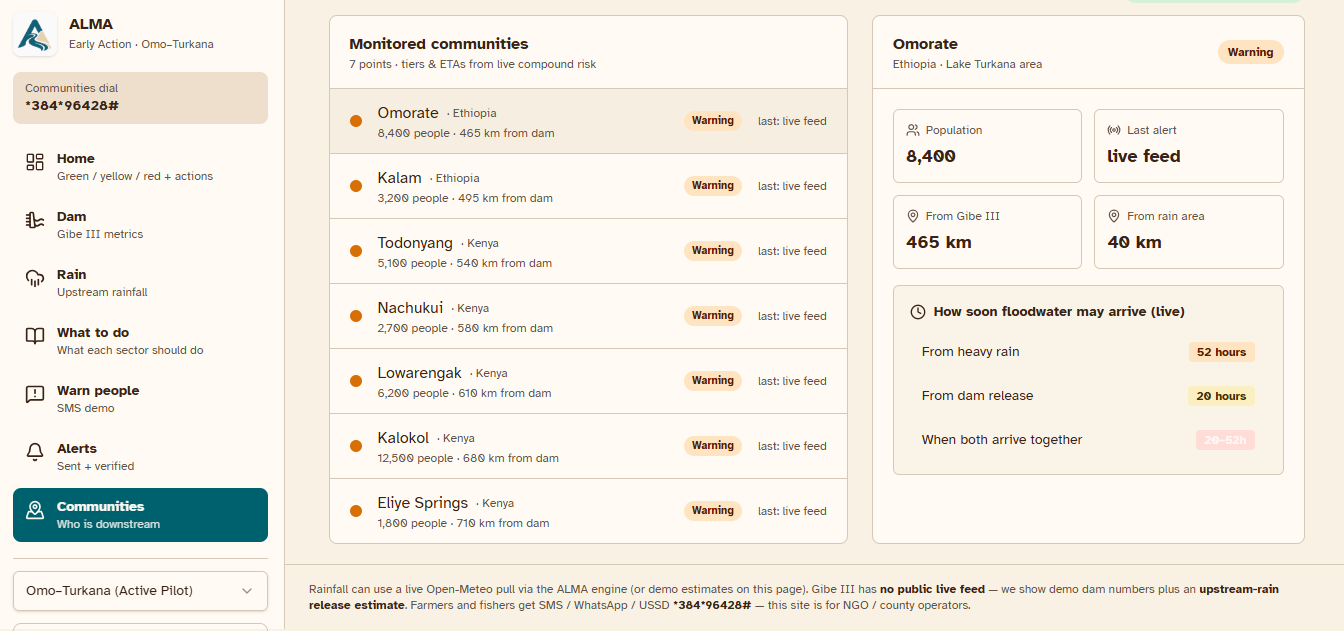
- Interactive Operations Web Dashboard: Built using React, Tailwind CSS, and Lucide icons to give county disaster managers and ICPAC analysts a real-time cross-border basin view, 7-day hydrograph forecasts, an active alert ledger, and a pitch simulator.
- Offline-First AI Pipeline: Integrated Google Gemma 2 and FunctionGemma running locally on edge hardware at county disaster offices. FunctionGemma acts as a zero-latency edge parser, converting messy, unstructured ground-truth messages ("Maji iko juu sana kwa Node 3") from WhatsApp and USSD into structured JSON objects without querying external cloud APIs.
- WhatsApp & Low-Bandwidth Gateway: Integrated Meta's WhatsApp Business API paired with Africa’s Talking USSD and Voice APIs to power a seamless fallback pipeline (WhatsApp $\rightarrow$ USSD $\rightarrow$ SMS). We built Cell-ID tower location mapping to automatically detect a user's ward without requiring manual navigation steps.
- Compound Hydrological Engine: Written in Python, modeling time-series propagation delays (~48–72h for upstream rain vs. ~12–24h for dam releases) and non-linear surge amplification.
Challenges we ran into
- Multi-Channel Fallback Orchestration: Designing the messaging bridge so that if a WhatsApp message fails due to mobile data cutouts in remote bush zones, the system automatically falls back to USSD/SMS within seconds without dropping user context.
- Modeling Non-Linear Compound Timing: Calibrating different propagation delays—where upstream rain runoff takes days to reach Lake Turkana while dam releases arrive in hours—required careful time-series alignment to avoid false positive alarms.
- USSD & WhatsApp Session Timeouts: Balancing rich WhatsApp interactive buttons with fast 30-second GSM USSD menu timeouts required building Smart Session Resume state tracking tied to the user's phone number.
- Offline Edge Multilingual Processing: Fine-tuning offline prompts for local languages (Swahili, Turkana, Oromo, Amharic) so that Gemma models could accurately parse unstructured local dialect texts across both audio calls and text messages.
Accomplishments that we're proud of
- Universal Access (WhatsApp + USSD): Creating an early action pipeline that serves both modern smartphone users via interactive WhatsApp chats and remote herders on basic $15 feature phones.
- True Dual-Trigger Logic: Moving beyond simple "rain monitor" tools to build an engine that actually calculates the physical collision of weather events and infrastructure spillways.
- Offline Edge Independence: Ensuring that even if a severe storm takes down internet connectivity at the local county disaster office, disaster managers can still run the full ALMA risk analysis and simulator locally using Gemma.
- Action over Information: Delivering actionable safe-corridor navigation ("Move herds 8km East to High-Ground Corridor B") instead of useless percentage probabilities.
What we learned
- Redundancy Saves Lives: Relying on a single channel (like WhatsApp or a mobile app) fails when data networks drop during storms. Pairing WhatsApp with USSD/SMS guarantees last-mile delivery.
- Context Trumps Data: Communities in vulnerable zones don't need complex charts—they need clear, feasible instructions delivered in their native dialect.
- Crowdsourcing Builds Trust: Combining satellite predictions with real-time feedback from local elders reduces false alarms and builds deep community trust.
What's next for ALMA (Automated Land & Moisture Action)
- Expansion to the Tana River Basin: Scaling ALMA’s dam module to monitor the Seven Forks Hydro-dam releases along Kenya's Tana River.
- Interactive WhatsApp Location Pinning: Allowing smartphone users to drop a live GPS pin on WhatsApp to receive hyper-precise, micro-topography flood routing.
- Offline USSD/WhatsApp Micro-Vouchers: Integrating automated, pre-disaster digital feed vouchers (
*384*77*VOUCHER#) so pastoralists can claim subsidized animal feed at local agro-vets before floods strike. - Mesh Network SMS Relays: Implementing peer-to-peer SMS broadcast chains between community lead herders to forward ALMA playbooks into deep bush zones where cell towers are damaged or absent.## Inspiration In the cross-border Omo River–Lake Turkana basin between Ethiopia and Kenya, pastoralists, crop farmers, and fishers face a recurring, compound climate threat. Upstream rainfall accumulation in the Ethiopian highlands frequently coincides with emergency spillway releases from the Gibe III hydro-dam. When these two events overlap inside the same 24-hour arrival window downstream, flash floods devastate local livelihoods.
Built With
- africas-talking
- climate
- climate-tech
- dam
- detection
- early-warning-system
- function-gemma
- gemma-ai
- gis
- hydrology
- kenya
- machine-learning
- offline-first
- python
- ragpipeline
- react
- risk
- tailwind-css
- ussd
- voice-api

Log in or sign up for Devpost to join the conversation.