

Inspiration
I love running, and I kept seeing the same gap. A personal coach is the best thing that can happen to a runner, but at the price they charge they can't adapt the plan to every runner's day-to-day: a truly personal plan is hard for them to sustain, so most runners end up with a spreadsheet template that doesn't move when their week does. I wanted to build something that treats you the way a personal coach would.
At the same time, running keeps growing among women year after year (53% of US race registrants in 2025 were women, according to RunSignup), and there is a widespread complaint that running products aren't built with a woman's body in mind. So Allyson is built for women who run.
What it does
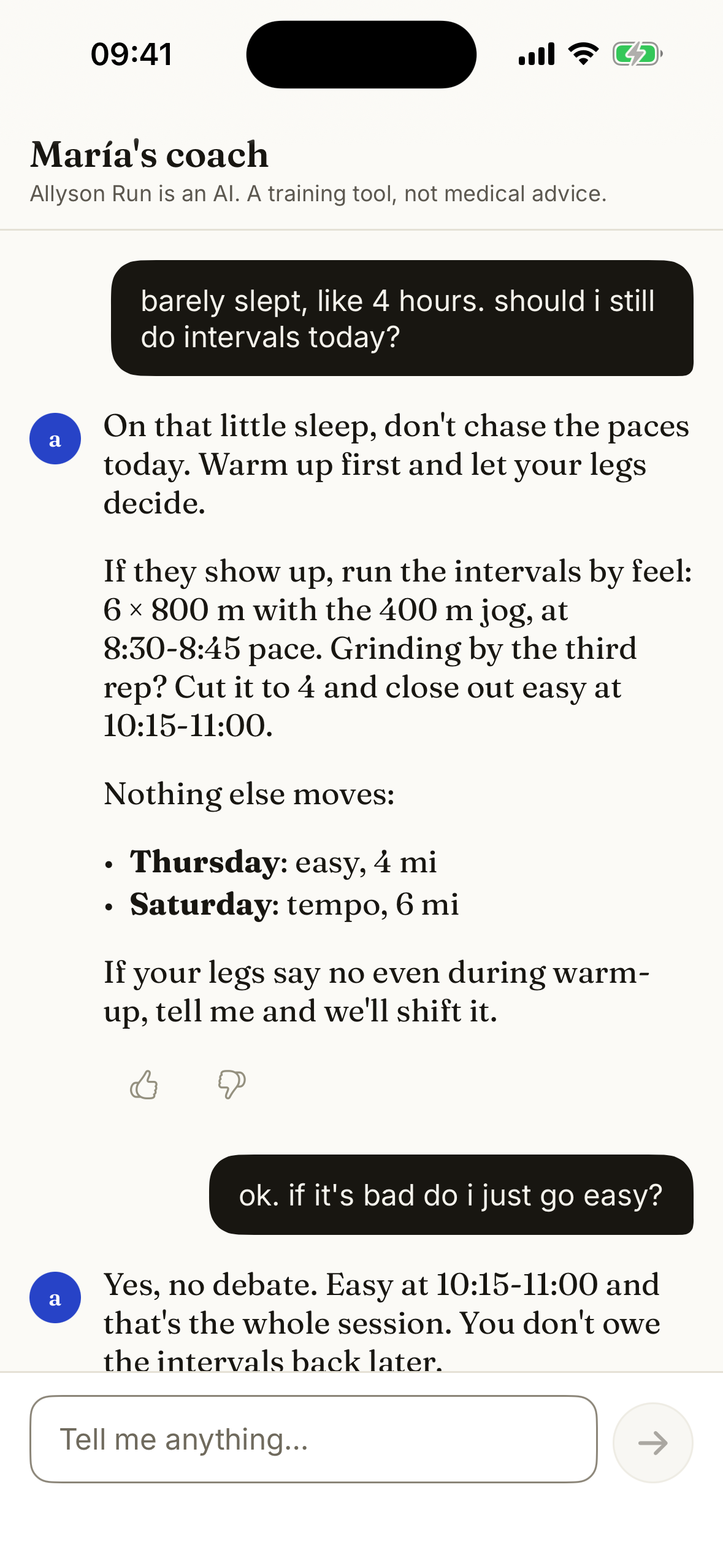
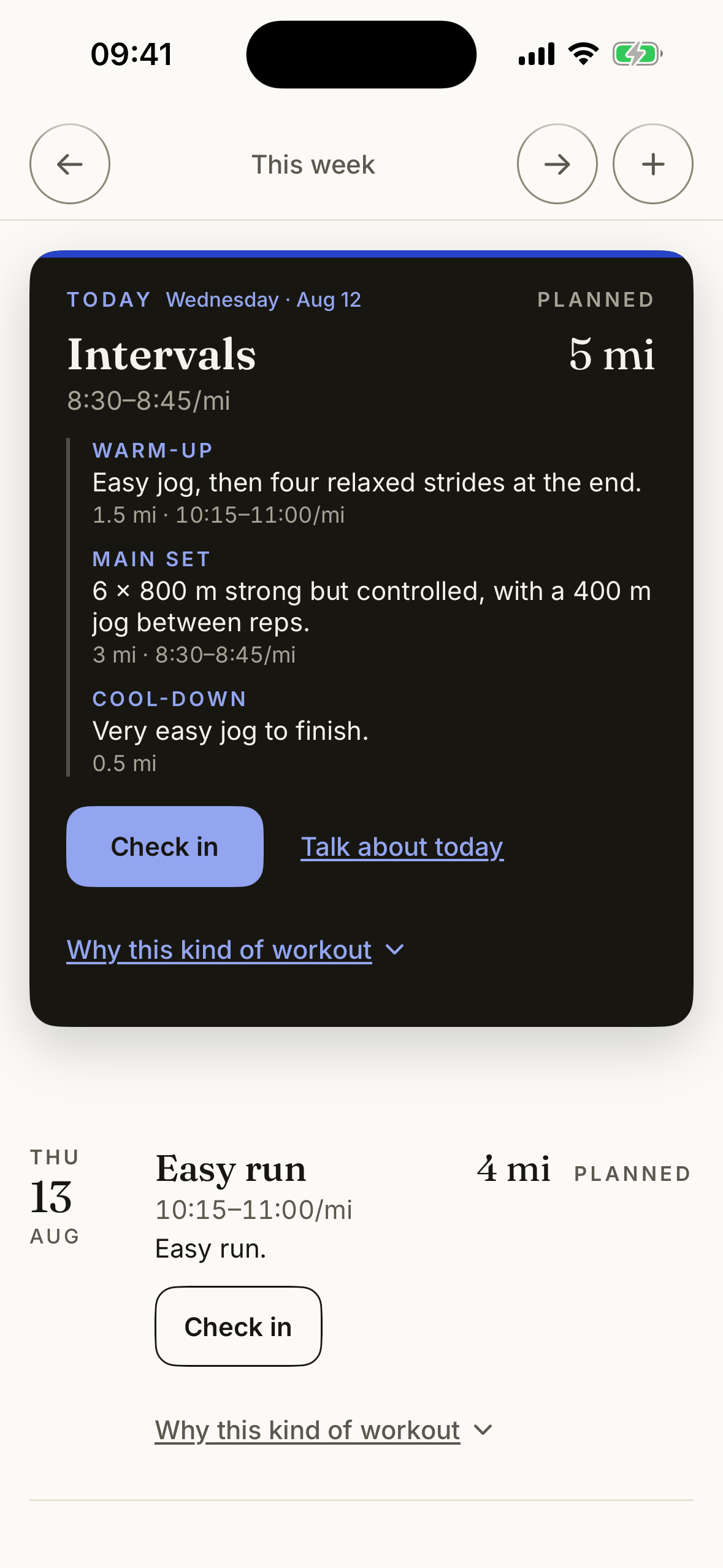
Allyson builds your training block around your race, the days you can actually run and the running you've been doing lately, and then she keeps talking to you about it. Every day has one clear answer: what to run, at what pace, and why.
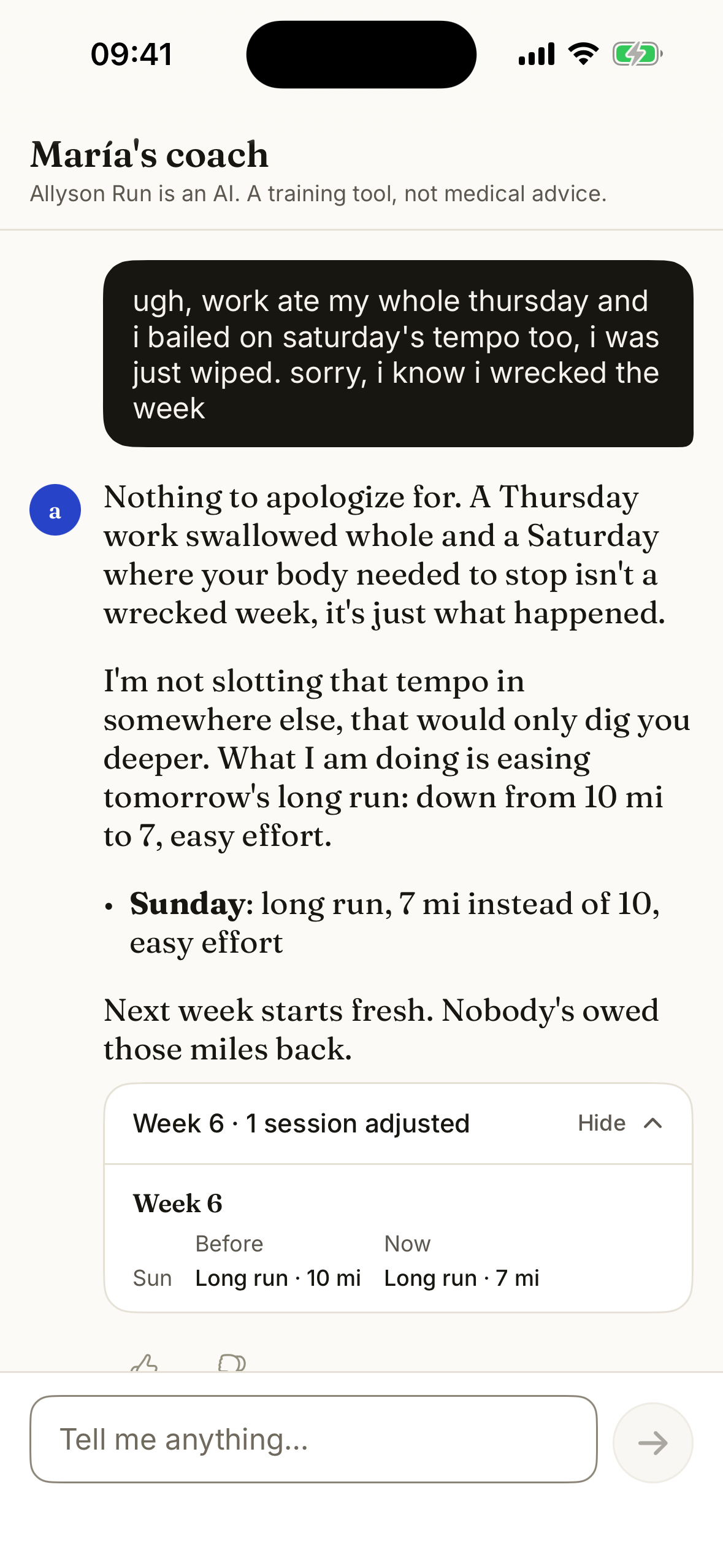
Tell her work swallowed Thursday, or that the kids start school next week. She answers with what to do, reshapes the week, and shows you the before and the after so you can read exactly what changed.
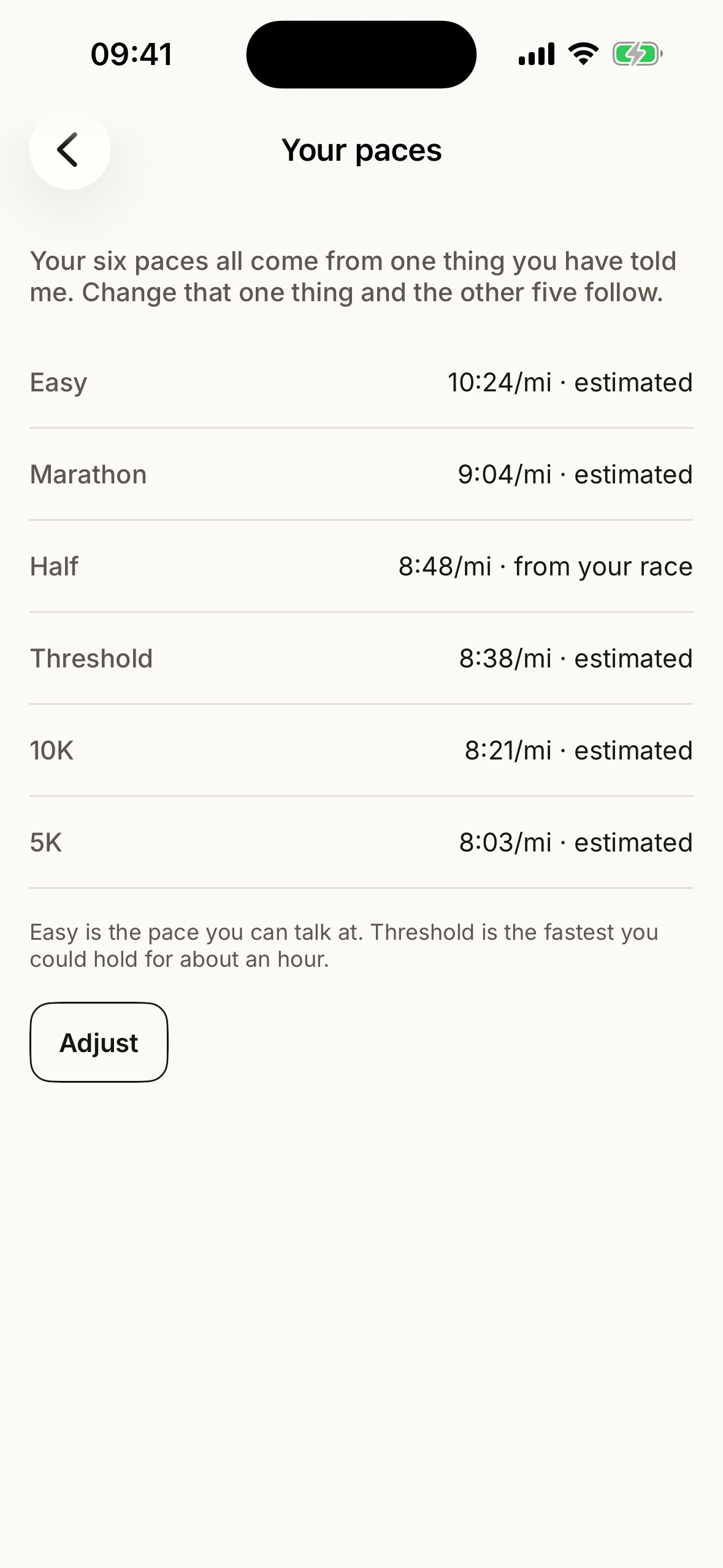
- She knows your numbers. Connect intervals.icu and your runs arrive on their own from whatever watch recorded them, read-only. Six training paces come from one anchor, and each one says where it came from: your race, your runs, or an estimate.
- Your body, your call. If you bring up your cycle, she talks it through with you and keeps only what you explicitly ask her to keep. She never predicts it and never asks about it unprompted.
- She is straight about what she is: a training tool, not medical advice, and an AI. She never promises you a finishing time.
How I built it
- A native iOS app in SwiftUI, with a home-screen widget for today's session.
- A Next.js and TypeScript API on Vercel, with Supabase Postgres and row-level security on every table.
- The coach runs on Claude (Anthropic). The model writes the periodisation and the paces together, and a deterministic validator checks every plan against structural and pace-sanity rules before an athlete sees it.
- RevenueCat sells the coach as a subscription. Her plan and her paces are always hers; the coach is what she pays for, with the first month free.
Challenges
The hard part was never the training maths. It was making sure the coach always says something that makes sense.
- Evals. Every change to the coach's instructions runs an eval suite against production before it ships: zero failures allowed on the safety lanes, and at least 90% on everything else. The coach actually has two brains, one that chats and one that writes plans, and I learned that the hard way: one day about 1,200 lines of the plan-writing brain changed while the safety gate was still watching the chat brain's file. Now each brain has its own gate.
- Green tests are not a working product. Once, four out of six plan builds against production died on a single 61-character sentence, while more than 4,600 tests were passing. Another time I walked through a fresh build on my phone and found fourteen problems on a build whose whole suite was green. Since then, no build ships without a real walk through sign-up and a real plan built against production.
- Plans that are good every time, not most of the time. If a plan can't be built safely, she says so and offers to try again, and the plan you already had stays exactly where it was. No generic template dressed up as yours.
What I learned
What makes a coach feel like a coach isn't more rules. It's context: her real paces, her real week, her real history, and then getting out of the way.
Made for women who run.
Built With
- anthropic-claude
- intervals.icu
- next.js
- postgresql
- revenuecat
- supabase
- swift
- swiftui
- tailwindcss
- typescript
- vercel
- widgetkit

Log in or sign up for Devpost to join the conversation.