-
-
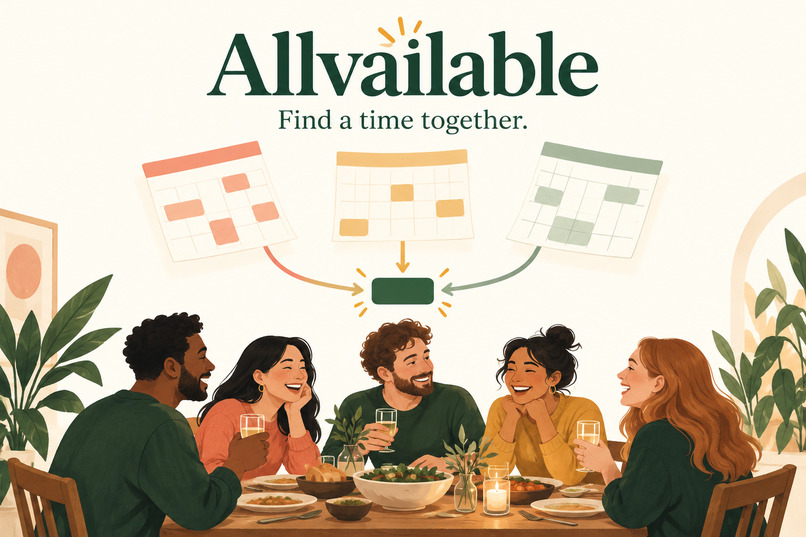
Concept illustration: keep your calendar, share reviewed availability, and find a time together.
-
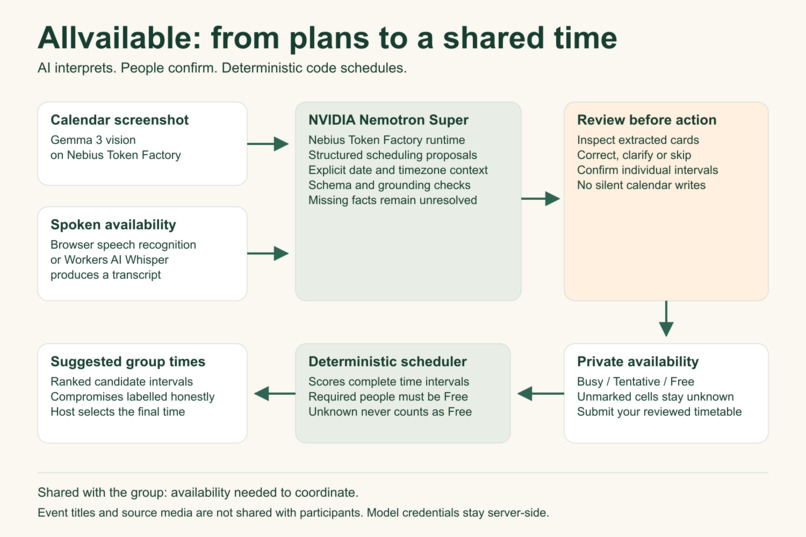
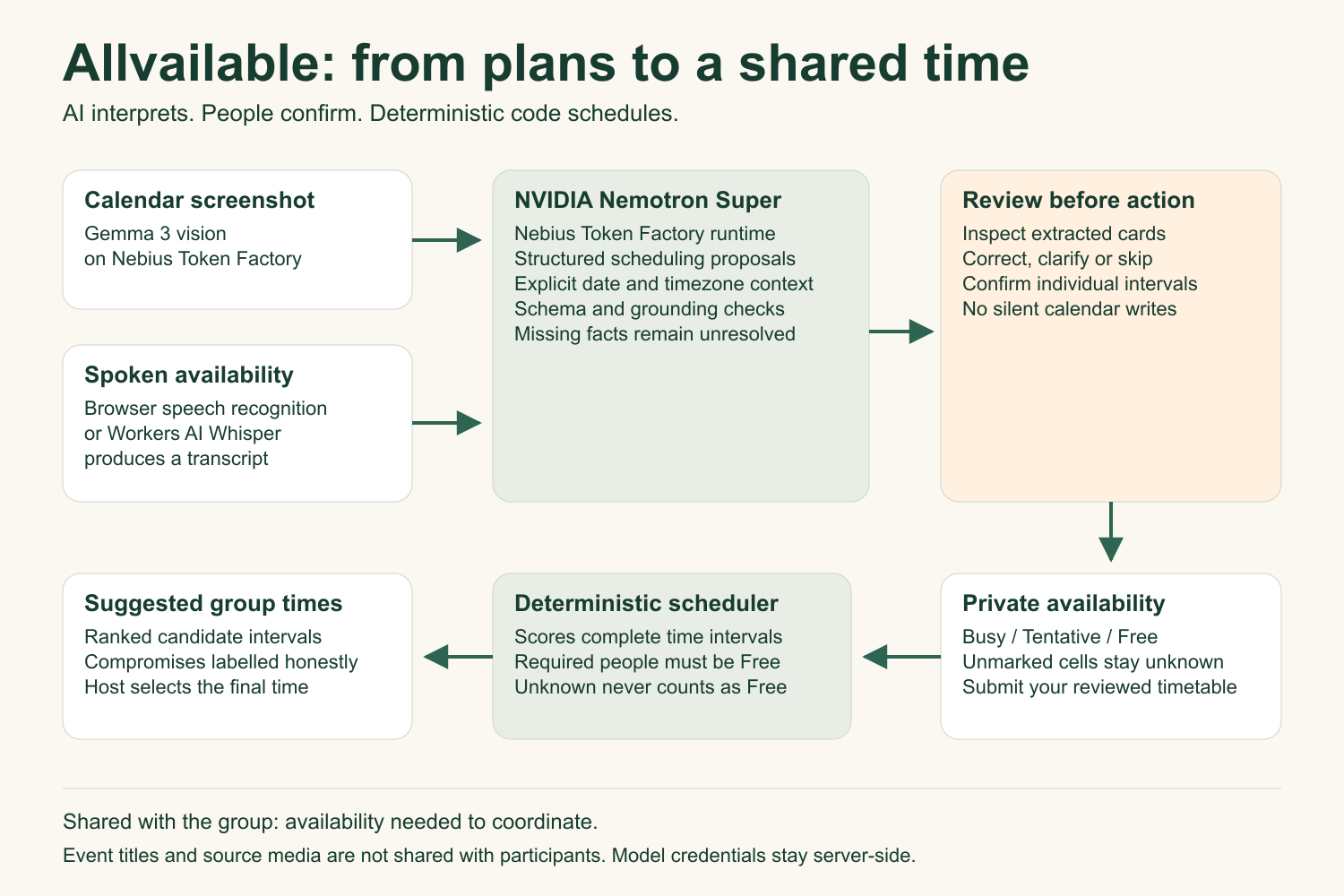
Architecture: Nebius/Nemotron interpretation, user-reviewed cards, private availability and deterministic group scheduling.
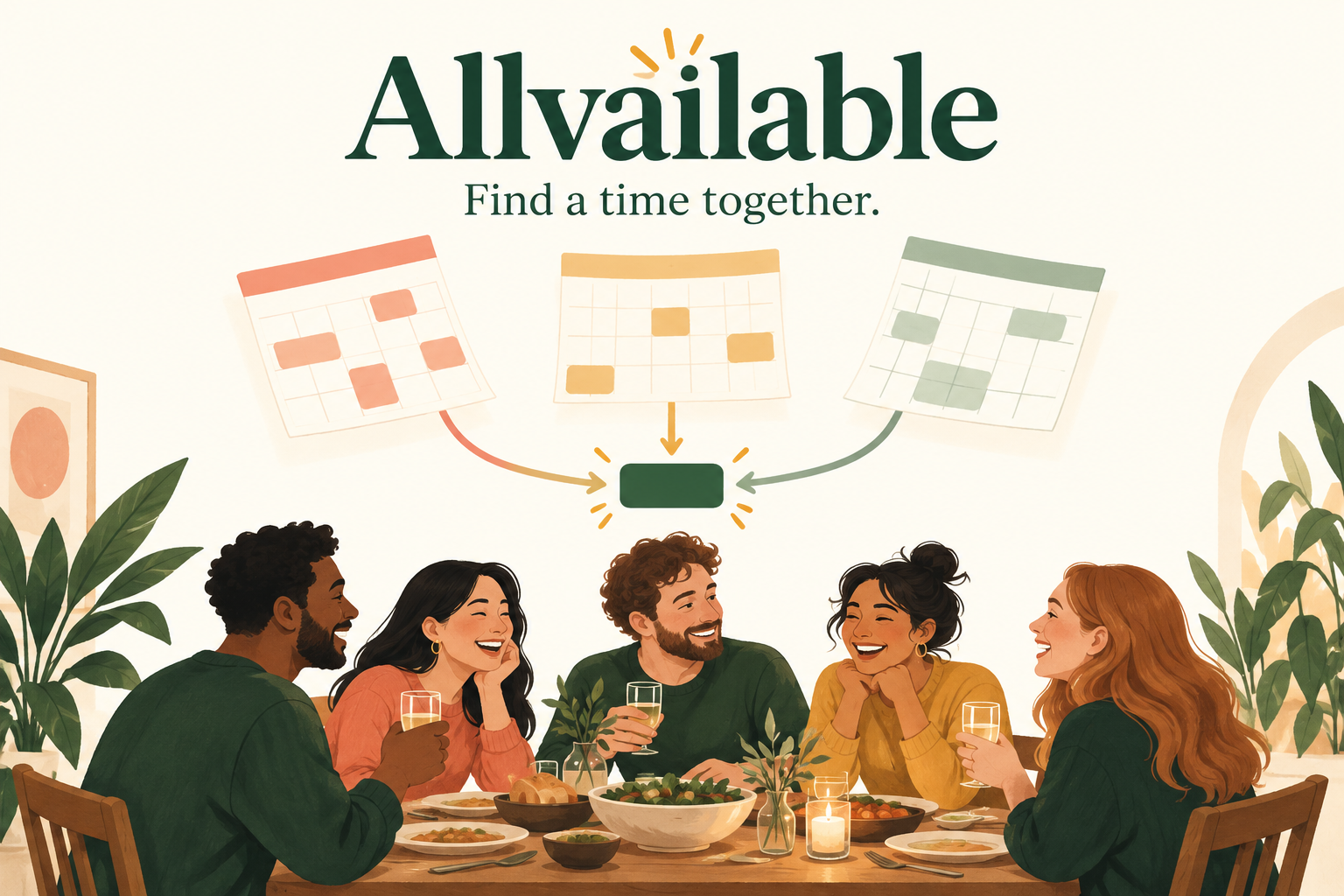
Keep your calendar. Share your availability. Find a time together.
Inspiration
Families and friend groups want to spend time together, but everyone's schedule lives somewhere different: Google Calendar, Apple Calendar, TimeTree, or simply a plan they remember. Finding a time when we are all available often means sending screenshots, comparing calendars by hand, and endless messages. Allvailable turns those scattered schedules into one shared answer: when can we meet?
What it does
Allvailable helps families and groups of friends find a time they can all make without switching calendar apps. A host creates an invitation and shares a link or six-digit code. Each person adds availability to a timetable in three explicit states: Busy, Tentative, and Free.
- Voice to timetable: say your plans or availability naturally. Speech is transcribed, and NVIDIA Nemotron extracts dates, time ranges, and availability into review cards. Confirm the cards to fill your timetable.
- Screenshot to timetable: upload screenshots from the calendar apps people already use, including Google Calendar, Apple Calendar, and TimeTree. AI extracts visible plans into editable review cards, then fills the timetable after confirmation. This screenshot-based approach works across different calendar interfaces without requiring everyone to connect the same calendar service.
- Suggested times for the whole group: a deterministic scheduler compares submitted availability and suggests overlapping time slots. Tentative replies remain distinct from Free, and unanswered or blank slots never count as available. If everyone cannot make a time, a compromise is not labeled as “all available.” Hosts can mark essential participants as required; they must be explicitly Free throughout the final interval.
Users can correct an extracted item, supply missing details, or skip a reminder. Calendar event names and source screenshots are not shared with the group; recommendations use the availability needed to coordinate.
How we built it — Nebius and NVIDIA
Nebius Token Factory is our runtime inference platform, and NVIDIA Nemotron is the language-understanding core. We use the NVIDIA open model nvidia/nemotron-3-super-120b-a12b to turn natural-language invitations and availability into structured drafts, and to interpret information extracted from calendar screenshots and spoken replies.
For screenshots, google/gemma-3-27b-it on Nebius Token Factory handles visual calendar understanding. Its output is interpreted by Nemotron, with deterministic grounding of date headers, calendar block geometry, and time-axis ticks. Ambiguous or missing details remain unresolved for the user to review.
For voice, browser speech recognition supplies live transcripts where supported. The recorded-audio fallback uses Cloudflare Workers AI @cf/openai/whisper-large-v3-turbo for transcription. Nemotron on Nebius then interprets the words as scheduling information; with live transcripts, completed phrases can become review cards while recording.
The web app uses React and TypeScript, GitHub Pages hosting, a Cloudflare Workers API, and Supabase Auth and Postgres. Model keys stay server-side. Structured-output validation and explicit user confirmation sit between AI extraction and timetable updates. Deterministic TypeScript and SQL scheduling logic computes candidate overlaps from half-hour availability cells.
Challenges we ran into
Calendar screenshots encode time through layout as well as text, while spoken plans contain relative dates, exceptions, and missing details. We separated visual extraction from Nemotron's structured interpretation and added deterministic checks. We also kept Busy, Tentative, Free, and unknown information distinct so an incomplete reply cannot produce a misleading recommendation.
Our early Nemotron Nano trials returned an incorrect duration and incompatible date formatting. We moved to Nemotron Super and validated the structured output. We also needed explicit chat-template controls for visible content in non-thinking requests. These findings shaped the actual integration rather than remaining model configuration on paper.
Accomplishments that we're proud of
We connected screenshots, spoken plans, and manual input to the same reviewable timetable, making cross-calendar coordination practical for families and friends. Hosted acceptance on October 3, 2026 passed 13/13 inference cases covering Chinese and English, overnight intervals, recurrence, relative dates, synthesized recordings, and calendar-grid reads. Synthetic browser microphone tests also exercised transcription, review cards, explicit approval, and saved timetable cells. Human phone-microphone and real-friend acceptance remain separate follow-up work.
The public acceptance log documents the fixtures, observed failures and repairs. These are bounded synthetic acceptance results, not a universal accuracy score or measured user time savings.
What we learned
AI is useful for understanding how people describe their schedules; explicit confirmation and deterministic scheduling make that understanding actionable. Nebius Token Factory let us test NVIDIA models through a hosted endpoint without provisioning GPUs. Keeping interpretation separate from overlap calculation made the system easier to inspect and improved the tested cases.
What's next for Allvailable
Expand real-device and real-family testing, improve extraction across more calendar layouts, and make voice review even smoother. Our goal remains simple: let everyone keep the calendar they prefer, and help the people they care about find a time together.
Allvailable was developed during the hackathon submission period, with visible repository history beginning September 13, 2026. Work added the private link-and-code flow, bilingual mobile-first availability submission, screenshot review cards, clarification and skip controls, and deterministic group recommendations.
Built With
- nebius-token-factory
- nvidia-nemotron
- react
- typescript

Log in or sign up for Devpost to join the conversation.