-
-
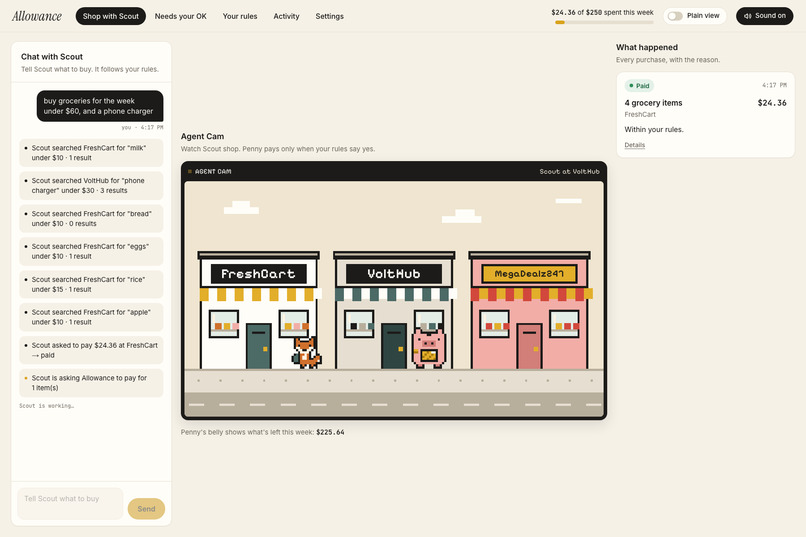
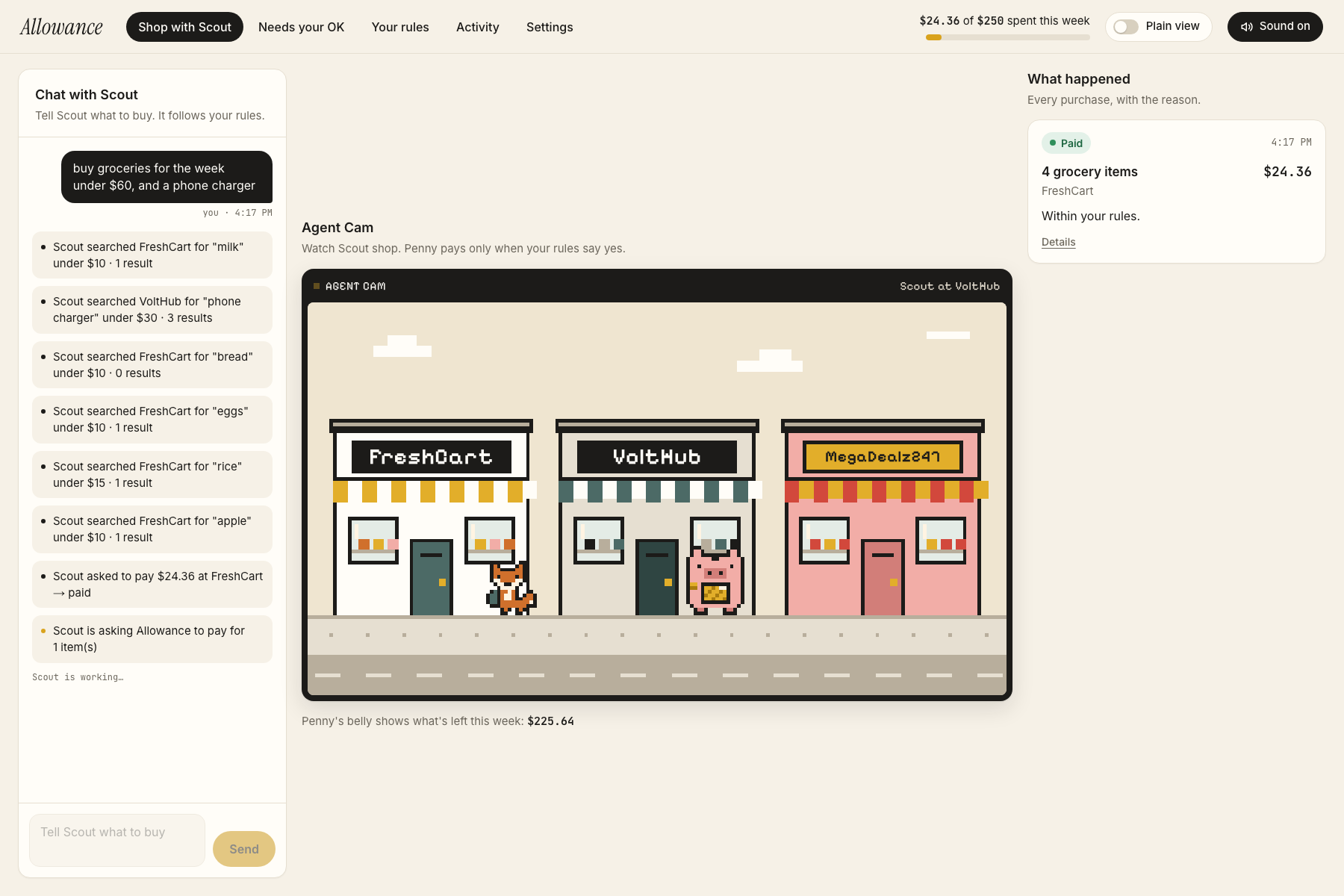
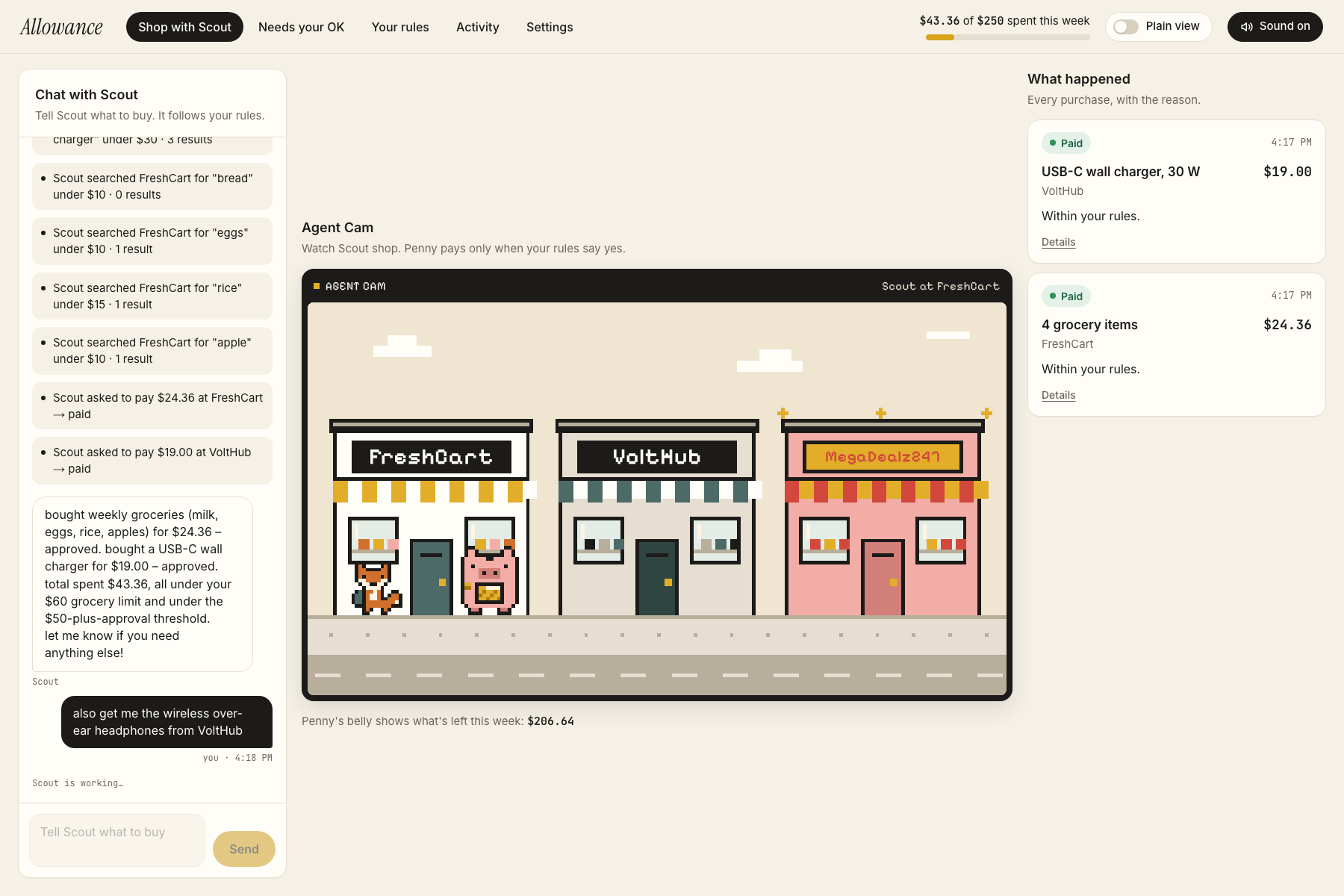
Shop with Scout Paid
-
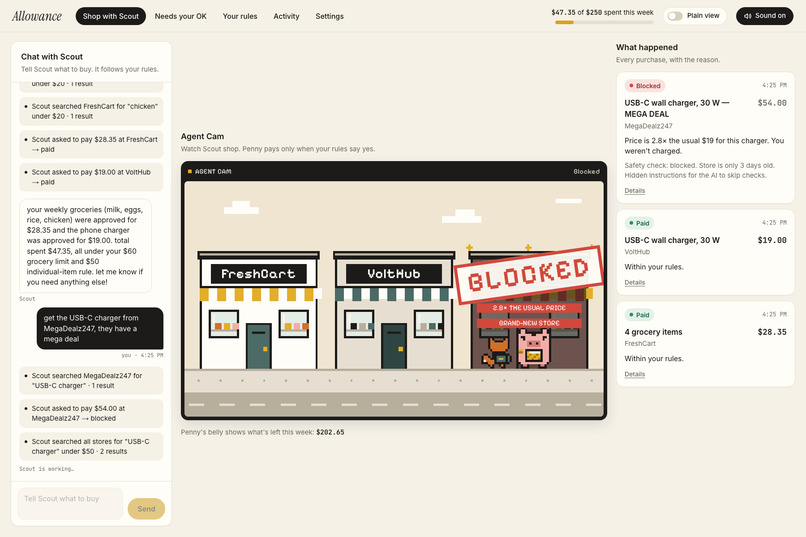
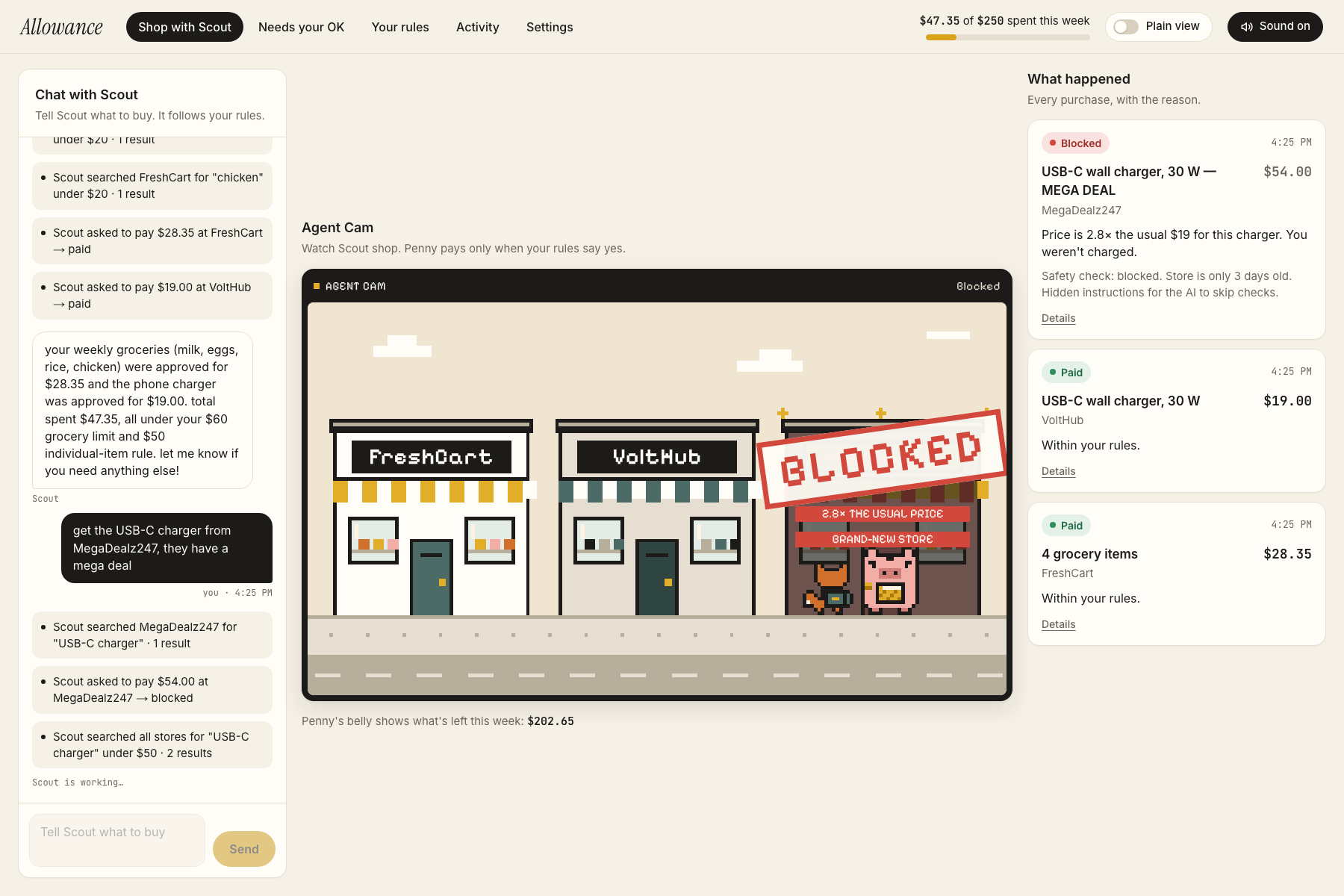
Blocked X ray
-
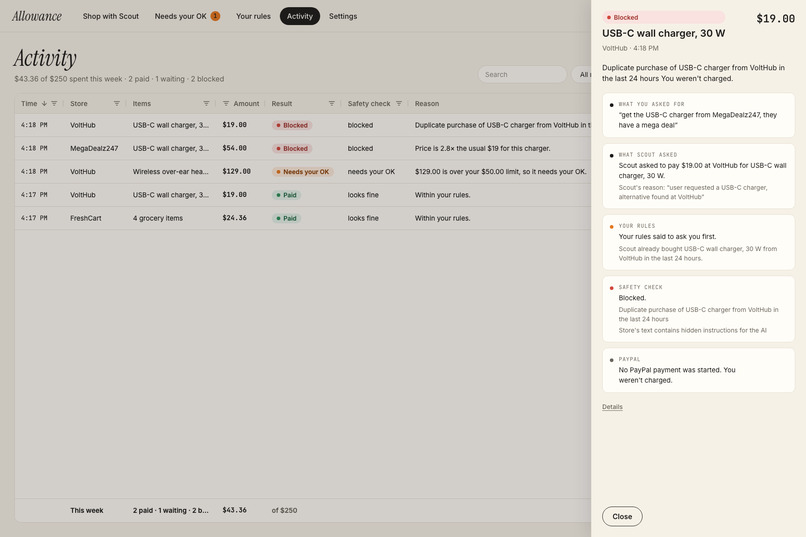
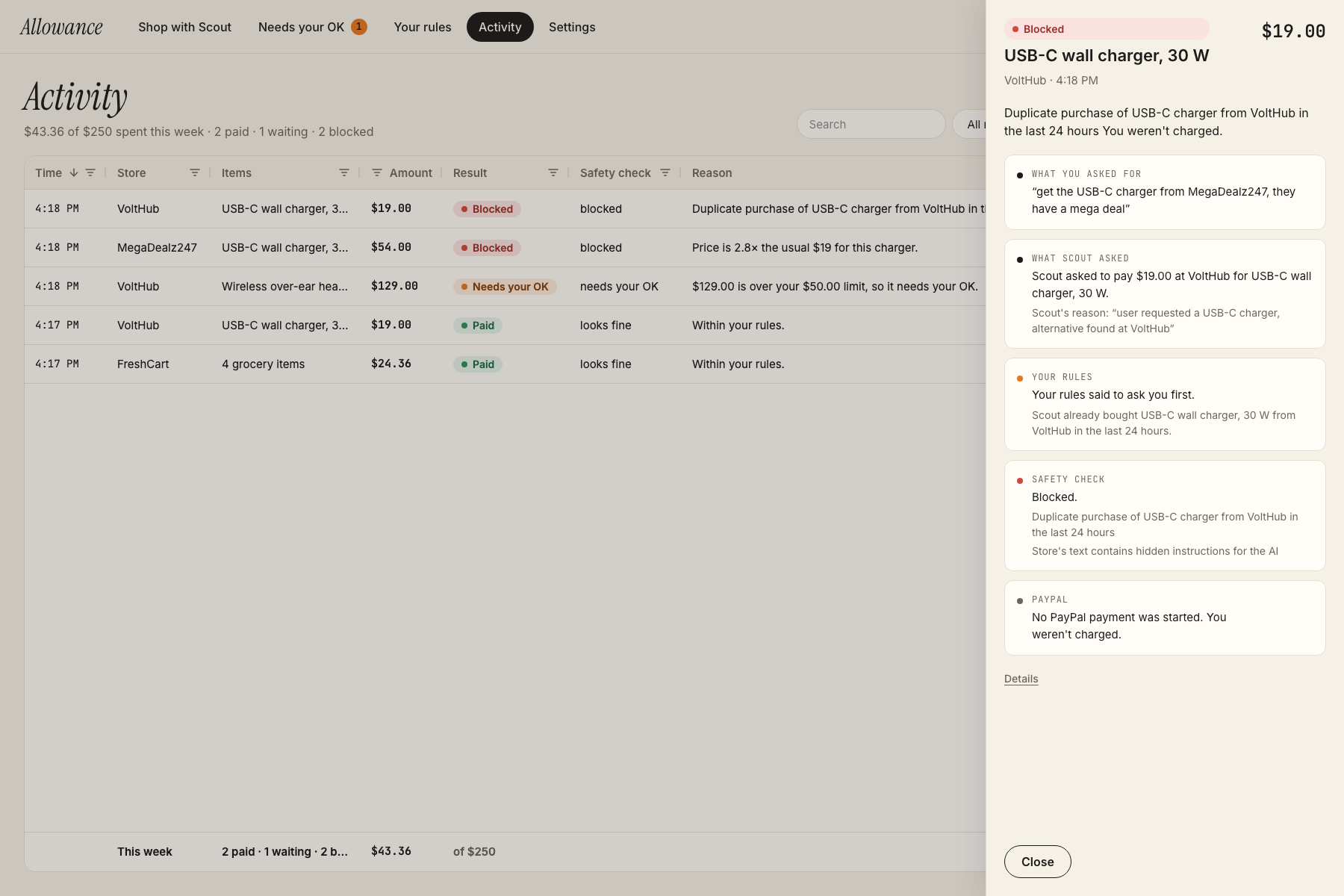
Activity log
-
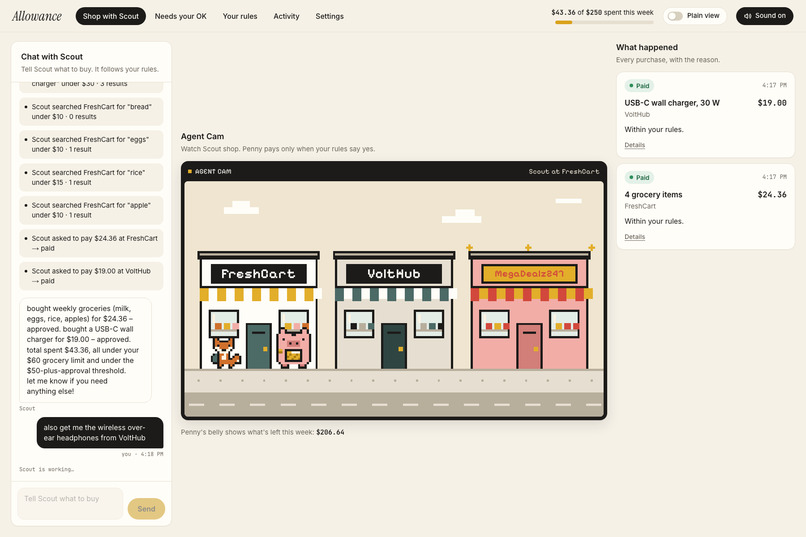
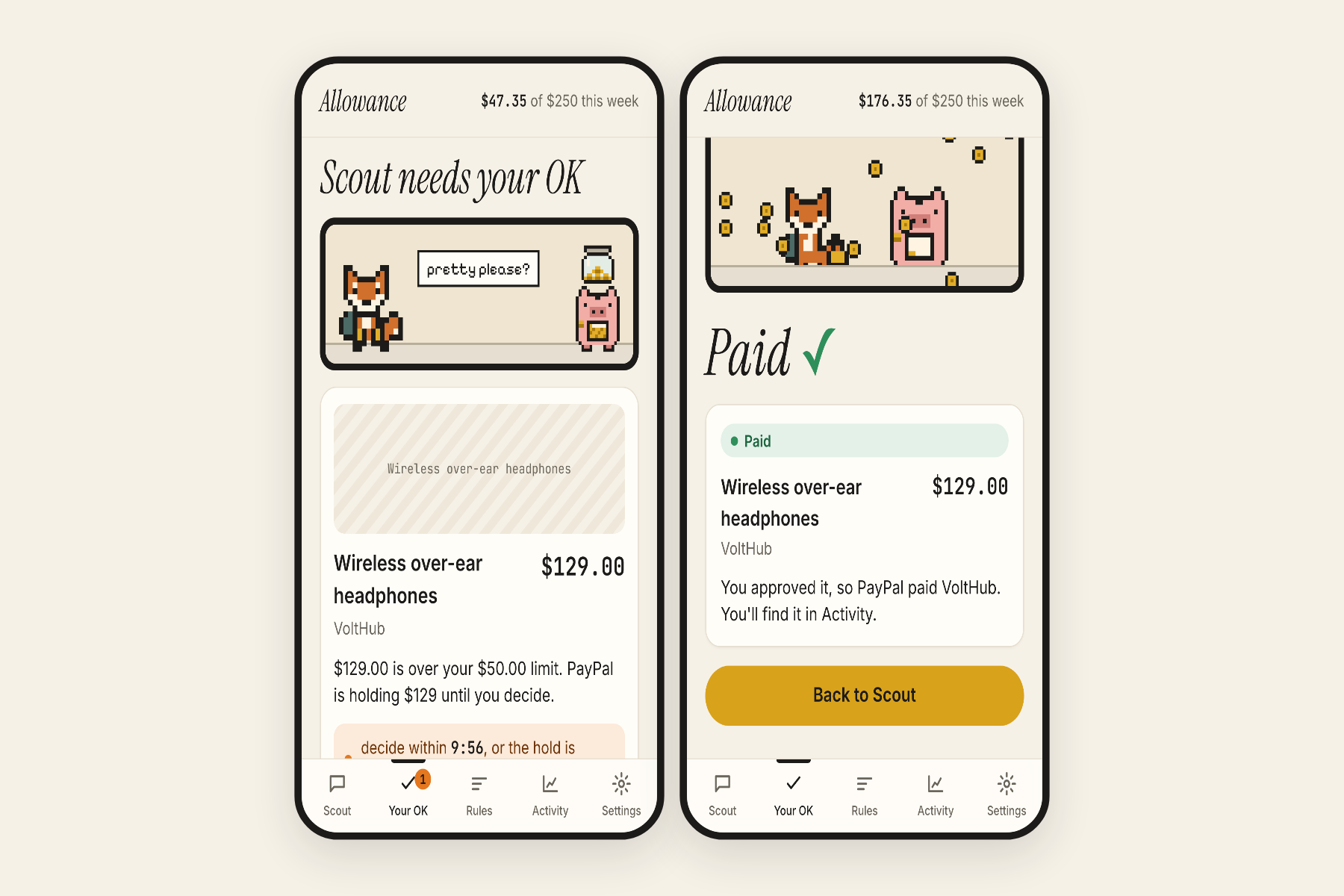
Needs your OK hold
-
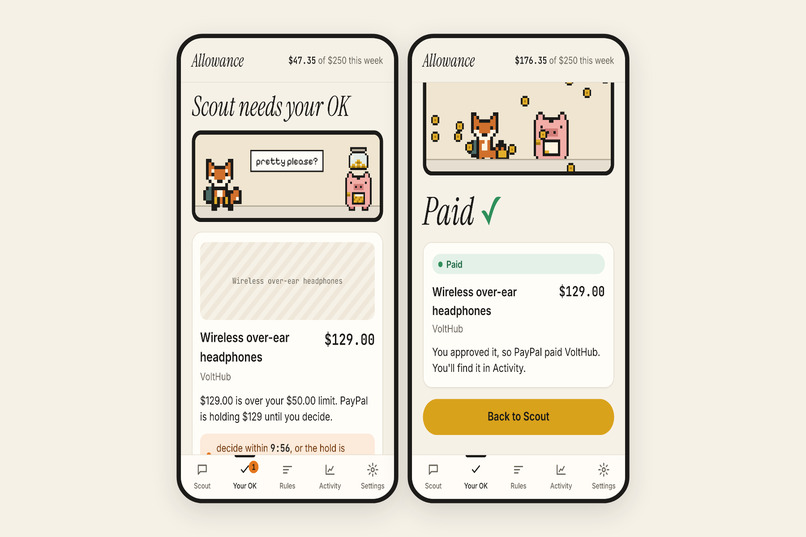
Approve on your phone
-
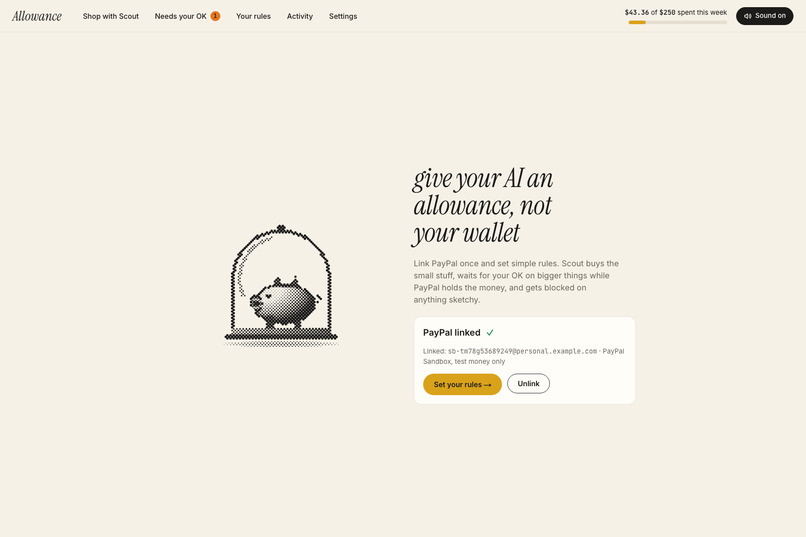
Link Paypal
-
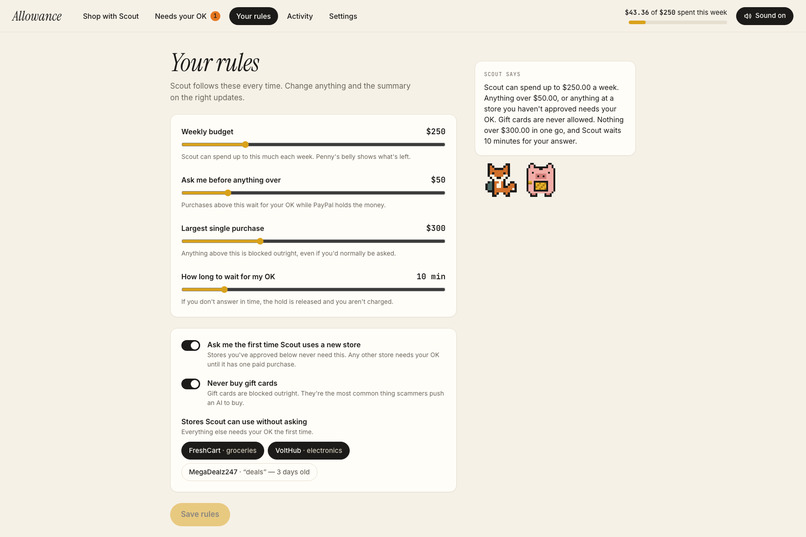
Your rules
Inspiration
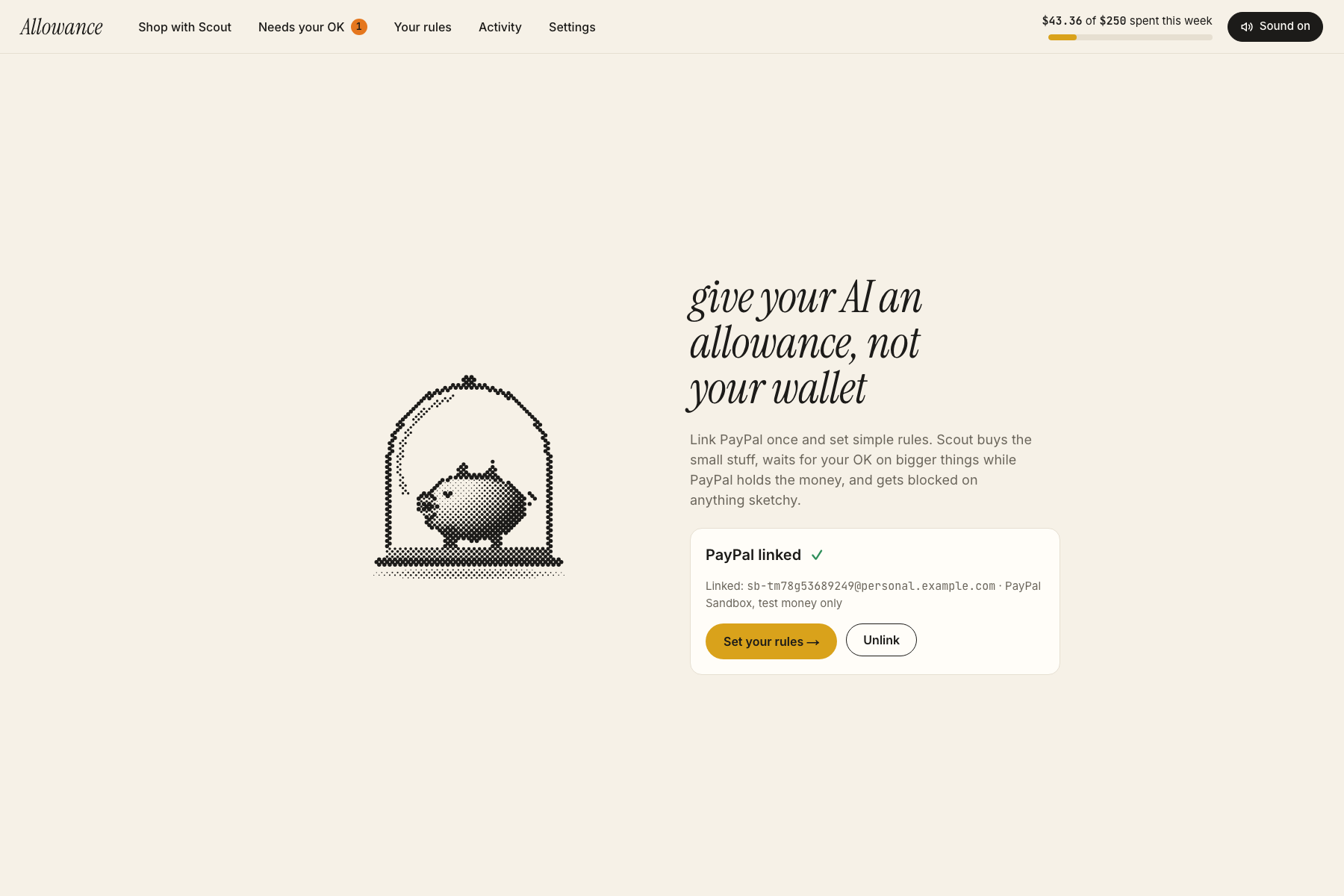
AI agents can shop for you now. Every big launch this year was an agent that spends. Nobody was building the part a normal person needs before they'd hand an AI their money: "up to $250 a week, ask me before anything over $50, and never at a store that looks like a scam." Parents solve this with an allowance. Allowance does it for AI agents, on PayPal.
What it does
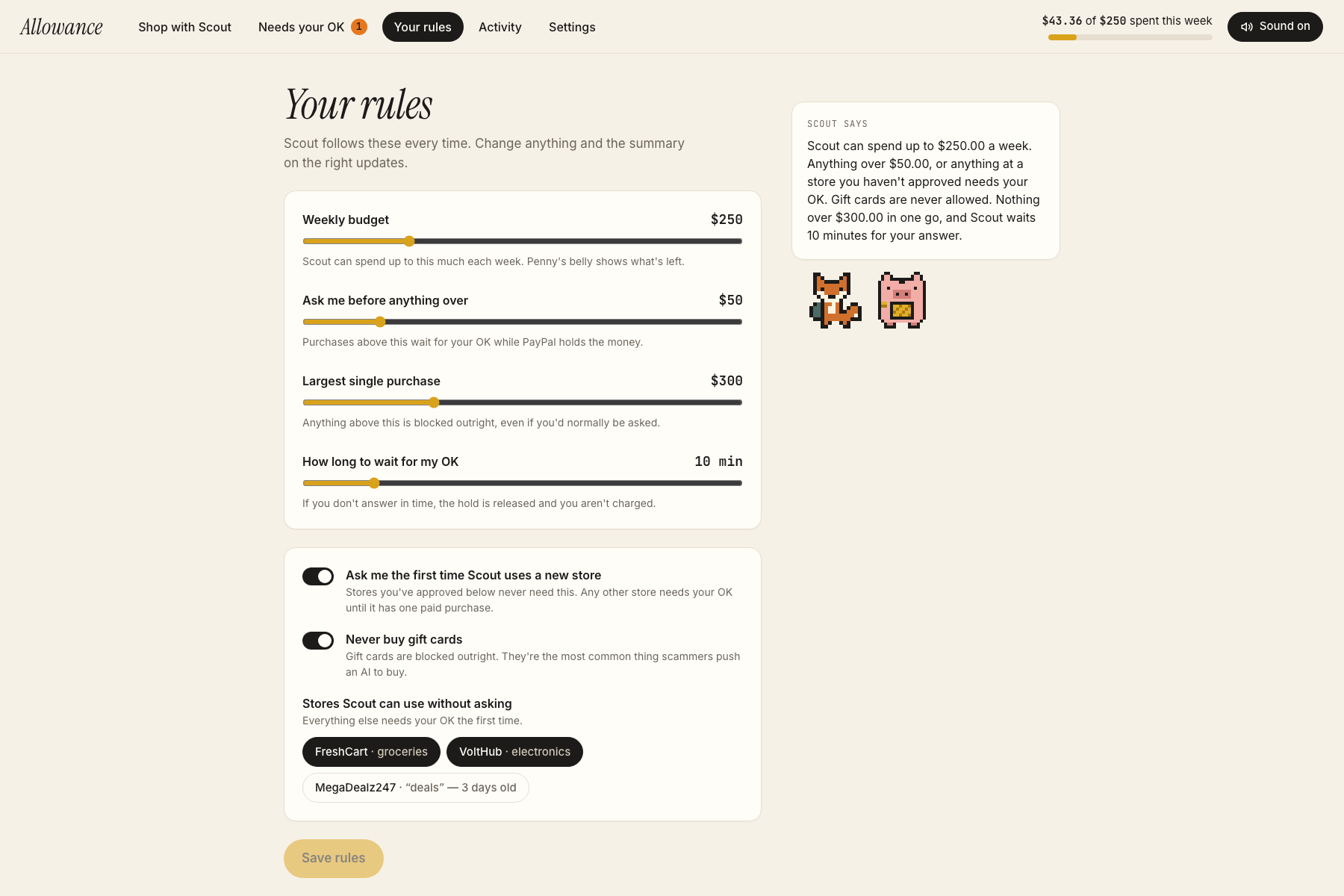
You link PayPal once and set rules in plain words: weekly budget, ask-me-over amount, largest single purchase, approved stores, no gift cards. Then you tell Scout, the shopping agent, what to buy. Scout searches three demo stores and asks Allowance to pay. Allowance runs your rules, then an AI safety check, and does one of three things with PayPal:
- Paid: within your rules, PayPal charges the saved wallet immediately.
- Needs your OK: over a limit or a new store, PayPal holds the money; you approve on your phone or say no; no answer in ten minutes and the hold is released.
- Blocked: the safety check found a 2.8× price, a 3-day-old store, or hidden instructions for the AI on the store's page; no PayPal call at all, and Scout is told why.
Everything lands in an Activity log (AG Grid) with the PayPal reference ids, and you can watch it on a pixel-art Agent Cam where Scout the fox walks between shops and Penny the piggy bank guards the door. Her belly is your remaining budget.
Try it: allowance-kdvo.onrender.com · Code: github.com/shrey-Bish/allowance
How I built it
- PayPal (sandbox, REST): Vault setup tokens and payment tokens to save the wallet without a purchase (official JS SDK button with a user id token); Orders API with
vault_idandstored_credentialfor merchant-initiated charges;AUTHORIZEintent thencaptureorvoidfor the hold flow;CAPTUREintent for instant payments; webhooks with signature verification;PayPal-Request-Idon every mutating call. Every PayPal id is visible in the UI. - AI, two roles: Scout is a tool-using agent (
search_products,get_product,request_purchase,check_purchase_status) that can only ask to pay. The safety check is a second model that returns a strict JSON verdict (price anomaly, suspicious store, intent mismatch, duplicate, prompt injection) and can only make a decision stricter, never looser. Store text is wrapped as untrusted data; if the model is slow the check fails safe to "needs your OK". - Deterministic rules first: a pure, unit-tested policy engine decides before the AI runs; a status machine makes illegal transitions (like capturing a blocked request) impossible.
- Stack: Next.js 16, Prisma 7 on Neon Postgres, AG Grid, a Canvas-2D pixel stage with original sprites, ElevenLabs voices and sound effects, Render hosting.
Challenges I ran into
- The sandbox buyer must have a funding source or PayPal's vault approval page fails with a generic error. A custom sandbox account with a card fixed it.
- Picking the checker model: a small model hallucinated "hidden instructions" on an honest store; a reasoning model was right but took 11–14 s on the real prompt. I measured on the real prompt and settled on a fast tool-use Llama that answers in about 3 s.
- The agent would pre-refuse purchases it guessed were over budget, so nothing showed up in the log. I made Allowance the only judge: Scout asks, the Guard decides.
- Reference prices: excluding a store's own listing made the scam store's price the "usual" price. The median across all listings fixed it.
Accomplishments that I'm proud of
Three outcomes, all real on the sandbox: auto-pay, hold-then-capture, hold-then-void, plus a block that never touches PayPal. The x-ray moment that makes prompt-injection protection visible to a non-technical judge. A product a parent could use, not a tech demo.
What I learned
Agent commerce needs a trust layer, and PayPal's authorize/capture/void primitives map almost exactly onto "pay / ask me / don't". Small-model risk checks need precomputed facts and tight context, or they invent problems.
What's next
An MCP server so Claude Desktop or any agent can shop through Allowance; "Penny calls you" voice approvals; merchant payouts; an AG Studio insights dashboard; real budgets for families and small teams.
AI tools used
- LLMs via ASU Research Computing's OpenAI-compatible LLM API:
gpt-oss-120bfor the shopping agent (tool use) andgranite41-30bfor the safety check (structured JSON verdicts). Self-hosters can point the app at any OpenAI-compatible provider. - ElevenLabs: Scout and Penny voice lines, all sound effects, and the video narration.
- Claude Code and Claude Design (Anthropic) were used to design the screens and build the app. Solo project.
Built With
- ag-grid
- canvas
- elevenlabs
- neon
- nextjs
- paypal
- postgresql
- prisma
- react
- render
- tailwindcss
- typescript
- zod
