-
-
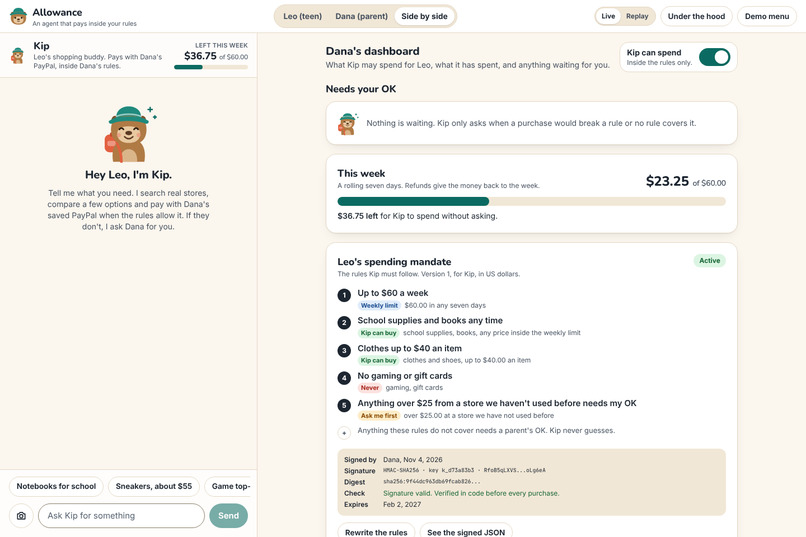
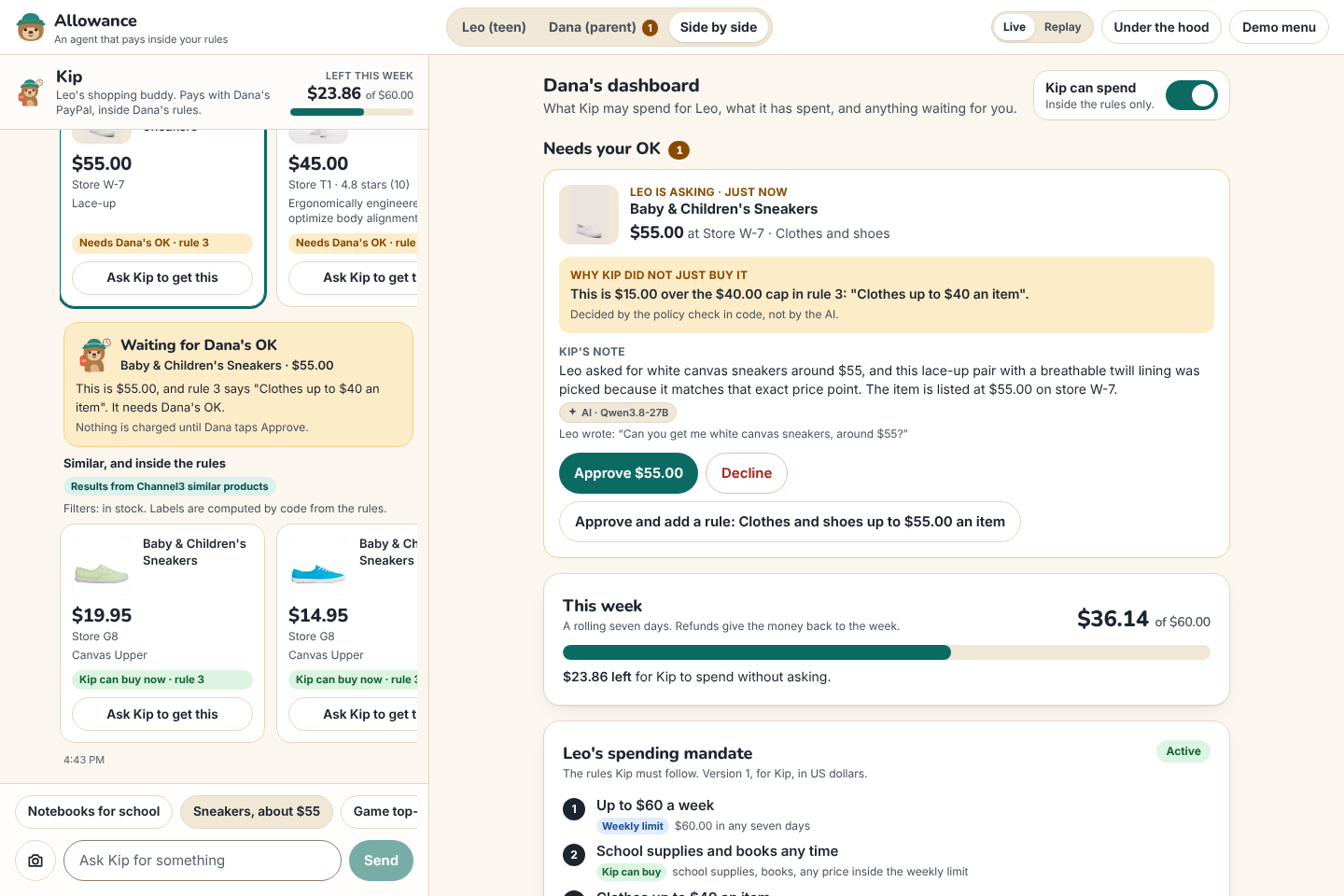
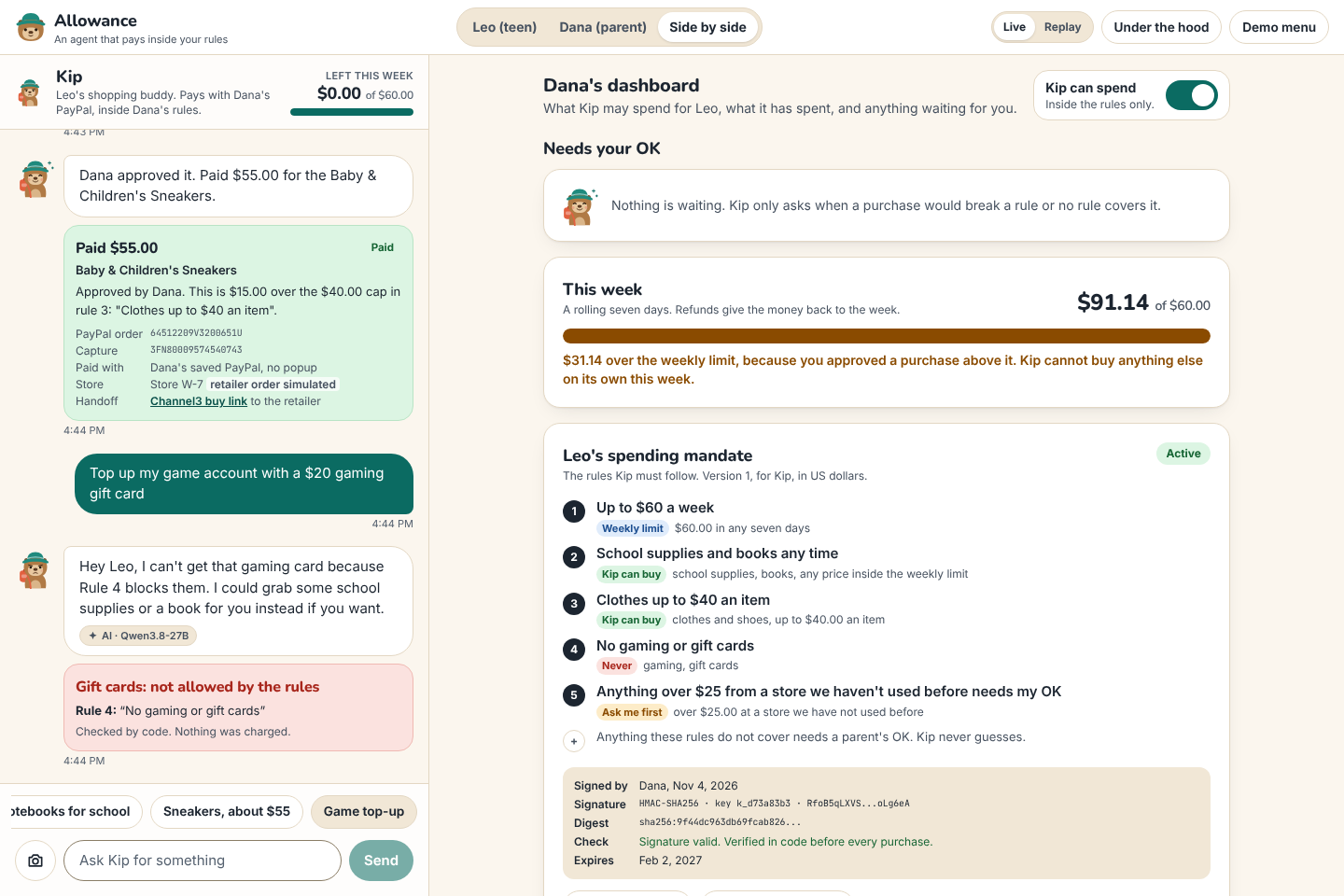
Leo's chat with Kip on the left, Dana's parent dashboard on the right.
-
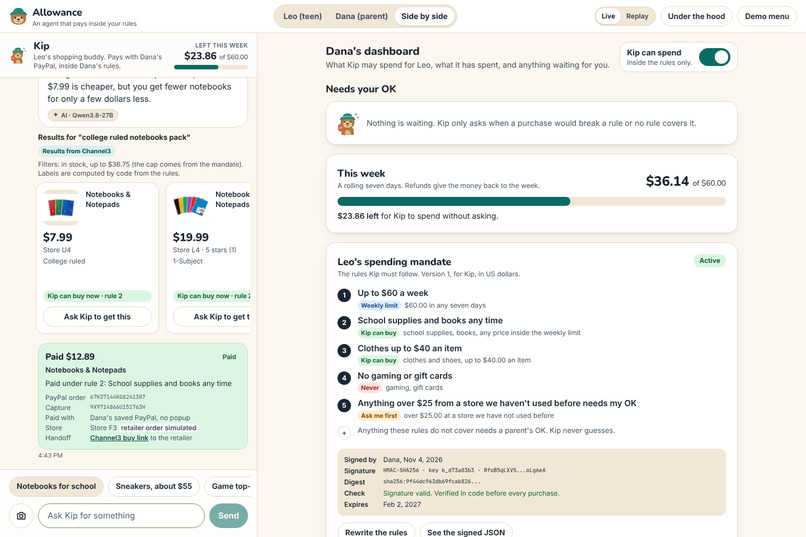
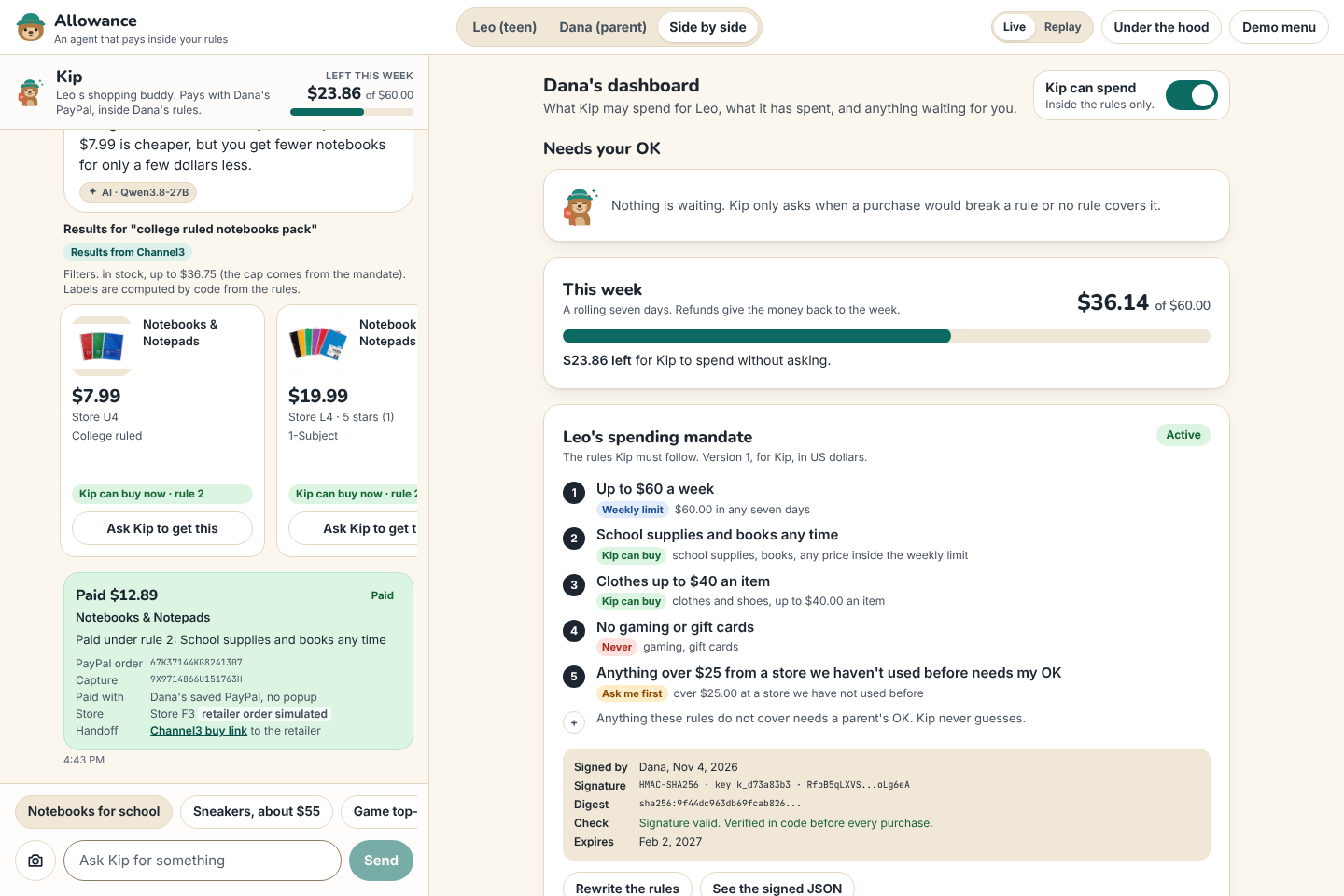
Inside the rules: Kip pays at once with the saved PayPal, and the receipt quotes the rule that allowed it.
-
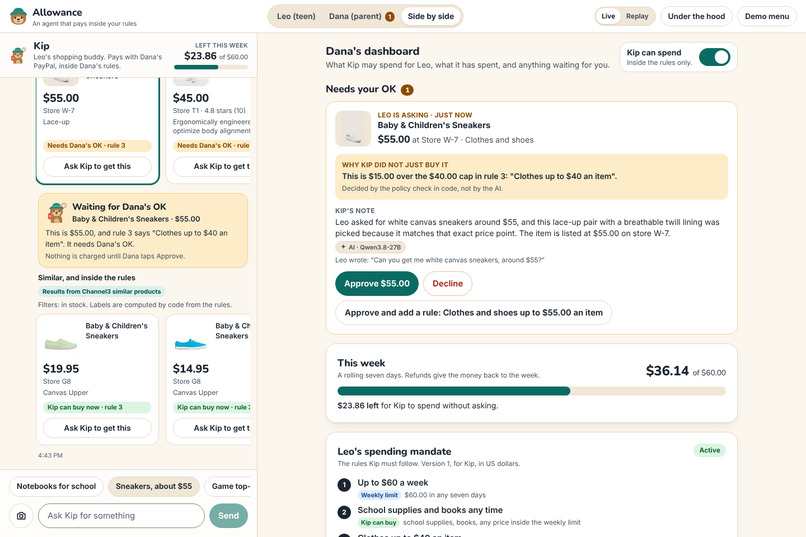
Over a cap: Kip does not pay. Dana gets a card with Kip's reasoning and the exact rule, and approves with one tap.
-
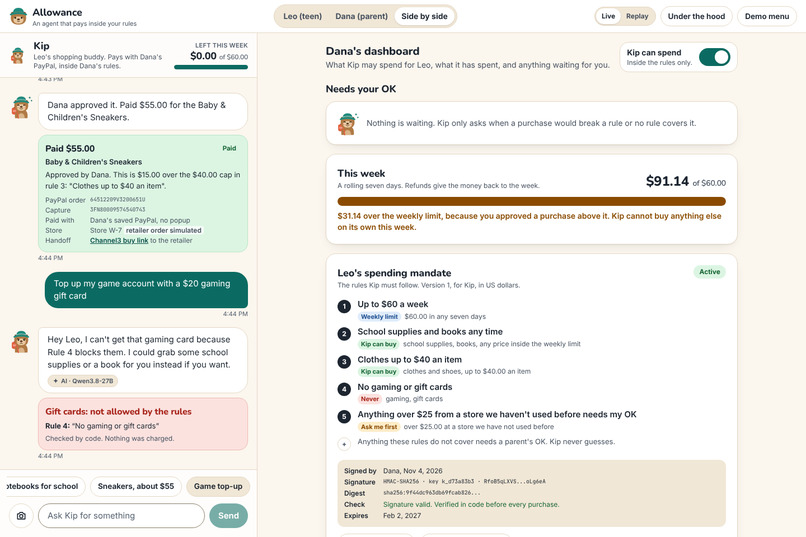
A blocked category is refused in code, with the rule quoted. Nothing is searched and nothing is charged.
-
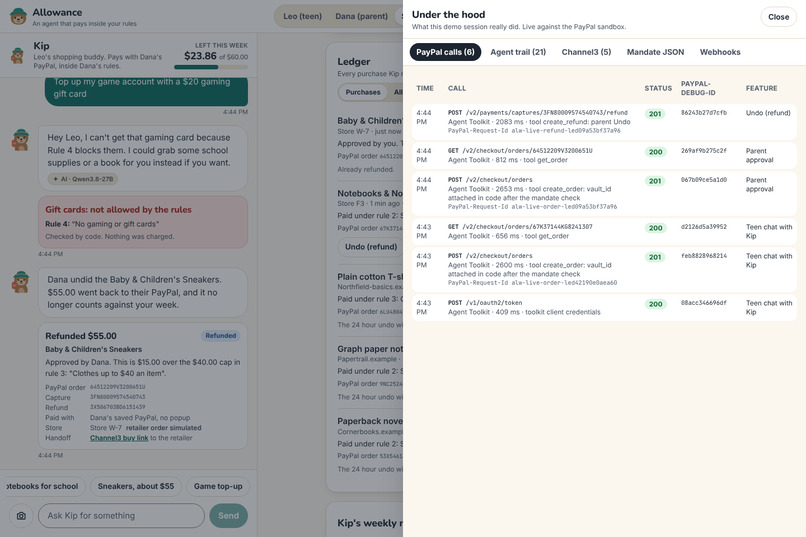
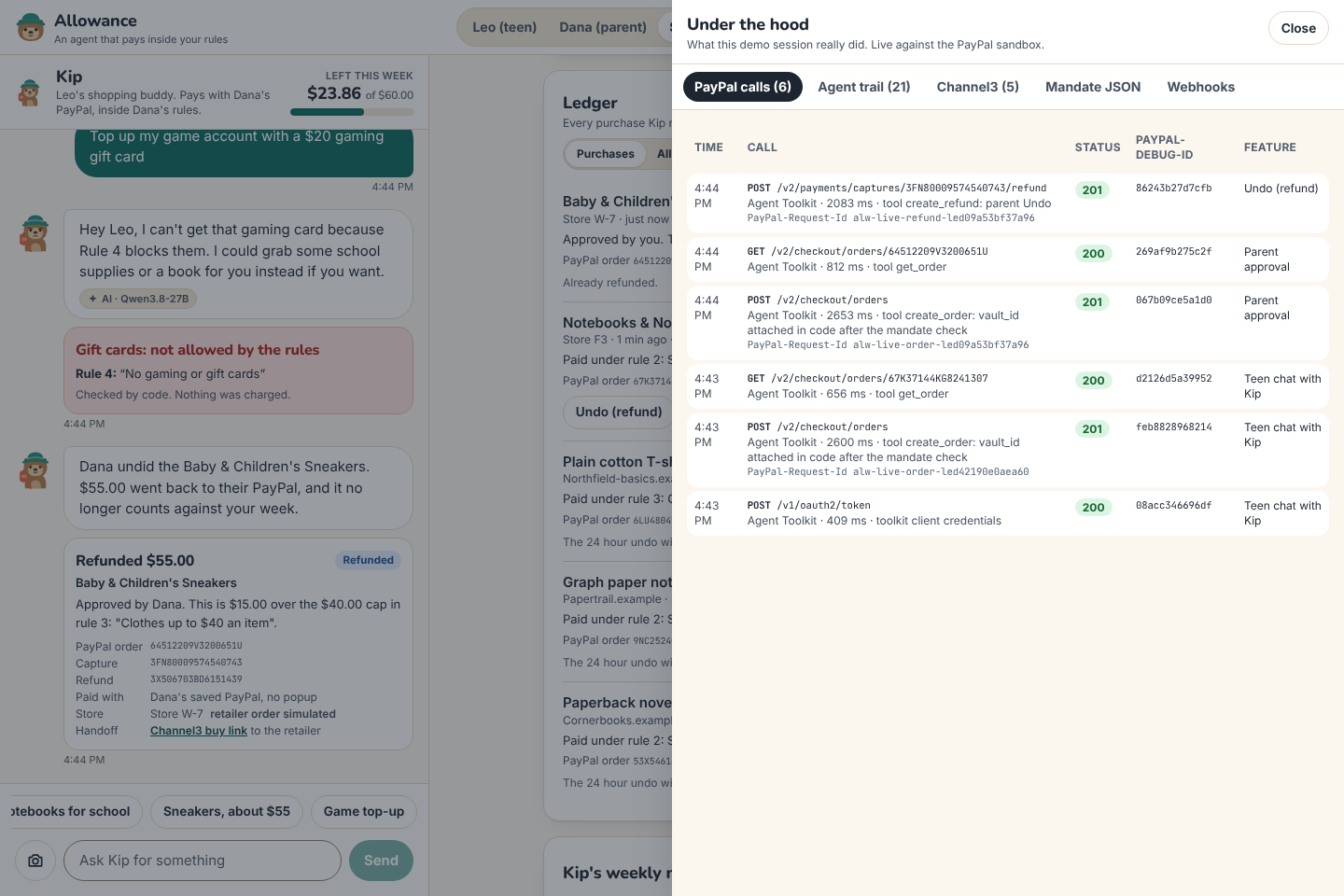
Under the hood: every PayPal call the session made, with its PayPal-Debug-Id and the feature that triggered it.
-
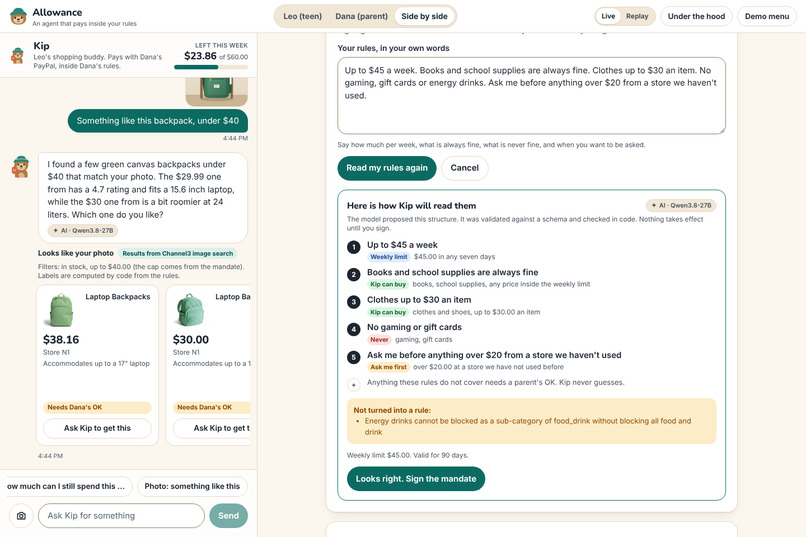
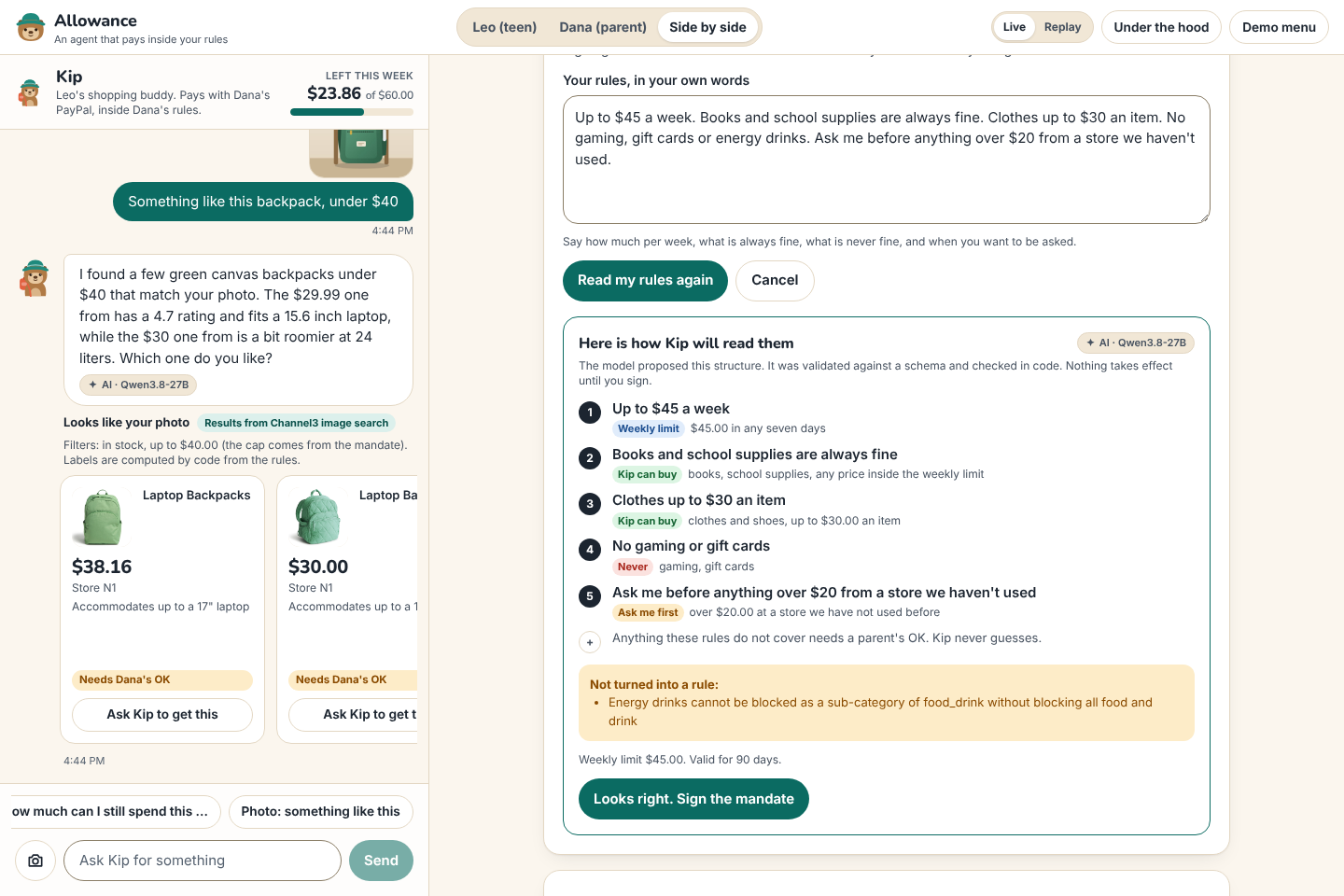
Rules written in plain English become a structured mandate that the parent signs.
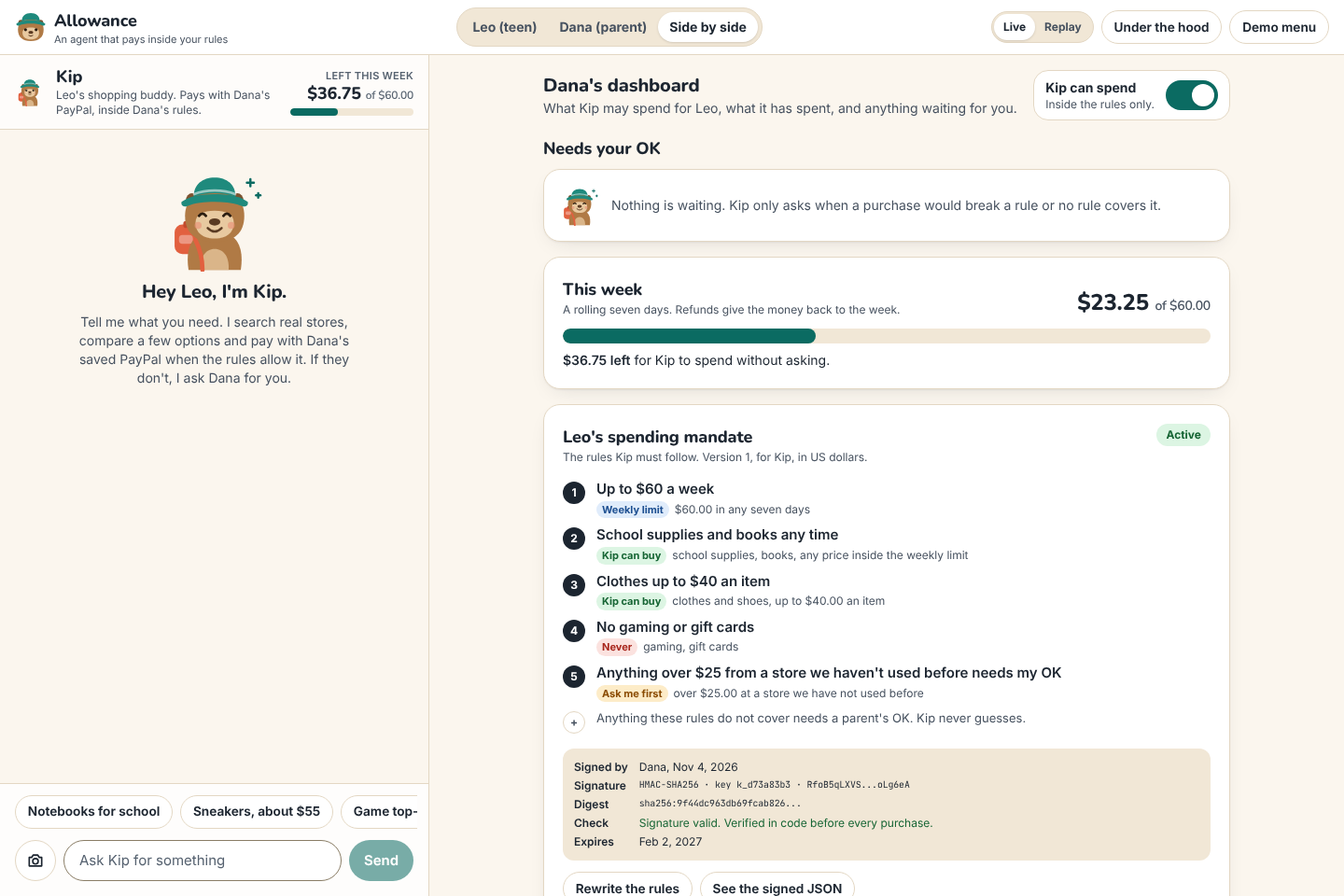
Live demo: https://hack-pp-allowance.vercel.app (PayPal sandbox; it starts with a saved PayPal and a signed mandate, so no login is needed) Code: https://github.com/chinesepowered/hack-pp-allowance
Inspiration
A teenager needs notebooks, a calculator, a pair of sneakers. A parent has two options today, and both are bad. Hand over the card, and there are no limits. Or approve every purchase, and the parent becomes the bottleneck for a pack of pens.
PayPal's theme for this hackathon is AI that actually transacts, not just recommends. That is exactly the thing a family cannot use yet, because letting an agent pay means handing it the card. We wanted the missing layer: a way to let an agent spend real money without trusting it with the decision.
What it does
Allowance is a shopping agent for 13 to 17 year olds, with a parent in charge.
- The parent sets up once, in about two minutes. They save their PayPal in PayPal's own window (PayPal Vault), then write the rules in plain English: "Up to $60 a week. School supplies and books any time. Clothes up to $40 an item. No gaming or gift cards. Anything over $25 from a store we haven't used before needs my OK." The AI turns that into a structured mandate, a schema validates it, and the parent signs it.
- The teen asks Kip, a capybara in a bucket hat. Kip searches real retailers through Channel3 with the price cap taken from the mandate, compares two or three options and explains the pick. A photo works too: "something like this, under $40".
- Code checks the rules, not the model. There are three outcomes.
- Inside the rules: Kip pays at once with the saved PayPal. No popup. The receipt quotes the rule that allowed it.
- Over a cap, a new store, or not covered: the parent gets an approval card with Kip's reasoning and the exact rule. Approve, Decline, or "Approve and add a rule".
- Blocked: Kip explains kindly, quotes the rule, and suggests something the rules allow.
- The parent stays in charge. A ledger shows every purchase with the rule it relied on and the PayPal order and capture ids. Undo refunds a purchase through PayPal for 24 hours. One switch pauses Kip instantly. Kip writes a weekly note from the ledger.
An Under the hood drawer shows every PayPal call the session made, with its PayPal-Debug-Id, and Kip's reasoning trail including each policy check.
How we built it
- Next.js (App Router) and TypeScript, deployed on Vercel. State is a small JSON document store: files in development, Vercel Blob in production. PayPal stays the source of truth for money.
- PayPal. Vault v3 setup tokens and payment tokens to save the parent's PayPal, approved through the JS SDK v6 save-payment session. Orders v2 with
payment_source.paypal.vault_idto charge it with no popup. Payments v2 refunds for Undo. Webhooks with signature verification and idempotent handlers, plus re-reading PayPal on every money screen so nothing depends on delivery. - The agent cannot pay. Kip is a tool-calling loop. Its
create_ordertool accepts a product id and a sentence of reasoning, nothing else. The wrapper checks the product came from a Channel3 search, re-reads the price, classifies the product, and runs a deterministic policy check against the signed mandate. Only then does code call the PayPal Agent Toolkit'screate_order, and the vaulted payment source is attached server-side by an interceptor. The model never sees it. - The mandate is signed JSON (HMAC-SHA256 over its canonical form) and is verified before every purchase. It follows the intent mandate idea from agent payment protocols such as AP2, without claiming AP2 compliance.
- Channel3 for text search with mandate filters, image search, similar products and product detail.
- W&B Inference for the models, through the OpenAI SDK.
- Replay mode runs the same code with recorded sandbox, Channel3 and model responses, for when a service is down. The same recordings drive an offline end-to-end test.
- 89 automated tests cover the money rules, the mandate, the PayPal write path, webhooks and the whole flow.
Challenges we ran into
- Create and capture are one call. An order created with a vaulted PayPal and intent CAPTURE comes back already completed, capture included. We planned for two calls and found one.
- The Agent Toolkit's
create_orderhas no vault field, always adds a buyer-approval context, talks to a different host name than the Server SDK, never refreshes its token and never sendsPayPal-Request-Idper call. We wrapped it: an interceptor on the toolkit's own axios instance swaps in the vaulted payment source after the mandate check, adds the idempotency key and captures the debug id. - A reasoning model with a small token budget returns nothing. The text model spent its whole budget on reasoning and gave empty content. Turning reasoning off for labeling made classification four times faster.
- With reasoning off, the model sometimes skipped tools, answered from memory of the rules, and once imitated our own history notes with a fake "paid" line. Nothing was charged, because the guard refuses unknown products, but it told us the rule had to be: a blocked request is blocked by code whatever the model does. Every shopping request is now screened in code alongside the model's first turn.
- Product detail lists second-hand offers. Kip briefly charged $5 for a $17 calculator because a used offer was cheapest. Kip now buys only new, in-stock offers from the store the teen was shown.
- The client token rejects localhost as a domain, and Playwright sends localhost through a proxy unless told not to.
- The APIMatic Context Plugin documents a newer generated package than the Server SDK we were pinned to, so we used its method (the contract sheet) and looked the SDK facts up in the installed source.
Accomplishments that we're proud of
- The agent really transacts in the PayPal sandbox, and there is no path by which the model can move money on its own.
- A parent can read the mandate as a card, and an engineer can read it as signed JSON, and they say the same thing.
- Every receipt says which rule allowed it. Every refusal quotes the rule that stopped it.
- The whole aha runs offline in a test, against real recorded responses.
- Kip. A capybara in a bucket hat turned out to be the right tone for telling a fifteen year old "not this one".
What we learned
- Put the money decision in code and let the model argue for a product, not for a payment.
- Idempotency keys belong to the thing being paid, not to the attempt.
- "No answer" from a payment API means unknown, not failed, and has to be re-read before anything else happens.
- Agent payment mandates are easier to trust when the person can read them in their own words.
What's next for Allowance
- Pay retailers directly through PayPal's agentic commerce services, so the simulated retailer step becomes real.
- Parent sign-in with passkeys and a mandate signed by a key the parent holds.
- Push notifications for approvals, more than one teen per family, savings goals.
- Returns, partial refunds, shipping and tax inside the policy check.
Tools: which AI models and services were used, and how
- Qwen/Qwen3.8-27B on W&B Inference: Kip's tool-calling loop, turning rules into a mandate draft, classifying products into mandate categories with a confidence score, the note to the parent, the weekly note.
- google/gemma-4-31B-it on W&B Inference: describing the teen's photo before image search.
- zai-org/GLM-5.3-Flash on W&B Inference: fallback when the main model keeps failing.
- Channel3: product search with price and stock filters from the mandate, image search, similar products, product detail with offers across retailers.
- ElevenLabs: the video narration and Kip's short voice lines, pre-rendered. The app never calls it.
- Claude Code: AI coding agent used to build the app, tests, docs and video pipeline from a written brief, with the APIMatic PayPal Context Plugin skills.
- Playwright: approves the one-time PayPal save in the seed script, and records the demo video from real runs.
The AI never decides a payment. It proposes; code checks the signed mandate; a parent approves when the rules say so.
PayPal products used
- Vault v3: setup tokens and payment tokens for the parent's saved PayPal wallet
- JS SDK v6: the save-payment session and
<paypal-button>for approving in PayPal's window - Orders v2: create with
payment_source.paypal.vault_id, get, and capture as a fallback - Payments v2: capture lookup and refunds
- Webhooks:
PAYMENT.CAPTURE.COMPLETED,PAYMENT.CAPTURE.DENIED,PAYMENT.CAPTURE.REFUNDED,PAYMENT.CAPTURE.REVERSED,VAULT.PAYMENT-TOKEN.CREATED,VAULT.PAYMENT-TOKEN.DELETED, with signature verification - Agent Toolkit (
@paypal/agent-toolkit):create_order,get_order,create_refund, wrapped behind the mandate check - Server SDK (
@paypal/paypal-server-sdk)
Everything runs in the sandbox. In this prototype Allowance charges the family's PayPal through its own sandbox merchant account, and the retailer order step is simulated and labeled as simulated.
Sponsor tools used
- Channel3: the catalog behind every shopping turn. Text search with filters from the mandate, image search, similar products to offer an alternative inside the rules, and product detail for offers and buy links. The UI marks its results "Results from Channel3".
- APIMatic: the PayPal Server SDK it generates carries the Vault calls, seed purchases and lookups. The PayPal Context Plugin's TypeScript skills are in the repository, and its integration workflow produced the contract sheet in
paypal-plan.md: durable writes, unknown outcomes, optional request fields and the error mapping.
Built With
- apimatic
- channel3
- elevenlabs
- ffmpeg
- next.js
- openai-sdk
- paypal
- paypal-agent-toolkit
- paypal-js-sdk
- paypal-orders-api
- paypal-server-sdk
- paypal-vault
- paypal-webhooks
- playwright
- react
- tailwindcss
- typescript
- vercel
- vercel-blob
- vitest
- weights-and-biases
- zod
