-
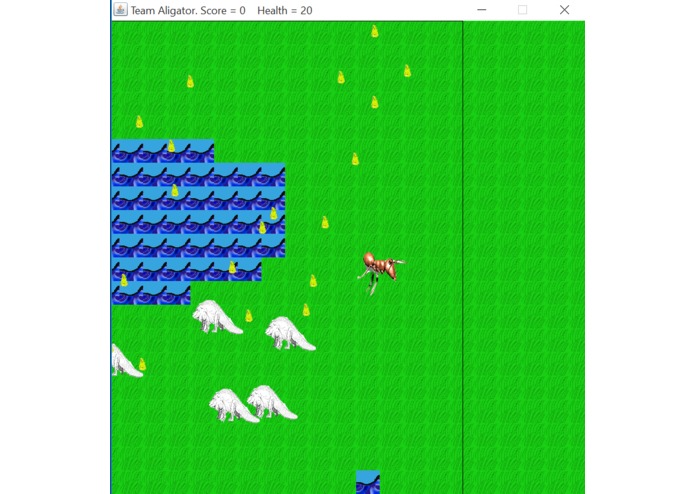
An ingame screenshot.
Inspiration
We started off taking influence from Earth Defense Force. The only remaining reference to this is the ant image used for the main character. We added features that made sense to add incremental improvements to a skeleton game, until it no longer resembled our original idea.
What it does
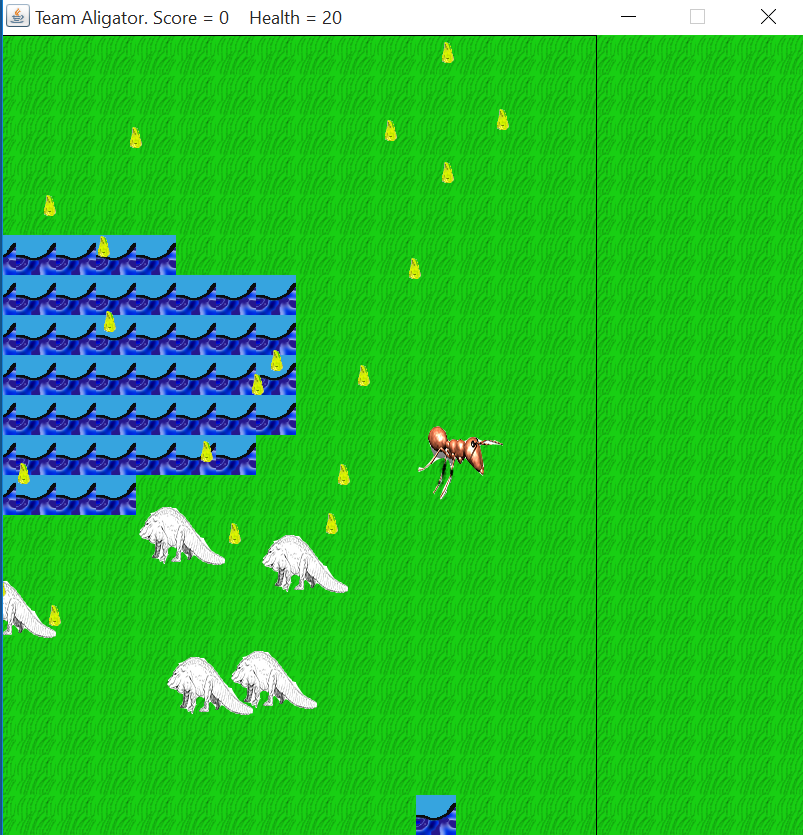
It engages the user with a compelling interaction of the perilous conflict between the individual ant and the horde of alligators, set in the epic battle arena of South Florida Grasslands. The player takes control of a weak ant, surrounded by powerful acid spewing alligators. Each time you strike one down, 3 more seem to take its place. How long can you last against this reptilian onslaught?
How we built it
Java Swing, using Eclipse IDE. The code loosely follows an encapsulated Model-View architecture. All 4 of our team members are programmers by trade, so we split up the work as we went along, frequently merging all of the changes into a local git repo.
Challenges we ran into
We encountered severe lag spikes as we increased the details of the grass and water textures from solid rectangles to actual graphics.
Time.
Accomplishments that we're proud of
Our team managed to create the artwork for the grass and water tiles without existing graphic design talent. We built are game engine up from the ground that Swing provides. This contributed to lots of minor problems, but ultimately taught us new skills. We also take pride in the separation of internal model data and the UI drawing code.
What we learned
We learned about buffering JPanels to decrease lag, using offsets to line up the image drawing calls, and loading resources into a JPanel. We learned the amazing utility of diffs for collaboration, and the difficulty of writing large quantities of code in 24 hours.
What's next for Alligator Attack
The next step is, as I believe it is for any short time limit hack, to add more features, and clean up the existing implementation. "This is a temporary hack" is an unofficial motto for these events, and Alligator Attack is no different. The model-view divide is well done because it's practical. I could add the ability to reset the game by pressing space-bar at any time by extracting a single method out of the constructor. The intra-module decoupling? Crushed like candy.
Ideally the added features would bring the project closer to it's original roots: Earth Defense Force. In that game, you gain small bits of the power of each alien you kill, slowly gaining the power of the creatures you hunt. In our ideal game, abilities the Alligators have: walking faster on water, healing on water, more melee damage, growth, more melee defense, would be incrementally gained by killing Alligators. Projecting further into dream-space, a small variety of biological Floridian killing machines would be fighting each other, with the player caught in the crossfire. ANY entity that killed an Alligator would incrementally gain those traits. Other creatures would have different bonus traits they reward their killers with.
This game differs significantly from the story we presented at the beginning. Our game was guided more by what we could add to the game, rather than what we wished we could add. We realized that we could not build the game we dreamed of in this time, and decided it was better to build a working kernel of it, than a broken dream. For now.

Log in or sign up for Devpost to join the conversation.