-
-
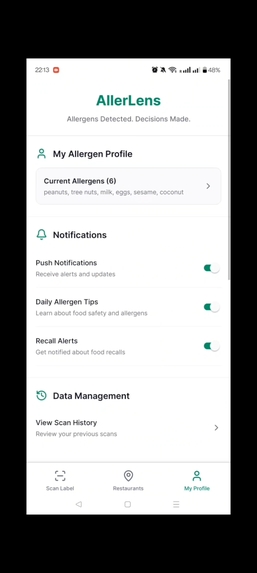
AllerLens Profile Tab
Inspiration
As someone with an MSc in Risk and a background in sustainability and food safety, I saw firsthand how poor allergen labeling and restaurant transparency endanger lives. While studying Natasha’s Law, I realized that most apps simply list allergens — they don’t interpret risk. I wanted to create a real-time, intelligent tool that helps people instantly understand whether a food is safe for them or their kids — especially in ambiguous or high-risk situations.
What it does
AllerLens helps people with food allergies instantly assess risk from food labels, restaurant menus, and nearby eateries. Unlike barcode-only scanners, it uses OCR (optical character recognition) AND barcode scanners to analyze photos of ingredients and menus — even from homemade or small-brand products. It highlights potential allergens and cross-contamination risks using a traffic-light system, informed by UK/EU allergen law and real-world phrasing patterns.
Key Features: Upload or snap a photo of an ingredient list or menu
Select specific allergens (e.g., nuts, dairy, soy, gluten)
Get a risk summary using traffic-light logic
Browse “Safe Nearby Eats” filtered by dietary needs (e.g., vegan, halal)
Use KidShield mode to flag additives and food dyes unsafe for children
Bonus: “Did You Know?” facts to raise awareness
How we built it
AllerLens was built in Bolt.new as a web-based MVP, using:
OCR capabilities to extract text from images
Regex + NLP logic to analyze phrases like "may contain," "produced in a facility with..."
Traffic-light system coded with a simple risk-scoring framework modeled on Natasha’s Law
Supabase (coming soon) for user login and preferences
Map/location APIs to display safe dining options nearby
Founder's Voiceover and face-to-camera narration were combined for a more human, trust-building demo.
Challenges we ran into
Label ambiguity: Parsing real-world phrasing like “shared lines” vs. “certified free from” required nuanced logic, not just a keyword match.
Mobile OCR accuracy: In low lighting or with blurry menus, image-to-text conversion can misfire — we had to implement fallback cues. Also there were issues with Expo Go and other things- still working on them!
Balancing usability vs. complexity: Risk-based analysis needed to be accurate but user-friendly, especially for parents.
Accomplishments that we're proud of
Built a functioning MVP that allows users to select allergens and analyze sample product data using a risk logic framework
Developed a traffic-light summary system that reflects real-world risk, not just keyword matching
Combined allergen analysis with a roadmap for location-based dining safety, setting the stage for future integration with map APIs
Designed the KidShield filter to address food dyes and additives — a rarely addressed concern in existing allergen apps
Grounded the entire logic in Natasha’s Law and regulatory principles, rather than just automation.
What we learned
Simplicity is hard — designing something that’s accessible and readable while still grounded in complex food risk logic requires constant iteration
Food safety tech is still underserved, especially when it comes to cross-contamination, dye sensitivity, and low-literate users
Creating from lived experience (or studied expertise) adds credibility and emotional clarity — and it shows in the product.
What's next for AllerLens: Allergens Detected. Decisions Made.
We designed AllerLens to be flexible and scalable. Alongside OCR and risk logic, we're planning a community-sourced feedback system where users can rate or flag nearby eateries based on their allergen-handling practices — something missing from most map-based tools.
This will eventually plug into a Google Maps integration, but with a layer of human context (e.g., “they changed their oil between fryers,” or “staff was unsure about cross-contamination”), making decisions more informed than what’s available through menus alone.
We also plan to:
Add real-time OCR and barcode scanning for faster label processing
Google Maps integration for a seamless “Safe Nearby Eats” experience
Build a community feedback loop, where users can:
Flag unsafe restaurants
Recommend trusted spots
Leave notes about cross-contact awareness (e.g., shared fryers, staff knowledge)
Add a reputation/rating system so restaurants with good allergen practices rise to the top
Enable user accounts via Supabase to save preferences and contribute to the community
Monetize via affiliate partnerships and premium features (e.g., school meal scanning)
By combining machine logic with community insight, AllerLens aims to become the TripAdvisor for allergen safety — real-world, real-time, and trusted by the people who need it most.
Built With
- bolt
- capcut
- javascript
- maps
- ocr
- regex

Log in or sign up for Devpost to join the conversation.