Inspiration
Campus answers live in too many places at once: the academic calendar, a course page, a last-minute announcement, and a student thread that may or may not be current. Searching those yourself is slow. Asking a chatbot is faster, but you cannot tell whether the due date came from this term, last year, or the model’s memory.
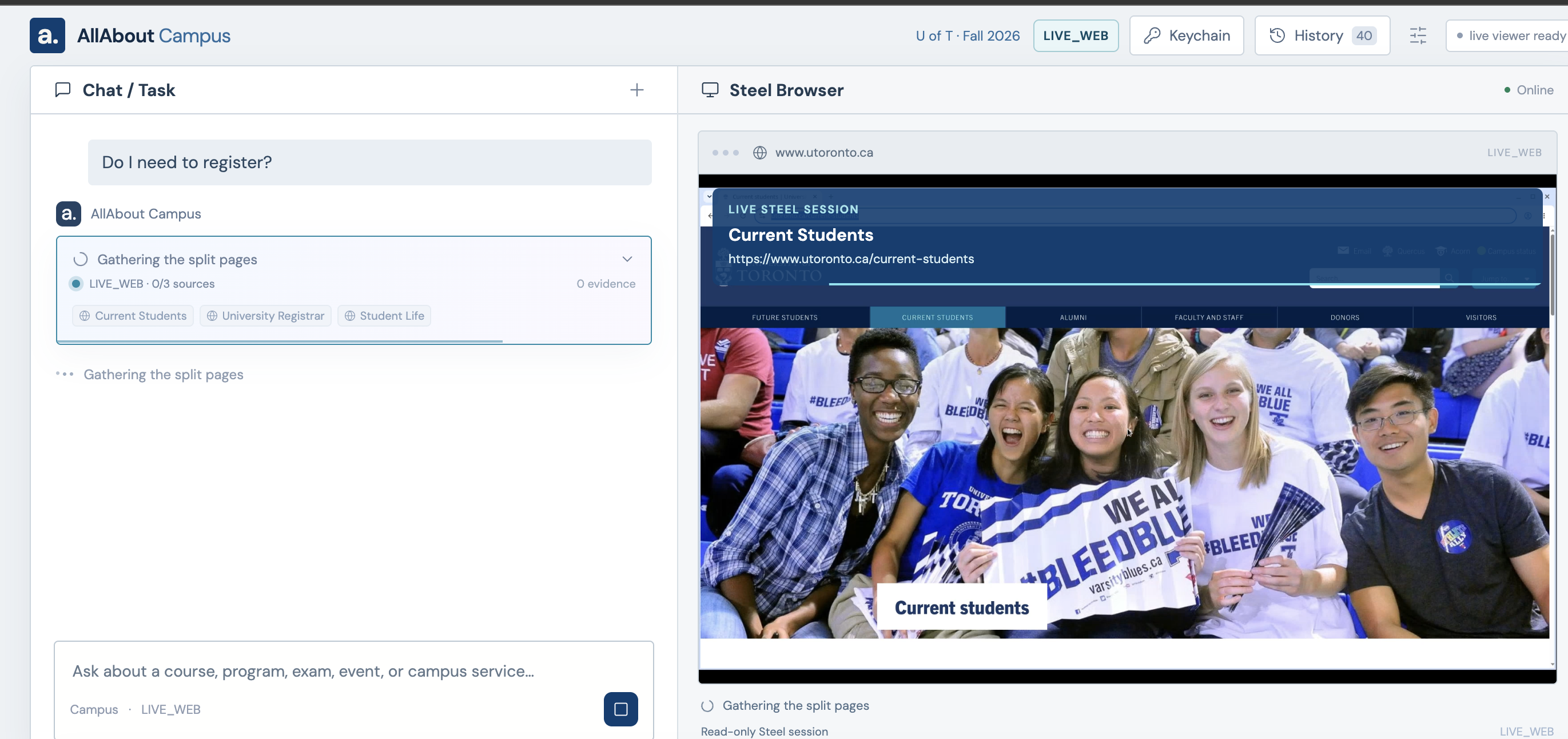
We wanted an assistant that behaves more like a careful TA: open the relevant pages, show the browse, quote the source, and say what it did not check. AllAbout Campus is that workflow for University of Toronto students — one question, several campus sources, one cited answer.
What it does
A student asks something concrete (“What are CSC207’s prerequisites?” or “When is the Labour Day carillon recital?”). AllAbout:
- plans which registered sources to open
- browses them live in a Steel cloud browser you can watch
- extracts facts with quoted evidence
- returns a structured answer (summary, requirements, dates, unknowns)
- keeps official pages, course notices, and student chatter in separate layers so a Reddit vibe never becomes a syllabus
The desk also shows a coverage receipt (what was checked vs skipped) and two timelines: the query process, and any key dates found in the pages.
How we built it
Four people, four modules, shared TypeScript contracts:
- A — Web: React + Vite campus desk (chat, live viewer, evidence, history)
- B — Orchestrator: Fastify API, run store, SSE events, OpenAI planner (
gpt-5-mini) - C — Browser: Steel SDK + Playwright, bounded navigate/read, viewer URL, session cleanup
- D — Evidence: rule-based extraction, conflict handling, citation-backed answer bundles
The model never receives Steel or portal credentials. Citations are checked against the actual page text before they ship. Live sources are an allowlisted registry (for example CSC207 Academic Calendar and U of T Events), not “the whole internet.”
Challenges we ran into
The hard part was not generating an answer. It was making four pipelines agree on truth.
- Contracts vs reality. Planner fields (
requirements,eligibility) and extractor fields (deadline,submission_format) drifted. Until those vocabularies matched, a successful browse still produced “unknown.” - Live browser lifecycle. Viewer-ready, answer-ready, and session-released are different moments. We had to stop treating “answer done” as “browser gone,” and drop expired viewer URLs on late SSE replay.
- Honesty under a deadline. Fixtures, replays, and live web look the same on a pretty UI. We labeled
LIVE_WEBvsLIVE_FIXTUREvsREPLAYand refused to sell mock pages as logged-in Quercus. - Citation discipline. Models like to sound sure. We reject quotes that are not in the snapshot, keep unknowns visible, and never invent a
23:59when the source only has a date.
Accomplishments that we're proud of
- A real HTTP → Steel → evidence → cited answer path on a public U of T page, with a watchable browser and session cleanup.
- Shared Zod contracts so frontend, planner, browser, and evidence could ship in parallel without guessing each other’s JSON.
- Citation verification: if the quote is not on the page, the claim does not ship.
- Coverage receipts that show login-walled, bot-checked, or skipped sources instead of pretending the campus is fully readable.
- A desk that streams the run (
viewer_ready,browser_step,source_checked,answer_ready) instead of hiding the agent behind a spinner.
What we learned
A campus agent is useful only if the user can audit it. Showing the page, the quote, the coverage gap, and the cleanup is the product — not a nicer paragraph.
We also learned that “it compiled” is not integration. Field names, authority labels, and viewer lifetime have to be treated as product decisions, not leftovers. And that labeling demo modes is a feature: judges and students both deserve to know whether they are watching live web, a fixture, or a replay.
What's next for AllAbout
- Authorized connectors for Quercus / Piazza-style portals, with credentials staying off the model.
- Deadline Detective: when a syllabus and a later instructor notice disagree, show old value, new value, and why the update applies.
- Answer-to-action: download a
.icsfrom confirmed dates (no calendar OAuth in v1). - Follow-ups that keep course/term context (“what about late penalties?”).
- A “what changed?” recrawl that diffs deadlines, locations, and requirements instead of restating the whole page.
Built With
- artificial-intelligence
- browser-automation
- edtech
- evidence-based-search
- fastify
- live-web
- node.js
- openai-api
- playwright
- react
- retrieval-augmented-generation
- source-verification
- steel.dev
- student-tools
- typescript
- university-education
- vite
- web-agents
- web-research

