All Things Graph
Inspiration
The graph ecosystem is growing rapidly—spanning graph theory, graph databases, knowledge graphs, and graph-powered AI—but the community remains fragmented. Valuable ideas are scattered across blogs, papers, and social platforms, where content is ranked by likes or recency rather than long-term influence.
We were inspired by a simple question: what if the platform for sharing graph knowledge was itself built as a graph?
All Things Graph was created to give graph thinkers a dedicated home—one where ideas are connected, influence compounds over time, and discovery is driven by relationships rather than engagement-driven feeds.
What It Does
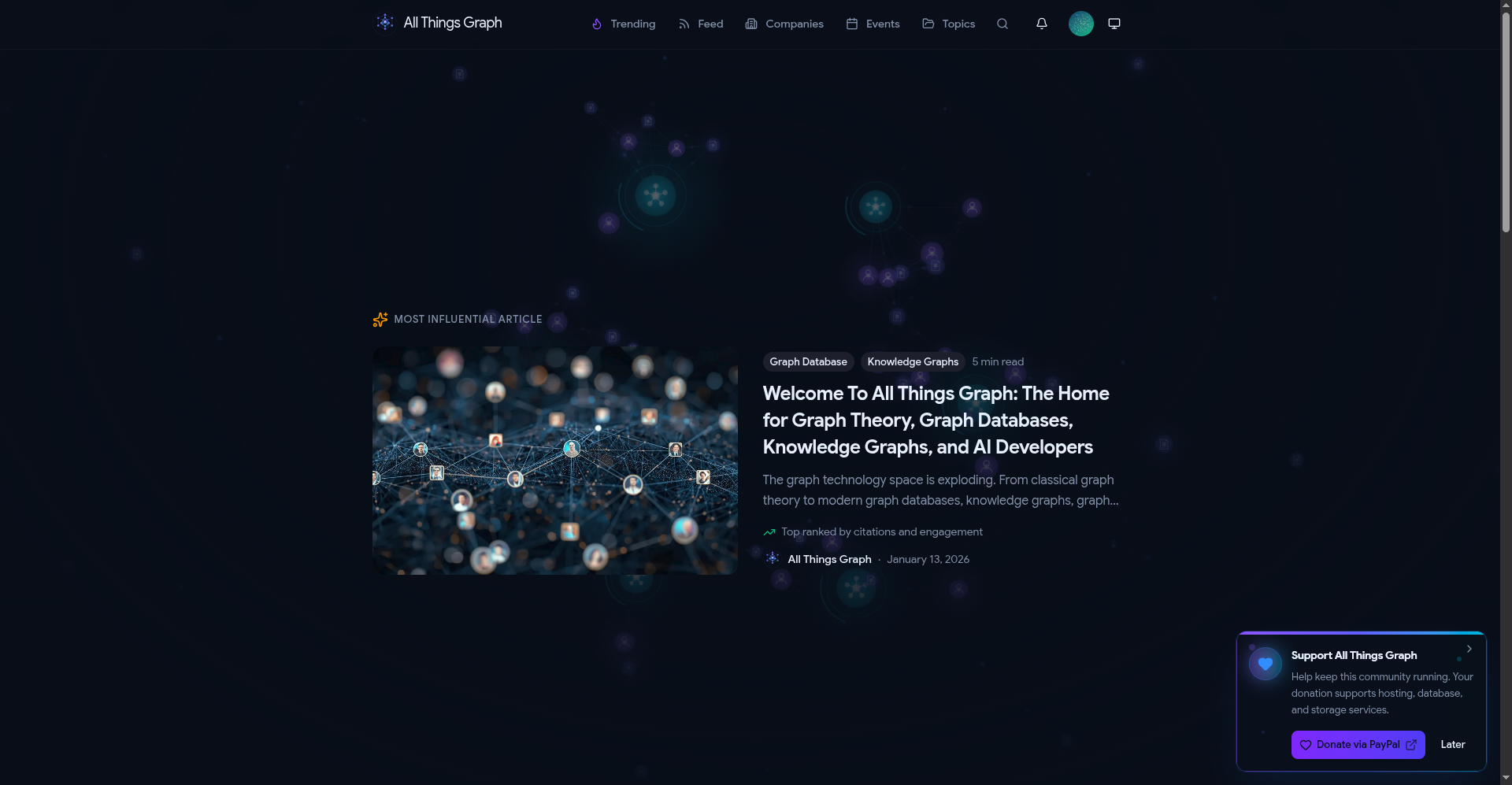
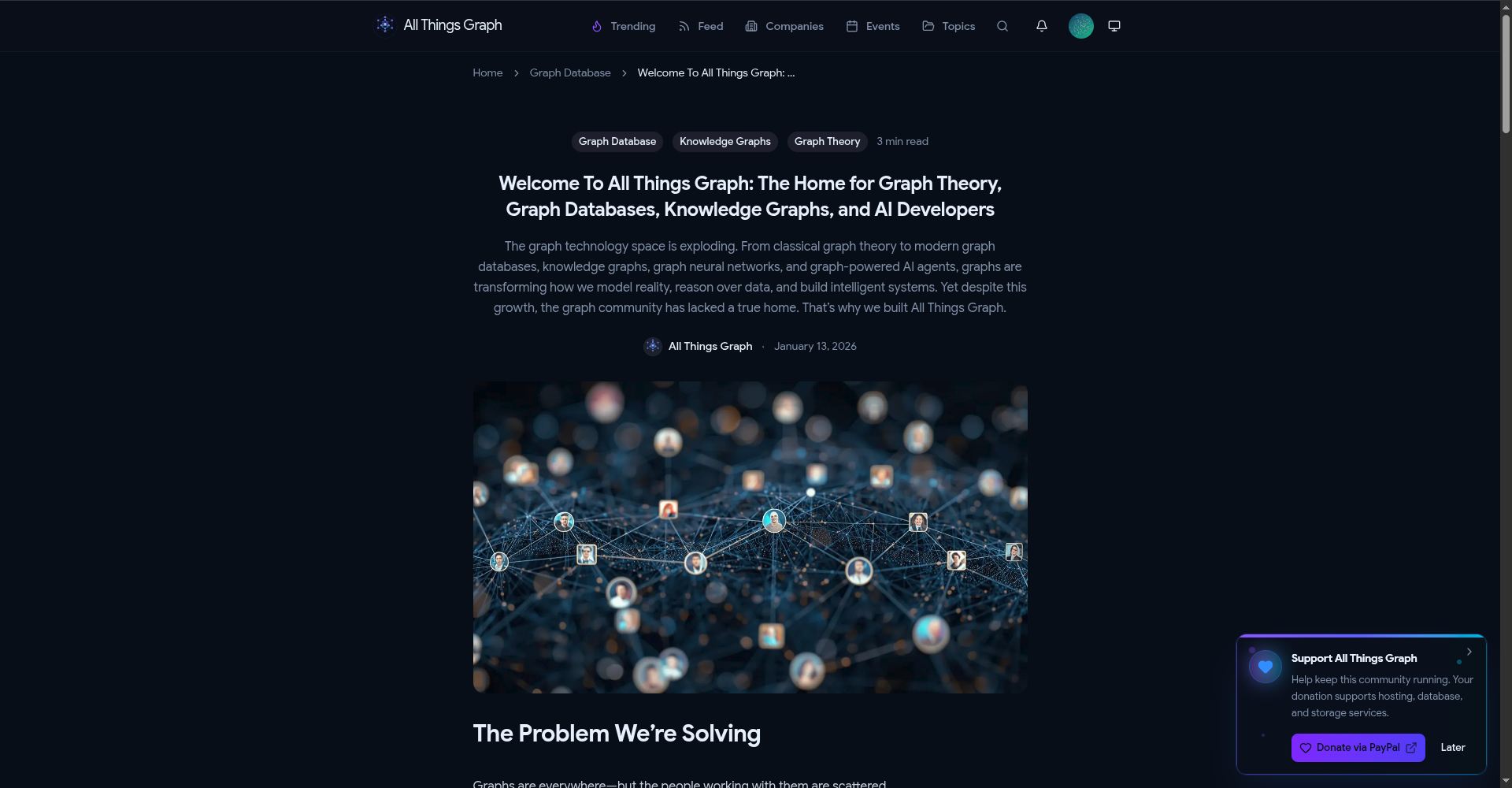
All Things Graph is a graph-native community platform for graph theorists, engineers, and AI developers.
Users can:
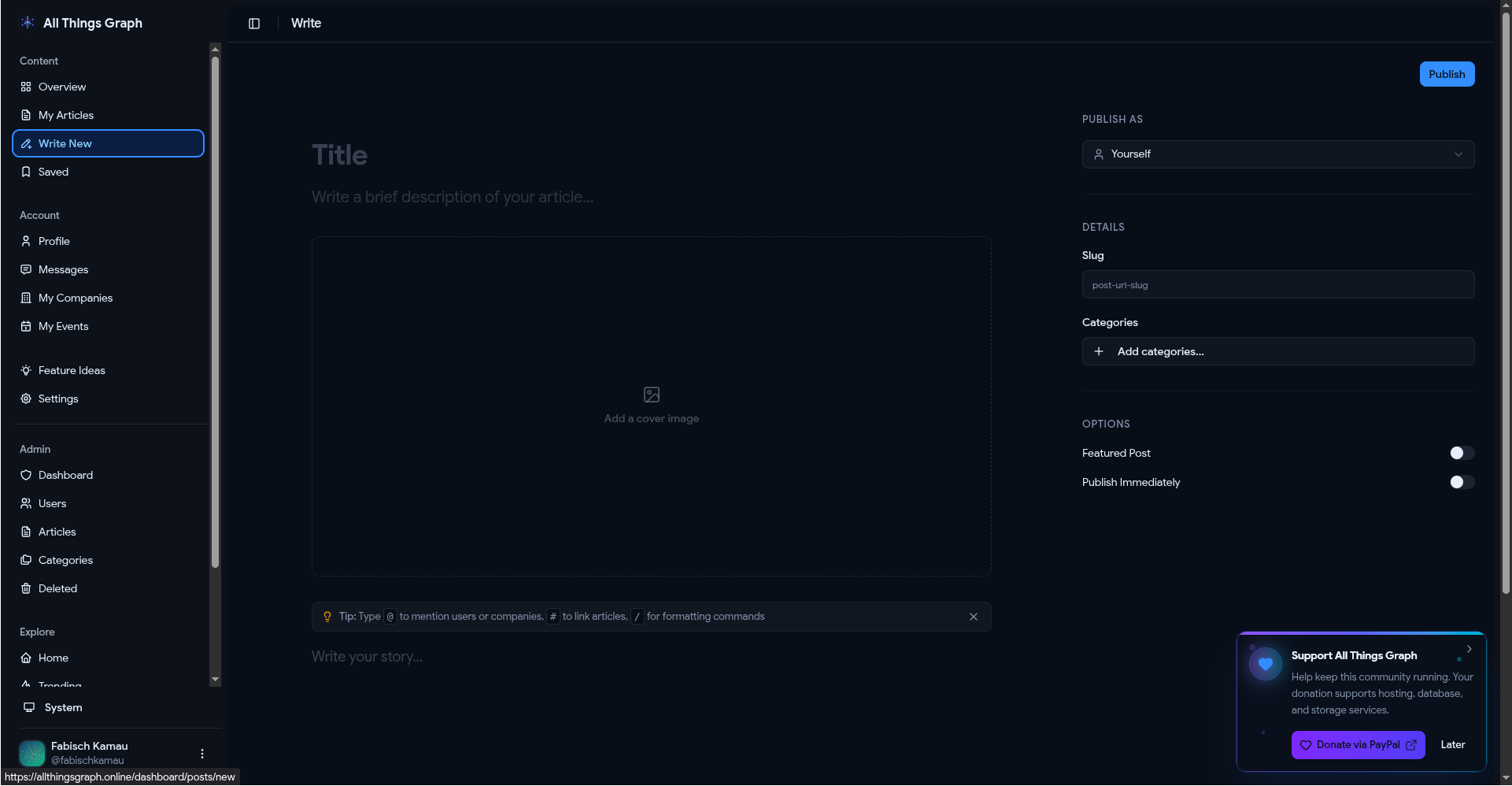
- Publish long-form technical articles with a rich text editor supporting code blocks, mentions, and citations
- Cite other articles using
[[article-title]]syntax, forming a real citation network stored as graph relationships - Follow users and companies to build a personalized feed
- Send direct messages (DMs) to collaborate and share ideas privately
- Post and discover events such as meetups, conferences, webinars, and workshops
- Discover influential content ranked by PageRank and ArticleRank algorithms instead of simple likes
- Explore connections between articles, authors, topics, and citations through a living knowledge graph
- Submit and vote on feature requests to shape the platform's roadmap
Instead of flattening content into timelines, the platform models people, content, and interactions as connected knowledge—15+ node types and 30+ relationship types in Neo4j.
How We Built It
All Things Graph is built end-to-end using graph-native principles.
Graph-First Architecture:
- Core database: Neo4j Graph Database
- Graph modeling: Users, companies, articles, events, citations, follows, likes, comments, and messages are all first-class nodes and relationships
- Graph algorithms: PageRank and ArticleRank influence scoring using Neo4j Graph Data Science (GDS)
- Personalization: Real-time graph queries power feeds, discovery, and recommendations
Tech Stack:
- Framework: Next.js 16 with App Router
- UI: React 19 with TypeScript
- Styling: Tailwind CSS 4 + shadcn/ui components
- Editor: TipTap rich text editor with custom extensions for mentions and citations
- Authentication: NextAuth.js with email verification and password reset
- Images: Cloudinary for uploads and optimization
- Email: Resend for transactional emails and digests
- Rate Limiting: Upstash Redis
Key Implementation Details:
- 60+ API endpoints covering content, social, discovery, and admin features
- 150+ library functions for business logic
- Citation extraction creates
CITESrelationships enabling graph-based influence ranking - Soft-delete pattern with retention periods for data recovery
- Real-time notification streaming
- Comprehensive engagement tracking (views, likes, comments, bookmarks)
Challenges We Ran Into
Designing social features in a graph-native way. Modeling follows, messaging, company memberships, and event RSVPs while keeping queries efficient required careful schema design. Every relationship had to be meaningful for both functionality and future analytics.
Balancing technical depth with usability. The power of graph databases lies in their structure, but exposing that complexity to users required thoughtful UX. We wanted users to benefit from graph algorithms without needing to understand them.
Graph algorithm transparency. Users trust systems more when they understand why content is surfaced. We made influence scoring explainable by combining PageRank with visible engagement metrics, so users can see both algorithmic importance and community interaction.
Efficient trending calculations. Computing trending scores across thousands of articles while incorporating graph metrics, engagement data, and time decay required optimized Cypher queries and smart caching strategies.
Accomplishments That We're Proud Of
- Fully graph-native community platform where every feature leverages the graph structure
- Citation network with real influence ranking using PageRank and ArticleRank computed via Neo4j GDS
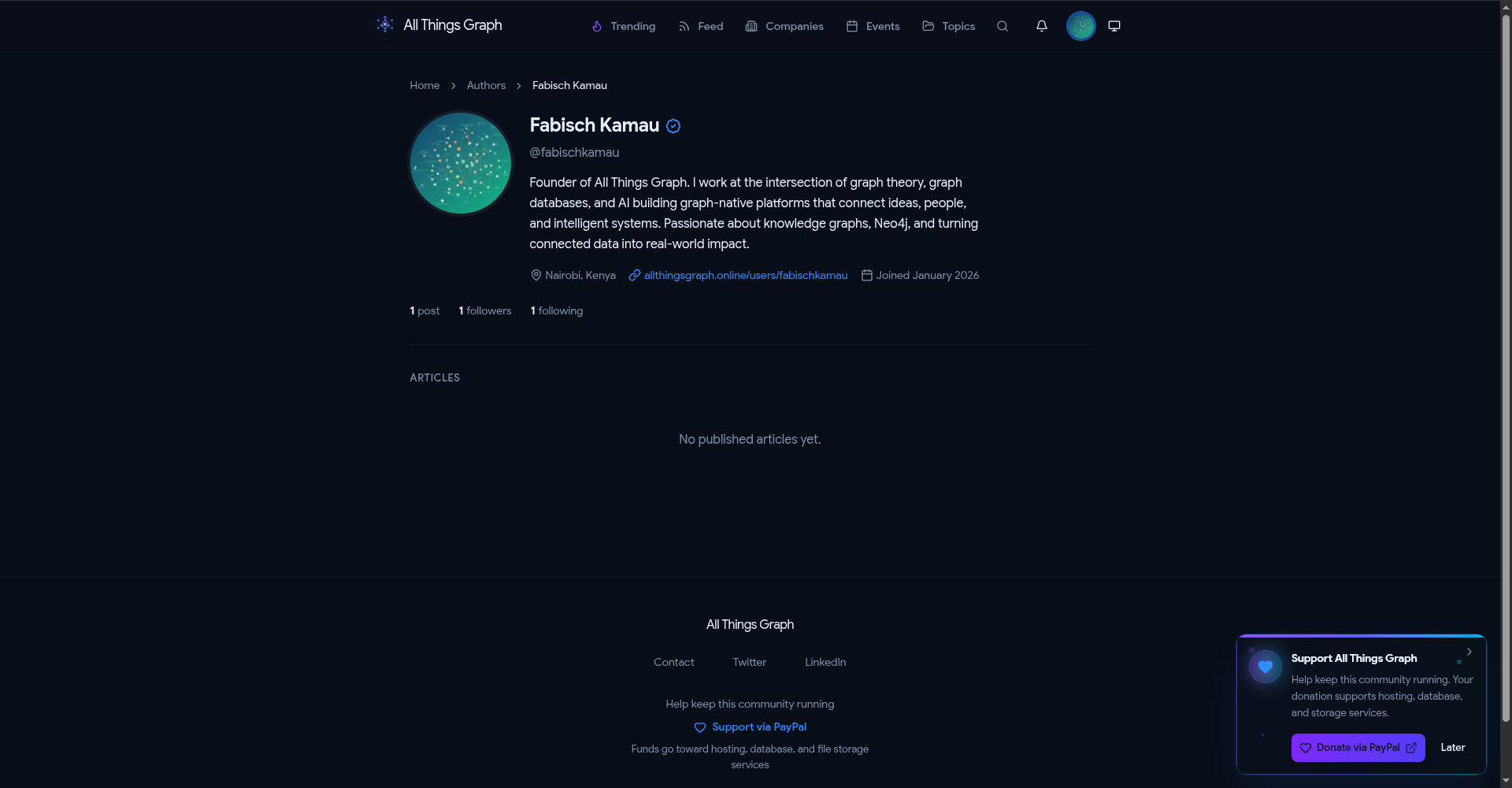
- Complete social layer (follows, DMs, company profiles, team management) implemented directly as graph relationships
- Event system integrated into the knowledge graph with RSVPs, attendee tracking, and discovery
- Rich content editing with TipTap supporting mentions (
@user,@company) and citations ([[article]]) - Personalized feeds powered by graph traversal of follow relationships
- Similar article recommendations based on shared categories, citations, and author connections
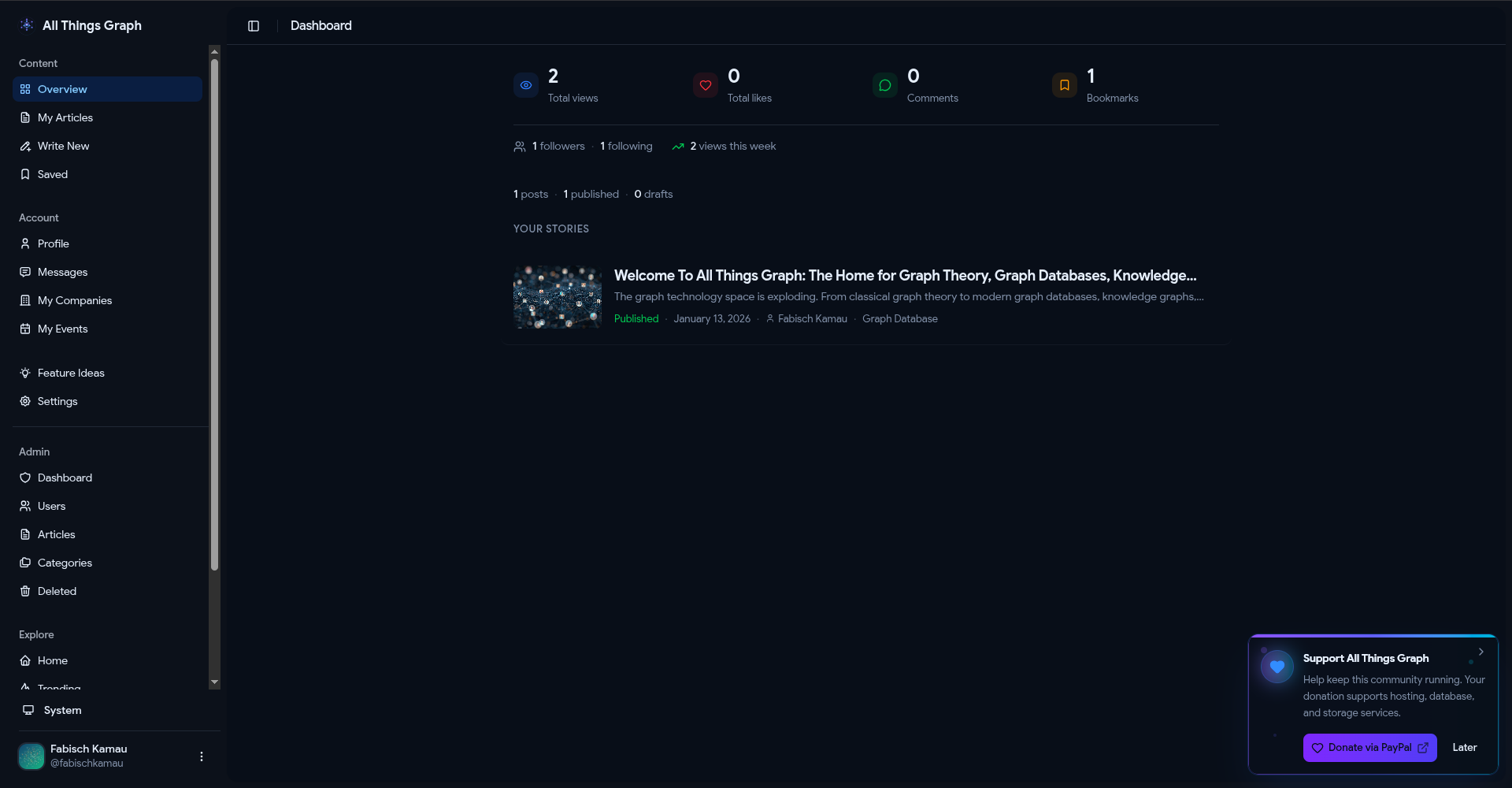
- Comprehensive analytics showing engagement over time with chart visualizations
- Admin dashboard with user/post management, moderation, and platform health metrics
- 50+ pages and a polished dashboard experience
What We Learned
We learned that graphs are not just a backend optimization—they fundamentally shape how people discover, learn, and collaborate.
By making relationships first-class citizens, meaningful structure emerges naturally. Citations become influence networks. Follows become personalized feeds. Company memberships become collaborative publishing. Every interaction adds to the knowledge graph.
We also learned that users trust systems more when they can see how ideas, people, and content are connected. Transparency in ranking builds confidence in the platform.
Finally, we saw how graph databases excel at the "connections" use case—queries like "show me articles by authors I follow" or "find similar articles via citations" are natural graph traversals, not complex JOINs.
What's Next for All Things Graph
Graph-Powered AI Agents:
Research Agent Helps users research topics, trace citations, summarize connected ideas, and understand how concepts evolve across articles and authors. The citation graph becomes a navigable knowledge base.
Knowledge Graph Navigation Agent An AI assistant that helps users search, traverse, and explore the knowledge graph—answering questions like:
- Which articles are most influential on this topic?
- Who are the key authors or companies in this area?
- How are these ideas connected?
- What's the citation path between two articles?
Platform Enhancements:
- Graph visualizations showing article citation networks, author collaborations, and topic clusters
- Semantic search using embeddings stored in the graph for concept-level discovery
- Event recommendations based on user interests and community graph position
- Company analytics showing influence and reach within the knowledge graph
- API for integrations enabling external tools to query the knowledge graph
Long-Term Vision:
Our goal is for All Things Graph to become the definitive, AI-augmented home for graph knowledge—from pure theory to production systems. A place where the community's collective understanding is preserved, connected, and made discoverable through the very technology it discusses.
Technical Highlights
| Category | Details |
|---|---|
| Database | Neo4j with 15+ node types, 30+ relationship types |
| Graph Algorithms | PageRank, ArticleRank via Neo4j GDS |
| API Routes | 60+ endpoints |
| Pages | 50+ routes |
| Components | 100+ React components |
| Social Features | Follows, DMs, Comments, Likes, Bookmarks, Mentions |
| Content | Rich editor, Citations, Categories, Cover images |
| Community | Events, Companies, Feature requests |
| Discovery | Trending, Rising, Personalized feed, Similar articles |
Built With
- neo4j
- nextjs
- resend

Log in or sign up for Devpost to join the conversation.