Inspiration
Most AI failures stem from data, not models.
Broken schemas, silent distribution shifts, mislabeled samples, and misaligned image–text pairs often go unnoticed until after a model is trained and performance degrades. While studying DataOps, I realized a fundamental gap in most ML pipelines:
there is no explicit system that decides whether a dataset itself is safe to use before damage occurs.
Modern Vision-Language Models (VLMs) are especially fragile.
A small number of semantically misaligned samples can poison training, yet current MLOps stacks assume datasets are “mostly fine” and focus on monitoring models after deployment.
AlignOps started from a simple question:
What if datasets had status, audits, and control planes—just like services in DevOps?
What it does
AlignOps is a dataset-centric DataOps control plane for Vision-Language Model (VLM) development.
It ensures that models are never trained on untrusted data by treating datasets as first-class operational objects.
AlignOps provides:
L1 Validation (Deterministic)
Rule-based checks for schema integrity, volume thresholds, and freshness.L2 Semantic Auditing (LLM-based)
Uses Gemini as an independent VLM auditor to judge semantic alignment and dataset risk.Drift Detection
Vector-based distribution analysis using real SigLIP multimodal embeddings to compare dataset versions (v1 vs v2).Outlier Discovery
Automatically surfaces semantically suspicious samples using cosine-distance analysis.Lifecycle Control
Explicit dataset states:PASS,WARN,BLOCK, with human-in-the-loop overrides.Explainable Decisions
Every decision includes structured reasoning traces instead of black-box scores.
In short:
Models do not train unless the data passes inspection.
How I built it
AlignOps is designed as a cloud-native, modular DataOps system.
Backend (Data Control Plane)
- FastAPI for orchestration and API design
- SigLIP (google/siglip-base-patch16-224) for multimodal embeddings
- Qdrant as a vector database for dataset-level analysis
- Gemini for semantic auditing and reasoning
- Docker-based deployment on GCP
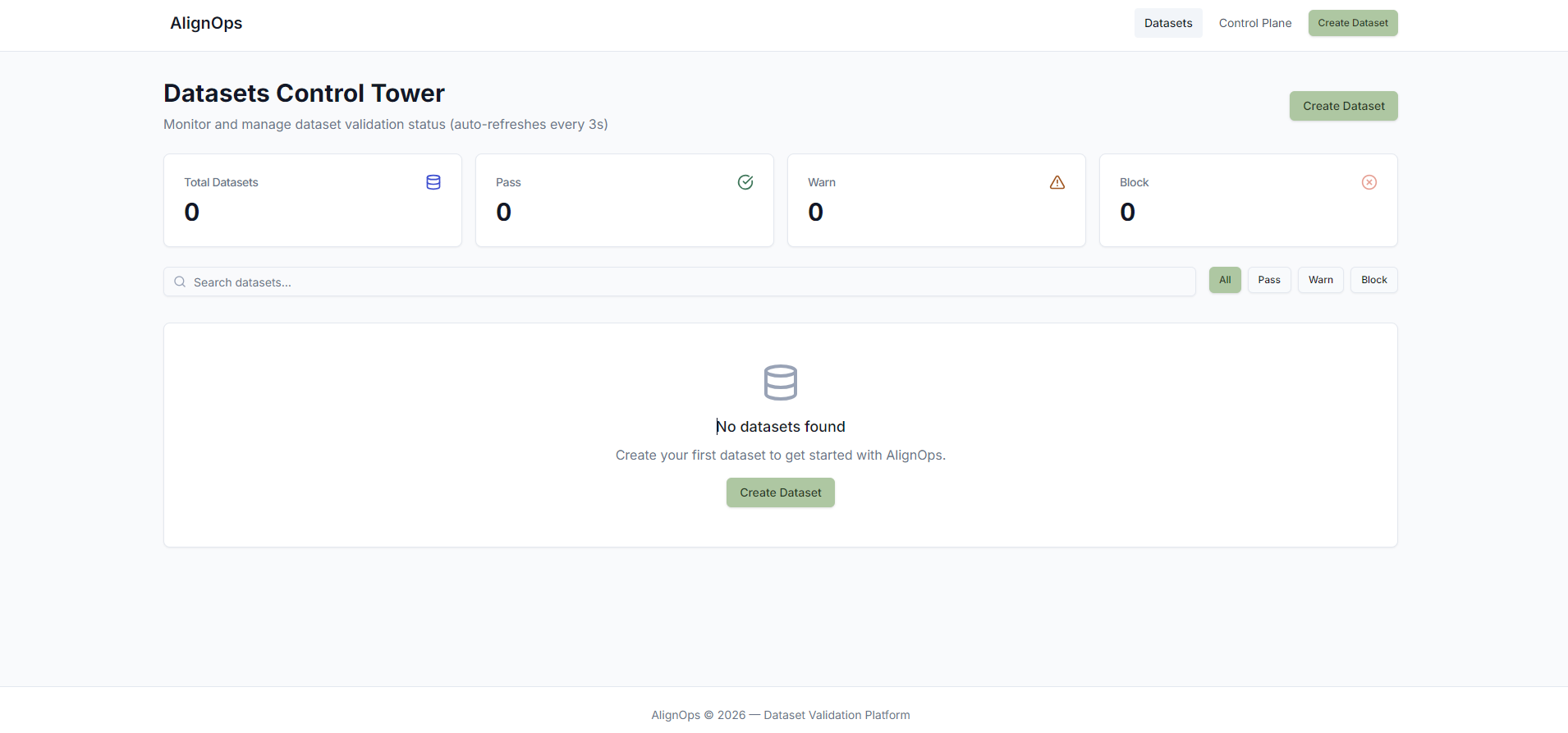
Frontend (Observability & Control)
- Next.js (TypeScript) for UI
- TanStack Query for reliable data fetching
- Recharts for drift and metric visualization
- Accessible, light-mode UI inspired by clinical dashboards
Core Pipeline
- Dataset ingestion
- L1 rule-based validation
- Image–text embedding & vector storage
- Distribution drift analysis (v1 → v2)
- Outlier sampling
- Gemini-powered semantic audit
- Dataset status decision
- Control-plane actions (block, warn, override)
AlignOps is intentionally not a training framework.
It exists before training begins.
Project Story
This project was an intentional deep dive into DataOps, not just model performance.
The core philosophy is simple:
- Data before models
- Reminder that datasets have state
- Semantic errors require semantic reasoning
- Models should never audit themselves
That is why Gemini is used here not as a model being trained, but as an external, independent auditor.
AlignOps acts as a gatekeeper:
it decides whether training should happen at all.
Challenges I ran into
Separating data errors from model errors
Solved by introducing an external VLM (Gemini) instead of relying only on embedding statistics.Meaningful outlier selection
Implemented combined distance logic to surface samples that deviate from both historical and current distributions.Explaining decisions, not just metrics
Required designing structured reasoning traces instead of raw scores.Time constraints
Prioritized architectural correctness and auditability over optimization and scale.
Accomplishments that I'm proud of
- Built a fully functional full-stack DataOps system, not a mock or concept
- Integrated real multimodal embeddings and vector databases
- Used Gemini as a reasoning engine, not just a text generator
- Made dataset decisions transparent, inspectable, and auditable
- Delivered the project end-to-end under tight time constraints knowing I could iterate later
What I learned
- DataOps is fundamentally about trust
- Metrics alone are insufficient without explainability
- VLM pipelines require semantic validation, not just statistical checks
- Treating datasets as operational entities fundamentally changes system design
- Reasoning is a product feature, not an afterthought
What's next for AlignOps
AlignOps is only the beginning.
Planned next steps include:
- Persistent dataset registry using PostgreSQL
- Multi-version drift analysis beyond simple v1/v2
- Automated re-labeling and remediation workflows
- Policy-based gating for production training pipelines
- Integration with schedulers and MLOps systems
The goal is simple:
No model should train on data it doesn’t trust.
Built With
- docker
- fastapi
- gcp
- next.js
- python
- pytorch
- qdrant
- react
- siglip
- typescript
- vercel

Log in or sign up for Devpost to join the conversation.