-
-
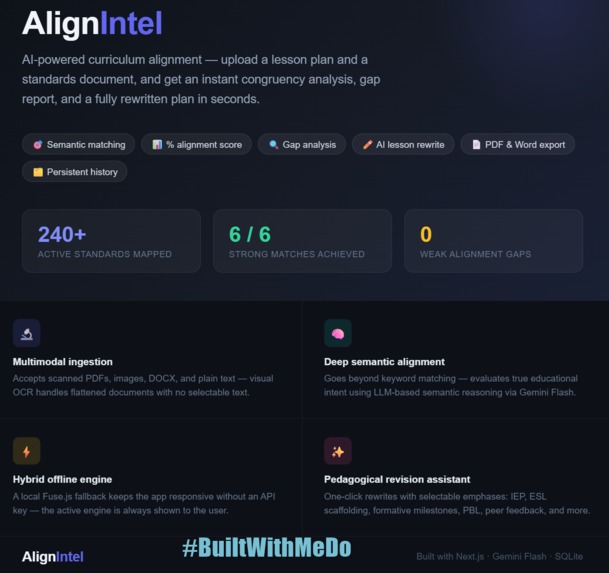
AlignIntel - Hero banner
-
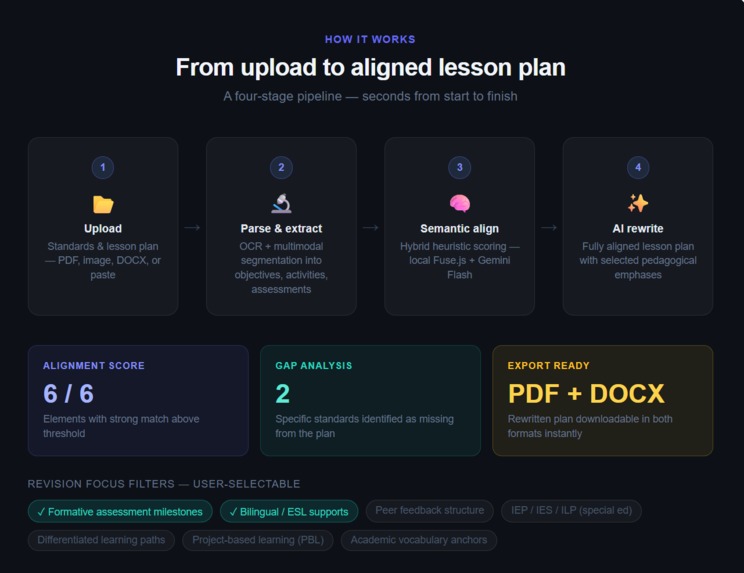
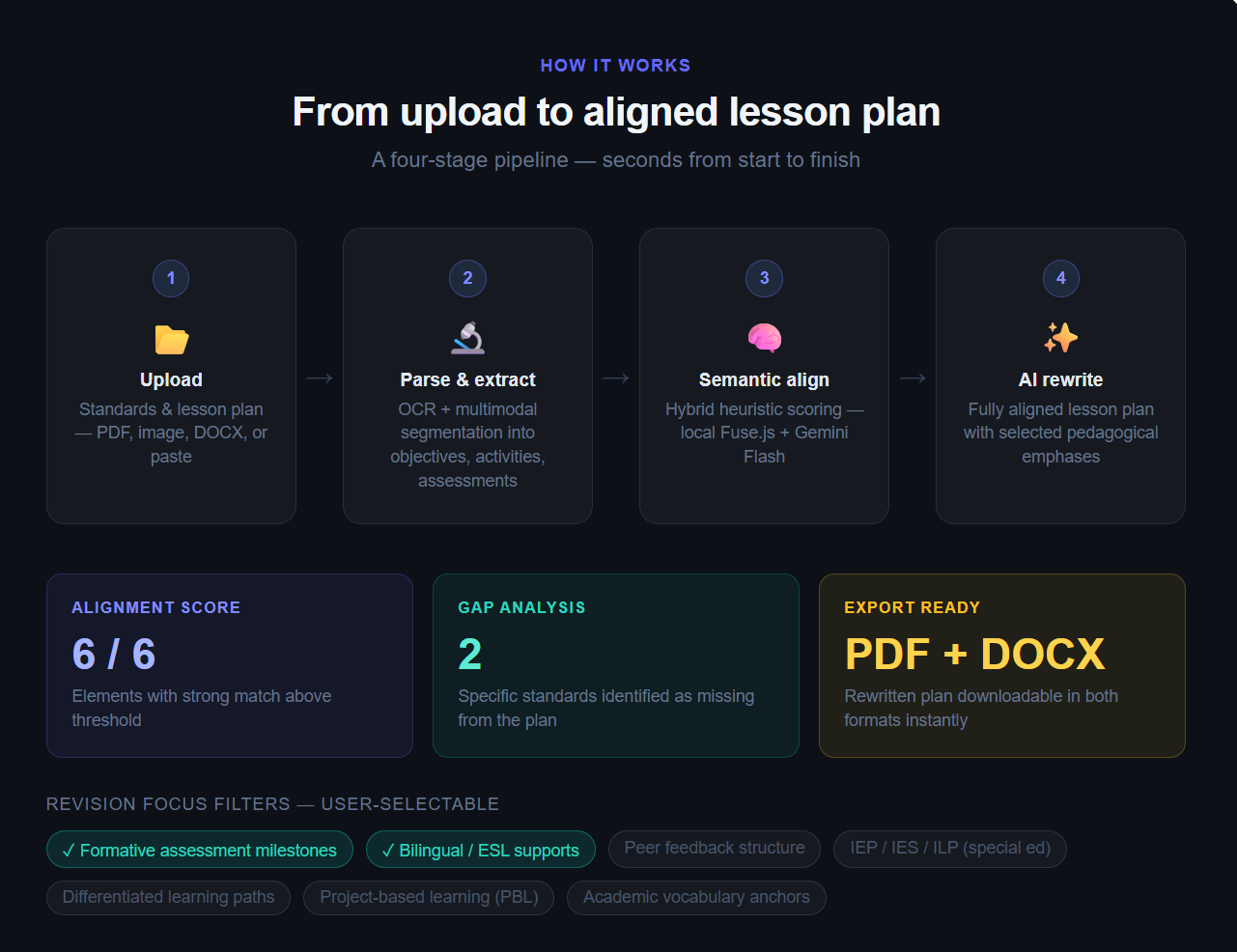
How AlignIntel works
-
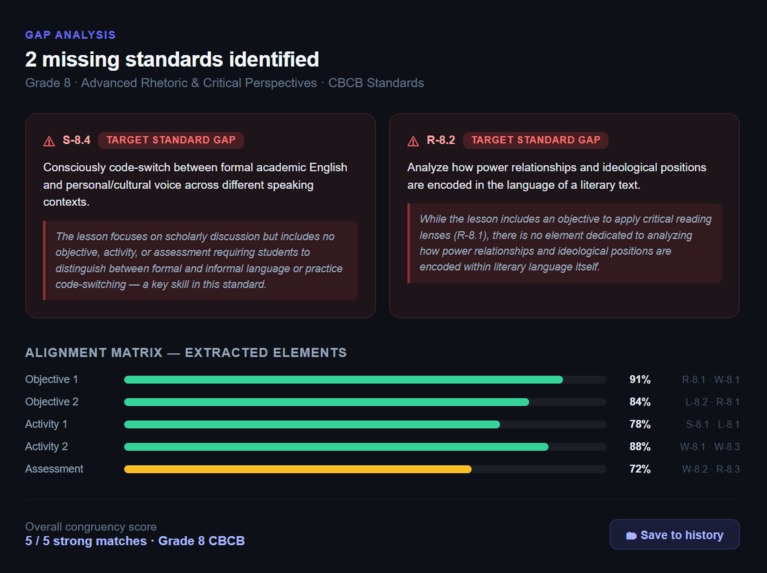
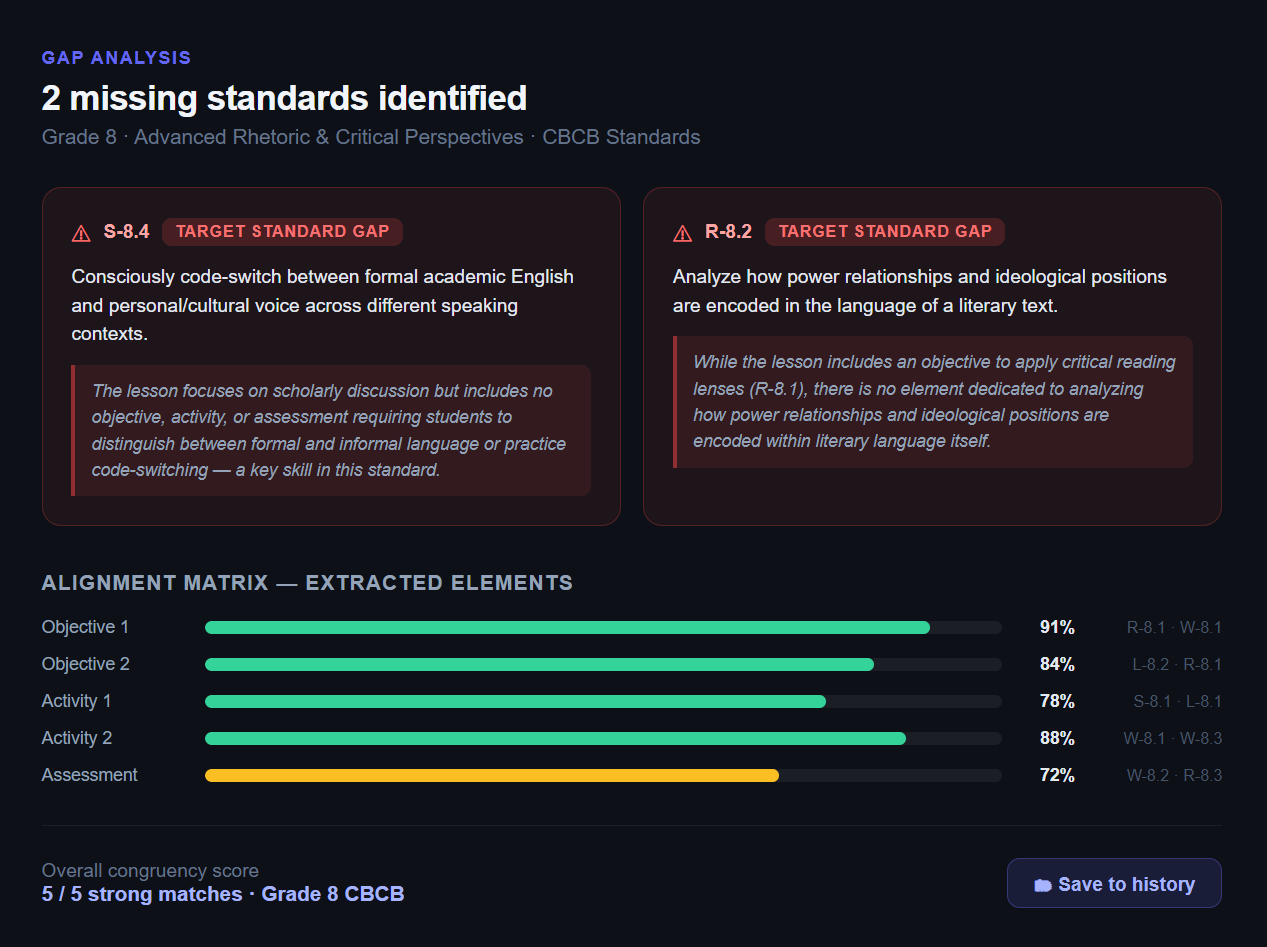
Gap analysis spotlight in AlignIntel
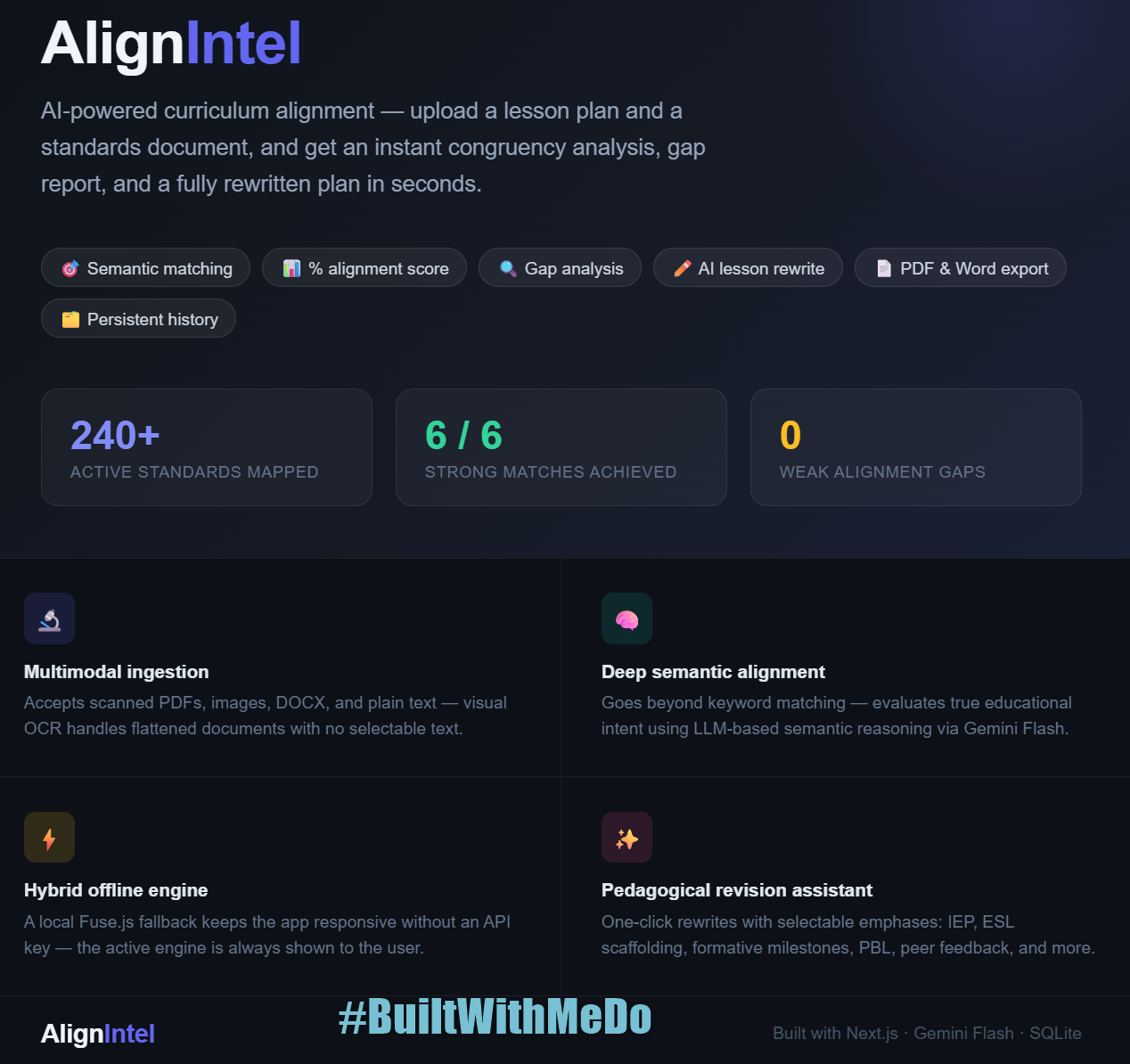
AlignIntel — About the Project
Inspiration
Educators the world over shoulder a largely invisible administrative burden: manually cross-referencing lesson plans, classroom activities, and assessments against complex, multi-tiered curriculum standards. When guidelines are revised or accreditation reviews approach, this task escalates from tedious to unmanageable — hundreds of teaching points checked against sprawling standards databases, one by one.
The problem is compounded by format fragmentation. A significant portion of real-world teaching materials exist not as clean digital text, but as scanned worksheets, photographed whiteboard notes, printed binders, and flattened PDF snapshots. Conventional document parsers fail entirely on these inputs, leaving teachers without any automated support for their most format-diverse materials.
We built AlignIntel to close this gap — a tool that bridges the physical-digital divide and automates the full curriculum alignment pipeline: ingestion, semantic analysis, gap identification, and AI-assisted lesson revision. The goal was unambiguous: eliminate the administrative overhead so that educators can redirect that time toward teaching.
What We Built
AlignIntel is a full-stack, AI-powered curriculum alignment dashboard with five core capabilities:
- Multimodal Lesson Ingestion: Teachers can paste raw text or upload scanned PDFs, image files, and Word documents. A dual-pathway processing engine handles both text-selectable and image-only inputs, automatically segmenting content into its key pedagogical elements — Objectives, Activities, and Assessments.
- Deep Semantic Alignment Scoring: Each lesson element is evaluated against grade-specific curriculum standards, producing a structured confidence score rather than a naive keyword count.
- Gap Analysis: The system scans the full lesson plan and surfaces any curriculum objectives that are absent, identifying precisely which skills or standards are not being addressed.
- Pedagogical Revision Assistant: With a single action, teachers can trigger an AI rewrite of their lesson plan with user-selectable instructional emphases, including ESL/bilingual scaffolding, IEP accommodations, differentiated learning paths, project-based learning structures, peer feedback integration, and formative assessment milestones.
- Persistent History Hub: An integrated SQLite backend enables institutions to save, search, and reload past alignment reviews, supporting longitudinal tracking across the academic year.
How We Built It
AlignIntel was developed on a modern, performance-oriented stack:
- Frontend: Next.js and React, structured as a single-page application with a results dashboard designed to surface alignment data at a glance.
- Multimodal AI Engine: Google Gemini Flash serves as the core model, simultaneously functioning as a visual OCR parser for image-based documents and as a semantic evaluator for curriculum alignment.
- Client-Side Document Parsers:
pdf.jsandmammothare dynamically loaded in the browser to pre-process standard PDF and DOCX files before they reach the AI pipeline, reducing unnecessary API load. - Hybrid Alignment Architecture: A local offline engine (powered by
Fuse.js) handles fast, cost-efficient matching for straightforward cases. For semantically complex comparisons, the pipeline escalates to the cloud-based Gemini model. The active engine is surfaced to the user in real time. - Persistent Storage: SQLite provides a lightweight but structured backend for saving alignment history.
The Scoring Model
To align extracted lesson elements E against curriculum standards S, we implemented a hybrid heuristic that combines fuzzy string matching with structural pedagogical parameters:
- $$ S(E, S) = Score_{fuzzy}(E, S) + \delta_{grade}(E, S) - \gamma_{mismatch}(E, S)$$
Where:
- $$ Score_{fuzzy}(E, S) \in [0, 100]$$ is a fuzzy matching confidence score derived from Levenshtein distance and character-sequence overlap.
- $$\delta_{\text{grade}}(E, S)$$ is a grade-match reward applied when the system confirms grade-level alignment:
$$\delta_{\text{grade}}(E, S) = \begin{cases} 15 & \text{if } \text{Grade}(E) = \text{Grade}(S) \\ 0 & \text{otherwise} \end{cases}$$
- $$\gamma_{\text{mismatch}}(E, S)$$ is a penalty for grade-level mismatches, preventing coincidental vocabulary overlap from producing false-positive alignments between, for instance, elementary objectives and high-school standards:
$$\gamma_{\text{mismatch}}(E, S) = \begin{cases} 20 & \text{if } \text{Grade}(E) \neq \text{Grade}(S) \text{ and both are defined} \\ 0 & \text{otherwise} \end{cases}$$
The final score is clamped to a percentage scale:
$$S_{\text{final}}(E, S) = \max\left(0,\, \min\left(100,\, S(E, S)\right)\right)$$
Challenges We Faced
The Flattened Document Paradox. A core product requirement was supporting real classroom materials, not just ideally-formatted files. In practice, a large share of teachers' existing resources are scanned or photographed — images containing no selectable text. Standard parsers returned nothing on these inputs. We resolved this by building a dual-pathway ingestion system: text-selectable documents are parsed instantly in the browser; image and scanned files are routed directly into the Gemini multimodal pipeline, where OCR and semantic analysis run concurrently in a single pass.
Semantic vs. Vocabulary Alignment. Keyword-based matching consistently fails on educational content due to the discipline-specific vocabulary of curriculum standards. A lesson stating "Students will debate historical perspectives" is substantively aligned with a standard about "analyzing rhetorical strategies and biases," yet shares zero surface-level vocabulary. Replacing string matching with LLM-based semantic reasoning allowed AlignIntel to evaluate true educational intent rather than lexical overlap.
Offline Fallback Stability. We required the application to remain functional without an active API connection — a realistic scenario in many school environments. Calibrating the local Fuse.js engine to produce alignment scores that closely approximate the AI model's output required extensive parameter tuning and validation against a hand-labeled test set of lesson-standard pairs.
What We Learned
Multimodal capability is a prerequisite, not a premium feature. In real-world classroom settings, perfectly formatted text inputs are the exception. Supporting scanned documents, photographed worksheets, and printed handouts via visual AI is a foundational requirement for any tool that aims to achieve genuine adoption in schools.
Deterministic heuristics and AI models are complements, not substitutes. Large language models provide powerful semantic reasoning, but hard, interpretable rules — grade-level matching filters, structured scoring bounds, and logged alignment history — are what make an AI system trustworthy and auditable in a high-stakes professional context. The most robust architecture combines both.
Domain specificity matters at every layer. Education is a nuanced field with deeply domain-specific vocabulary, pedagogical frameworks, and institutional conventions. Building AlignIntel required not just technical engineering but genuine engagement with how teachers think about lesson design and curriculum compliance.
What's Next
- LMS Integration: Direct export to Canvas, Google Classroom, and Moodle, so teachers can deploy revised lesson plans without leaving their existing workflow.
- Multi-Framework Alignment: Simultaneous mapping of a single lesson against multiple standards frameworks — for example, checking alignment with a school's local bilingual curriculum alongside Common Core or IB guidelines in a single pass.
- District-Level Analytics: A collaborative dashboard for administrators to monitor standards-coverage progress across departments, grade levels, and schools.
- Evolving Pedagogy Support: The revision assistant's emphasis library is designed to expand continuously, ensuring AlignIntel remains relevant as instructional trends and educational research evolve over time so new instructional frameworks, emerging trends, and shifting curricular priorities can be added as selectable focus areas, keeping the tool relevant no matter where education moves next.
Built With
- a
- and
- and-premium-dark-mode-controls.-lucide-react:-provides-clean
- and-robust-serverless-api-routes.-react-&-typescript:-employed-to-build-a-highly-responsive
- browser.
- copy
- determine
- digital
- directly
- document
- enabling-highly-optimized
- extract-raw-text-characters
- fast-routing
- grade-distributions
- heuristics
- in
- is
- lesson
- mammoth.js:
- medo.dev
- microsoft
- next.js-(app-router):-the-core-foundation
- ocr.
- offline
- or
- parse
- plans
- png/jpeg-files
- requires
- robust-relational-database-used-to-store-alignment-logs
- search
- server-rendered-views
- smooth-transitions
- styling-sleek-glassmorphic-cards
- the
- to
- utilized
- visual
- whether
- word


Log in or sign up for Devpost to join the conversation.