-
-
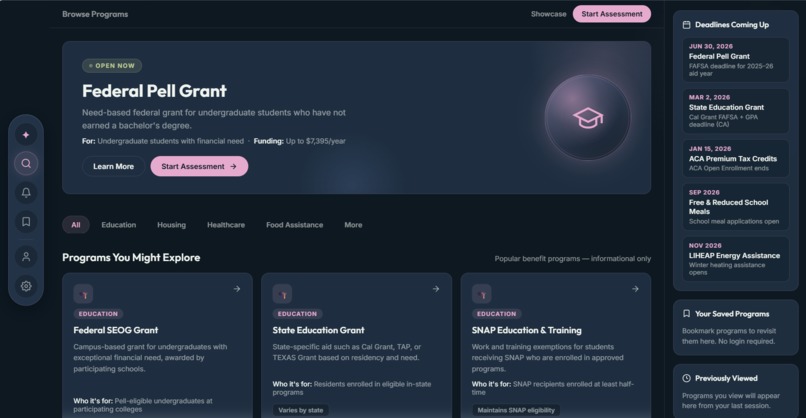
Dashboard
-
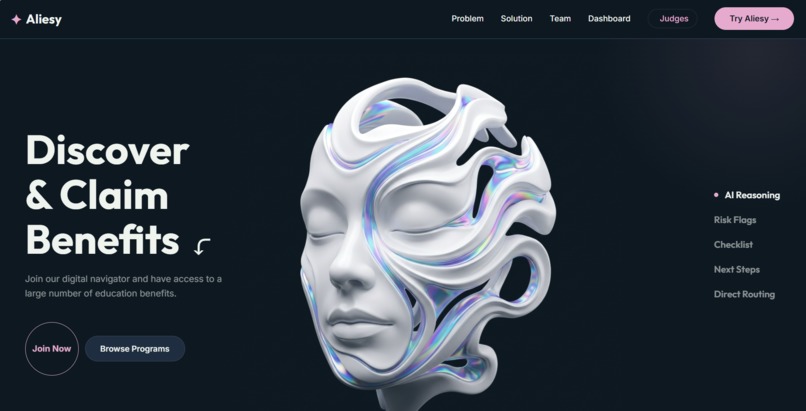
Landing page
-
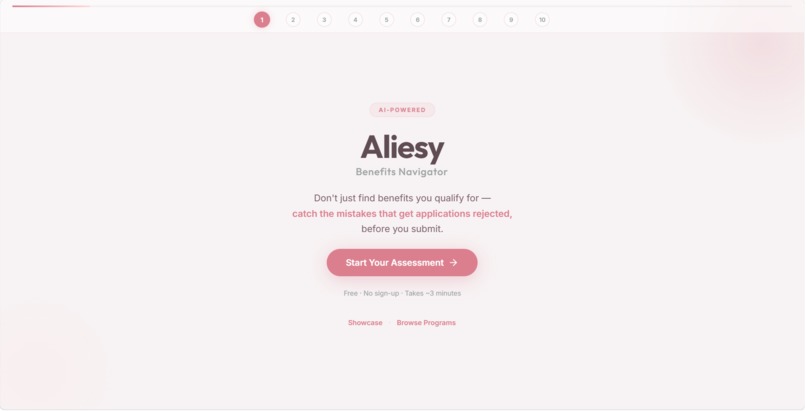
main app
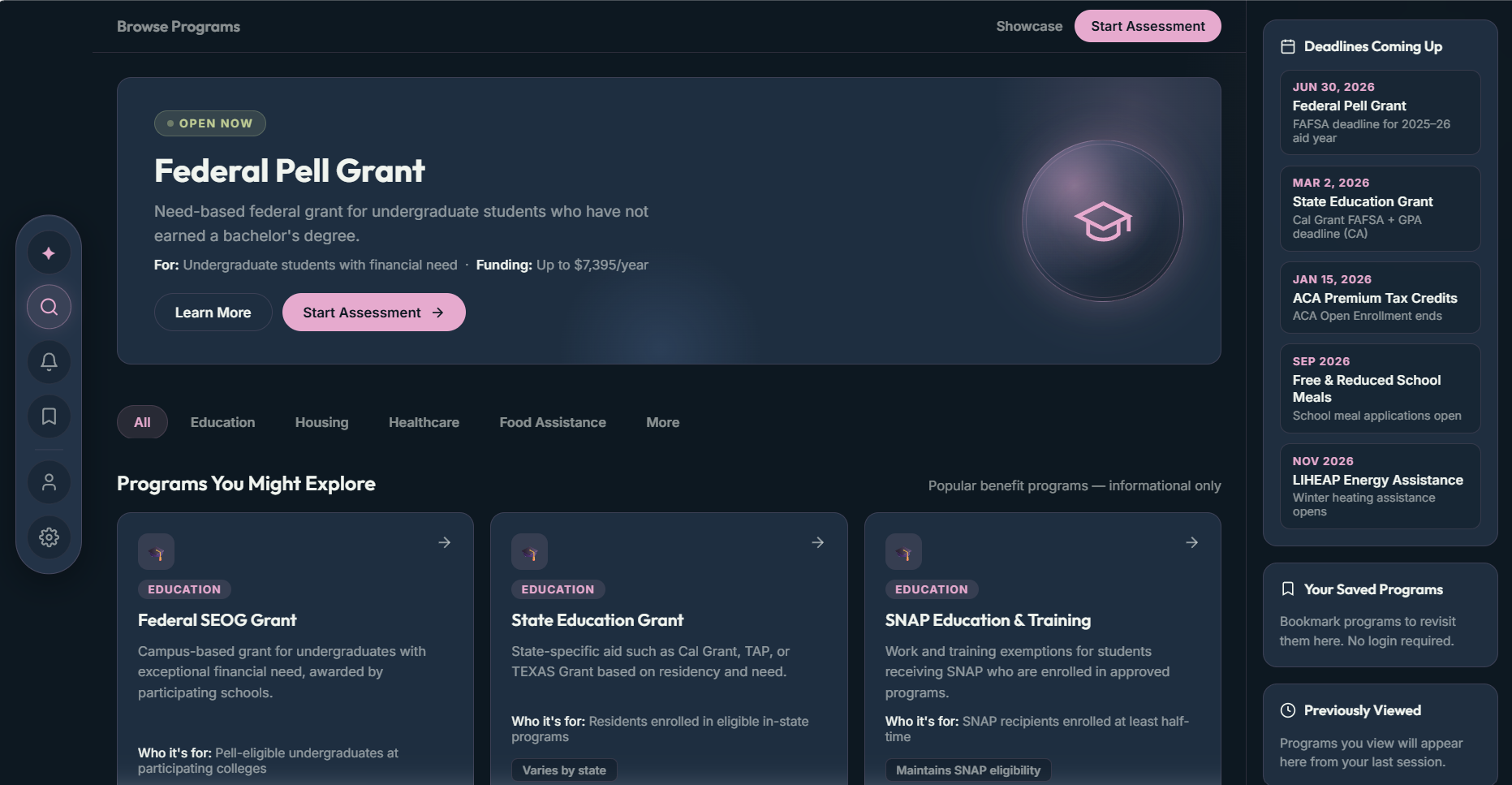
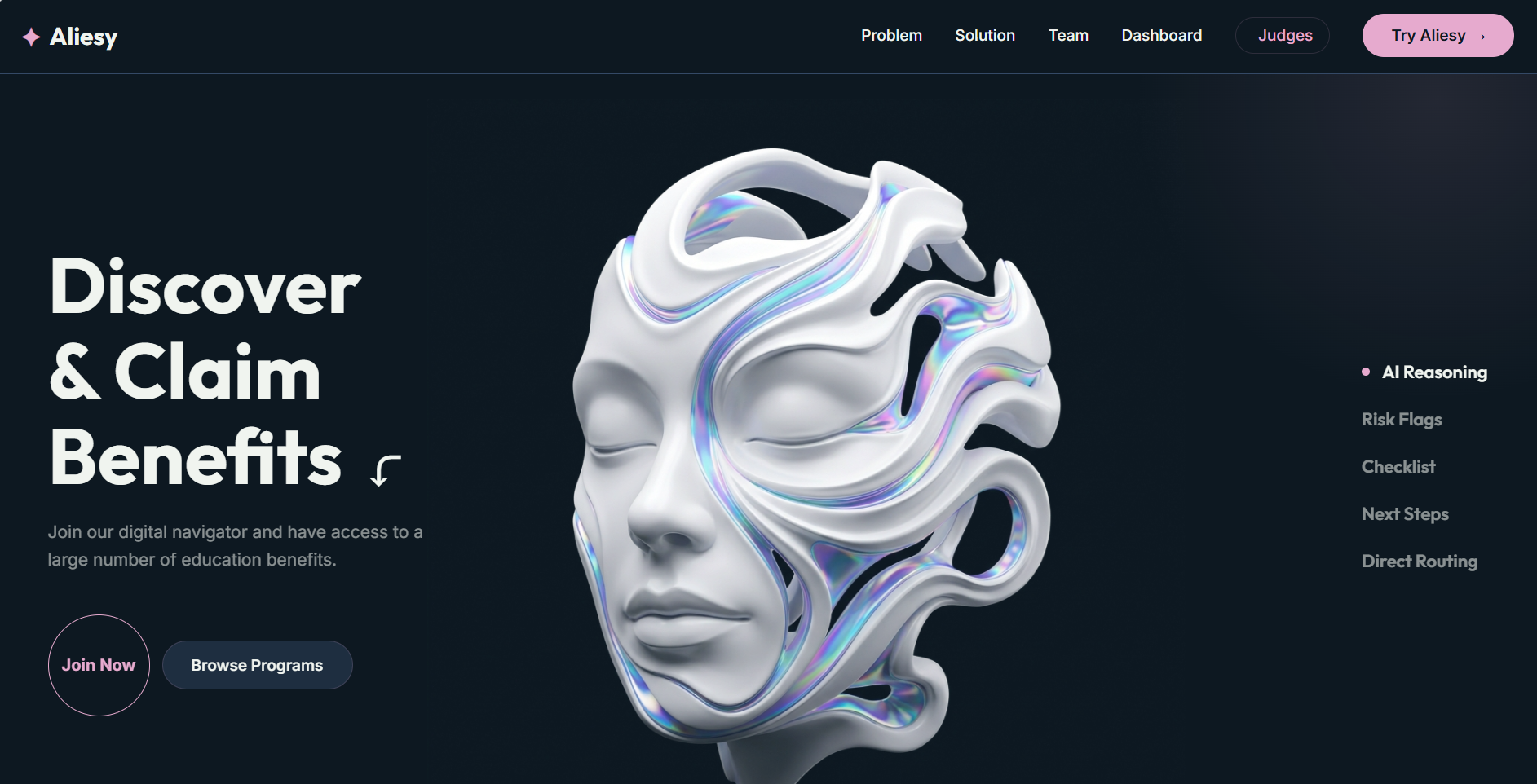
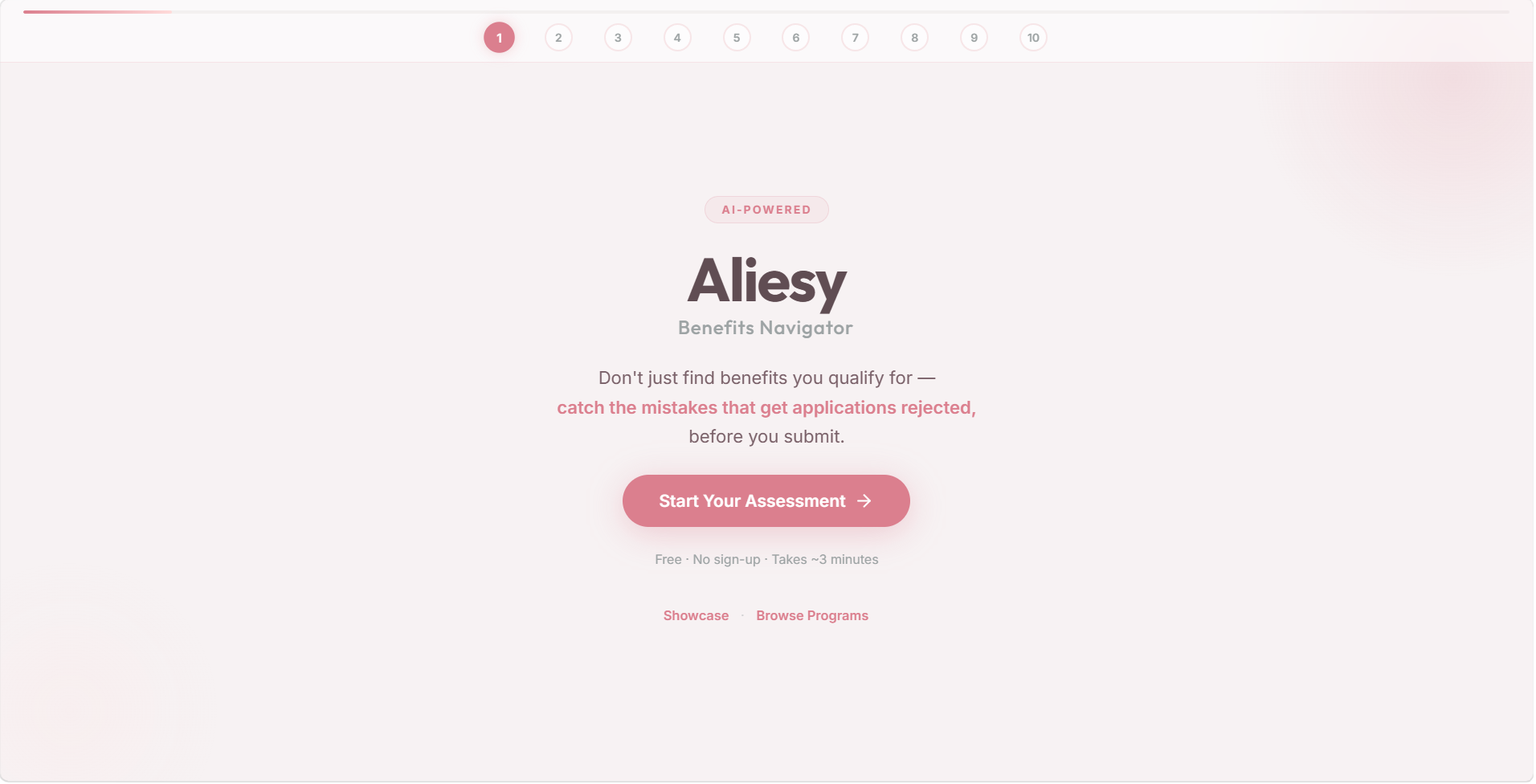
Aliesy — About the Project
Inspiration
Every year, people miss out on public benefits they're actually eligible for — not because the information doesn't exist, but because somewhere between knowing about a program and successfully applying, something goes wrong.
We started by testing an obvious assumption: "people just need a tool to find and explain schemes." But when we ran that against existing solutions — ChatGPT, Gemini, government benefit-finder portals — we realized that part is already solved. Discovery exists. Summarization exists.
What broke our assumption was a real scenario: someone who knew the scheme, knew the office, had the right documents — and still got rejected. The reason wasn't a lack of information. It was a mismatch in interpretation: the applicant filled in 6 months of income (matching their certificate's validity), while the system expected an annual figure.
That's when the actual problem became clear: the gap isn't informational, it's interpretational — and it shows up exactly at the moment people are filling out forms, under stress, with no second chance.
What it does
Aliesy is a conversational AI Benefits Navigator focused on U.S. education assistance programs (Pell Grant, SNAP Education Waiver, state-level grants).
Instead of stopping at "you may qualify," Aliesy:
- Understands your situation through natural conversation — not a static form
- Shows its reasoning — which eligibility rules apply, which don't, and why (not a black-box yes/no)
- Estimates eligibility responsibly — always "you may qualify," never "you qualify"
- Flags personalized rejection risks before you submit — like tax-year mismatches, income reporting confusion, or name mismatches across documents — the exact kind of mistakes that get real applications denied
- Gives a tailored document checklist and concrete next steps with links to official sources
- Always routes to human help — Aliesy never makes the final decision
The core idea: most tools tell you if you qualify. Aliesy tells you why — and catches the mistakes that get applications rejected.
How we built it
Architecture — a deliberate 60:30:10 split between reasoning and execution:
- 60% Reasoning AI — Gemini 2.0 Flash handles natural language understanding (classifying the user's situation) and generates plain-language explanations of eligibility reasoning.
- 30% Agentic-assist — A deterministic local rules engine evaluates eligibility criteria (income thresholds, enrollment status, citizenship, state-specific rules) and a risk-detection layer flags rejection-prone patterns. Gemini turns these into personalized, readable warnings.
- 10% Direct routing — Instead of generating or fetching application forms ourselves (a real risk — government forms change by state and outdated copies cause the very rejections we're trying to prevent), Aliesy routes users to the correct official source (studentaid.gov, Benefits.gov, state portals).
Tech stack:
- Frontend: HTML, Vanilla CSS (glassmorphism design system), Vanilla JS
- Backend: Node.js + Express (proxy server — keeps the Gemini API key server-side, never exposed to the client)
- AI: Gemini 2.0 Flash
- Fallback: A deterministic rule-based engine that activates automatically if the API is rate-limited or unavailable — so the demo never breaks
- Deployment: Render
Why a dual-engine design? Eligibility logic is rule-based and auditable by design — not left to an LLM to "guess." The LLM's role is strictly natural language understanding and explanation, not deciding outcomes. This also means the app stays fully functional even under free-tier API rate limits.
Challenges we ran into
The biggest challenge wasn't technical — it was resisting the obvious idea. Our first instinct was "AI that finds and explains schemes for you." We spent significant time deliberately stress-testing that idea against what already exists in the market, and found it didn't hold up as meaningful differentiation. The harder, more useful problem — interpretation gaps and rejection prevention — only surfaced after we pushed past the surface-level read of the brief.
On the technical side, working within free-tier API constraints meant designing a fallback system from day one rather than bolting it on later, and being deliberate about where in the flow an LLM call was actually necessary versus where deterministic logic was more reliable and explainable.
What we learned
That "AI-powered" doesn't mean "AI does everything." The most defensible parts of Aliesy are the parts where we didn't use AI — the deterministic eligibility rules and risk-detection are auditable and explainable by design, not generated. AI's job here is understanding and communication, not decision-making — and being explicit about that boundary turned out to be both a responsible-AI requirement and a genuine product strength.
What's next for Aliesy
- Expand beyond education benefits into other high-friction domains (housing assistance, healthcare)
- Add multi-state rule coverage beyond our current pilot states
- Build a "community case manager" mode for case workers managing multiple applicants at once
- Integrate document verification (e.g., checking if a tax document's year actually matches the academic term being applied for)
Built With
- css
- express.js
- gemini-2.0-flash-api
- html
- javascript
- node.js
- render


Log in or sign up for Devpost to join the conversation.