-
-
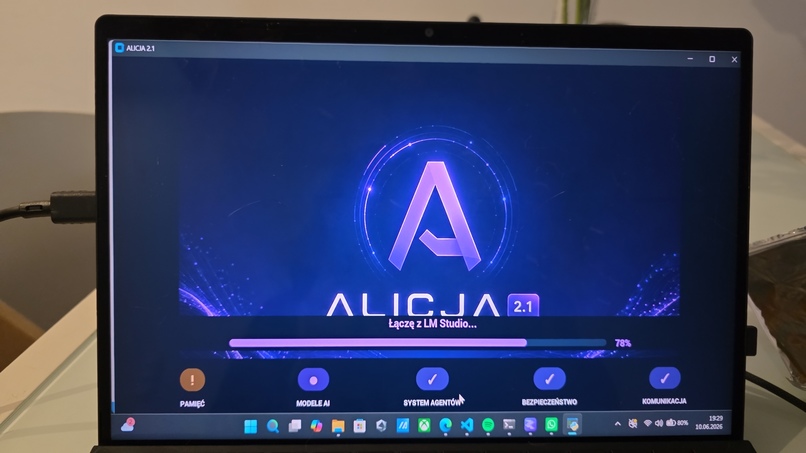
Starting to work
-
Alicja 2.1
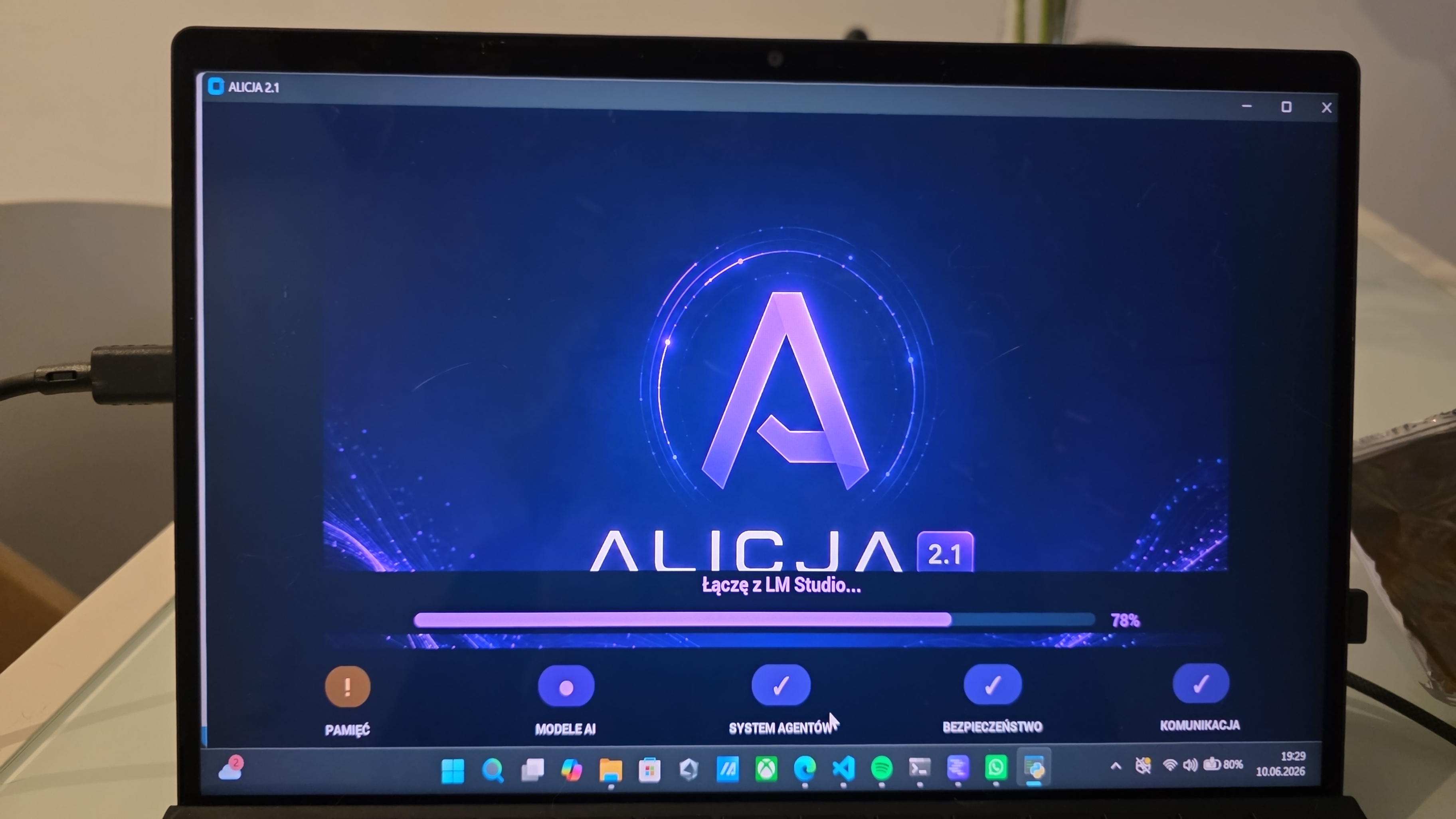
Alicja 2.1
Inspiration
Alicja 2.1 started with a frustration that many people experience when using AI tools today.
One application is used for conversations, another for programming, another for image generation, and yet another for documents, voice interaction or automation. Each tool works in isolation, with its own interface, context and limitations. Users repeatedly explain the same information, move data between platforms and lose valuable context along the way.
I wanted to build something different: one intelligent workspace that could bring these capabilities together while giving the user greater control over their data.
The idea behind Alicja 2.1 is not to create another chatbot. It is to create a personal AI assistant that can remember important context, understand different types of information, support everyday work and safely interact with the user’s digital environment.
Privacy was an important part of this vision from the beginning. Alicja can work with local AI models and local memory, while still allowing users to connect cloud-based services when they need additional capabilities.
What it does
Alicja 2.1 is a privacy-focused, multimodal AI assistant that combines local models, cloud AI services, long-term memory, voice interaction and automation within a single application.
Instead of depending on one model for every task, Alicja can select an appropriate processing path based on what the user is trying to accomplish. A simple conversation can be handled quickly, while more complex requests can use stronger reasoning, memory retrieval or specialized tools.
Alicja can:
work with local and cloud-based language models;
maintain long-term, structured memory about projects, preferences and previous decisions;
understand text, images, screenshots and documents;
support speech-to-text and text-to-speech interaction;
assist with programming, code analysis and technical problem-solving;
search documents using semantic indexing;
analyze computer processes, logs, resource usage and system events;
prepare messages and support workflows in connected applications;
use specialized AI agents for different types of tasks;
provide a consistent experience across desktop and mobile interfaces;
keep sensitive information local when the user chooses fully local execution.
The goal is to provide one place where users can talk to AI, search their own knowledge, automate repetitive work and receive assistance based on real personal context.
How we built it
Alicja 2.1 was designed as a modular system rather than a single monolithic application.
The platform separates the user interface, memory, model providers, automation tools, voice processing and system analysis into independent components. This makes it possible to improve or replace individual technologies without rebuilding the entire application.
The project uses technologies including:
Python for the core application and backend services;
FastAPI for service communication and integrations;
React and React Native for web and mobile interfaces;
local LLM inference through providers such as LM Studio, Ollama and llama.cpp;
external AI APIs when cloud processing is enabled;
SQLite and vector databases for structured and semantic memory;
speech recognition and text-to-speech models;
vision-language models for image and document understanding;
GPU acceleration for local inference;
agent orchestration for multi-step tasks;
controlled application automation;
automated testing and continuous integration.
A routing layer evaluates each request and determines whether it should use a fast conversational model, a standard response path, deeper reasoning, memory retrieval or a dedicated tool.
This helps balance response quality, speed and computational cost.
The memory system also combines several approaches. Structured facts are stored in a relational database, while semantic search makes it possible to retrieve information based on meaning rather than exact wording. Users can review, correct, archive or remove information instead of treating AI memory as an invisible black box.
Challenges we ran into
The main challenge was not connecting individual AI models. It was making many independent technologies behave like one coherent assistant.
Every provider uses different APIs, response formats, context limits and configuration options. Local models also behave differently depending on the available hardware, quantization and inference engine.
Some of the most demanding challenges included:
integrating multiple local and cloud AI providers;
reducing latency without sacrificing response quality;
designing reliable long-term memory;
distinguishing temporary conversation context from information worth remembering;
preventing duplicate, outdated or unsupported memories;
handling text, voice, images and documents within one workflow;
optimizing local inference for consumer hardware;
synchronizing desktop and mobile experiences;
building safe automation that does not perform sensitive actions without confirmation;
presenting advanced functionality through an interface that remains understandable.
Another major challenge was finding the right balance between privacy and convenience.
Cloud models can provide excellent quality and access to powerful services, but sensitive personal information should not automatically leave the user’s device. Alicja therefore follows a local-first approach while allowing optional external integrations when the user deliberately enables them.
Accomplishments that we are proud of
One of the biggest accomplishments is that Alicja has grown beyond a simple conversational prototype.
The current system combines:
local and cloud-based AI models;
structured and semantic long-term memory;
text and voice interaction;
image and document understanding;
application assistance and controlled automation;
system monitoring and log analysis;
proactive reminders and background assistance;
user-controlled privacy and security mechanisms.
We are particularly proud of the memory architecture. Alicja does not simply store conversation history. It extracts relevant information, associates facts with categories and relationships, tracks their source and gives the user tools to review or remove them.
We are also proud of the safety model used for automation. The assistant can prepare actions and recommendations, but sensitive operations require explicit user approval. Automation should save time, not take control away from the person using it.
The project also includes a large automated test suite and continuous integration, which has helped us develop new capabilities without constantly breaking existing functionality.
What we learned
Building Alicja 2.1 showed us that a useful AI assistant is not defined only by the size or benchmark results of its language model.
The experience around the model is just as important.
We learned that:
fast and predictable responses often matter more than maximum model intelligence;
memory becomes useful only when it is accurate, explainable and editable;
good routing can make smaller models feel significantly more capable;
privacy should be part of the architecture, not an additional setting added later;
users need to understand when an assistant is suggesting an action and when it is actually performing one;
modular systems are easier to adapt as new AI models appear;
local AI is already practical for many everyday tasks;
a simple interface is difficult to design when the underlying system is highly complex;
AI becomes much more valuable when it understands an ongoing project rather than only the latest message.
Perhaps the most important lesson was that trust is built through transparency. An assistant should be able to explain what it remembers, why it reached a conclusion and what it is about to do.
What’s next for Alicja 2.1
The next stage of the project is focused on turning Alicja into a more complete personal AI workspace while preserving user control.
Planned developments include:
collaboration between multiple specialized agents;
more advanced long-term memory and knowledge graphs;
improved reasoning and task-planning pipelines;
safer and more capable computer interaction;
AI-assisted software development workflows;
improved voice conversations and live assistance;
personalized learning based on user-approved information;
broader offline functionality;
enterprise deployment options;
a plugin architecture for external developers.
Future integrations may include:
WhatsApp Business;
Gmail and Google Calendar;
Microsoft Teams;
Slack;
Discord;
Telegram;
GitHub;
Jira;
Notion;
Microsoft 365.
The long-term goal is not to create an AI that replaces the user.
It is to build a trusted digital partner that can understand context, reduce repetitive work, organize knowledge and support people across work, creativity, learning and everyday life.
Alicja should become more helpful over time, but the user should always remain in control of their data, their decisions and the actions performed on their behalf.
Built With
- api
- chatgpt
- comfyui
- cuda
- fastapi
- github
- javascript
- nvidia
- onnx
- openai
- postgresql
- python
- qwen
- react
- rest
- runtime
- sqlite
- typescript
- whisper
- xtts-v2


Log in or sign up for Devpost to join the conversation.