Aliboard 3D was developed by one independent human creator working with a collaborative team of AI assistants. The human creator designed the system, set its direction, and made all final decisions, while AI supported the development process through programming, analysis, testing, and content preparation. Throughout this description, “we” refers to this human-AI team.
Inspiration
Most AI design tools follow a one-way model: a user gives a command, and AI immediately generates a result. We wanted to explore a different approach — a shared workspace where humans and AI understand the same 3D scene, propose changes, and create together while the human remains in control.
Aliboard 3D grew from PolubiszTo.pl, a larger online education platform, and its collaborative whiteboard technology. We extended this concept beyond a traditional 2D board to create a foundation for human-AI collaboration in a shared 3D environment.
The way Aliboard 3D was developed reflects the same principle built into the product itself: AI proposes and supports, while the human sets the direction and makes the final decisions.
What it does
Aliboard 3D allows users to create and edit 3D objects through both direct manual interaction and natural-language instructions.
Axel, the integrated AI assistant, can:
- understand structured information about the current 3D scene,
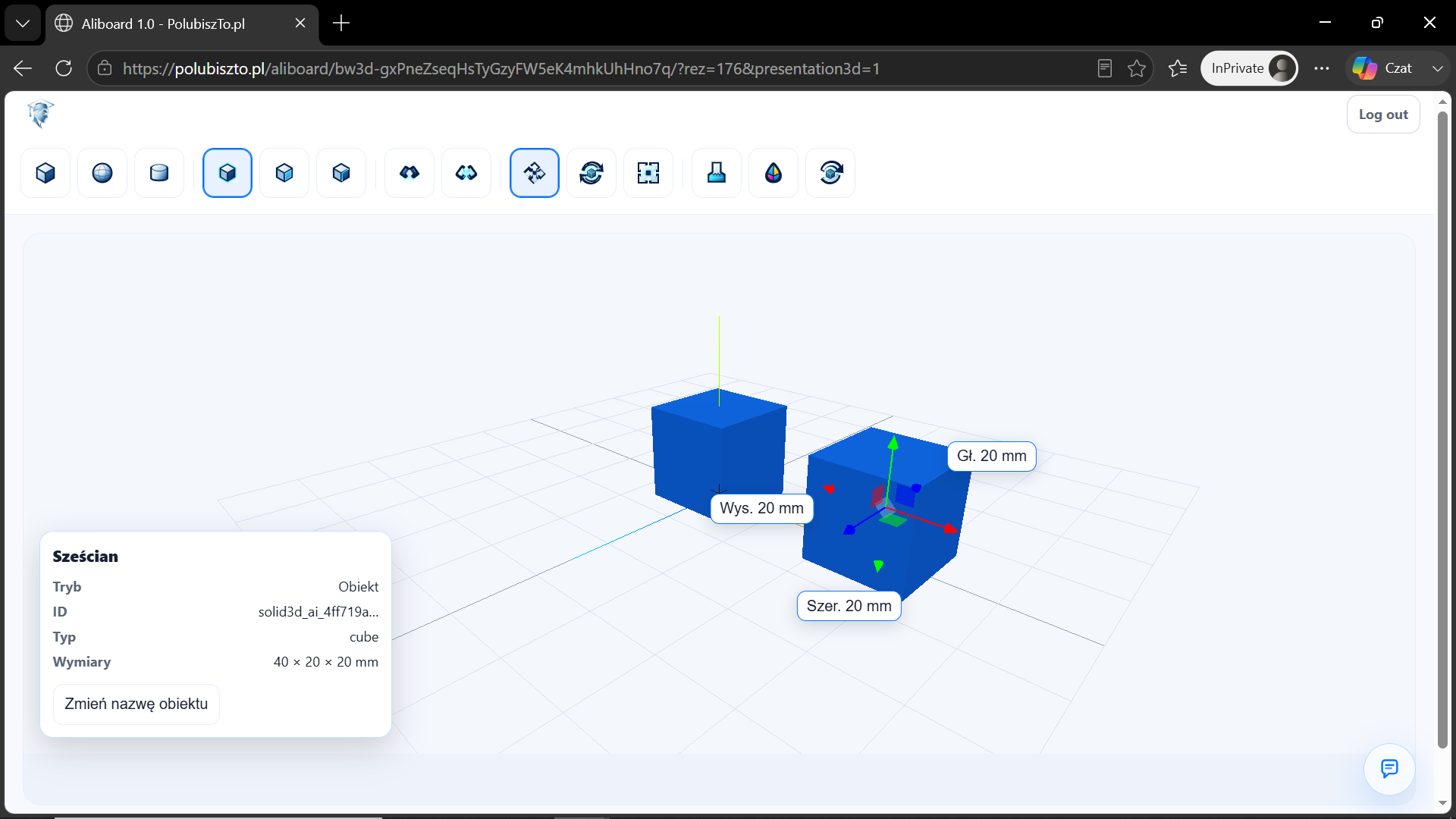
- create new objects with specified dimensions,
- use context from earlier instructions,
- position new objects relative to existing elements,
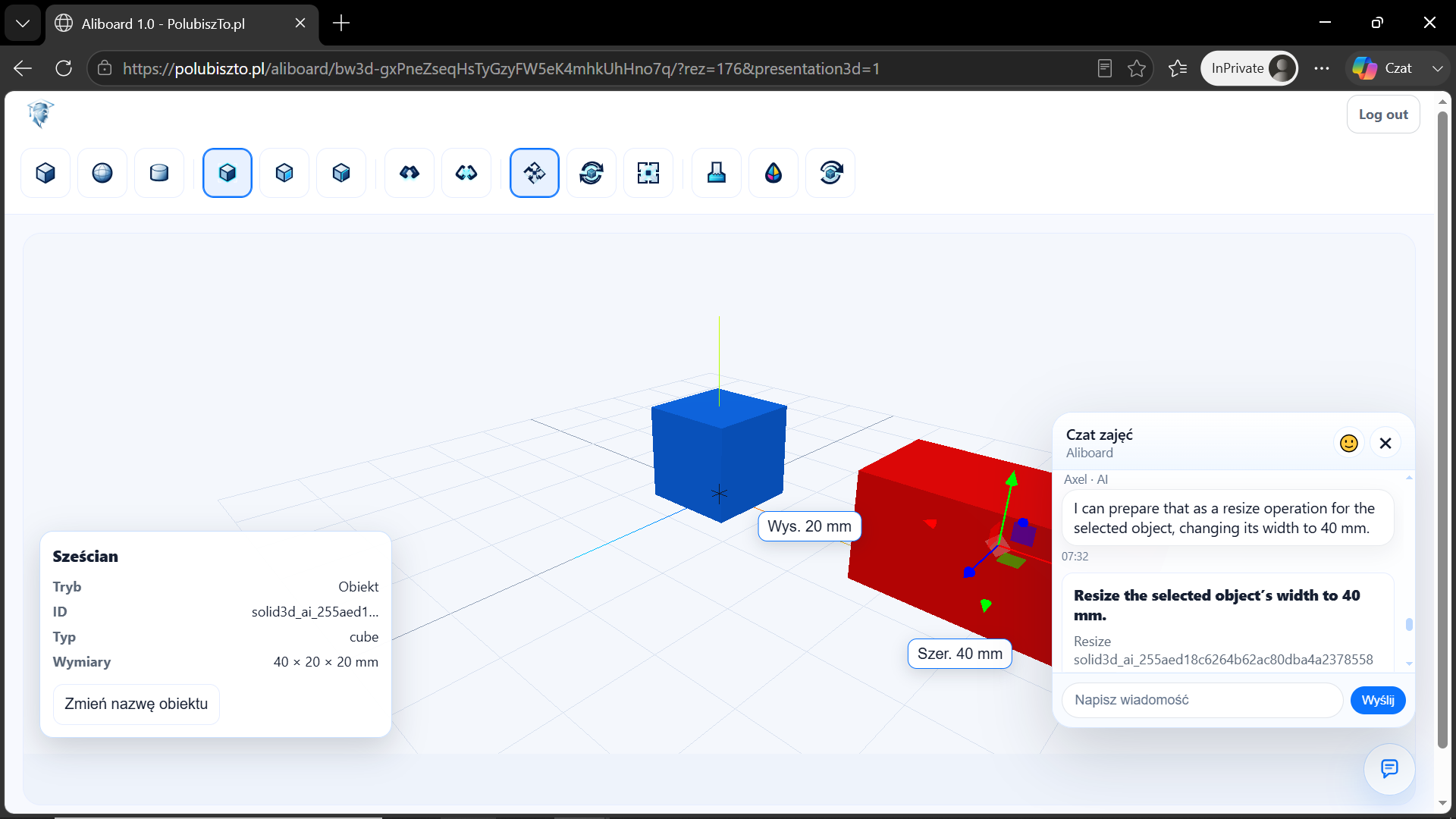
- change the colors and dimensions of selected objects,
- and report the current properties of objects in the scene.
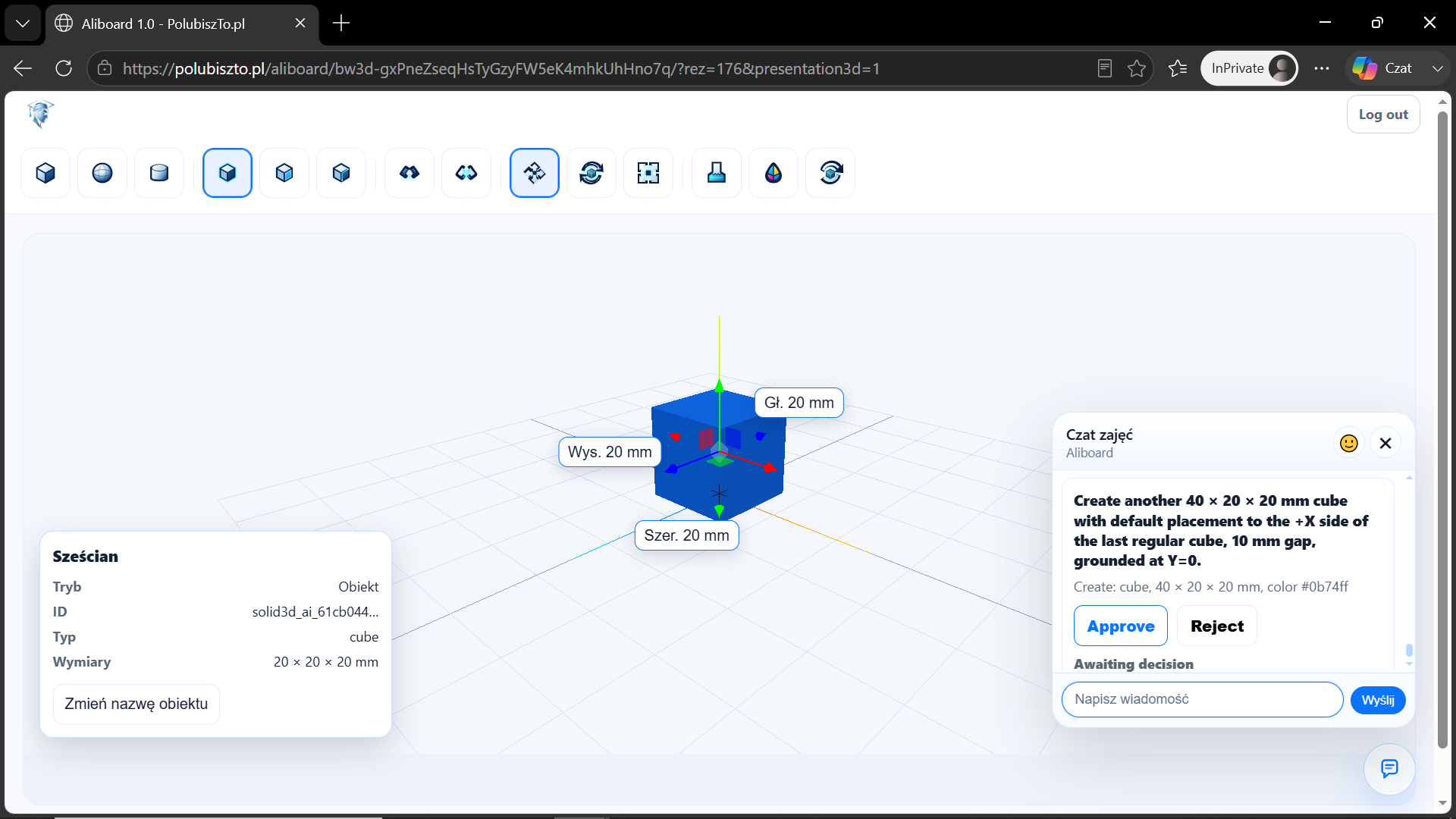
Before an AI-generated operation changes the project, Axel presents it as a transparent proposal. The user can review the requested action and choose to approve or reject it.
Only an approved operation is applied to the scene. If the proposal is rejected, the project remains unchanged. Objects created by AI also remain fully editable through the standard manual tools.
This creates a hybrid workflow: users can describe what they want in natural language, adjust the result manually, and then continue working with AI using the updated state of the scene.
Thanks to real-time operation-based synchronization, multiple users can join the same workspace from different locations, computers, or devices.
How we built it
Aliboard 3D combines:
- a browser-based 3D workspace,
- real-time operation-based synchronization with server-authoritative conflict control,
- direct manual object manipulation,
- an integrated chat interface,
- structured scene context for AI,
- and a controlled AI action layer.
Natural-language requests are interpreted and converted into structured operations. Before execution, each operation is validated and displayed to the user as a proposal. The scene changes only after explicit human approval.
Axel also receives structured information about the current state of the workspace. This allows it to reason about existing objects, selected elements, dimensions, colors, and earlier operations instead of responding without scene context.
After a manual or approved AI-assisted change, the updated state can be read again by Axel. This means that manual editing and AI assistance are not separate workflows — they operate on the same project.
The system is integrated with a Django-based platform and uses real-time communication to synchronize users, 3D objects, and AI-assisted changes.
The project was developed through a human-AI collaboration process. The human creator defined the architecture, product vision, requirements, and final implementation decisions. AI assistants supported programming, debugging, analysis, testing, and the preparation of project materials.
Challenges we faced
One of the main challenges was giving AI enough information to understand the scene without allowing it to modify the project unpredictably.
We solved this by separating AI reasoning from execution. Axel can interpret a request and prepare an operation, but it cannot silently apply the proposed change. The user must first approve it.
Another challenge was combining three different ways of working:
- direct manual editing,
- AI-generated operations,
- and real-time collaboration between multiple users.
All of them had to operate on the same synchronized scene without losing consistency between participants.
We also had to separate the existing 2D and new 3D collaborative environments. Each workspace needed to manage its own data, state, pages, rendering, and synchronization safely without interfering with the other.
An additional challenge was building a system in which AI understands not only the user’s latest message, but also the current project state and the context of earlier operations.
What we learned
We learned that meaningful human-AI collaboration requires more than generating objects from prompts.
For AI to become a useful creative partner, it must:
- understand the current context,
- explain the operation it intends to perform,
- allow the human to review that operation,
- respect rejection,
- and continue working from changes made manually by the user.
We also learned that real-time operation-based synchronization can provide a strong foundation not only for collaboration between people, but also for shared work between people and AI.
The development process itself reinforced this idea. One independent creator supported by a team of AI assistants can build and test a system that would normally require knowledge from several technical and creative areas — as long as the human remains responsible for direction, verification, and final decisions.
What's next
Our next goal is to expand Axel’s ability to understand more complex scenes and create advanced structures composed of multiple related objects.
We also plan to add:
- more 3D creation and transformation operations,
- deeper visual and spatial scene analysis,
- educational tools for teachers and students,
- collaborative project workflows,
- support for more complex technical structures,
- and AI-assisted analysis and improvement of existing designs.
In the long term, we want Aliboard 3D to become a shared environment where teachers, students, designers, technical specialists, and AI can build, analyze, and improve projects together.
Aliboard 3D is not intended to replace the human creator. Its purpose is to give people an AI partner that understands their shared workspace, prepares useful operations, and supports the creative process while leaving control in human hands.
AI proposes. Human decides. Together, they create.

Log in or sign up for Devpost to join the conversation.