-
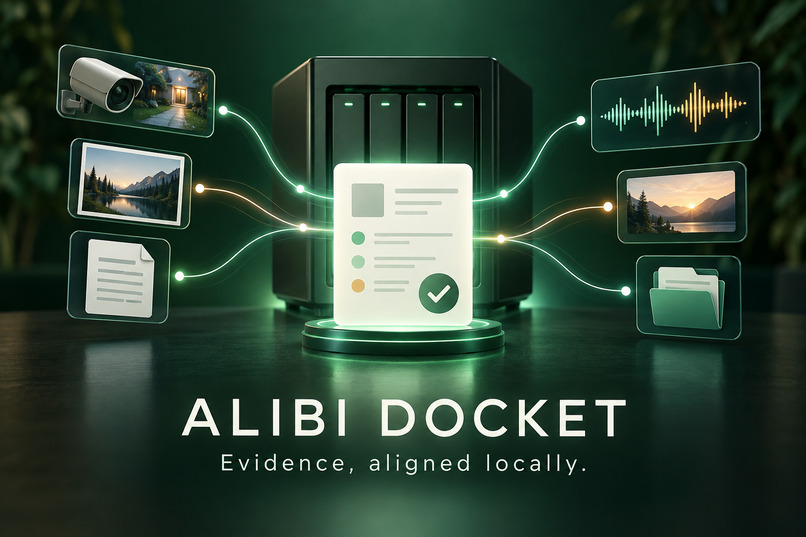
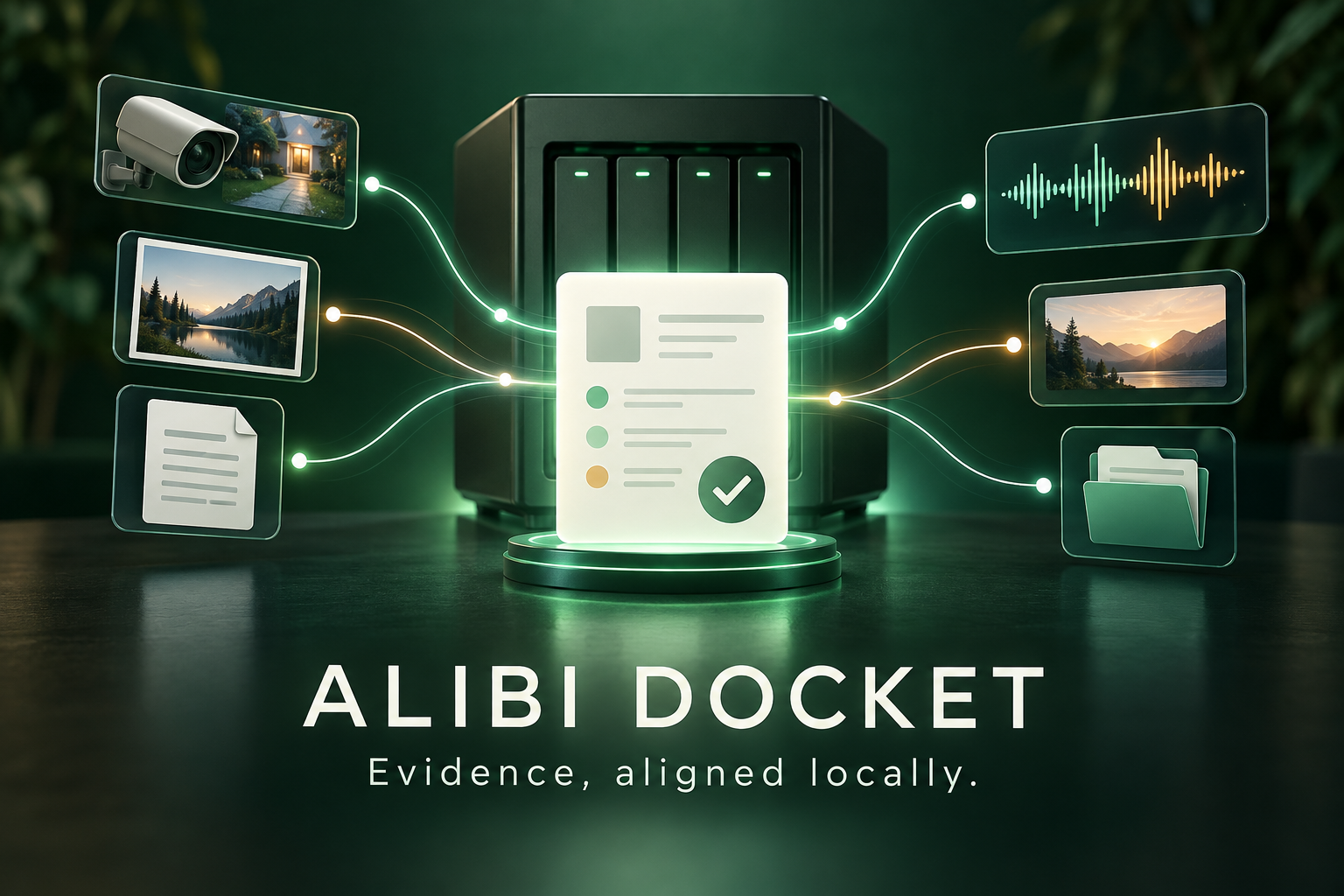
Alibi Docket correlates authorized NAS files, camera events, photos, documents, and recordings into a privacy-first evidence timeline.
Inspiration
When a delivery, property, warranty, or tenant dispute occurs, useful evidence is rarely in one place. A status PDF may claim one time, a camera may show another, a photo may have incomplete metadata, and a voice note may capture what happened afterward. Manual reconciliation is slow, privacy-sensitive, and easy to overstate.
Alibi Docket turns scattered, user-authorized NAS evidence into a conservative incident timeline without uploading private material to a general cloud service.
What it does
The Skill accepts a neutral claim, incident window, timezone, any known clock offset, authorized NAS paths and cameras, and an intended output location. It coordinates Uliya experts to:
- inventory candidate files and calculate SHA-256 fingerprints;
- query camera events only within the authorized scope;
- inspect photo metadata, OCR, and relevant visual details;
- extract and reconcile statements from documents;
- transcribe authorized recordings;
- build a chronological evidence matrix labelled CORROBORATES, CONFLICTS, or UNKNOWN;
- preview write effects and wait for approval before saving a summary or creating an album.
Alibi Docket never changes original evidence, treats missing camera events as missing evidence rather than proof, and does not make legal conclusions.
How we built it
The Round 1 deliverable is an original Markdown-only Uliya orchestration Skill created during this hackathon. Every operation maps to the official UGREEN capability catalog:
- ug-filesystem and ug-filemgr -> file-agent
- ug-surveillance -> security-monitor-agent
- ug-photo -> photo-agent
- ug-document -> document-agent
- ug-knowledge -> knowledge-agent
The parent Skill delegates self-contained instructions with fixed scope, negative conditions, expected outputs, and handling for completed, failed, cancelled, waiting_user, and waiting_approval. Three linked references define the evidence rubric, test walkthrough, provenance, privacy boundaries, third-party disclosures, and AI-assistance disclosure.
Verification and accomplishments
The official UGREEN uliya-skill-kit 0.7.3 checker reports static-pass with 0 errors and 0 warnings. This verifies package structure and orchestration rules only; it does not claim execution on UGREEN hardware.
Challenges
The hardest design problem was preventing plausible-looking evidence from becoming an unsupported conclusion. Timestamp provenance is therefore separated into camera-event time, embedded-media time, document statements, transcript statements, and weaker filesystem time. A file hash identifies a file but does not prove authenticity, truth, chain of custody, or legal admissibility.
A second challenge was coordinating multiple capability domains without bypassing user control. Read-only discovery happens first. Every write waits for explicit approval, and dependent steps stop when required upstream results are unavailable.
What we learned
A trustworthy evidence assistant needs stronger uncertainty handling than ordinary search or summarization. It must preserve the difference between an observation and a claim, distinguish an empty result from a contradiction, and expose partial results rather than filling gaps.
What's next
If selected as a finalist, testing on the assigned UGREEN AI NAS will validate runtime capability behavior, permissions, latency, camera query formatting, approval prompts, and output creation. Planned cases cover a synthetic courier dispute, a synthetic deposit audit, and an edge case with stripped metadata, a missing timezone, and disagreeing clocks.
Safety and disclosure
Synthetic test data only. No credentials or real personal information are included. No evidence is transmitted externally. OpenAI ChatGPT assisted with concept review, drafting, official-rule checking, package preparation, and this description. The entrant reviewed the submission and remains responsible for ownership, accuracy, submission, and finalist testing.
Built With
- computer-vision
- document-ai
- local-ai
- markdown
- ugreen-ai-nas
- uliya

Log in or sign up for Devpost to join the conversation.