Inspiration
Imagine you’re law enforcement. You’re investigating a crime. It’s 2026 so naturally the first thing you would look at are the devices of the suspects and victim. But that could mean dozens of phones and hundreds of thousands of records. We found that 70% of law enforcement agencies still do manual processing of device data, and it takes an average of 69h to complete this step.
Today's tools, like Cellebrite Pathfinder, present case data as a link chart; forming pairwise joins between any two data points. But significant patterns often involve several people at once:
- a message passed along three phones within minutes
- circular money flows
- a group acting in sync
- two people who never contact each other but meet often
Arlequin AI's work on topological neural networks (TNNs) gave us the answer. In a TNN, one relationship can join any number of entities, so multi-layer networks are formed between pairs and groups. That turns a flat link chart into a picture with several dimensions, where complex relationships involving several actors can emerge. We paired this with Arlequin's second principle: every result must trace back to its evidence.
What we built
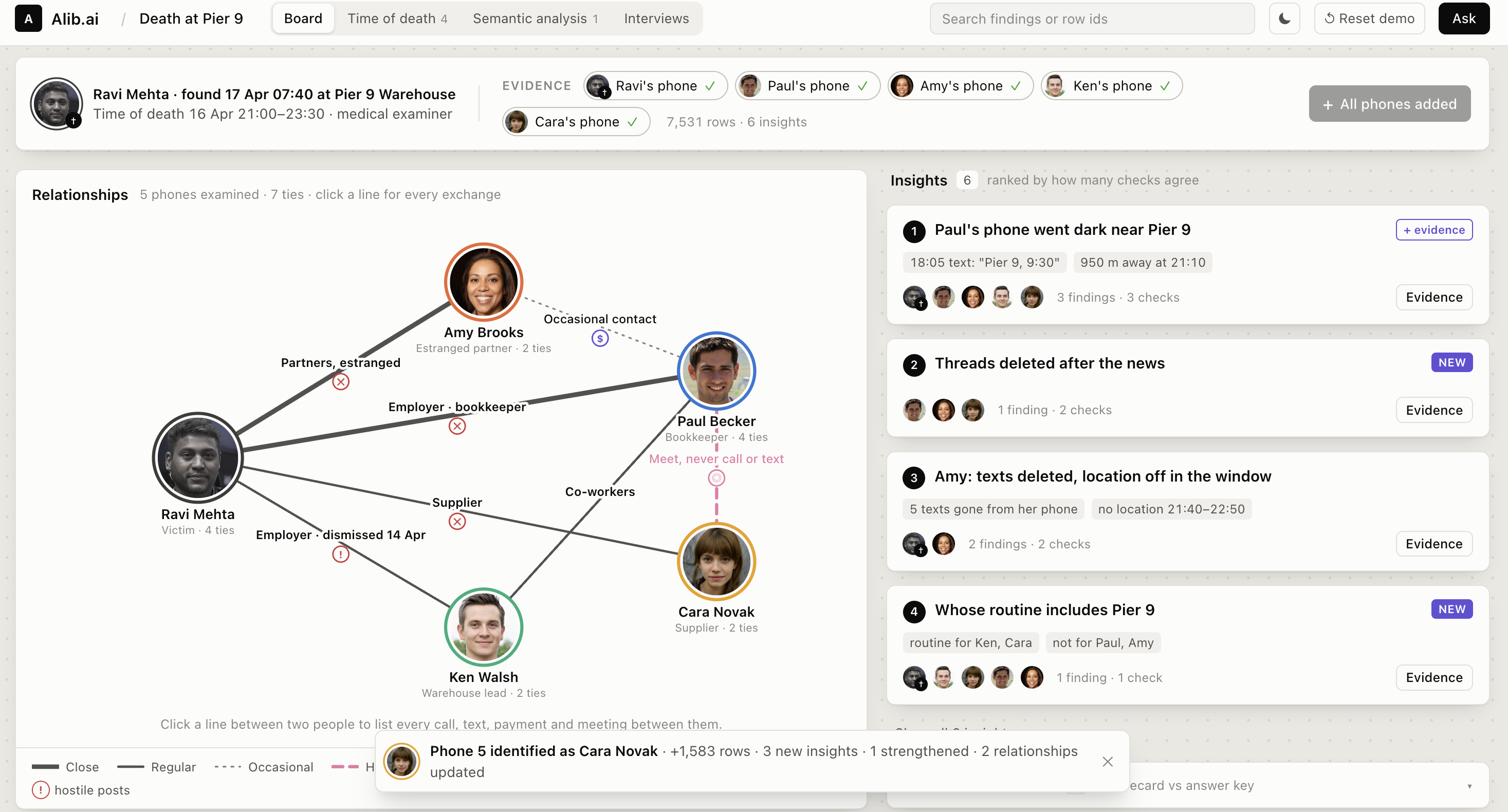
Alib.ai organises every data point in a case into one knowledge network, linking people, places, accounts and messages. It finds higher-order patterns that pairwise queries miss, without even being told what to look for. The story isn't on any single phone: it only appears when the data points connect, and those connections are rarely obvious.
Features:
- Relationship network. We map a knowledge graph of known actors based on the digital evidence uploaded. Relationships are weighted by how much they interact and labelled with their relationship.
- Data integrity check We cannot just treat the data as the ground truth. We crosscheck logs between devices to identify inconsistencies in the data itself, to ensure the trustworthiness of our knowledge graph. Red flags like deleted messages show up when we compare message logs between multiple phones.
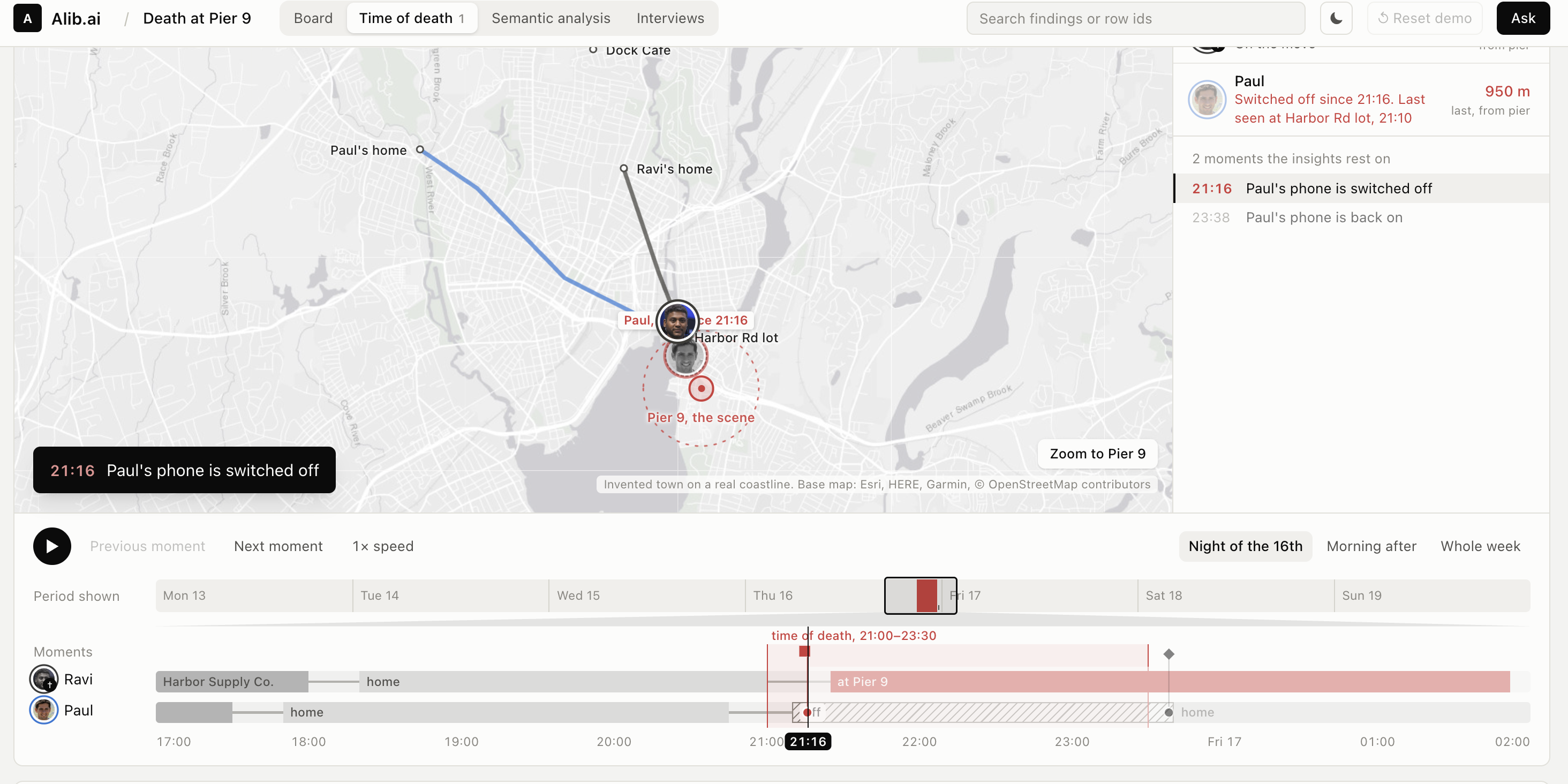
- Timeline mapper. This visualises evidence along 2 axes of location and time, helping investigators gain a mental model of suspects’ movements and activities.
- Semantic analysis. Everything people wrote is grouped into five themes (threats, grievance, arranging to meet, money, distress), with the matched words underlined and each person's tone tracked over the week. Tonal trends over time can be seen, and unrelated actors can be linked by common topics.
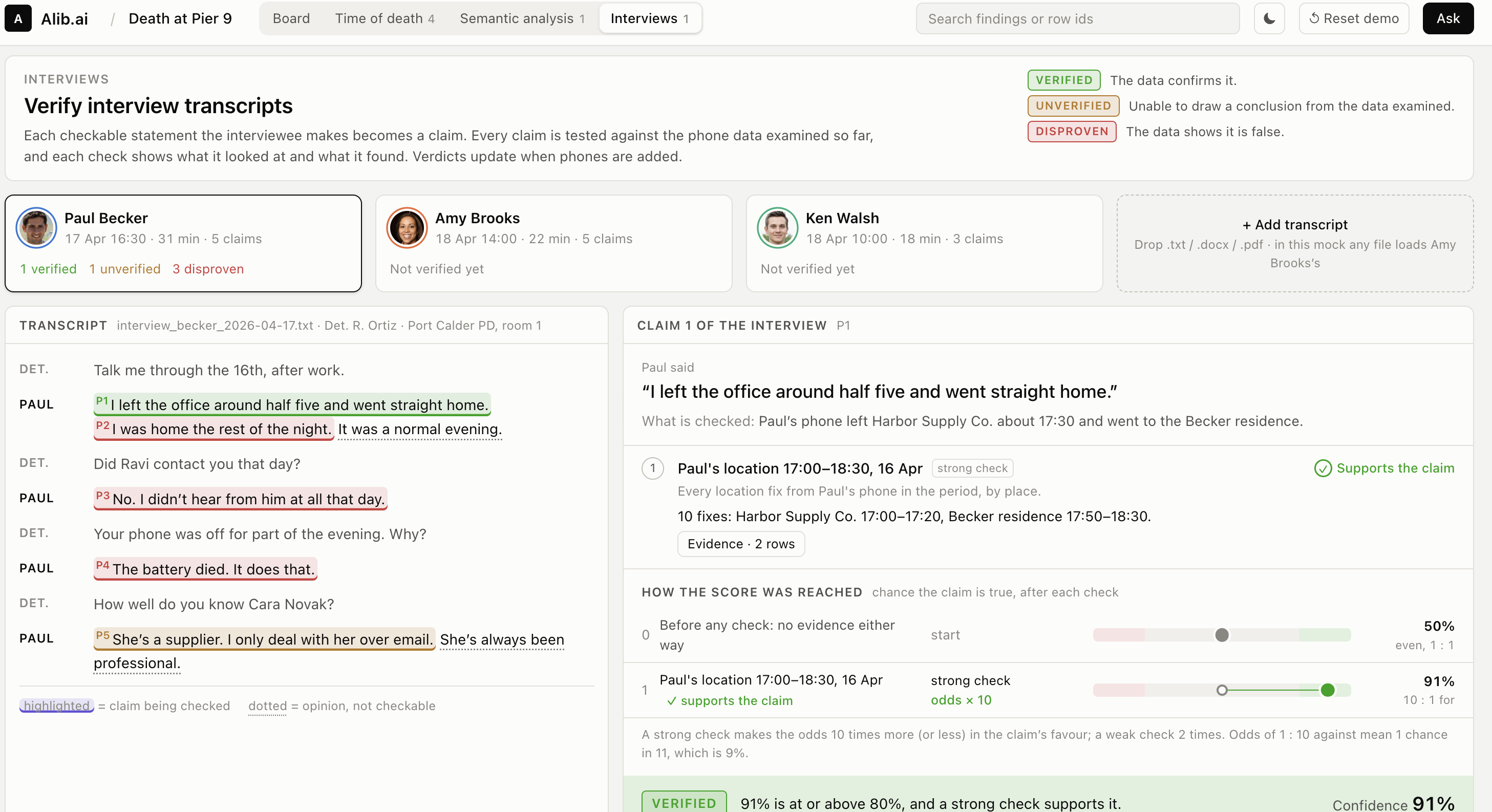
- Interview checking. Paste a transcript, and each claim is highlighted and checked against the phones. Each claim comes back verified, disproven or unverified, with a confidence score and the exact checks behind it.
How we built it
- Load: each phone is a Case Bundle: one file per record type, and every record keeps the file and line it came from.
- Data integrity check: code corrects clock offsets between phones and flags location jumps that would need impossible speeds, GPS that disagrees with Wi-Fi, and records present on one phone but missing from the other.
Find patterns (topological layer): we build the case into a combinatorial complex (TopoNetX) with three levels:
- entities: people, numbers, accounts, places
- pairs: calls, texts, payments, phones in the same place
- groups: three or more people active together, group chats, chains of payments
Features pass between levels through Hodge Laplacians with fixed weights: one TNN layer without training. An isolation forest with a fixed seed ranks the most unusual pairs and groups. Hodge decomposition exposes money moving in loops, and holes in the complex expose people who are closely tied but have no direct link. Each result is a lead, not a fact.
Verification: an orchestrator takes the leads, along with any claims or questions from the investigator, and splits them into tasks. A relationship-mapper subagent reads each lead and routes its check to one of five other specialists: location, messages, money, device events or social media. Each specialist sees only its own tools, so the orchestrator's context stays small. The specialists run plain, tested code checks against the records.
Data: NIST CFReDS, MSAB 2026 case. CFReDS is NIST's library of reference datasets for testing forensic tools and training examiners.
Challenges
- Finding the right problem. After four design versions, we moved from testing a detective's theories to showing them what they don't suspect.
- Scope. We put the weekend into what investigators see and trust first: the board, and the trail from every insight back to its records.
What we learned
- Real phone data is messier than any schema. Two phones from NIST's MSAB case held 2,370 databases between them. The iPhone counts time from 2001, its message text is buried in binary blobs, and the same Signal chat is readable on one phone but encrypted on the other. That's why we separated reading raw data from analysing it: everything converts to one standard format first.
- Use agents where they isolate context, not everywhere. We started with a report-writer agent and an auditor agent, then cut both. One had no tools of its own, and the other's job is done better by a validator in code. Subagents earned their place only where they keep thousands of records out of the orchestrator's context.
What's next
- A trained TNN: train a TopoModelX model on generated cases, compare it with the training-free version, then test it on a real case.
- Measure it: test against a plain AI chatbot on the same cases, counting clues found and mistakes made.
- More sources: bank records, flock logs and forensic lab reports.
Built With
- langchain
- react
- typescript

