-
-

Ali is already waiting on Galata Bridge—the first step into a ten-stop journey through Istanbul, language and hospitality.
-
Ten Istanbul stops
-
Your first Turkish
-
Adventure Map
-
Culture in context
-
Explore Istanbul
-
Into Ali's pocket
-
Practice with Ali
-
Pocket to paper
-
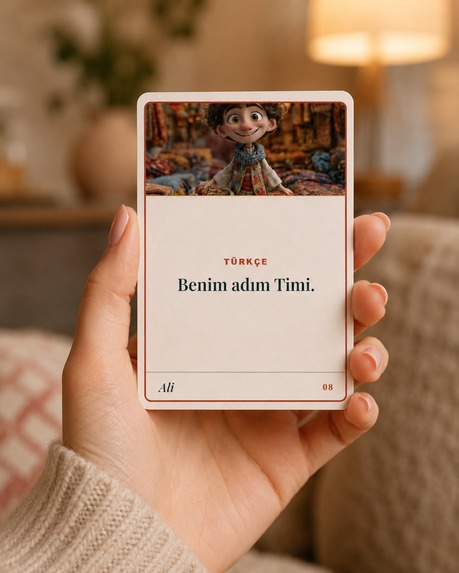
Into your pocket

Inspiration
Most language products begin with a curriculum: choose a level, complete a lesson, remember more.
Ali began with a different question:
What can stay with us after the browser is closed?
For many first-time travelers, speaking a new language is not primarily a knowledge problem. It is a confidence problem. They may know a few words, yet still feel like outsiders when the moment to speak arrives.
I wanted to create an experience where Turkish is attached to a place, a decision, a relationship, and a memory. That idea became Ali — The Turkish Companion.
Ali is not a teacher, chatbot, influencer, or traditional tour guide. He is a welcoming local companion. The visitor is not treated as a student or customer, but as a guest.
The initial experience was designed for Hungarian travelers and curious learners, while its architecture can later support additional interface languages and audiences.
What it does
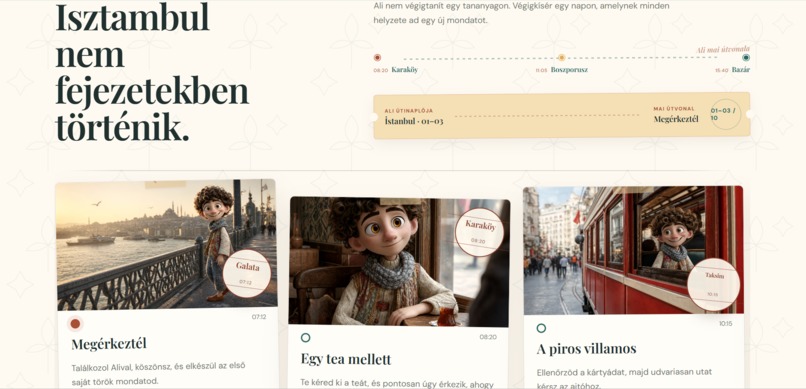
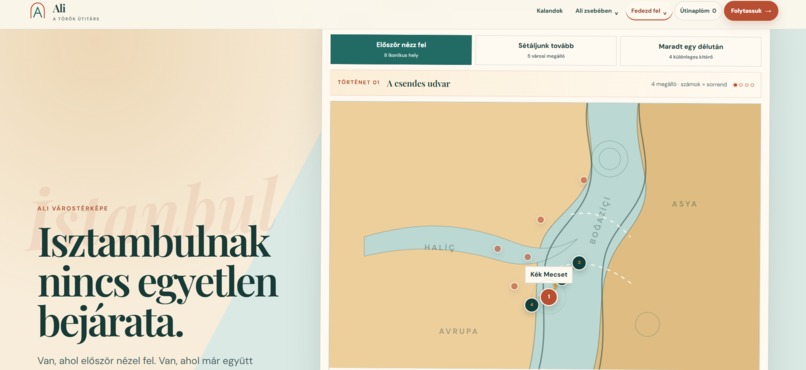
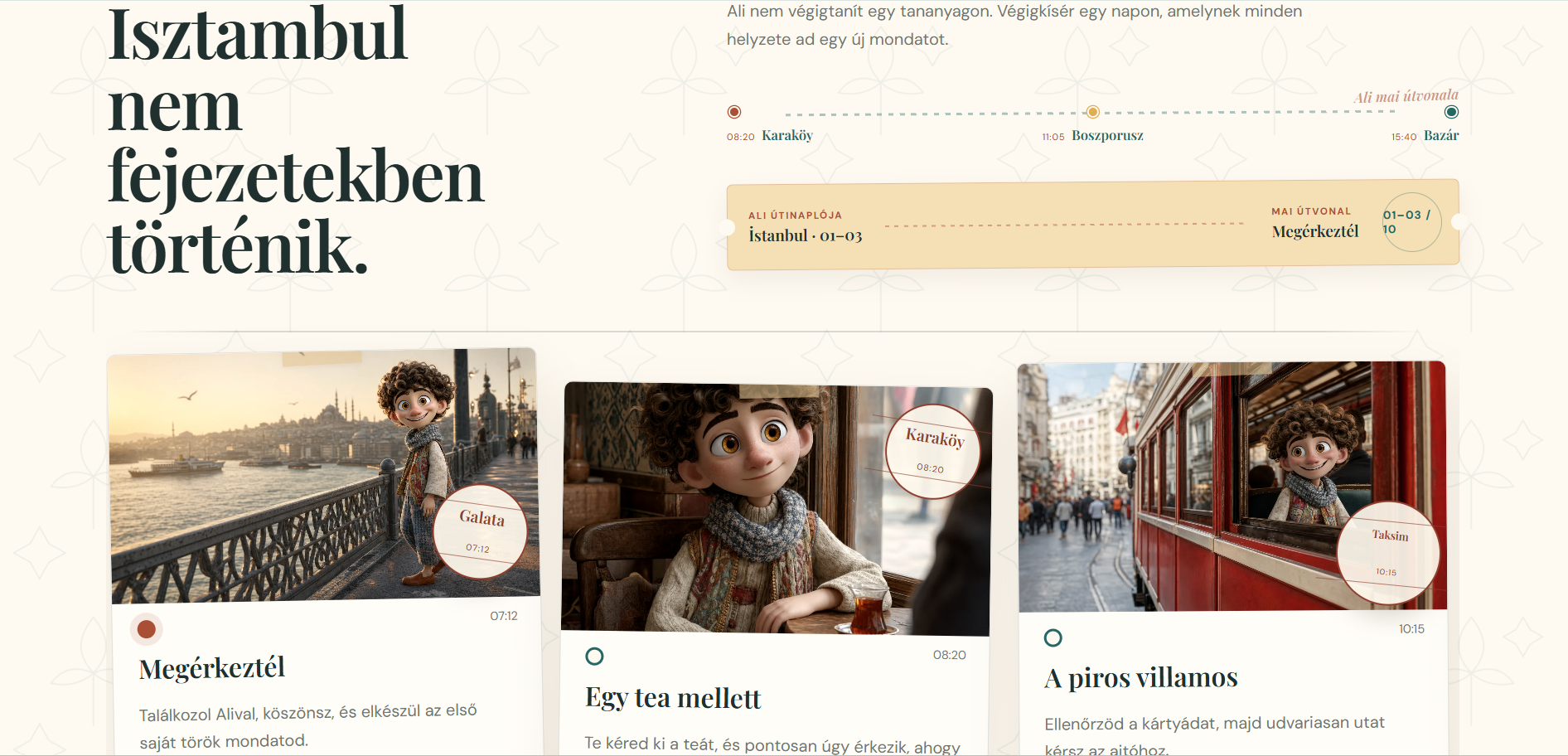
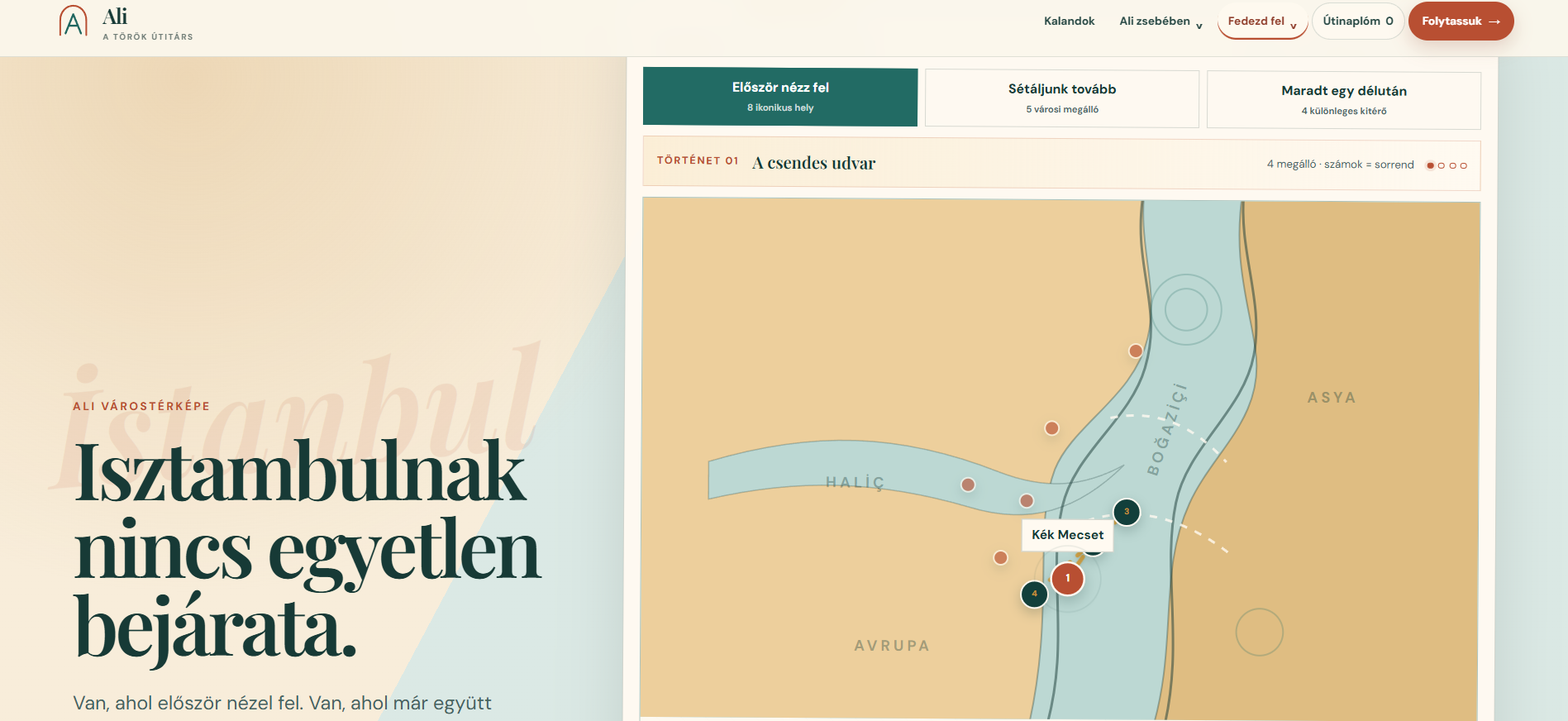
Ali welcomes the visitor into a ten-stop journey through Istanbul.
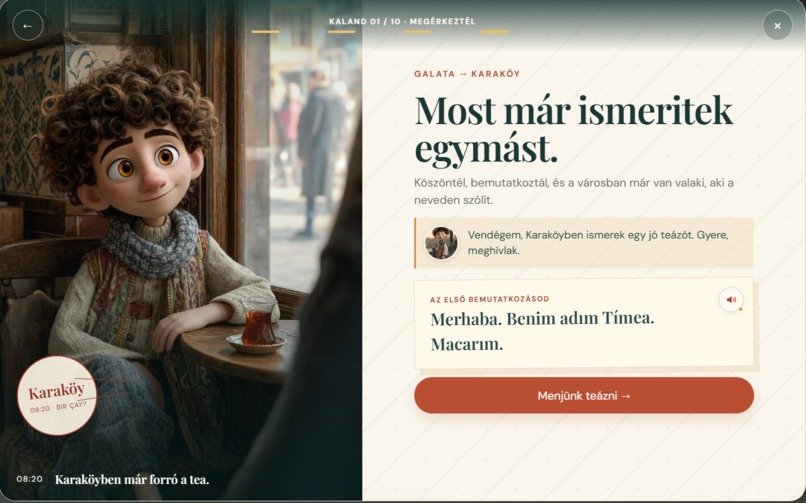
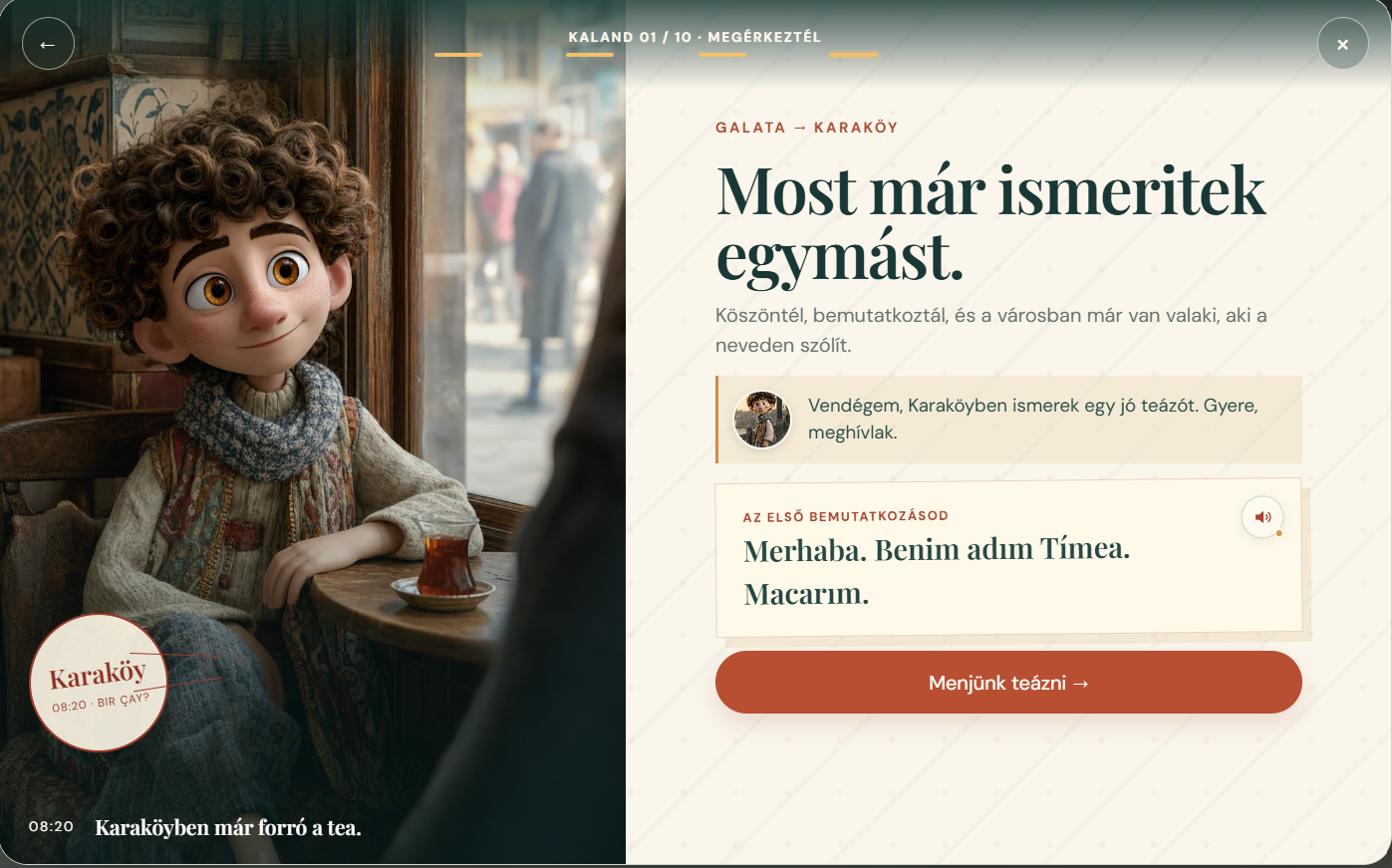
You introduce yourself on Galata Bridge, order tea in Karaköy, take the nostalgic tram, cross the Bosphorus, experience sunset in Üsküdar, order simit, enter a mosque courtyard respectfully, bargain in the Grand Bazaar, rest in Gülhane Park, and eventually invite Ali to continue the journey with you.
The progression is emotional as well as linguistic:
- the visitor begins as an observer;
- Ali first provides support;
- the visitor starts making choices and speaking;
- Ali gradually steps back;
- at the final stop, the visitor becomes the initiator.
There are no points or conventional “lesson completed” screens. Instead, Ali reflects what the visitor has already accomplished in Turkish: arriving, finding the way, connecting with people, making decisions, and speaking independently.
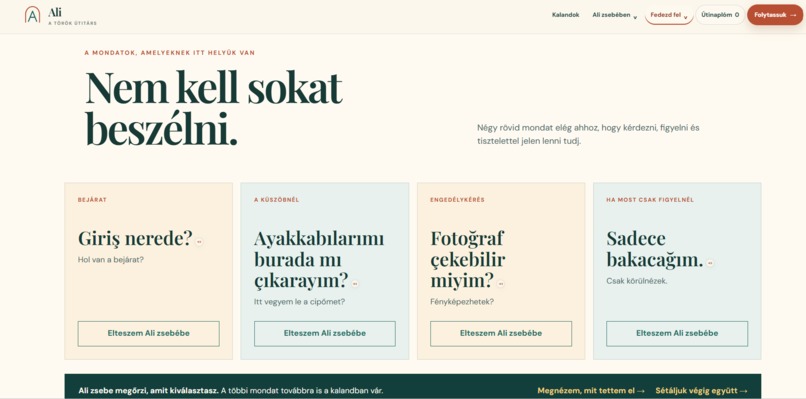
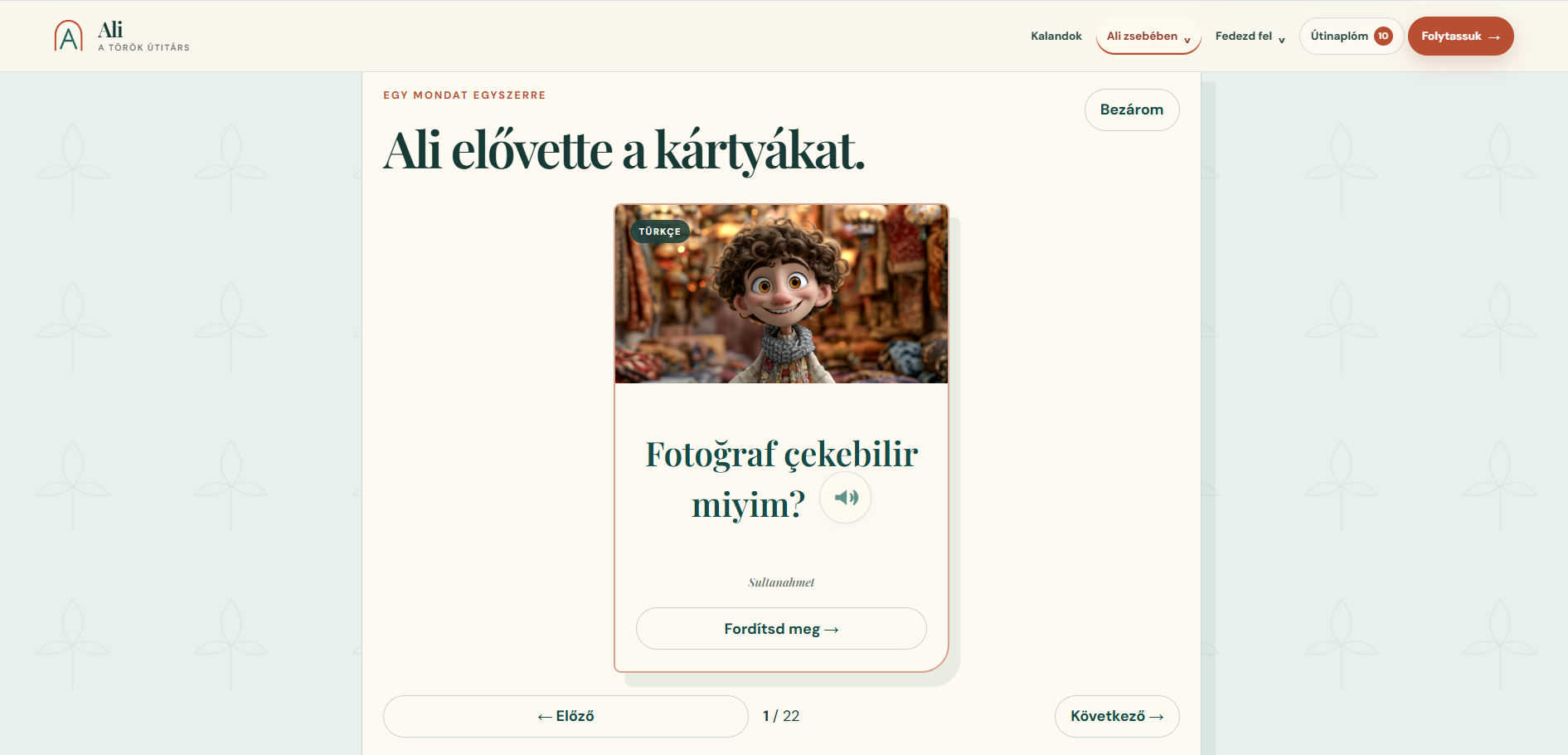
Choices persist across the journey and become part of a personal travel journal. Expressions that matter to the visitor move into Ali’s Pocket, where they can be:
- marked as still being practised or already familiar;
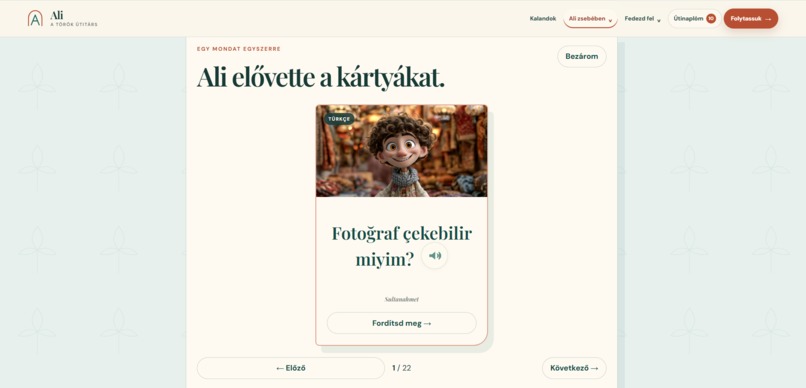
- reviewed with two-directional digital flashcards;
- selected for a personal learning deck;
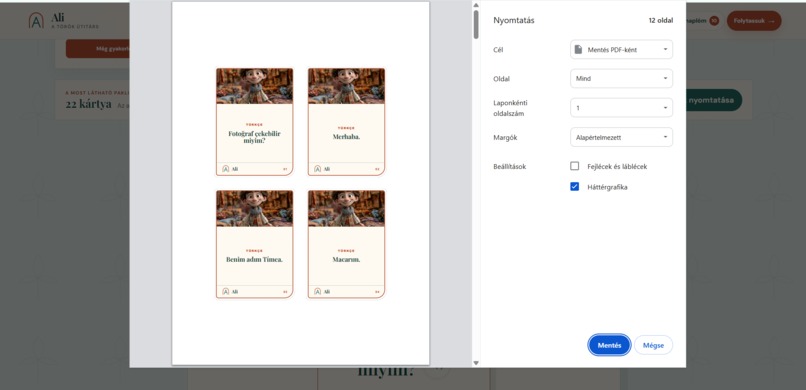
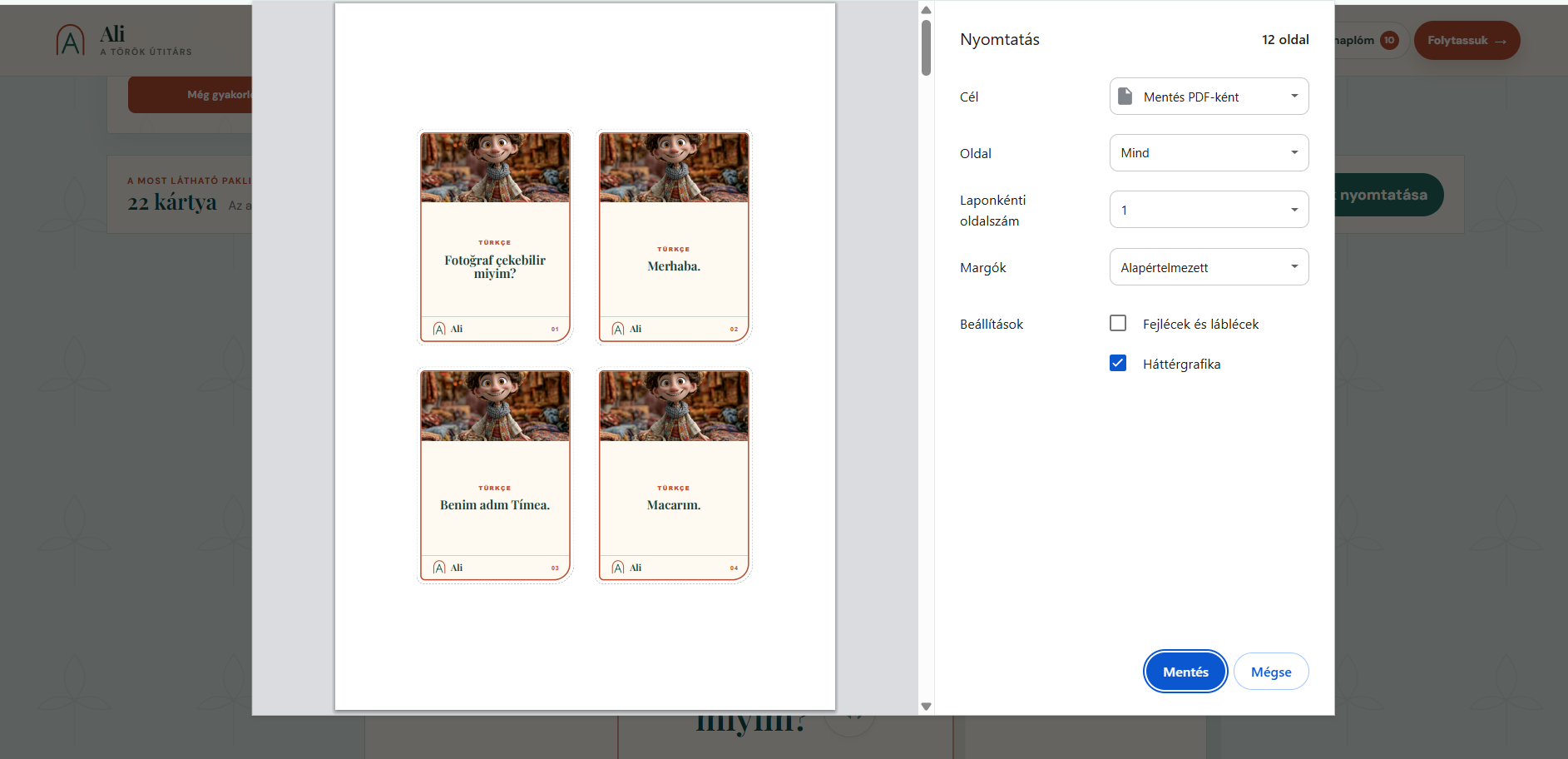
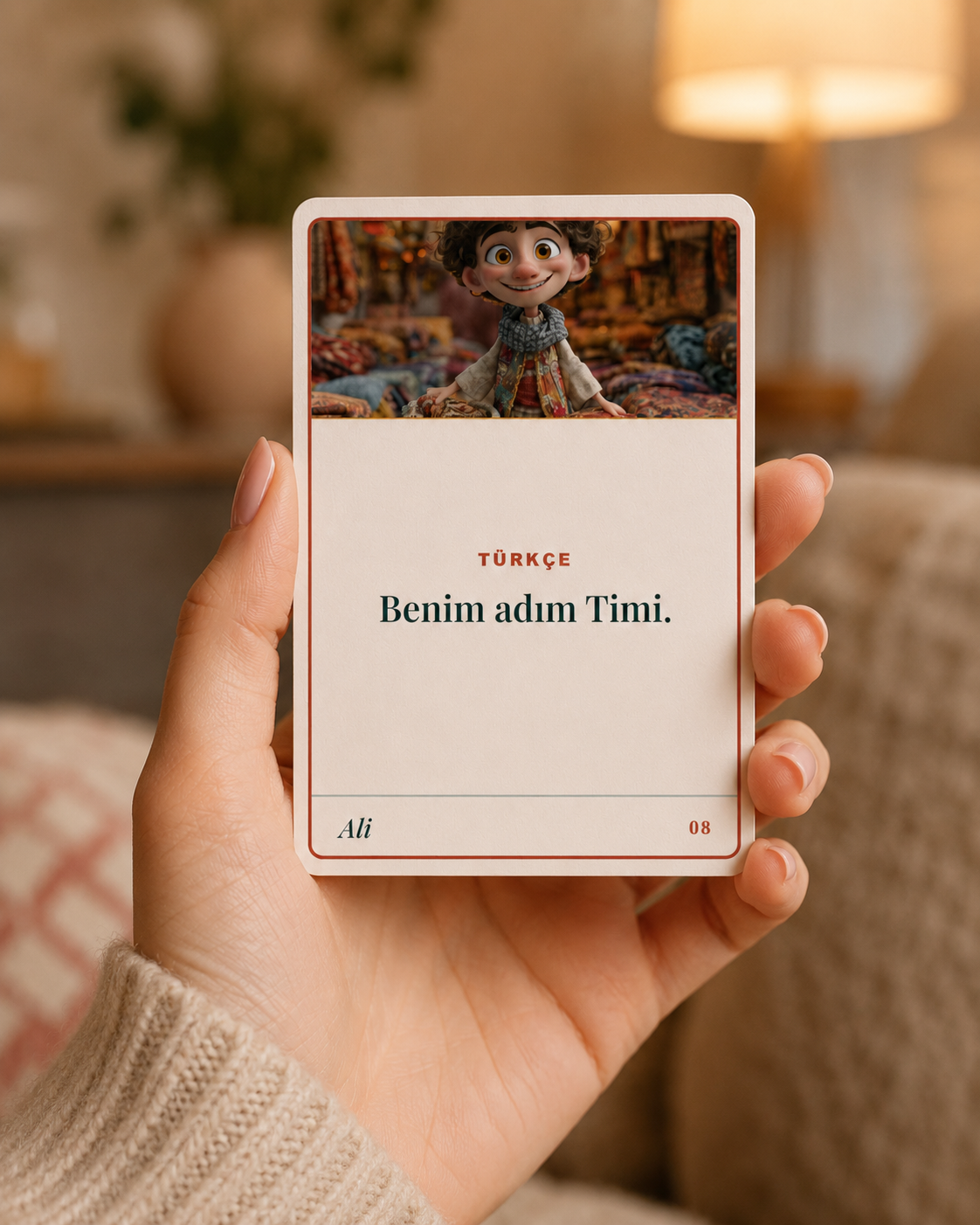
- printed as duplex 63 × 88 mm physical cards.
What moves from Ali’s pocket into yours stays with you after the browser is closed.
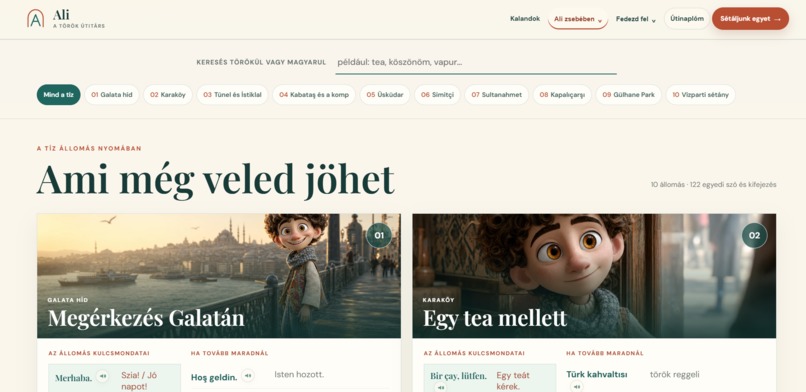
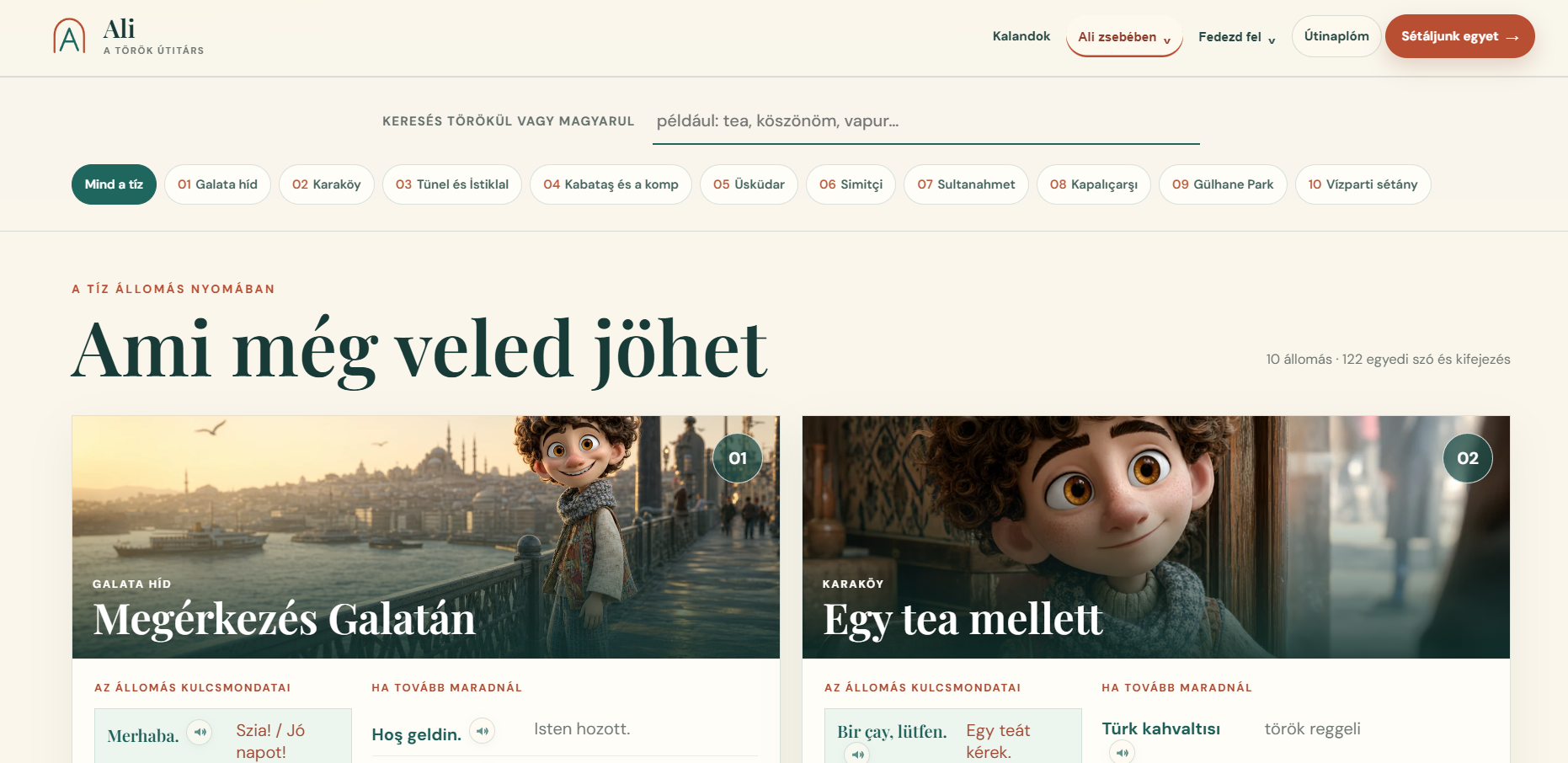
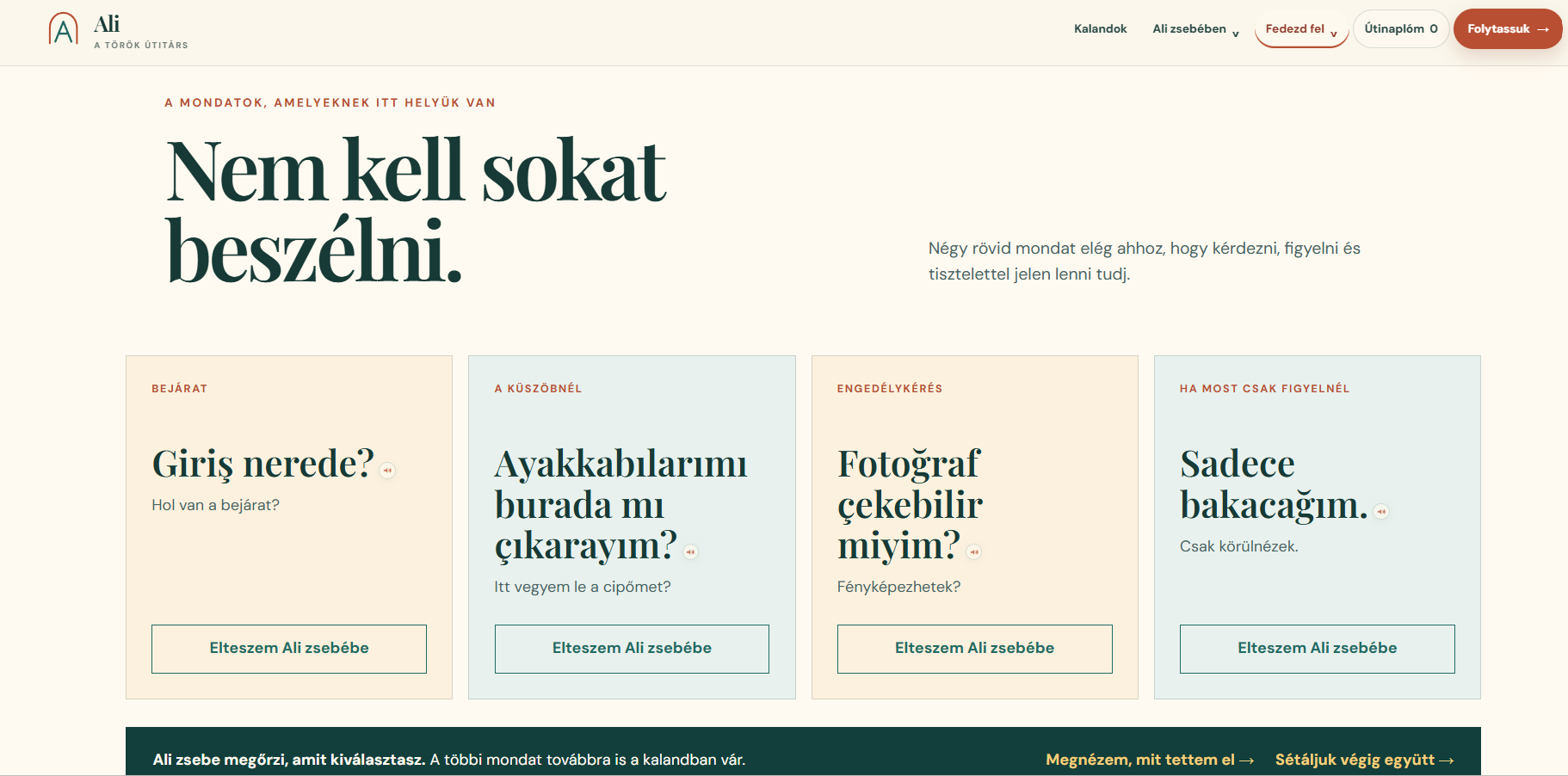
The first journey also opens into a searchable situation-based knowledge experience. Instead of choosing a grammar chapter, the visitor chooses what they want to say.
The underlying Ali Adventure Knowledge Map contains 1,574 processed language elements structured around ten real-life situations. It connects Turkish expressions, Hungarian meanings, locations, user decisions, story branches, search, saved learning states, and printable outputs.
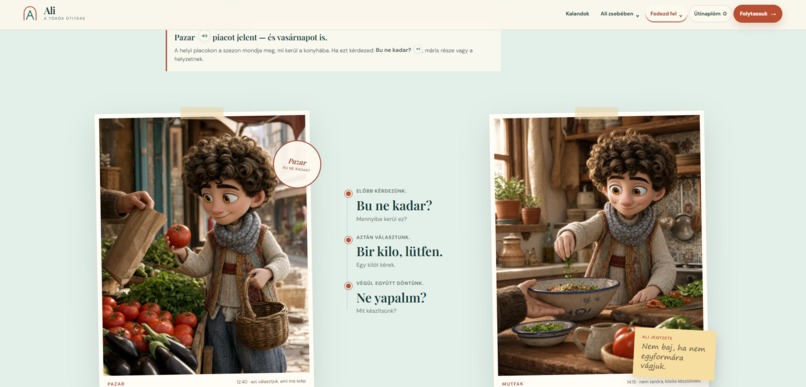
Ali’s world continues through cultural modules about Istanbul’s places and Turkish cuisine. Culture is not used as decoration. It helps the visitor understand when to ask, when to listen, and when simply being present is enough.
How I built it
I built Ali through an extended collaboration with Codex using GPT-5.6 SOL.
Codex worked with me as a product, UX, creative, content, and engineering partner. Together we:
- developed Ali’s Character Bible and Hospitality Manifesto;
- defined the visual canon and character-consistency rules;
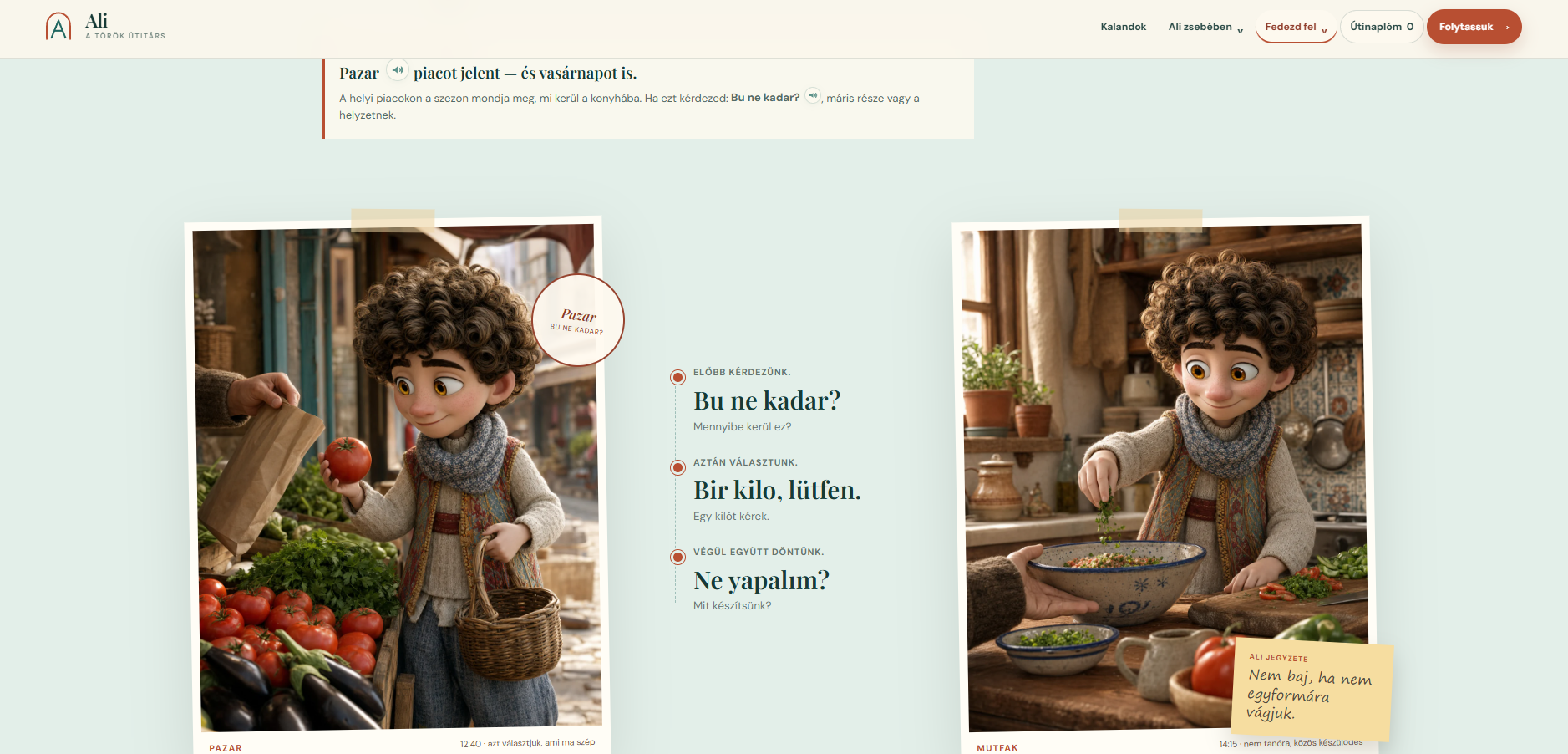
- created image-generation workflows for a canonical scene library in which Ali remains recognizably the same character;
- transformed ten source learning documents into the Adventure Knowledge Map;
- designed the ten-stop customer journey and its branching dialogue architecture;
- implemented the responsive interface in HTML, CSS, and JavaScript;
- built persistent journey state, personal choices, and the travel journal;
- created contextual search and Ali’s Pocket;
- implemented learning-state management and two-directional flashcards;
- built a duplex print system with mirrored back-page ordering;
- connected the language journey with Istanbul and Turkish cuisine modules;
- tested CTA destinations, navigation, map behavior, responsive layouts, every dialogue branch, Turkish–Hungarian content, and natural Hungarian wording.
The product work is also documented through interconnected structured artifacts, including the Adventure Knowledge Map, Character Bible, Hospitality Manifesto, Causal Journey Architecture, Living Story Map, Content Coverage Map, Question Tree Audit, and Adventure Quality Matrix.
I made the final product, character, pedagogical, visual, and prioritization decisions: when Ali should help, what the experience should remember, which features strengthened the feeling of hospitality, and when Ali needed to step back.
Codex and GPT-5.6 helped transform those decisions into one coherent, tested, and working world.
Challenges
Preserving one character across an expanding visual world
Ali appears in different locations, lighting conditions, camera angles, poses, and emotional states. A visually attractive image was not enough; every image had to be unmistakably Ali.
The solution was to separate character design from image generation. The Character Bible and visual canon define the character. The generation workflow renders the approved identity rather than inventing a new character for every scene.
Turning a large knowledge base into one meaningful first experience
The ten source documents contained far more vocabulary and expressions than should appear in a first journey. Including everything would have turned the experience back into a course.
I separated the product into two layers:
- a carefully paced, emotionally memorable first journey;
- a deeper searchable knowledge map for visitors who want more.
Making branches feel causal rather than decorative
A choice should not exist merely to prove that a button works. It should influence later dialogue, memory, journal entries, or learning output.
The journey was repeatedly audited and refactored so that choices leave visible traces in the experience.
Connecting emotional storytelling with active recall
The journey needed to feel magical without sacrificing learning value. Ali’s Pocket became the bridge: a sentence first appears in a meaningful situation, then becomes saved knowledge, an active-recall card, and finally a physical object.
What I learned
I learned that:
Character design is not image generation.
Product vision is not interface design.
Experience is not a list of features.
The most important implementation decisions were often decisions to remove, postpone, or quieten something.
Every feature was tested against two questions:
If we remove this, does the experience lose something essential?
Would a good host do this?
These questions kept the product aligned with Ali’s role and prevented the learning system from overpowering the feeling of being welcomed.
Accomplishments I am proud of
- A complete, runnable, responsive product rather than a visual mockup.
- Ten connected and visually canonical Istanbul adventures.
- A documented character and hospitality system.
- A structured map of 1,574 processed language elements.
- Persistent user choices and learning states.
- Searchable Turkish–Hungarian situational knowledge.
- Two-directional digital and physical learning cards.
- A coherent visual world recognizable beyond the logo or interface.
- A product in which the learning system remains strong while the visitor rarely feels like they are attending a lesson.
What’s next
The current MVP focuses on the first magical journey and the learning loop that follows it.
Future directions include:
- an AI-powered Turkish–Hungarian and Hungarian–Turkish dictionary;
- high-quality Turkish pronunciation and speech support;
- Turkish history presented through Ali’s visual world;
- live Turkish lira conversion;
- additional journeys and cultural invitations;
- more recurring inhabitants of Istanbul, including Mırmır;
- expansion from the initial Hungarian experience to additional interface languages.
Ali does not exist to make people finish Turkish lessons.
He exists to make Turkey feel familiar enough that speaking begins naturally.
Built With
- api
- codex
- css3
- generation
- github
- gpt-5.6
- html5
- image
- javascript
- localstorage
- openai
- pages
- responsive
- storage
- webdesign

Log in or sign up for Devpost to join the conversation.